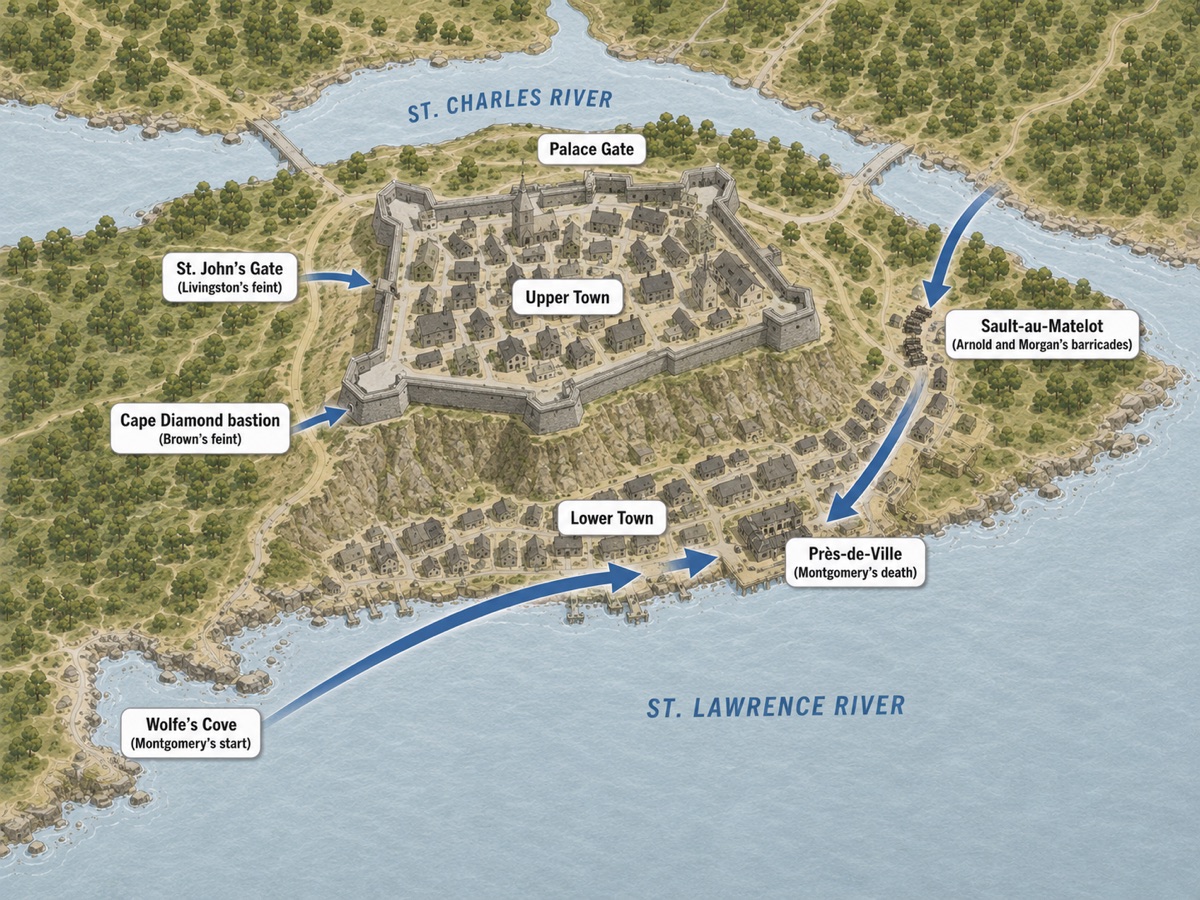
Quebec was really two cities. The Upper Town sat on top of the cape (the high headland above the meeting of the St. Lawrence and the smaller St. Charles River), behind the walls and most of the cannon, and it was effectively unreachable: its walls faced west, and cliff and river guarded the rest. The Lower Town was different. It was the commercial district, a narrow strip of wharves, warehouses, and merchants' houses squeezed between the foot of the cliff and the St. Lawrence, and it could be entered from either end along the shore.
The plan of the American commander, Major General Richard Montgomery, aimed there. Two feints (fake attacks meant to pull the defenders' attention) would hit the western walls: Colonel James Livingston with about 200 Canadian volunteers (Canadians who had enlisted on the American side) against St. John's Gate, and Major John Brown with about 160 men against the Cape Diamond bastion at the southwest corner. The two real columns would converge on the Lower Town from opposite ends: Montgomery from the south, along the riverside path under Cape Diamond, and Colonel Benedict Arnold (commanding the American column that had marched overland through the Maine wilderness) from the north, on the St. Charles side, through the streets called the Sault-au-Matelot, which the defenders had blocked with barricades (makeshift walls built across a street). They would meet in the middle, then force the Upper Town from below, or failing that, hold the merchants' property hostage to negotiation. Deserters had already betrayed earlier versions of the plan, and Guy Carleton, the British governor commanding the defense, had been warned an attack would come on a stormy night. So the storm needed to be a bad one. On the night of December 30 to 31, a nor'easter (a winter storm that blows in from the northeast) delivered a full blizzard, and at about four to five in the morning Brown's men fired the signal rockets.
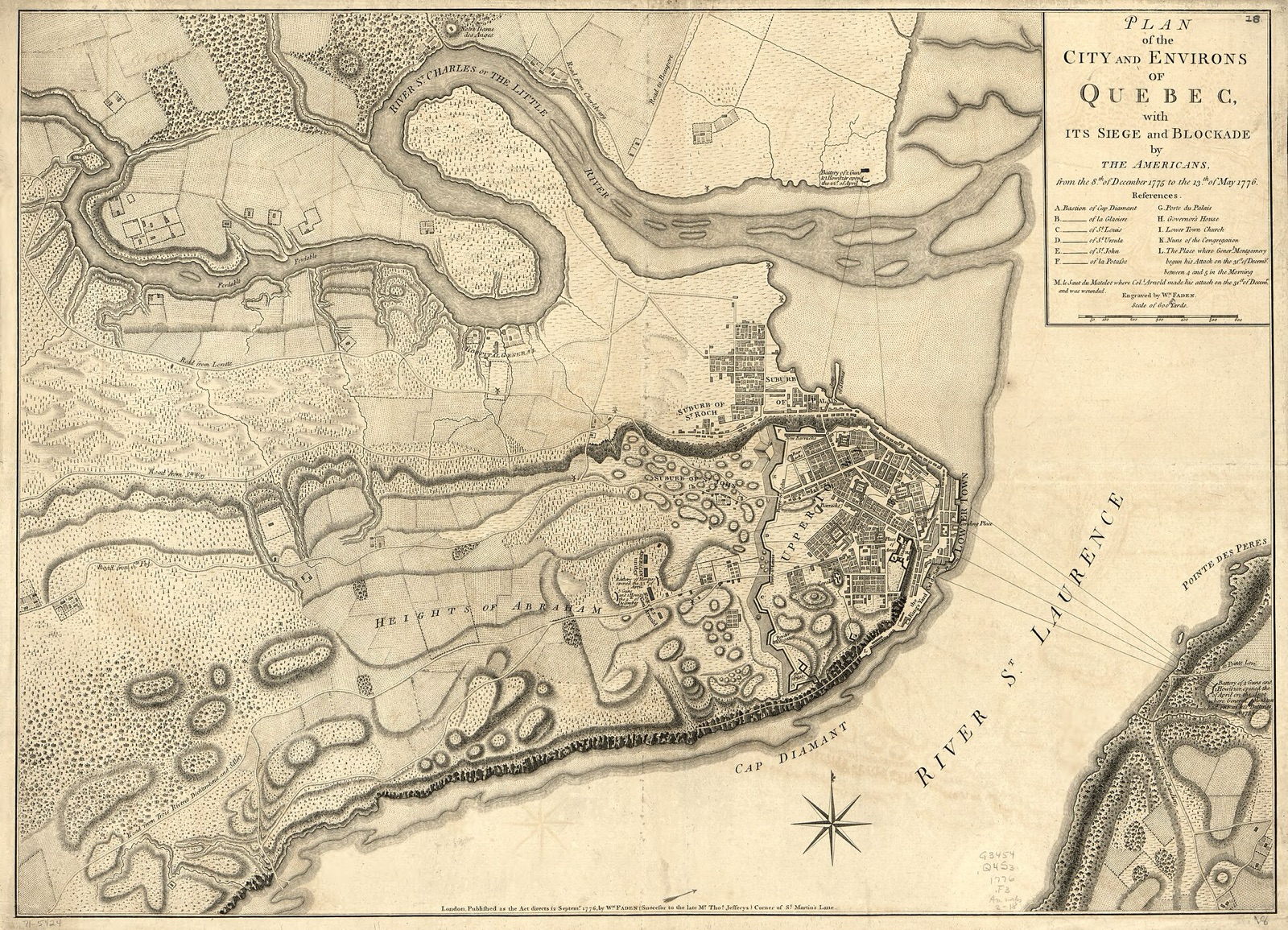
Montgomery's column, about 300 New Yorkers, started from Wolfe's Cove, and the name is not a coincidence: it was the same cove where General Wolfe's army had climbed the cliffs in September 1759 to take this city from France; sixteen years later an American column filed out of it in the dark to take the city from Britain. The shore path was narrow, drifted deep, squeezed between the cliff face and the ice of the frozen river. Imagine being one of the three hundred. The blizzard is in your face the whole way, the ice of the frozen river on your right, the black cliff climbing away on your left into snow you cannot see through. The path is drifted so deep you move single file, each man steering by the back of the man ahead because there is nothing else to steer by. Somewhere in front of you, carpenters are carrying saws for the palisades that block the path. Somewhere above you, on walls you cannot see, is a garrison that has been warned an attack will come on exactly this kind of night. The carpenters sawed through two palisades (defensive fences of upright wooden stakes), and Montgomery himself helped pull the pickets aside and stepped through with the lead group of about 50 men.
Just beyond the second palisade stood a fortified house at a spot called Près-de-Ville: a blockhouse with a battery of small cannon (a cluster of guns grouped to fire together), manned by a mixed picket (a small guard detachment) of perhaps 30 to 50 men, Canadian and British militiamen and sailors together, under the Canadian militia captains Chabot and Picard. They held their fire until the lead group was within tens of yards, and then fired a single blast of grapeshot (a cannon charge of small iron balls that turns the gun into a giant shotgun). Montgomery was killed instantly, struck through the head. His aide Captain John Macpherson and Captain Jacob Cheesman died with him, and most of the men beside them went down.
Tradition fills in the seconds before the blast with a last exhortation, "Push on, brave boys; Quebec is ours!", but the words come only from later accounts; nearly everyone who could have heard them died in the same moment. The other name tradition supplies is the man at the gun, Hugh McQuarters, a Royal Artillery sergeant, as the one who touched the match; the record only says the defenders fired.
The senior surviving officer, Lieutenant Colonel Donald Campbell, ordered the column back to Wolfe's Cove. He was much criticized afterward, but the command group lay dead in the snow. The southern attack was over in minutes.
At the other end of the Lower Town, Arnold's column of about 600 was having the longer fight. The route led under the walls past the Palace Gate (the gate in the city's north wall), single file through the drifts, under musket fire and grenades from above. The column's one field gun, a brass 6-pounder (a light cannon) hauled on a sled, bogged in a drift and was abandoned. At the first barricade in the Sault-au-Matelot, Arnold took a musket ball, likely a ricochet, in the left leg below the knee while organizing the assault. He was carried to the rear, bleeding into the snow, still shouting at his men to push on.
Command in the street fell to Captain Daniel Morgan (American), a Virginia frontier teamster who had driven supply wagons for Braddock's army (a British expedition against the French in the previous war) twenty years before, and who told a story on himself: 500 lashes once ordered for striking a British officer, 499 delivered by the drummer's miscount, so Britain still owed him one. No record of the sentence survives; Morgan showed the scars. At the barricade he was exactly the man the moment required. He scaled it himself, was knocked back on his first attempt, rolled under the muzzle of a cannon to escape the bayonets waiting for him, and went over on the second. The riflemen poured after him, the position fell with trivial loss, and its roughly 30 defenders surrendered. At this end of the town, the assault was closer to working than the odds said it should have been.
And then the attack stopped. The powder was wet, the scaling ladders were somewhere back along the column, there were prisoners to guard, and officers argued for waiting on Montgomery's column, which was never coming. The pause lasted somewhere between half an hour and an hour, in a narrow street, inside a hostile city, and it handed Carleton the battle. He fed troops to the second Sault-au-Matelot barricade, a twelve-foot wall mounted with guns: Lieutenant Colonel Henry Caldwell's British militia, Colonel Noël Voyer's Canadian militia, a company of the 7th Foot (a regiment of British regulars), Maclean's Emigrants, and sailors. When Morgan's men finally stormed it, they were stopped cold, and every attempt to flank it through the houses was thrown back at bayonet point.
Then Carleton closed the door. He sent Captain George Laws with a force of perhaps 200 to 500 men out the Palace Gate to retake the first barricade behind the Americans. The column was sealed in the street. Captain Henry Dearborn's company, bringing up the rear with soaked powder, was forced to surrender near the Palace Gate; the rest, packed into the Lower Town with their ammunition gone, gave up in groups by about ten in the morning. Morgan held out last, backed against a wall with his sword in his hand, in tears, refusing to surrender it to any British officer; he handed it to a priest instead. Around 400 to 430 Americans went into captivity. Carleton, in his dispatch to General Howe (the British commander-in-chief in America), reckoned "the rebels had between six and seven hundred men, and between forty and fifty officers, killed, wounded or taken prisoners," a tally that ran somewhat higher than the settled count.
Arnold, in the hospital with his leg wound, refused to lift the blockade. Days later, he wrote home.
I have no thought of leaving this proud town until I first enter it in triumph... Providence, which has carried me through so many dangers, is still my protector. I am in the way of my duty, and know no fear.
The Battles1759: the fall of Quebec, sixteen years before, in the French and Indian War