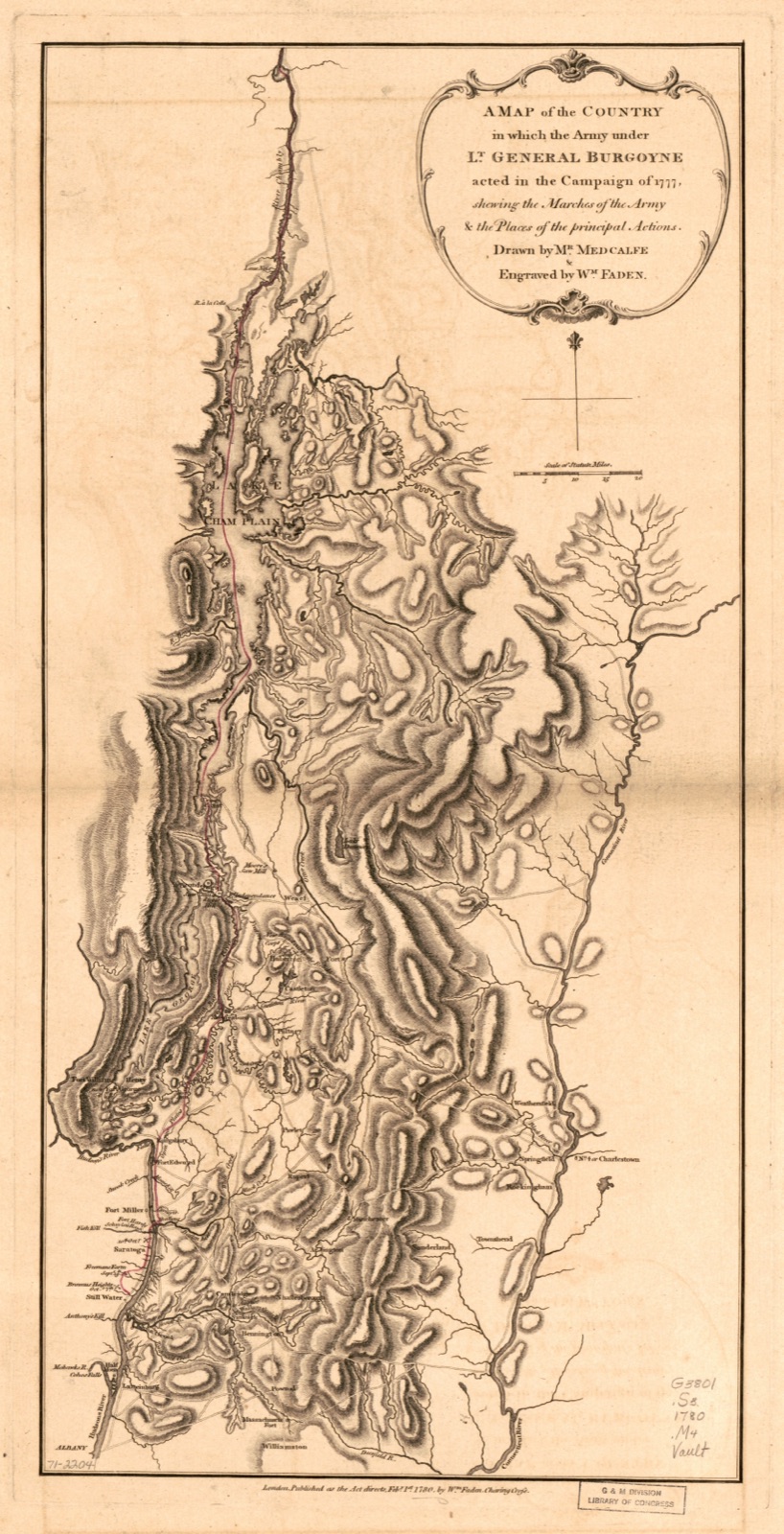
In July 1777, John Burgoyne (British) was the most celebrated general in the empire. His invasion had come down from Canada exactly as he had sold it to London: an army of about 8,000 men moving south along Lake Champlain toward Albany, New York, on a plan to seize the Hudson River corridor and cut New England, the furnace of the rebellion, off from the other colonies. A second, smaller British force under Colonel Barry St. Leger was to swing in from the west, down the Mohawk Valley, and meet him. And in the first week of July, Fort Ticonderoga, the most famous fortress in America, had fallen to Burgoyne in four days, almost without a shot.
The BattlesJuly 1777: the fall of Ticonderoga, this campaign's opening actThe plan had a hole in it, and the hole was in London: it assumed the main British army in New York City could cooperate up the Hudson, but its commander, General Howe, had sailed against Philadelphia instead, and nobody had ordered him to do otherwise. While Burgoyne's army shrank in the north, Howe's was fighting Washington at Brandywine and Germantown, three days' ride to the south. It was not a betrayal. It was a planning failure, and Burgoyne marched south into it.
After the triumph came the crawl. South of the lakes, Burgoyne took his army overland through country the Americans were unbuilding in front of him: trees felled across every road, bridges burned. It took roughly three weeks to cover the 23 miles to Fort Edward, on the upper Hudson, and every mile stretched a supply line running all the way back to Canada, short of carts and draft animals.
Then August broke the campaign's back twice. Burgoyne sent a German column under Lieutenant Colonel Baum east toward Bennington to forage (to gather horses, draft animals, and food from the countryside), and on August 16 John Stark's New Hampshire militia (part-time citizen soldiers, not the Continental regulars) destroyed it, then mauled the relief column that came after it. About a thousand men gone, and not a horse or a barrel of flour to show for them. That same month the western prong collapsed: St. Leger, bloodied at Oriskany and spooked by a ruse that inflated the relief force marching against him, abandoned his siege of Fort Stanwix on August 22 and fell back to Canada. There would be no meeting at Albany. By early September, Burgoyne's field force was down to just over 7,000 men.
The BattlesAugust 16: Stark's militia destroys the foraging expeditionAnd in the middle of all this came a killing the whole continent would hear about. On July 27, near Fort Edward, a young woman named Jane McCrea, about 25, from a New Jersey family, was seized by a party from Burgoyne's Native contingent and killed and scalped; her scalp was recognized in the British camp. She was engaged to David Jones, a Loyalist officer marching with Burgoyne's own army. That much is certain, and almost nothing past it is. One account, the one that fixed blame in the British camp, said her escorts had quarreled over the reward for bringing her in and one of them killed her. The other, which began with the accused man himself, said she was hit by American bullets fired at the retreating party and scalped after she was dead. A nineteenth-century exhumation claimed to find bullet wounds and no tomahawk wounds; by the next examination her skull was missing, and the forensics settle nothing. Who killed Jane McCrea is genuinely unknown.
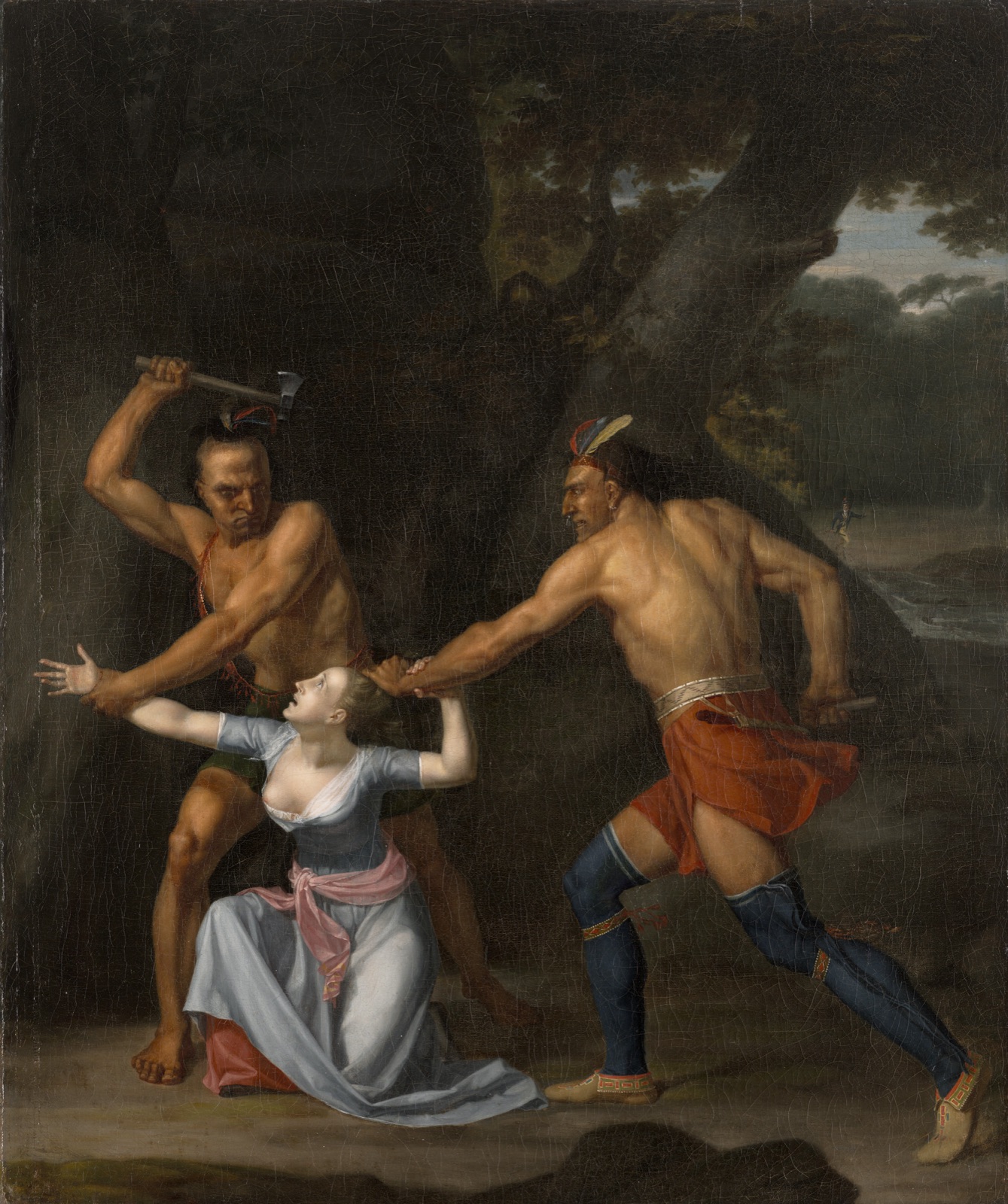
What happened next is the verified story, and it is the one that mattered. Burgoyne demanded the accused warrior for execution. Simon Fraser, his best brigadier, warned him that punishing the man would send every Native ally home or into revenge, and Burgoyne backed down. Fraser was the best soldier in the army, a veteran of Louisbourg and the Plains of Abraham in the last war, the man every advance turned on; when he counseled restraint, Burgoyne listened. Horatio Gates, who had just replaced General Philip Schuyler as the American commander in the north, then did something shrewder than fighting: he wrote Burgoyne an open letter about "a young lady lovely to the sight, of virtuous character and amiable disposition... scalped and mangled," and the letter ran through the newspapers. A Loyalist's own fiancée, killed by the King's allies, and the King's general unable to punish anyone for it: as a recruiting story it was a gift, and it helped fill Gates's camp with militia. An American officer who knew of her, James Wilkinson, later deflated the legend ("a country girl... without either beauty or accomplishments"). It made no difference. The legend, not the girl, raised the regiments.
The affair cost Burgoyne the other half of the bargain too. He had opened the campaign with about a thousand Native allies, threatening rebels with them in a bombastic proclamation while forbidding violence against non-combatants, and McCrea's death exposed the contradiction: he could not punish the accused without losing the alliance, and by not punishing he handed Gates a weapon and lost the alliance anyway. After Bennington, where some 80 Native fighters became casualties and got little thanks for it, the partisan leaders La Corne and Langlade and most of the contingent went home. By mid-September, fewer than 100 scouts remained. The consequence would decide battles: Burgoyne's army was nearly blind in the woods, its pickets (the sentries and small guard posts out ahead of the main camp) and foraging parties picked off nightly, while the American screen now included Daniel Morgan's rifle corps, roughly 500 frontier marksmen Washington had sent north in August, carrying long rifles with officer-killing accuracy. For the Native nations of this corridor, 1777 was the year neutrality broke into something like civil war, and that is a story of its own.
Off the fieldThe nations caught between two empires, told wholeOn September 13, Burgoyne made the bet that decided the campaign, and the line that explains the bet he had written two and a half months earlier, in an order of June 30.
This army must not retreat.
That was the gambler's whole creed in five words, and on September 13 he acted on it. His army crossed to the west bank of the Hudson on a bridge of boats just north of the little settlement of Saratoga, and rather than leave a chain of garrisoned posts behind him, he deliberately cut his communications back to Ticonderoga. A man who tells himself he must not retreat does not keep an open road home; he burns it, so that the only way out is forward, through the enemy, to Albany. From that moment there were two possible endings, Albany or capitulation, and Burgoyne, by temperament a gambler who had sold London this plan and staked his name on it, had chosen to leave himself no third option. He said as much himself later, defending the campaign in Parliament.
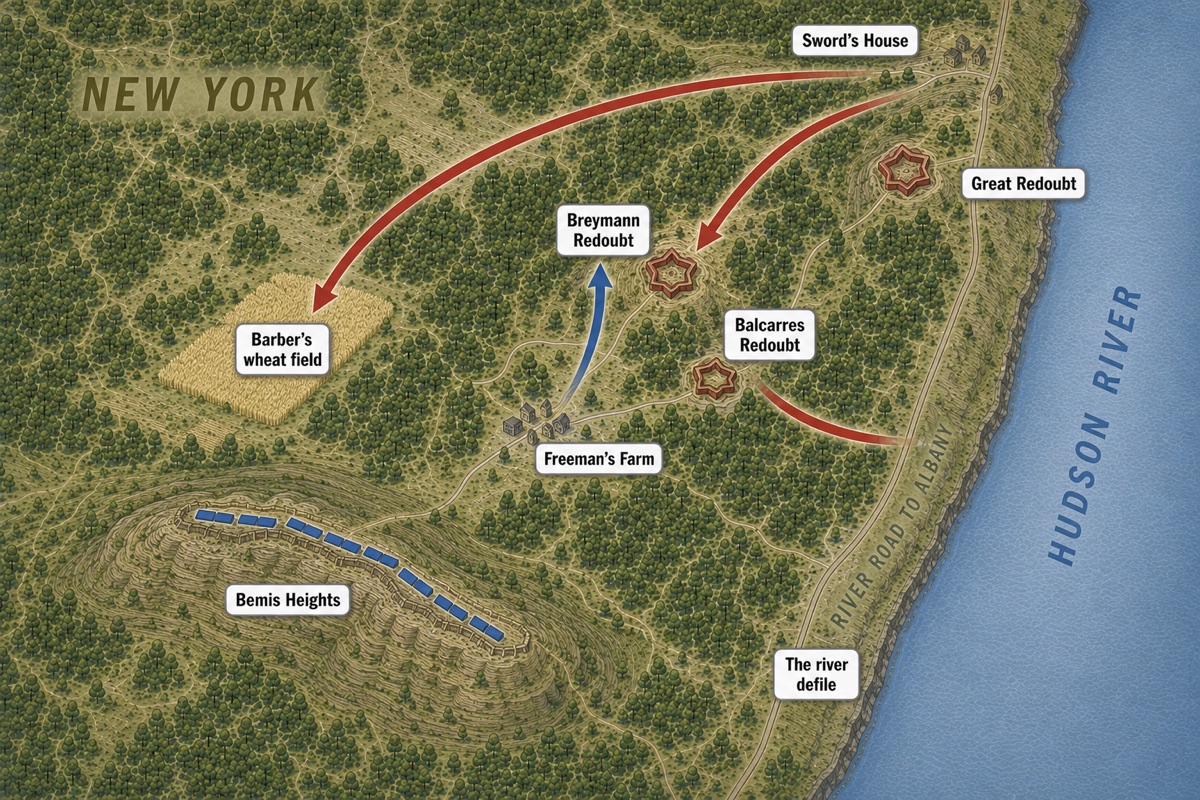
Ten miles ahead, the Americans were waiting on ground they had chosen. Gates had moved his army north from Stillwater in early September, and his chief engineer, Tadeusz Kościuszko, a Polish volunteer who had sailed for America in 1776, laid out the line on Bemis Heights: a plateau rising 100 to 200 feet above the river, at the exact place where the road to Albany squeezed through a defile (a narrow pass) between the bluff and the water. Entrenchments and batteries commanded the road below; a fortified line ran inland to the west. Behind those lines stood some 8,500 effectives (soldiers fit for duty), with militia arriving daily. Burgoyne could not force the defile, which left him one play: swing west through the forest and try to turn the American left. That is why both battles of Saratoga would be fought in woodland clearings northwest of the lines. One army on that river kept shrinking; the other kept growing, and no one on either side yet knew what those two curves would produce in the woods ahead.