On the morning of September 19, 1777, the British general John Burgoyne went looking for the American left. His army advanced in three columns: Simon Fraser's Advanced Corps swinging wide to the right, four regiments under Brigadier General James Hamilton (British, commanding the center) with Burgoyne himself, and Baron Riedesel's Germans with the guns and supplies on the river road. On Bemis Heights, the American commander Horatio Gates wanted to sit behind the entrenchments and let the British come onto the guns. Benedict Arnold, the aggressive Connecticut general commanding the American left wing, pressed him to fight in the forest instead, where British formations and bayonets were worthless. Gates grudgingly let Morgan's riflemen and the light infantry of Major Henry Dearborn (American, commanding a light-infantry battalion) go forward. It was the only major decision he had to make that day, and he made it right.
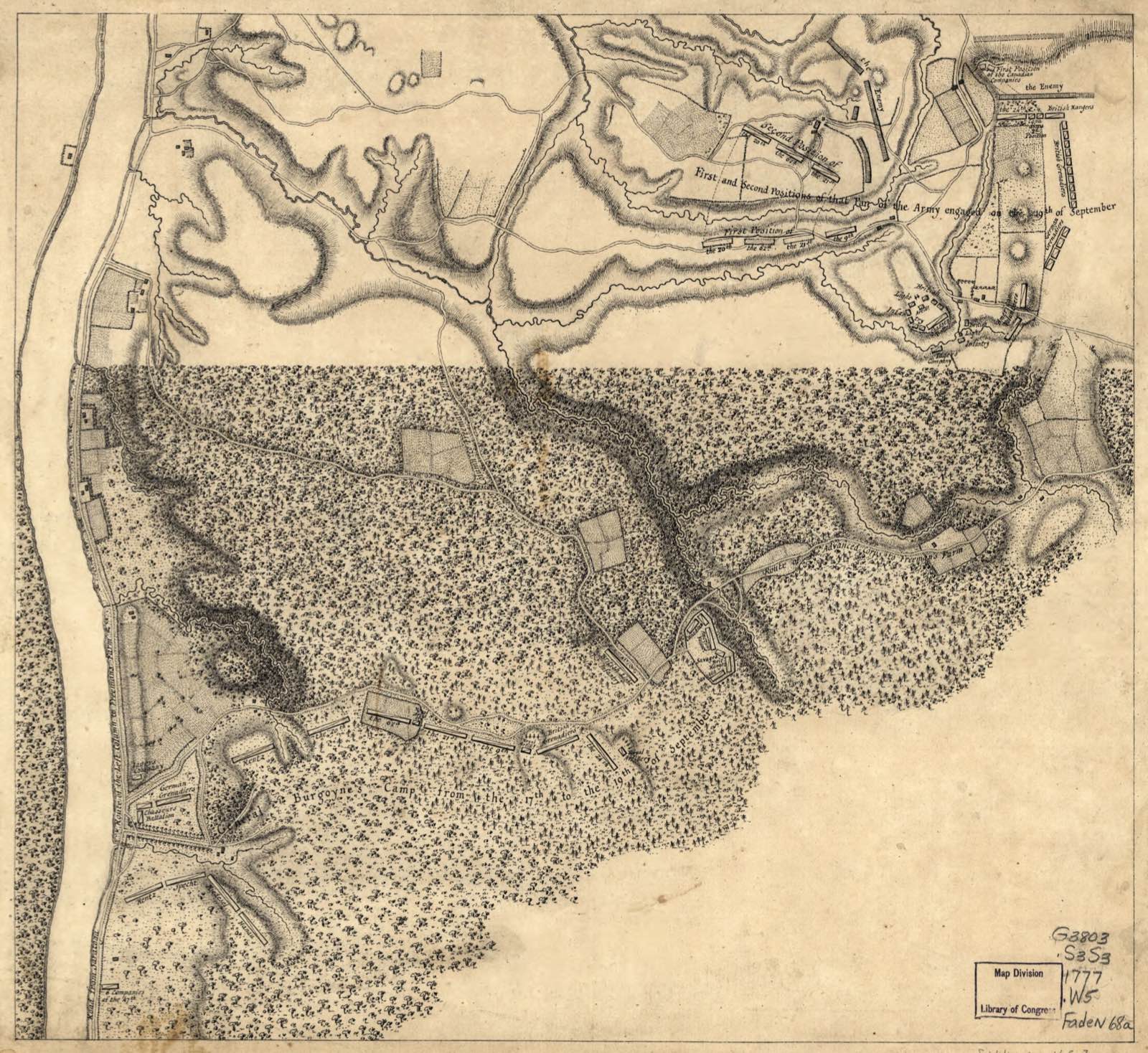
A little after noon, Morgan's riflemen met the center column's advance party at an abandoned farm clearing, Freeman's Farm, about a mile north of the American works, and in the opening fire they picked off virtually every officer in it. Then they over-pursued, ran into Fraser's main body, scattered (the story goes that Morgan rallied them with his turkey call), and what followed was a seesaw afternoon: three to four hours of attack and counterattack across a clearing some 350 yards wide, the field changing hands again and again. Several times the Americans took the British guns and could neither hold nor drag them off; they had shot the artillery horses and the crews, 36 of the 48 artillerymen in the center column. The 62nd Foot was reduced to about the strength of a single company; Burgoyne's artillery general, Phillips, personally led another regiment in to save the center.
What finally stabilized the British line came from the river road. Late in the afternoon Riedesel, on his own initiative, left 500 men on the baggage and threw his Brunswickers (the hired German soldiers from Brunswick who made up about half of Burgoyne's army) and two guns against the American right at the double. The shock held until dark, and darkness ended it. The Americans withdrew to their works; Burgoyne held the field and claimed the victory. It had cost him about 600 men to an American 300, and his best regiments were gutted. (Tradition puts Arnold on horseback in the thick of the smoke that afternoon; Luzader, the battlefield's own historian, found no contemporary evidence for it. He spent the day at headquarters, feeding regiments into the fight and pressing Gates for more, and his division did the fighting either way.)
Burgoyne meant to renew the attack within two days. Then, on September 21, a ciphered note reached him from General Henry Clinton, commanding in New York City, written nine days earlier: "You know my good will & are not ignorant of my poverty. If you think 2000 men can assist you effectually, I will make a push at [Fort] Montgomery in about ten days." On that thin promise Burgoyne dug in to wait. The arithmetic, from inside his tent, was not absurd: Bennington and St. Leger had already eaten his margins, his supply line was failing, and a junction with Clinton was the one path left that still ended at Albany. If Clinton moved, and moved fast, Saratoga was still a campaign rather than a catastrophe. So he waited, and the wait cost him everything. Rations shrank, the horses starved, militia and Morgan's men sniped the pickets nearly every night, and the American army grew daily.
It was a poisoned month inside the American lines too. Gates's report to Congress credited Freeman's Farm to "a detachment of the army," never naming Arnold, then stripped Morgan's corps out of Arnold's division. Arnold protested in writing; there was a furious confrontation, recorded at the time in letters by his aides (former aides of the Schuyler whom Gates had replaced, which did not help); Gates issued him a formal pass to leave for Philadelphia, effectively sidelining him. But a pass to Philadelphia was also a pass to miss the battle he had spent the summer building toward, and Arnold stayed in camp, with no clear command. Gates, for his part, had stripped Arnold's role and could not give it back without conceding the quarrel. The two men were stuck: a commander who could not afford to lose his best fighting general, and a general who would not leave. The feud is documented fact; the shouting-match dialogue in the popular tellings comes from memoirs written decades later, and is not.
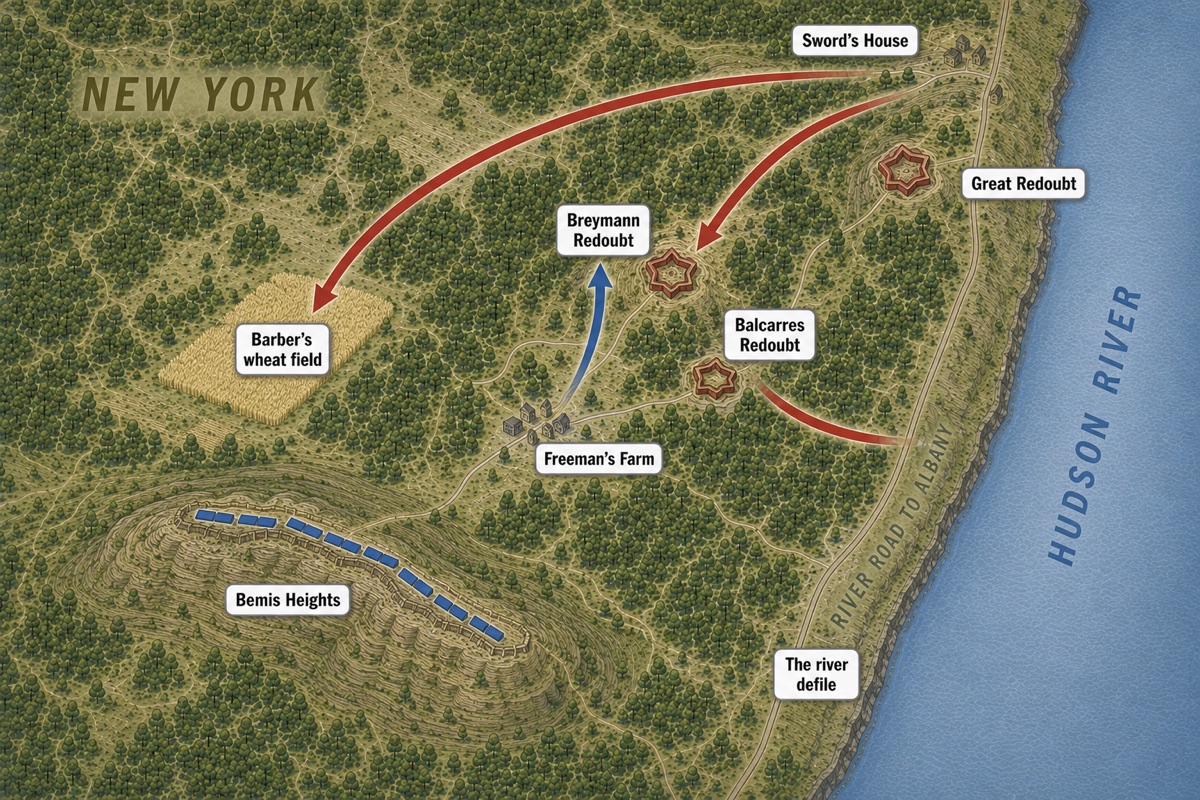
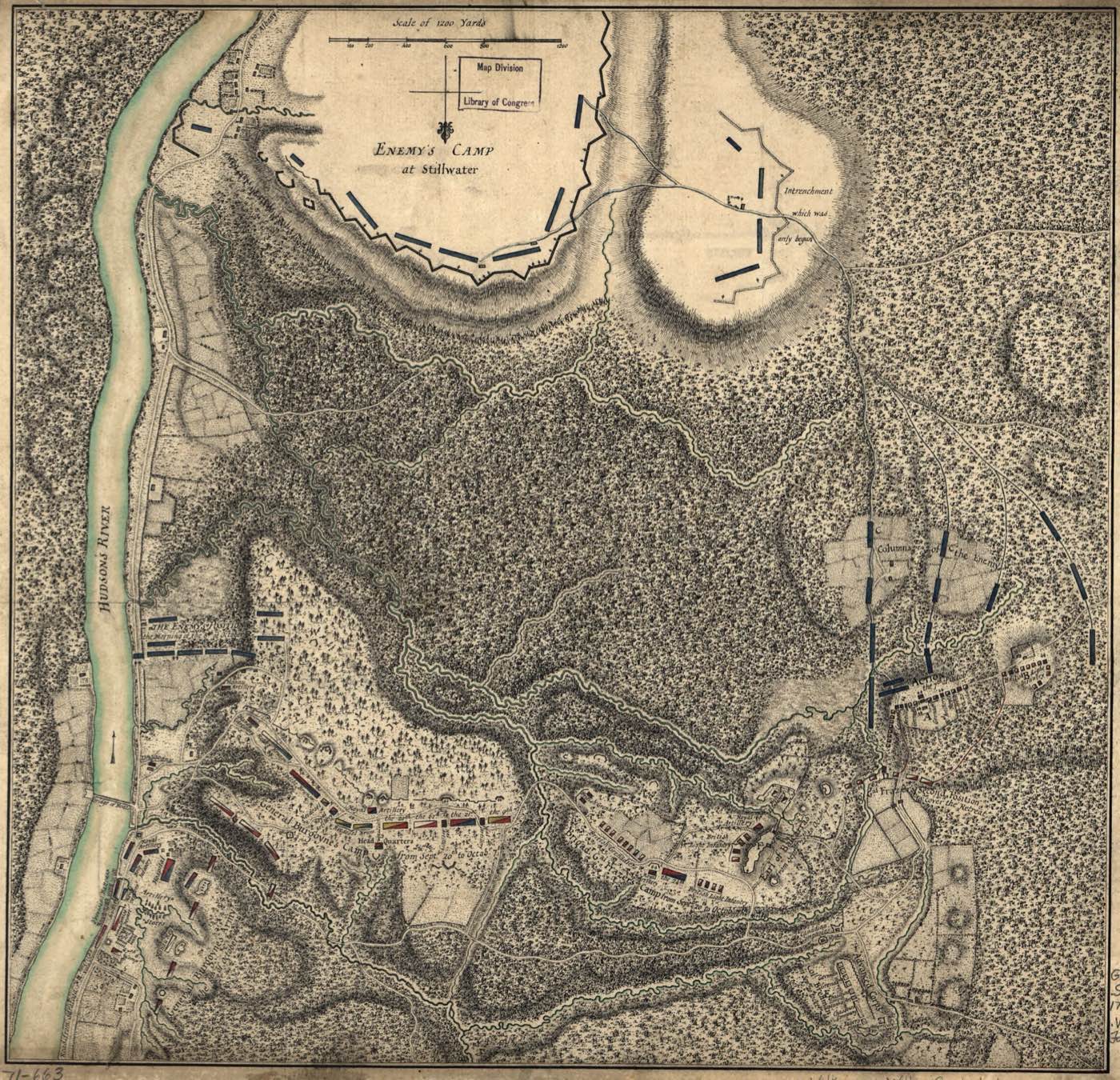
The war story1777, the whole campaign: two British armies, two separate warsBy early October Burgoyne's army was on short rations and down to about 5,000 effectives. Over the advice of Riedesel and Fraser, who wanted to fall back across the Hudson while it was still possible, he ordered a reconnaissance-in-force (a heavy armed probe) for October 7: some 1,500 to 1,700 picked men and ten guns, led by Burgoyne, Fraser, Riedesel, and Phillips in person, to test the American left and cut forage in the wheat (the army was nearly out of food, and the standing grain in the fields was worth the risk). About two in the afternoon the column halted on an exposed rise in Barber's wheat field while the officers studied the woods through their glasses. Told the British were out, Gates is supposed to have said, "Order on Morgan to begin the game."
The American counterpunch hit both ends of the line at once. Poor's brigade smashed the grenadiers (the British army's elite heavy infantry, the biggest and most experienced men in the line) on the British left, where Major John Acland (British, commanding the grenadier battalion) fell shot through both legs and was captured; Morgan swung wide and crushed the light infantry (fast-moving skirmishers who fought in open order, not in the shoulder-to-shoulder line) on the right; Dearborn hit the breaking line head-on. Within about an hour the reconnaissance had lost some 400 men and six of its ten guns and was streaming back toward its fortifications. Fraser, conspicuous on horseback rallying the rearguard, was shot through the stomach by one of Morgan's riflemen. Tradition, first written down 68 years later from family stories, credits the marksman Timothy Murphy, and gives Morgan a grim order that the gallant officer had to die; the wounding is fact, the names and the speech are tradition.
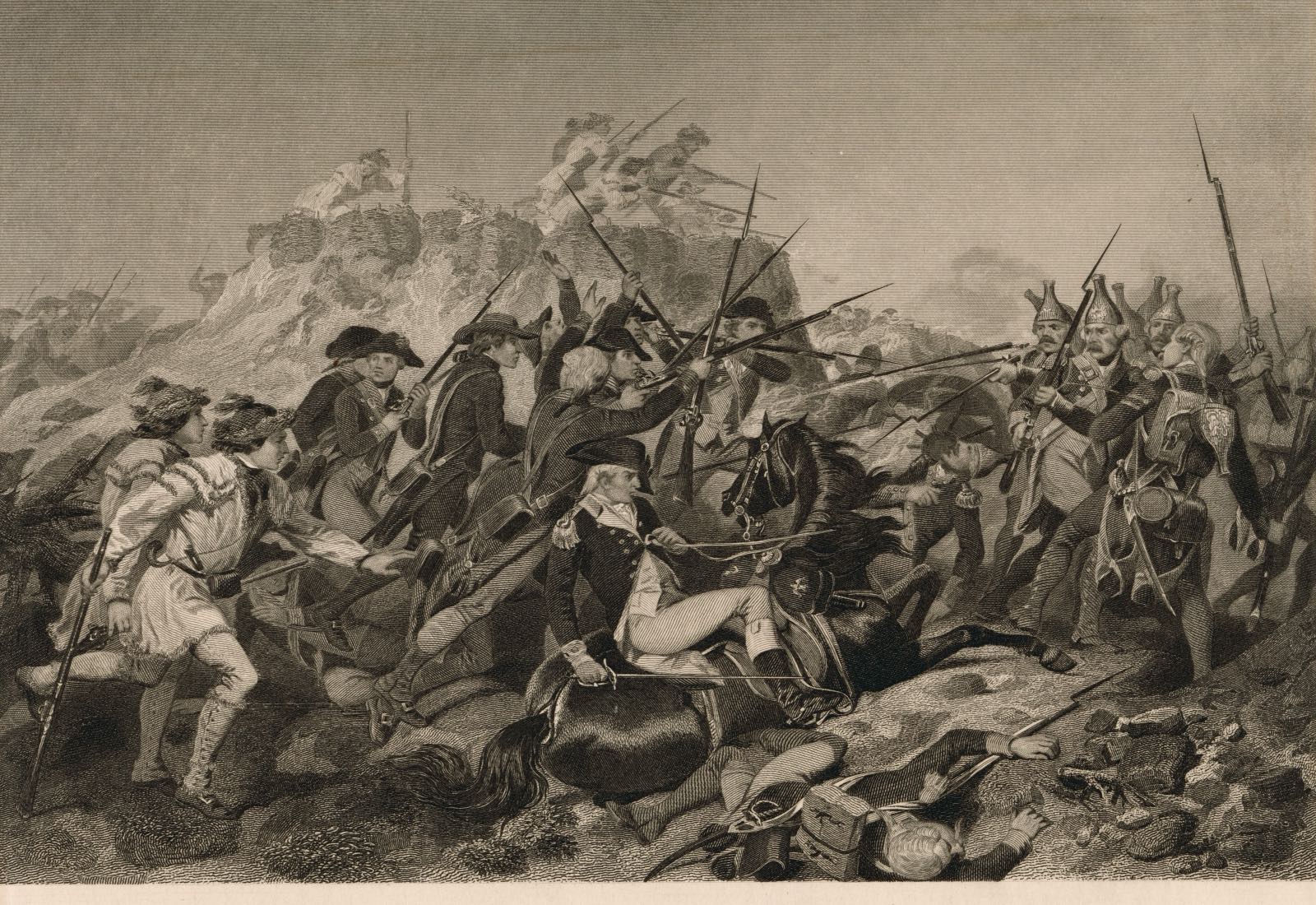
Then came the ride. Arnold, who still had no command, rode to the firing anyway. In the famous version he galloped off without orders, and Gates sent an aide after him who never caught up. The evidence cuts both ways: Burgoyne wrote that Arnold commanded on the American left that day, another general wrote that Gates ordered him forward, and Gates's own report praised "the Gallant General Arnold," strange praise for a mutineer. Whether Gates blessed the ride, tolerated it, or chased it with a messenger is genuinely disputed. What Arnold did on the field is not. He led the attacks on the Balcarres redoubt (a redoubt being a small earthwork fort, a low square of dug walls with firing platforms inside), the fortified line at Freeman's Farm, fierce and futile; then spurred across the field, through the crossfire of both armies, untouched, to the weaker Breymann redoubt on the British far right, and led the storming through the gap between the works while Morgan's men circled behind. The redoubt fell at dusk. Its commander, Breymann, was killed, reportedly by his own men after he sabered four of them. In the final volleys Arnold's horse was shot and fell on him, and a musket ball shattered his left leg, the same leg hit at Quebec two years before. With the Breymann redoubt gone, Burgoyne's whole line was turned, his camp open on its right. That night he abandoned the position.
Frederika Riedesel, the German general's wife, who had followed the army with their three small daughters, had set a dinner table for the generals that afternoon. Her journal: "About three o'clock in the afternoon, in place of the guests who were to have dined with me, they brought in to me, upon a litter, poor General Fraser (one of my expected guests), mortally wounded." The table was cleared and a bed made up for him in its place. Through the night she heard him.
Oh, fatal ambition! Poor General Burgoyne! My poor wife!
Fraser died the next morning, and at sunset on October 8 he was buried as he had asked, inside the Great Redoubt on the river bluff, the chaplain reading the service while American round shot threw dirt over the burial party and Burgoyne and his generals stood bareheaded. Frederika watched from below: "Many cannon balls flew... not far from me, but I had my eyes fixed upon the hill, where I distinctly saw my husband in the midst of the enemy's fire."