On September 16, 1779, before Lincoln's army had fully joined him, the comte d'Estaing (French) summoned Savannah to surrender. He did it in a way that would cost the alliance for the rest of the campaign: he demanded the town give itself up "to the arms of the King of France." The wording landed badly with the Americans, whose war this presumably was, and became a lasting grievance. It was also premature. D'Estaing had summoned the town before his siege guns were ashore and before Benjamin Lincoln's (American) army had fully arrived, on nothing but the moral force of a fleet in the river and the clock in his own head.
Augustine Prevost (British), commanding a garrison too thin to be confident, asked for twenty-four hours to consider. D'Estaing granted it. Standard siege custom gave a garrison the right to ask for time to consult, and d'Estaing, certain the town would yield, saw no harm in it. This was the masterstroke of the siege, and it belongs to the British as competence, not trickery: a commander who needed time asked for it, and got it, and used every minute. While the truce held (the formal ceasefire both sides observed while a surrender demand was under consideration), the Royal Engineer James Moncrief (British) kept his crews digging, and the truce's real prize came in by water. Lieutenant Colonel John Maitland (British) had been at Beaufort, on Port Royal Island up the coast, with about 800 men of the 71st Highlanders and other troops. Sick with fever himself, he brought them out of Port Royal and threaded them through the half-charted tidal creeks of the inside passage, behind Daufuskie Island, by Wall's Cut and Skull Creek, a water route that ran between the barrier islands and the mainland, hidden from the open sea where the French fleet lay, with local fishermen as guides, dodging the French ships in the sounds and Lincoln's army on land. It took him roughly four days to cover the fifty-odd miles. An intercepted dispatch boat in Skull Creek had even warned the Americans he was coming, and it made no difference, because the allies had left the one inside-water door they knew about unguarded: responsibility for watching it fell between the French navy and the American army, and so nobody did. Maitland's column reached the town during the truce window, and with those 800 men in the lines the garrison went from doubtful to defensible. Prevost sent his answer. There would be no surrender; he would fire a cannon at sundown to signal the truce was over and the fighting had resumed.
The popular version makes the truce a simple blunder by d'Estaing. That reading undersells the allied failure to guard a water route they knew about, and the fact that d'Estaing had summoned the town before he was ready to take it. The twenty-four hours did not lose the battle by themselves. They were the hinge on which a thin garrison became a held one.
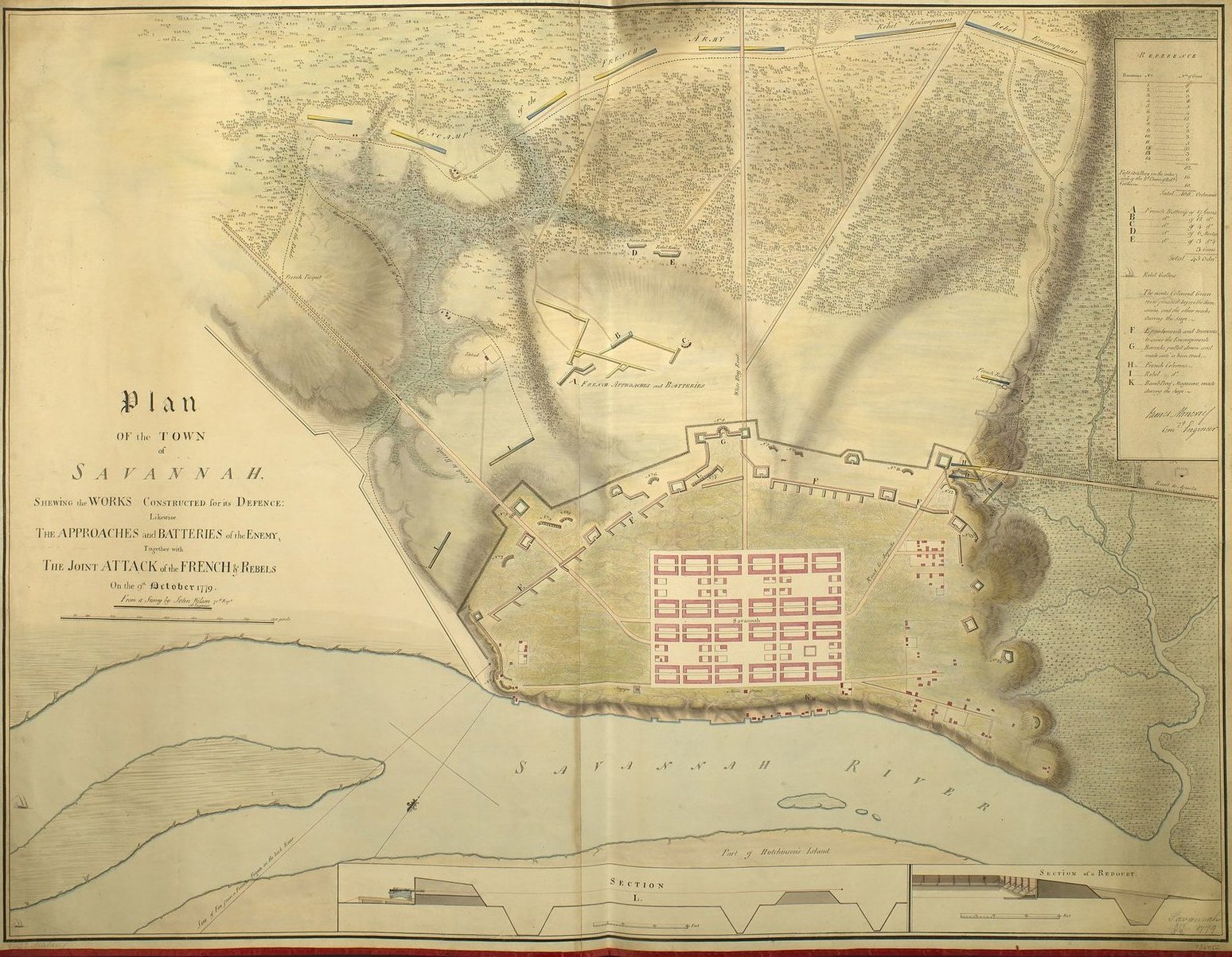
After that the siege settled into its slow work. The allies dug their approaches and hauled heavy guns and mortars ashore from the fleet, a mule-starved, grinding process that did not have the artillery in position until early October, and all the while d'Estaing's naval officers pressed him daily about the exposed fleet, the sick crews, and the hurricane season. A British sortie (a sudden attacking raid launched by defenders from inside the fortifications) on September 24 hit the allied working parties in the trenches; the Chasseurs-Volontaires de Saint-Domingue were among the troops engaged, and took casualties, one killed and seven wounded by the documented count, the best-recorded action of the unit's siege. When the guns were finally ready, on October 4, the allies opened a bombardment of the town that ran for about five days: some 53 cannon and 14 mortars. It smashed houses and killed civilians and did almost nothing to the earthworks. One British officer wrote that "there was hardly a house that had not been shot through." An American officer wrote that "the poor women and children have suffered beyond description." Prevost asked leave to send the women and children out of the town, his own wife and children among them, and the Georgia general Lachlan McIntosh's (American) family inside the bombarded town as well; the allies refused, suspecting a ploy for time. It was standard siege practice on both sides, and it was grim.
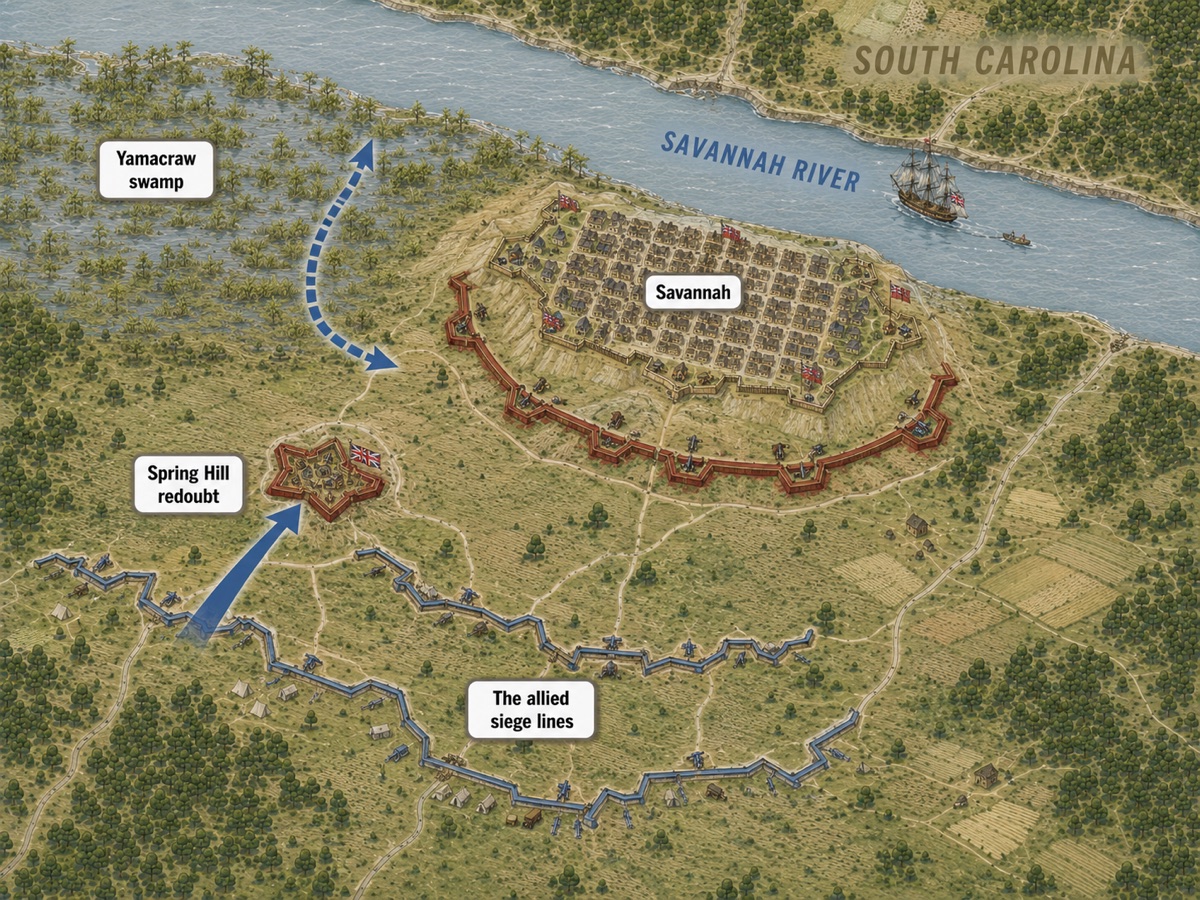
By October 8 the fleet had been on an open coast for five weeks, the crews were sicker, and the clock that had been running since the day d'Estaing arrived was now running out of weather and ships. His engineers told him a proper siege needed perhaps ten more days; his naval officers gave him none. Rather than lift the siege and sail with nothing, he chose to storm the works at dawn on October 9, with the main blow falling on the Spring Hill redoubt (a redoubt being a small earthwork fort) on the British right, where the defenders were believed to be mostly militia.
They were not, because the plan had already crossed the lines. By the standard account a sergeant major of the Charleston Grenadiers named James Curry, who had overheard officers discussing the assault, deserted to the British and told Prevost where the main attack would fall and when. Prevost stacked the Spring Hill sector accordingly: not militia, but a mix of Loyalist provincials (Captain Thomas Tawse's dismounted dragoons, South Carolina Royalists, Thomas Brown's King's Rangers) backed by regulars, grenadiers, marines, and the 71st under Maitland's command of the right. The allies were about to attack the one point on the line the defenders had spent a day reinforcing, at the hour the defenders expected them.
The Battles1775: an earlier dawn assault on a fortified town, also at terrible cost