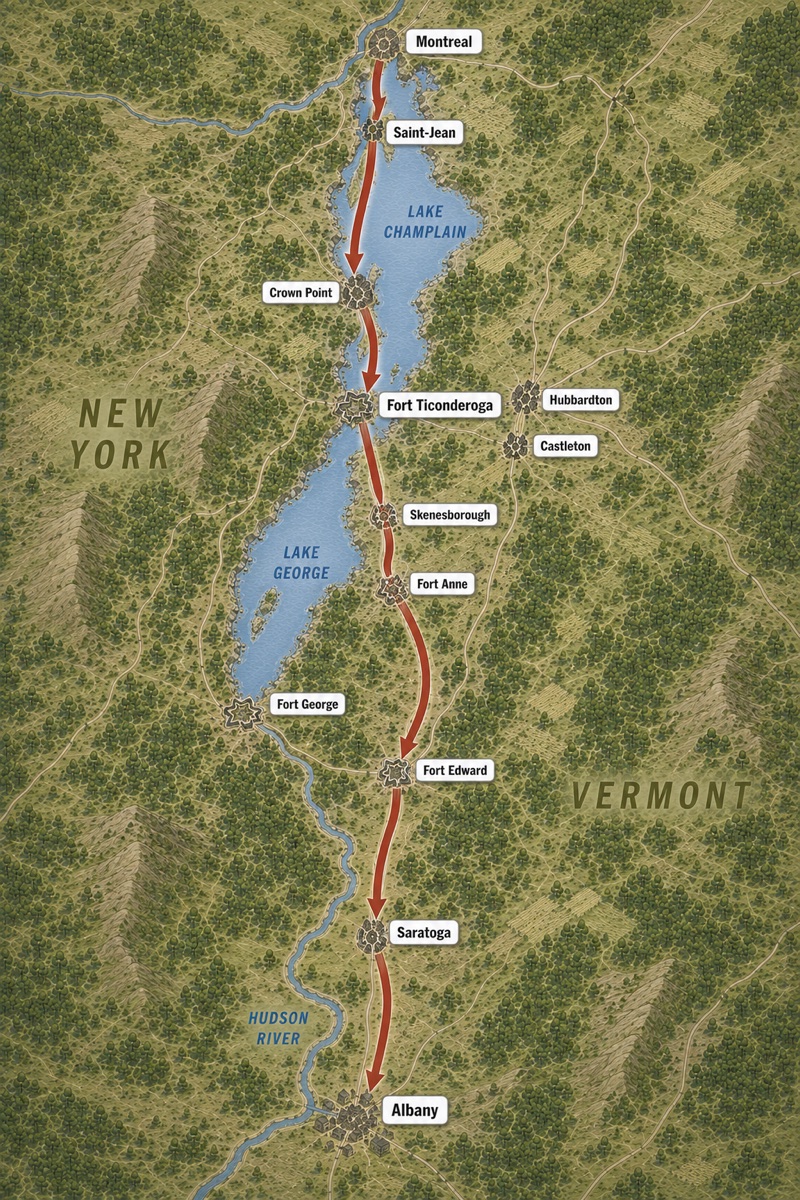
The news that the Gibraltar of the North had been abandoned without a battle landed on the two capitals like two different thunderclaps. In Philadelphia, Congress was stunned. Nobody outside the northern army understood the arithmetic of the place (the hollow garrison, the sprawling works, the bare hill), so the explanations people reached for were darker: incompetence, cowardice, treason. Rumor said St. Clair (the American general who had ordered the retreat) and Philip Schuyler (his superior, commanding the Northern Department from Albany) had been bribed, and one story, absurd even by the standards of wartime rumor, had the British paying them in silver balls fired into the fort for the generals to collect. Washington, the American commander-in-chief, who had genuinely not seen it coming, wrote to Schuyler that the evacuation was "an event of chagrin and surprise not apprehended, nor within the compass of my reasoning." John Adams, writing to his wife Abigail that August, put the country's fury into one sentence, and since the line is usually misquoted, here it is exactly as he wrote it, period spelling and all.
I think We shall never defend a Post, untill We shoot a General.
Nobody shot a general, but heads rolled upward. Congress recalled both St. Clair and Schuyler from the Northern Department, and Schuyler's replacement, Horatio Gates, took over in August, a change of command that would shape the politics of everything that happened at Saratoga. Both recalled generals demanded courts-martial (military trials) to clear their names, and both were acquitted: St. Clair, tried in 1778 on every charge his enemies could draft, was acquitted "with the highest honor," and Schuyler was cleared of neglect of duty the same autumn. Congress confirmed both verdicts. It did not matter. Neither man ever led a major field command again. St. Clair, in his report to Congress that July, had stated his own defense plainly: "I have made good a retreat from under the nose of an army at least four times their numbers." It took years, and a lost British army, for that sentence to read as the achievement it was.
In London the same news arrived as proof that the rebellion was collapsing. Parliament cheered Burgoyne; the fortress whose name every Englishman knew, the place that had humiliated a British army in 1758 and been stolen by rebels in 1775, was British again, in four days, almost for free. The story everyone repeats has George III bursting into the Queen's chamber crying "I have beat them! beat all the Americans!" That scene is a legend, a piece of gossip with no contemporary source behind it, and it should be enjoyed as exactly that: not a fact about the King, but a perfect fossil of the mood, because that is how the fall of Ticonderoga felt in London in the summer of 1777.
And then the inversion began. Start with what Britain actually won. Burgoyne now owned the most famous fort in America, which meant he had to hold it: a garrison of 900-plus men, mostly the Brunswick regiment Prinz Friedrich and the British 62nd, subtracted from his field army before it fought a single major battle. He owned the lake, which meant his supplies now traveled the whole length of it, back over Champlain to Canada, a line that grew longer and thinner with every mile he advanced. And at Skenesborough he made the choice that turned geography against him: rather than backtrack and take the Lake George water route south, he pushed his main army overland toward Fort Edward, on the upper Hudson (the river that runs the rest of the way to Albany), 23 miles of creek, ravine, and forest. Schuyler's axemen got there first. They felled trees across the road, broke the bridges, and choked Wood Creek with timber, and the 23 miles took Burgoyne's army about three weeks. Only his guns went by water.
Now count what America actually lost, and saved. The cannon, the flotilla, and the supplies were gone, and they stung. But the garrison, the thing St. Clair gave up the fort and his own reputation to keep, was alive. The men who marched out over the floating bridge reassembled at Fort Edward and folded into the northern army. Long's men and Warner's men, the survivors of Skenesborough and Hubbardton, fought again at Bennington in August. The army that gathered in front of Burgoyne that fall, the one that fought him to a stop at Bemis Heights and took his surrender at Saratoga in October, contained the army "lost" at Ticonderoga. In September, an American raid even came back: Brown's raid (named for the officer who led it) retook the outworks on the portage and Mount Defiance itself for a few days and freed a haul of prisoners, a postscript with a point, which was that Britain's grip on its great prize was a garrison and a promise, nothing more.
The war story1777: the campaign that ends at Saratoga, told whole
The verdict on the week depends entirely on where the clock is stopped. Stop it on July 6, and Burgoyne has taken the most famous fort in America in four days, almost for free, and the rebellion is reeling. Stop it in October, and the fall of Ticonderoga looks like the moment a British army was handed a famous trophy and a fatal errand: garrison the trophy, feed yourself from Canada, and keep walking south into a country that was felling trees across every road, toward the army you had assumed would meet you, which was never coming. The men who were vilified for the retreat had, between them, saved the soldiers and slowed the enemy. The court-martial verdicts said as much, years too late to give either general his career back.
After Saratoga, the fort's own story simply stopped. The British burned and abandoned Ticonderoga in November 1777, and the Gibraltar of the North never mattered in a war again.