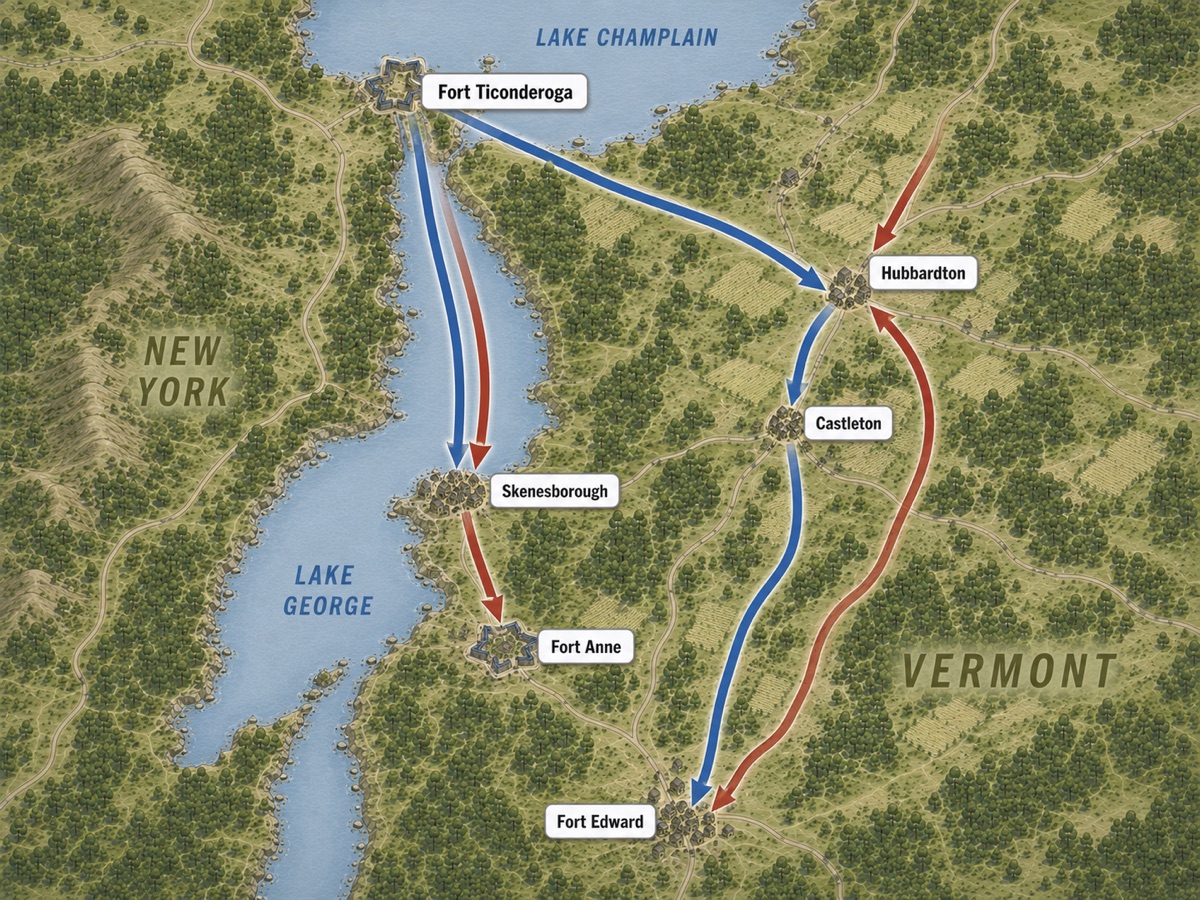
By June 30, 1777, the British invasion army under Lieutenant General John Burgoyne had staged at Crown Point, about 10 miles north of Ticonderoga, and on July 2 it came on in two wings: Brigadier General Simon Fraser's Advanced Corps of grenadiers (the army's big assault infantry), light infantry, and marksmen leading the British division down the west shore toward the old fort and the 1758 French lines (earthworks left from the French war nineteen years earlier), and Baron Riedesel's Germans down the east shore toward Mount Independence and the road behind it, the garrison's only escape route by land. Too short of men to hold the outer ground, the American commander, Major General Arthur St. Clair, pulled in the nearly cut-off garrison of Mount Hope, the outpost covering the portage road and the water supply, on the morning of July 2; the withdrawing troops burned it behind them, and Fraser's men occupied the height. That afternoon a picket line (an outlying guard) banged away at British and Native skirmishers on the west lines. Those few hours of musketry were nearly the entire battle of Fort Ticonderoga.
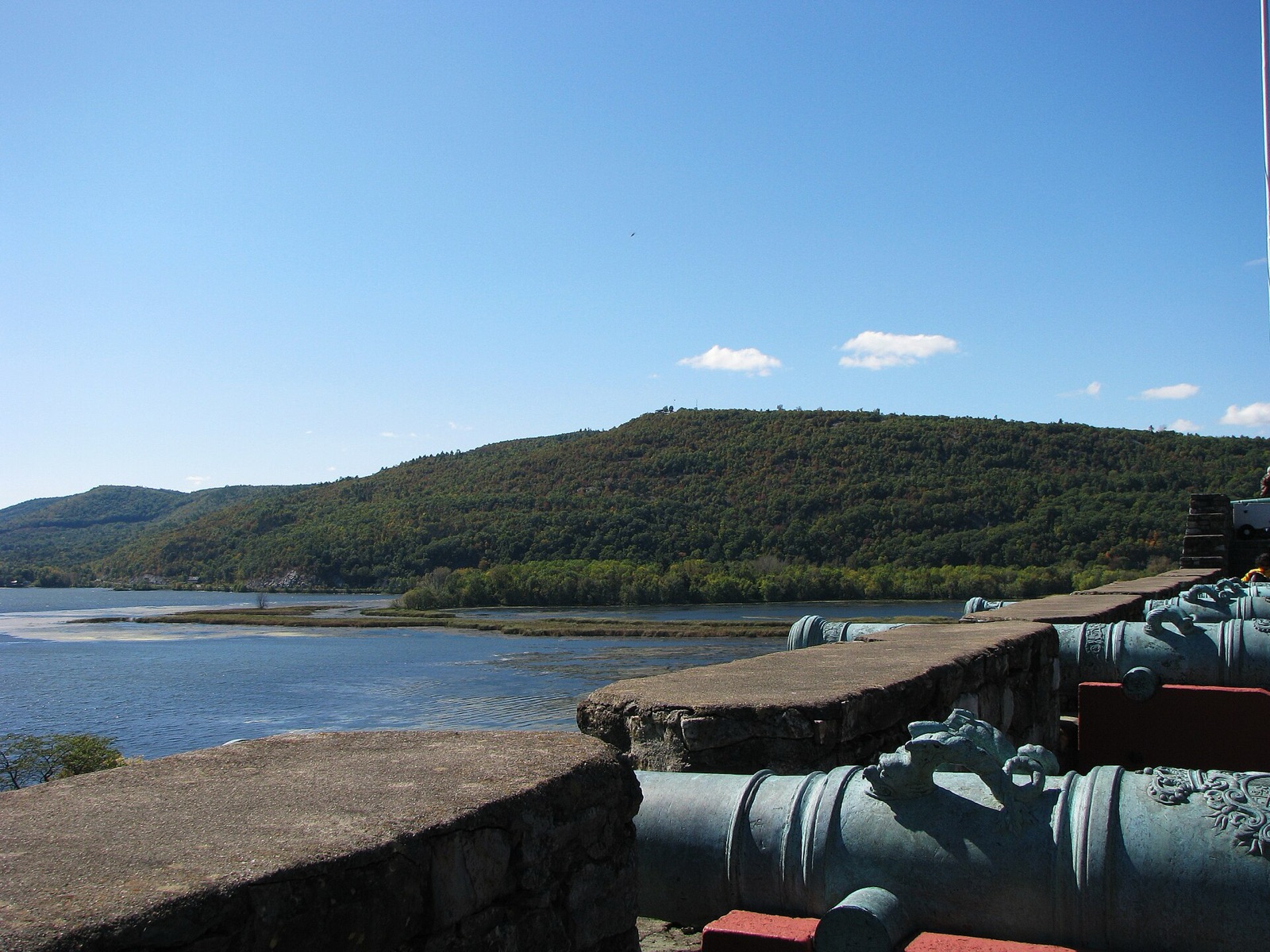
The real action was an engineering survey. On July 3 and 4, Lieutenant William Twiss, one of Burgoyne's engineers, climbed Sugar Loaf, the Americans' name for the 850-foot hill they had left bare (the British were already calling it Mount Defiance), and reported what the ignored warnings of 1758 and 1776 had said: the summit commanded both forts, and a road could be cut up the back slope. Fraser and Major General William Phillips, Burgoyne's artillery commander, put about 400 men and most of the army's draft cattle on the job. Phillips is supposed to have said (the attribution is traditional; no document records it), "Where a goat can go, a man can go; and where a man can go, he can drag a gun." By midday on July 5 the first two guns, a pair of 12-pounders (cannon throwing twelve-pound iron balls), stood on the summit. The work was meant to stay hidden until the battery could fire.
It did not stay hidden. The night of July 4 the Americans had seen campfires on the summit, lit by Native warriors with the road-cutting force; on the morning of the 5th there was movement and a flash of scarlet on the bare rock. Every man who looked up understood the geometry at once. Cannon on that summit could drop shot into every corner of the fort and Mount Independence both, while the forts' own guns could do almost nothing about a battery 850 feet over their heads. Around noon St. Clair called his four brigade commanders into council, and the vote was unanimous.
it is impossible with our force to defend Ticonderoga and Mount Independence
The council resolved that "a retreat ought to be undertaken as soon as possible," and it had to be that night (the night of July 5–6), while Riedesel's Germans were still short of the only road out. The threat alone had decided it; the two 12-pounders on Mount Defiance never fired a shot. St. Clair said afterward that he had faced a choice between saving his reputation and losing the army, or saving the army and losing his reputation, and chose the army. He was right about both halves.
The evacuation was a desperate improvisation that mostly worked. Everything that could float, more than 200 bateaux (flat-bottomed cargo boats) and the small armed vessels, was loaded with the sick, the stores, and what cannon could be moved, and sent south up the lake to Skenesborough (the cramped harbor at the lake's southern head, where the navigable water gives out) under Colonel Pierse Long. The main body crossed to Mount Independence and took the military road southeast toward Hubbardton and Castleton, in the New Hampshire Grants (soon to be Vermont). Left behind: dozens of cannon (period claims ran past 70; the count was disputed even then), plus flour, meat, tents, and ammunition, a windfall for Burgoyne.
Imagine the discipline that night asked for. An army that had been promised it was holding the strongest place in America was walking away from it in the dark, in file, across a quarter-mile of floating bridge, every man listening for the sound that would mean the British had noticed. The orders were whispered. The oars were kept quiet. It almost held. Around 3 a.m., Brigadier General Matthias Fermoy, commanding on Mount Independence, set fire to his own quarters, against orders. The blaze lit up the bay and the retreating columns like a stage. Whether the fire actually betrayed the retreat is doubtful (British accounts credit deserters with the news, and dawn was an hour off), but it did the men marching under its light no favors.
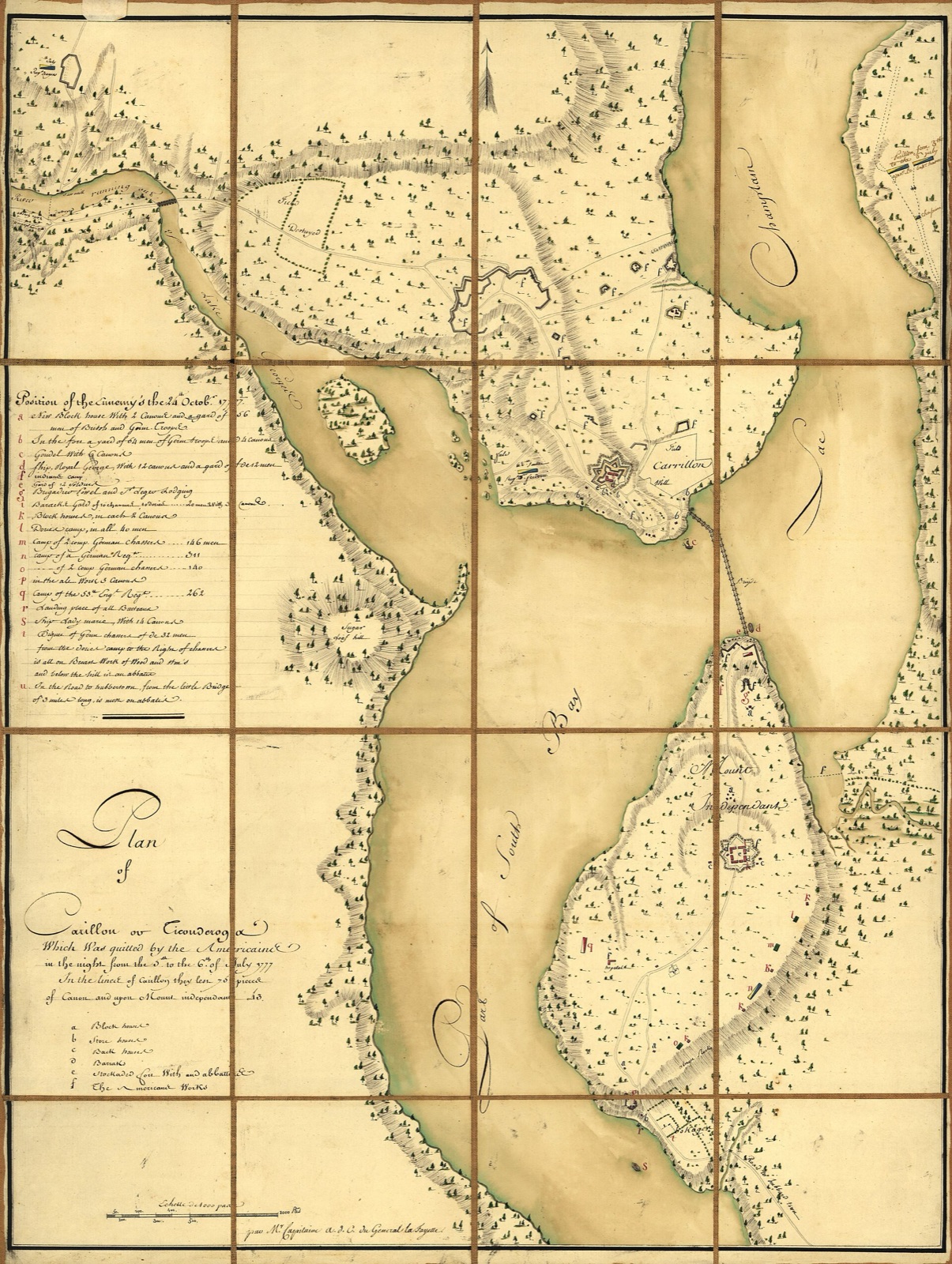
By early morning on July 6, Fraser's men were across the bridge and British colors flew over both works without a single shot fired at the fort. The "impassable" log-and-chain boom across the lake stopped Burgoyne's gunboats for about half an hour. By late afternoon the British fleet had run south and caught the American flotilla at Skenesborough: galleys (small armed rowing vessels) taken or blown up, stores burned, Long's men escaping overland toward Fort Anne. St. Clair's land column made Castleton, about 30 miles from the fort, by evening. One Hessian soldier, Johannes Schwalm, wrote afterward: "If the enemy had made a truly determined effort to defend the post, we could not have taken it."
The bill came at dawn on July 7, at Hubbardton. St. Clair's rearguard (the detachment left to march last, between the escaping army and its pursuers), under Colonel Seth Warner of the Green Mountain Boys (the Vermont frontier militia, veterans of the land feud with New York), with Colonel Ebenezer Francis's 11th Massachusetts and Colonel Nathan Hale's 2nd New Hampshire (not the executed spy; a different Nathan Hale), had orders to march on to Castleton, and halted at Hubbardton instead, about 1,000 to 1,200 organized men plus hundreds of sick and stragglers. Fraser, pursuing with 750 to 850 grenadiers, light infantry, and men of the 24th Foot (an infantry regiment), hit them at first light. Hale's encampment by Sucker Brook was overrun first.
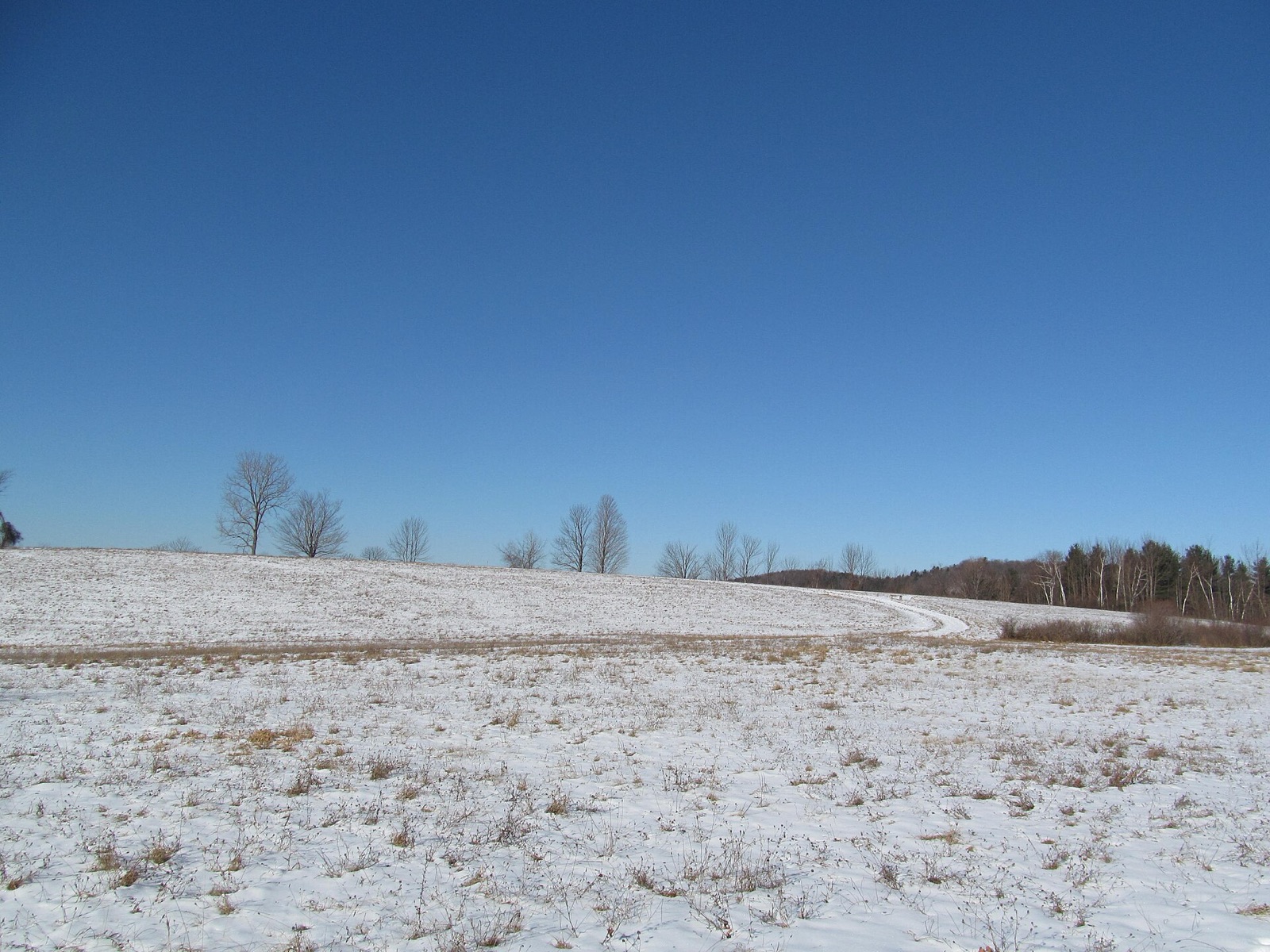
Francis and Warner formed on Monument Hill and fought Fraser to a standstill, for somewhere between 45 minutes and two hours, shooting down about one man in five of his force and bending his left flank back.
Then the Americans on Monument Hill heard something no battle had prepared them for: singing. Up the Castleton road came Riedesel's Brunswickers, jägers (riflemen) and grenadiers, advancing into the fight singing a hymn, with a military band playing, on Riedesel's order, so that a few hundred winded men would sound like an army arriving. It worked. The American right broke. Francis was killed by a volley where he stood. Warner, by the traditional account, told his survivors to scatter and meet him at Manchester. Hale and somewhere between 230 and 300 men were captured. The Americans lost roughly 40 percent of the rearguard; Fraser lost over 20 percent of everyone he brought. And the mauled rearguard had done its job: Fraser's bloodied force stopped at Hubbardton with its wounded and prisoners, the pursuit on the land road ended there, and St. Clair's main column marched on unmolested to rejoin the army. The rearguard was wrecked buying exactly what it had been left behind to buy: time. It was the only Revolutionary War battle fought on Vermont soil.
The week's last fight came on July 8 at Fort Anne, where Long's water-column survivors, about 600 men joined by 400 New York militia, turned on their pursuers, some 190 men of the British 9th Foot under Lieutenant Colonel John Hill, and nearly enveloped them in a two-hour firefight up Battle Hill. They fell back only when ammunition ran out and a war whoop sounded from the woods, seemingly Native reinforcements arriving. It was a single British officer, Captain John Money, whooping ahead of his stalled scouts. The Americans burned Fort Anne and withdrew toward Fort Edward, and the week was over.