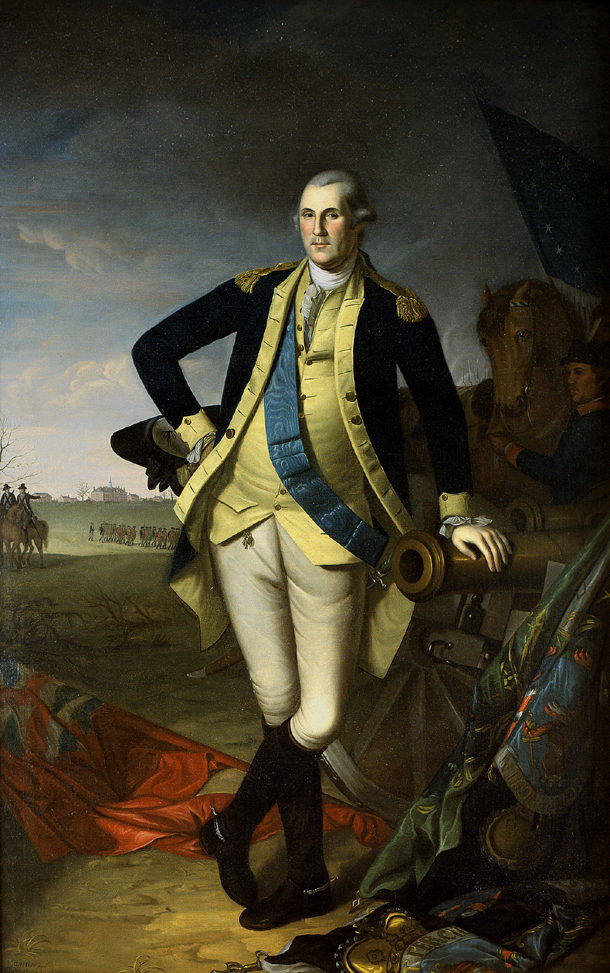
By mid-morning on December 26, 1776, the fighting at Trenton was over, and the army George Washington (American) had brought across the Delaware in a nor'easter (a violent winter storm) the night before started counting. The Hessian garrison (the German brigade holding the town for Britain) had lost about 22 men killed, roughly 90 wounded, and roughly 900 captured, along with all six of its cannon, about a thousand muskets, the regiments' colors (their battle flags), wagons, supplies, and some forty hogsheads (large barrels) of rum, which Washington ordered destroyed, an order mostly obeyed. The American battle losses were famously tiny: by the standard account, not one man killed by enemy fire in the assault, and around four to six wounded, Lieutenant James Monroe (the future fifth president, eighteen that morning) and Captain William Washington (the general's cousin) among them. The commander in chief reported it to John Hancock, the president of the Continental Congress (the assembly governing the rebelling colonies), the next day.
Our Loss is very trifling indeed, only two Officers and one or two privates wounded.
Almost no one fell to Hessian fire, but the weather was another army, and it collected its own casualties. By noon on the 26th Washington was recrossing the Delaware with his prisoners, guns, and stores, which meant his exhausted men made the icy crossing a second time in roughly 24 hours, and many units a third within days. Exposure and illness after the double crossing killed American soldiers through the days that followed, by some accounts more men than the battle had cost the Hessians in dead. A victory this cheap was not free; the bill just came later, and quietly.
Colonel Johann Rall, the garrison's commander, shot twice leading his last counterattack, was carried to his headquarters in Stacy Potts's house, where he died within a day. By the consistent early accounts, his last request was that Washington treat his captured men humanely, and Washington, who visited the dying colonel (with Major General Nathanael Greene, one of his column commanders, by most tellings), agreed and kept the promise. No verbatim record of the words survives. Rall was buried, tradition says in an unmarked grave, at Trenton's First Presbyterian Church. His army was not done with him. In 1778 a Hessian court-martial (a military court), ordered by the prince back home, investigated how three regiments and their colors had been lost, and fixed the blame on Rall, who was dead and could not answer. The victors got the kinder legend: Major James Wilkinson, an American officer on the campaign, in memoirs written forty years later by a man with a famously high opinion of himself, has Washington saying that morning, "This is a glorious day for our country"; take it as Wilkinson remembered it.
The roughly 900 prisoners were ferried over the river, marched to Newtown in Pennsylvania, and then paraded through the streets of Philadelphia to enormous crowds. The spectacle was the point. The Hessians had been the terror of the 1776 campaign, and here they were, captive, walking through an American city. And who were they? Not quite what American propaganda said. The Declaration of Independence had denounced the king's "large Armies of foreign Mercenaries," but the men in the column were not soldiers of fortune chasing loot contracts. Over the course of the war Britain hired about 30,000 German auxiliaries from six small principalities, more than half of them from Hesse-Kassel, which is why Americans called them all Hessians. Their princes signed subsidy treaties with George III (Britain's king), renting out their standing regiments; the Landgrave (the ruling prince) Friedrich II of Hesse-Kassel collected the payments, including extra rates, blood money, for his soldiers killed and wounded. The soldiers themselves were conscripted subjects serving for their ordinary army pay, sent across an ocean by a prince balancing his books. They were good troops; this same brigade had stormed Fort Washington six weeks earlier. Congress understood the arrangement well enough to aim at it, running a deliberate campaign offering land to Hessian deserters, and a substantial number of Hessian prisoners from the war ultimately chose to stay in America and become the thing they had been sent to fight.
What the victory actually bought still had to be purchased man by man, because the calendar had not moved: the army's enlistments still expired on December 31. On December 30 Washington recrossed into Trenton yet again, and there, in the last days of the year, the war came down to a speech. He asked the veterans of the campaign, men whose enlistments ran out at the new year, to stay six more weeks for a bounty of ten dollars, and by a sergeant's account rode along the line and asked again when no one stepped forward at first. About half of the eligible men stayed in the moment, and the army held together into January. Congress had voted Washington emergency powers for six months on December 27. Ten dollars and six weeks: that is the margin by which the United States kept an army.
Off the fieldThe enlistment problem: an army from nothingThe six weeks were earned almost immediately. On January 2 the British commander Lord Cornwallis marched down from Princeton, the next post up the chain about ten miles to the northeast, with a force in the thousands to crush the impudent army at Trenton; a day-long delaying fight on the road and a repulse at the Assunpink Creek bridge held him off, and that night Washington slipped his whole army around Cornwallis's flank by back roads and smashed his rearguard at Princeton on the morning of January 3. Those ten days, December 25 to January 3, flipped the psychology of the entire war: the British pulled in their outpost chain and abandoned most of New Jersey, and a rebellion that had been a week from expiring was suddenly the side with momentum. At the start of the winter, the question had been how fast the rebellion would collapse. The answer Trenton gave was that it would not, and the war went on, because roughly 2,400 freezing men, about half of whom then agreed to stay for ten dollars, kept an army in the field for it to be fought with.