On Christmas night 1776, George Washington (American), commander in chief of a rebel army that would mostly dissolve when its enlistments expired on December 31, put about 2,400 men on the bank of the Delaware River at McConkey's Ferry. Nine miles downstream sat Trenton, New Jersey, and its garrison of about 1,500 Hessians (German troops in British service) under Colonel Johann Rall. The plan was three crossings and a converging attack before dawn. The password, written into the order of march, was "Victory or Death."
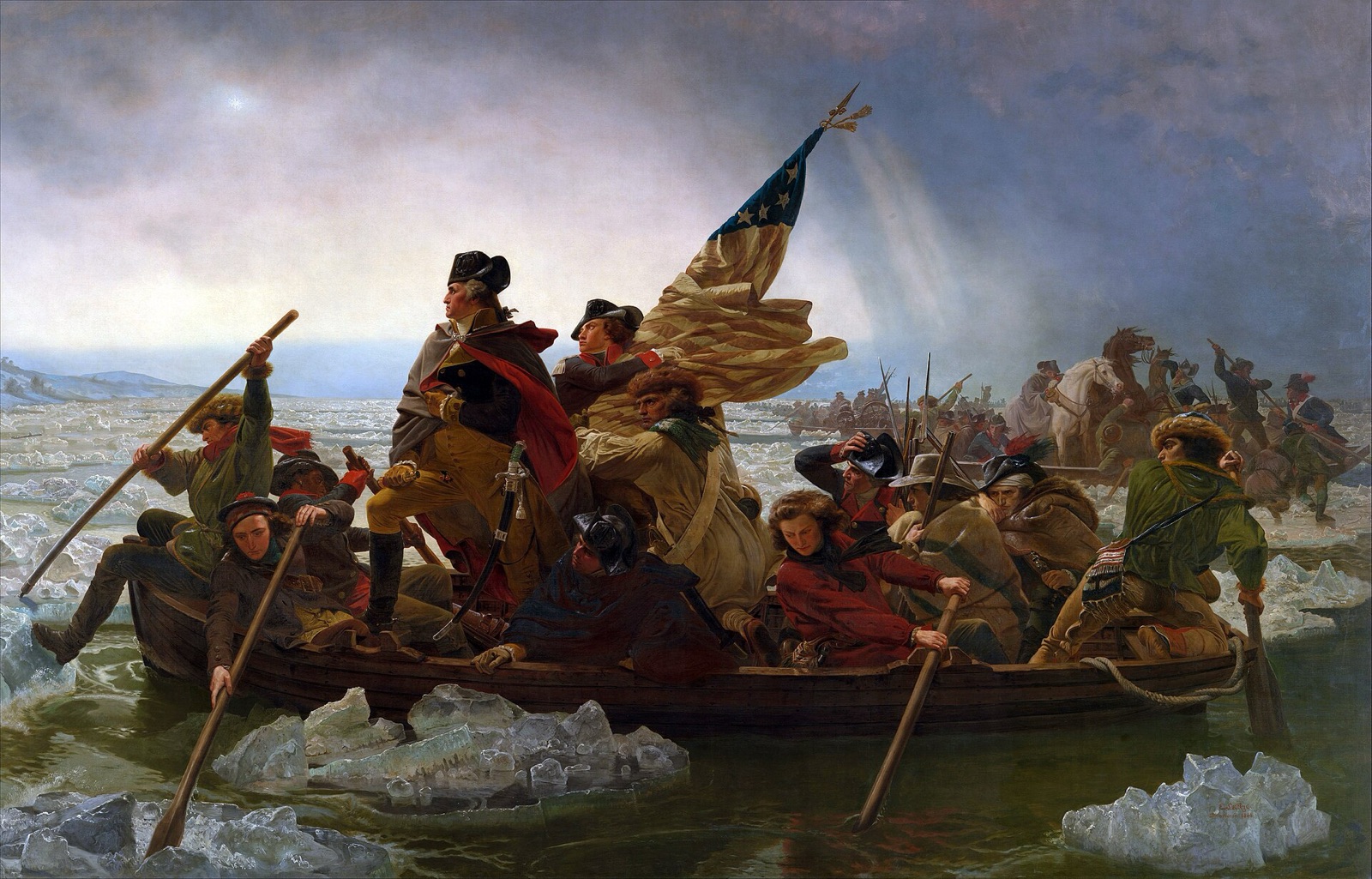
Christmas evening the weather broke into a nor'easter: rain turning to sleet, snow, and hail, a high wind, and ice floes running in the 300-yard-wide river. The army crossed in the boats Washington had hoarded, big Durham boats (40-to-60-foot cargo boats built to haul raw iron) for the men and flat ferries for the horses and guns, poled by Colonel John Glover's (American) "Marbleheaders," a regiment (a unit of several hundred soldiers) of Massachusetts fishermen and sailors who had already rowed this army to safety off Long Island in August. Colonel Henry Knox (American), the 280-pound Boston bookseller turned artillery chief, ran the embarkation, his enormous voice carrying over the storm. He was taking across an unusually heavy 18 guns, and the loading took most of the night. Not a man or gun is recorded lost. Knox, writing to his wife Lucy, set the scene in one line: "The night was cold and stormy; it hailed with great violence; the troops marched with the most profound silence and good order."
The other two crossings failed. Downstream, where the river behaved differently, sheet ice piled along the Jersey shore: Brigadier General James Ewing's militia, who were to seal Trenton's southern escape route, never got across at all, and Colonel John Cadwalader, who was to pin the enemy post at Bordentown, got some infantry over but could not land his guns and turned back. Washington's column was now the whole attack, three hours behind schedule, the last guns over around 3:00 a.m. and the march stepping off around 4:00, which meant the assault would come in broad daylight. Washington judged retreat now more dangerous than attack, and went on.
Imagine being one of the 2,400. You have been awake since before the crossing. Your shoes, if you still have shoes, have been soaked through since the riverbank, and the sleet comes over your shoulder and down your collar, because the storm is at the column's back. The order is silence. Nine miles in the dark, the password from the order of march running in your head: victory or death. Somewhere on that road you check your musket and find the priming soaked, and you understand that whatever happens at the far end will happen with the bayonet (the long blade fixed on the musket's muzzle for close fighting).
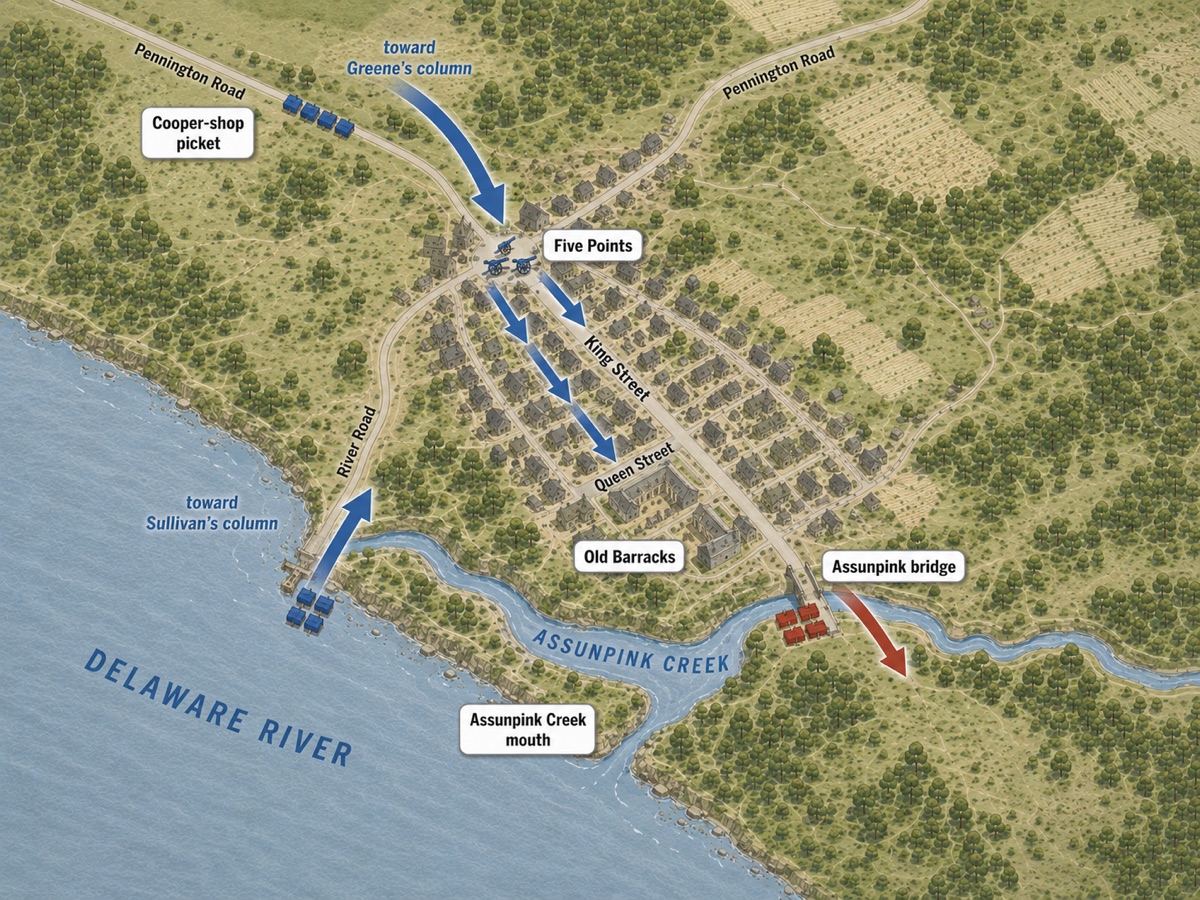
Nine miles of road in driving sleet, men with broken shoes leaving what soldiers described as bloody footprints in the snow. The same storm that had nearly wrecked the crossing was now cover: it muffled and hid a marching army, and no one in Trenton imagined an attack could move in it. About four and a half miles out the army split as planned. Major General Nathanael Greene (American) took the left column inland to the Pennington Road, Washington riding with it, to come at Trenton from the northwest; Major General John Sullivan (American) took the right column down the River Road along the Delaware, toward the lower town and the bridge over Assunpink Creek (the stream at the town's southern edge). Sullivan sent word that the storm had soaked his men's powder (the gunpowder poured down the musket barrel for each shot; wet, it was useless). The answer that came back, in wording polished by generations of retelling, was to use the bayonet, for the town must be taken.
Ahead of them, the garrison was not what the legend says. Generations of storytellers have the Hessians sleeping off a drunken Christmas; no eyewitness on either side describes drunkenness, and when the shooting started the garrison turned out fast and fought (the forty barrels of rum the Americans found in the town probably helped the legend along). What the Hessians actually were was exhausted. Weeks of New Jersey militia ambushes had kept the brigade under constant alarm, sleeping in uniform with muskets at hand, and on Christmas night the whole garrison had turned out to chase a raid: about 50 Virginians under Captain Richard Clough Anderson, sent across by General Adam Stephen (American) without Washington's knowledge, had hit an outpost and vanished. Washington, when he learned of it, was furious at Stephen, by one account telling him he might have ruined all his plans. But the unauthorized raid was an accidental gift: Rall concluded that the attack he had been warned about had come and gone, and stood his garrison down on the worst possible morning.
And he had been warned: at least three credible warnings, including word from the British command itself on Christmas Day, and his own officers urging him to fortify the town. He built nothing. Witnesses at the later Hessian inquiry recalled him scoffing that the rebels were nothing but a lot of farmers: "Let them come... We will go at them with the bayonet." There is also the story of the note: a Loyalist farmer (an American who sided with the king), the Hessians said afterward, brought Rall a written warning at the merchant Abraham Hunt's supper table that night; Rall pocketed it unread, and it was found on him as he lay dying. No note survives; it is the story the Hessians told afterward, a story that put the whole disaster in a dead man's pocket.
At about 8:00 a.m., a mile northwest of town, Greene's vanguard (the lead troops of his column) came out of the sleet at the Hessian picket post (a small guard detachment posted outside town to give warning) at a cooper's shop on the Pennington Road. Lieutenant Andreas Wiederholdt's outpost fired and fell back fighting, shouting the alarm Wiederholdt himself recorded: "Der Feind! Der Feind! Heraus! Heraus!" (The enemy! Turn out!). Within minutes Sullivan struck the River Road picket, and the two columns rolled into both ends of Trenton almost together. Knox's guns wheeled into position at the head of King and Queen Streets, the two main streets running downhill toward the Assunpink, and swept them end to end. American infantry worked through houses and yards, firing from cover, while the storm blew straight into the Hessians' faces.
These, in the twinkling of an eye, cleared the streets.
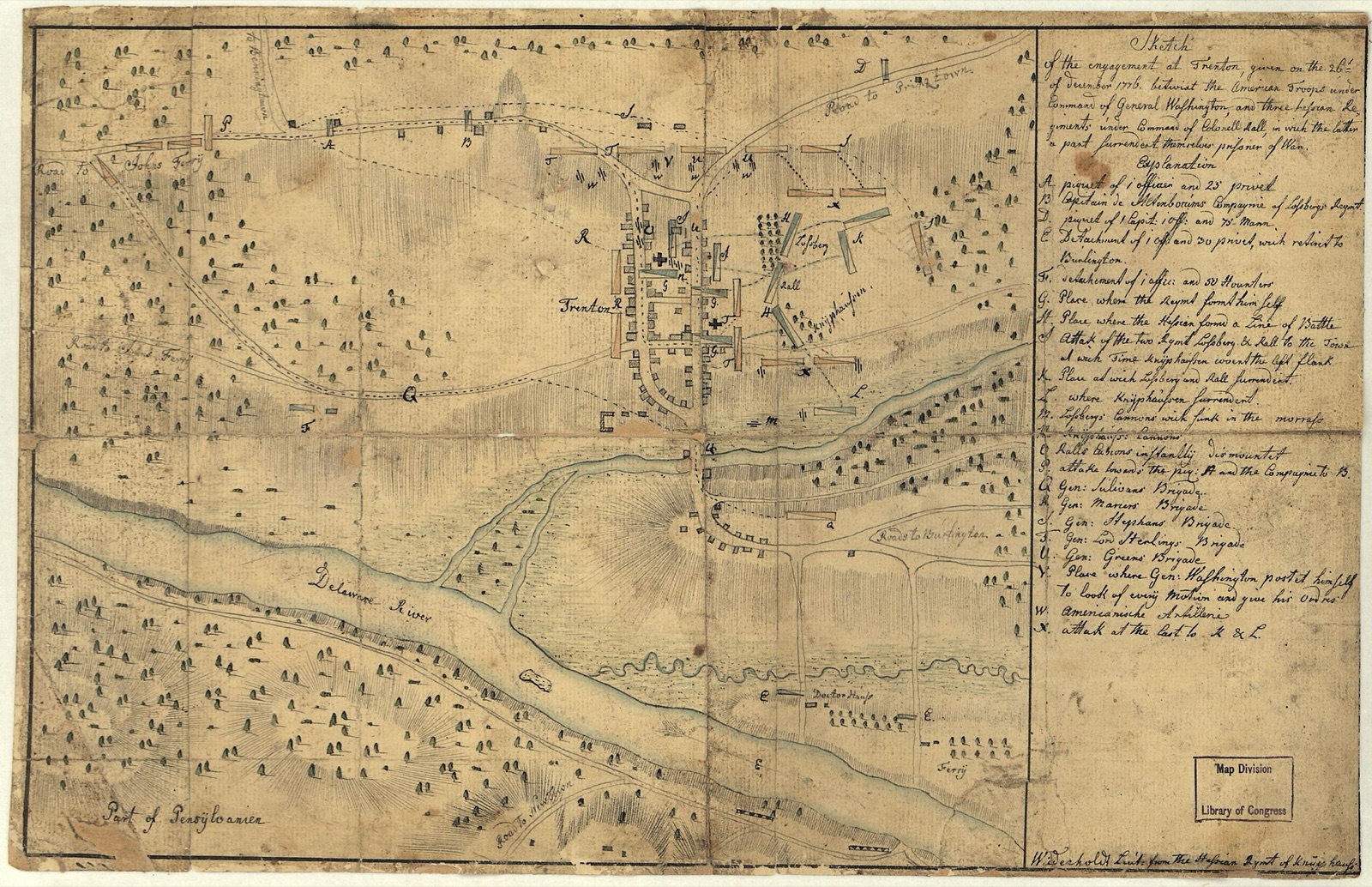
The three Hessian regiments, Rall's own grenadiers and the von Lossberg and von Knyphausen fusiliers (grenadier and fusilier were old distinctions of infantry type, by then mostly regimental titles), tumbled out and tried to form (line up shoulder to shoulder in ranks; an eighteenth-century regiment fought as a formed line or it could not fight at all) in the streets, and the streets were exactly where Knox's cannon were pointed. Rall, woken after the firing began, ordered a counterattack and briefly retook a pair of guns. On King Street, Captain William Washington (the general's cousin) and Lieutenant James Monroe, an eighteen-year-old Virginian (the future fifth president), led the rush that took the Rall regiment's two cannon; both were wounded, Monroe nearly fatally, a ball severing an artery in his shoulder. Driven out of the streets, Rall pulled his own and the Lossberg regiment into an apple orchard east of town, re-formed them, and led them back toward King Street one more time. In that counterattack he was shot twice in the side and fell from his horse. His regiments, caught in the open with cannon cutting them up and surrounded, struck their colors, lowered their flags, and it was done. The Knyphausen regiment tried to escape south over the Assunpink, bogged in the marshy creek bank, and surrendered around 9:30 or 10:00. First shots to last surrender had taken roughly an hour and a half to two hours; the decisive fight in the streets, the part tradition compresses to forty-five minutes, was over in less than an hour. Because Ewing had never crossed, the stone bridge over the creek stood open long enough for the British dragoons, the jägers (light riflemen), and several hundred Hessians to get away south toward Bordentown before Sullivan sealed it.