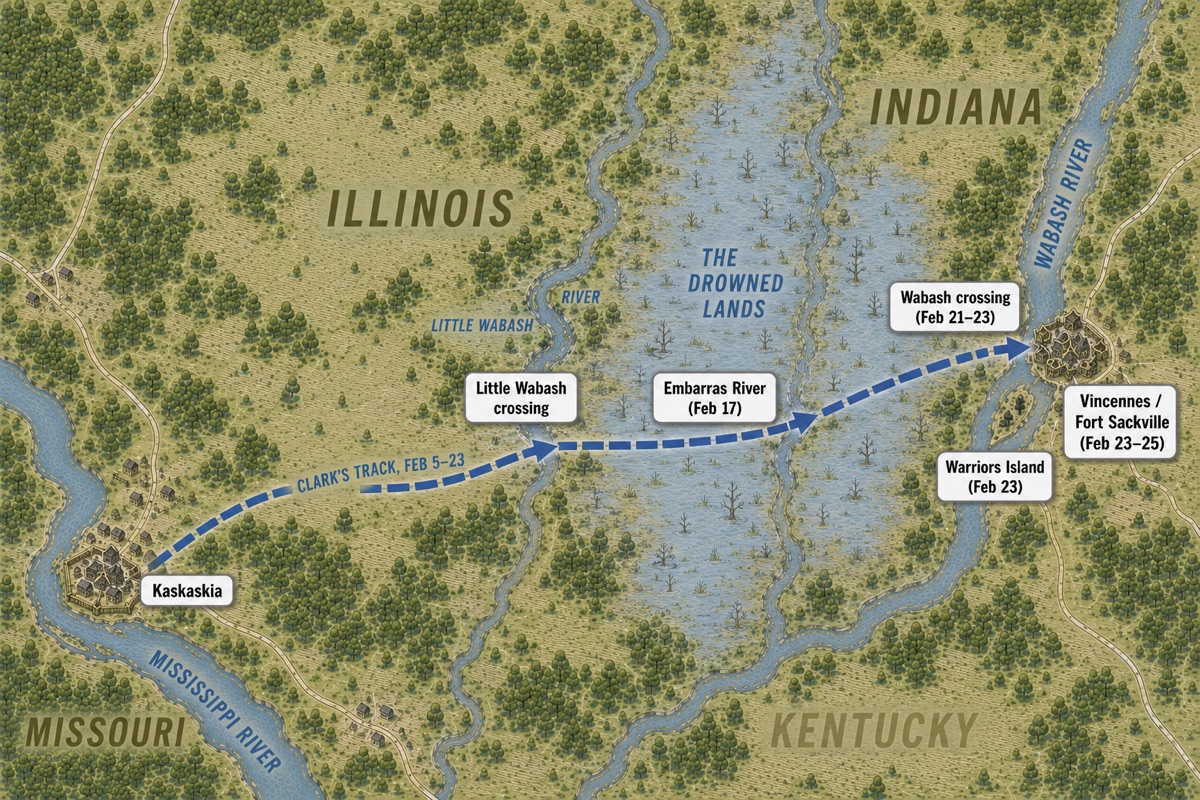
On February 5, 1779, after Mass and a blessing from Father Gibault, about 170 men, Clark's entire force in the Illinois Country and every man he could field, left Kaskaskia in the afternoon and turned east toward Vincennes, roughly 180 miles (290 km) away. Nearly half of them were French volunteers from Kaskaskia and Cahokia; the rest were Virginia and Kentucky frontier riflemen. It was an unseasonably wet winter, and the prairies between them and the Wabash River were not prairies anymore but sheets of rain-flood. Clark (American) wrote afterward that the plains lay "under water several inches deep." The first week was the easy part: the going was passable, game was plentiful, and the French companies were in good humor.
Then the rivers stopped them. On February 13 they reached the Little Wabash, normally two channels three miles apart, now a single flooded crossing about five miles wide. They built a pirogue (a dugout canoe), ferried the baggage, and waded, and lost about two days. On February 17 they hit the Embarras River, nine miles from Vincennes, too deep to ford and its banks drowned. They could not reach dry ground on the Wabash side. They camped wet, and the food began to run out.
The next days were the worst of it. By February 20 the provisions were effectively gone. Maj. Joseph Bowman (American), Clark's second-in-command, kept the campaign's plainest record; on February 20 he wrote that the men were "very quiet but hungry; some almost in despair," and on February 22, the whole of the entry: "No provisions yet. Lord help us!" A captured hunting party out of Vincennes, taken by canoe, gave them intelligence (the town did not suspect a thing, and the fort's numbers were confirmed) and a quarter of a buffalo from another captured canoe yielded a thin broth. They ferried the Wabash itself in canoe-loads between February 21 and 23, and then waded the drowned bottomlands beyond, where the water ran at times to the chest and shoulders and ice formed at the edges. Men too weak to walk were carried in the canoes; the strong hauled the weak. On February 23 the column reached Warriors Island, a timber rise above the flood about two miles from town, and saw Vincennes at last.
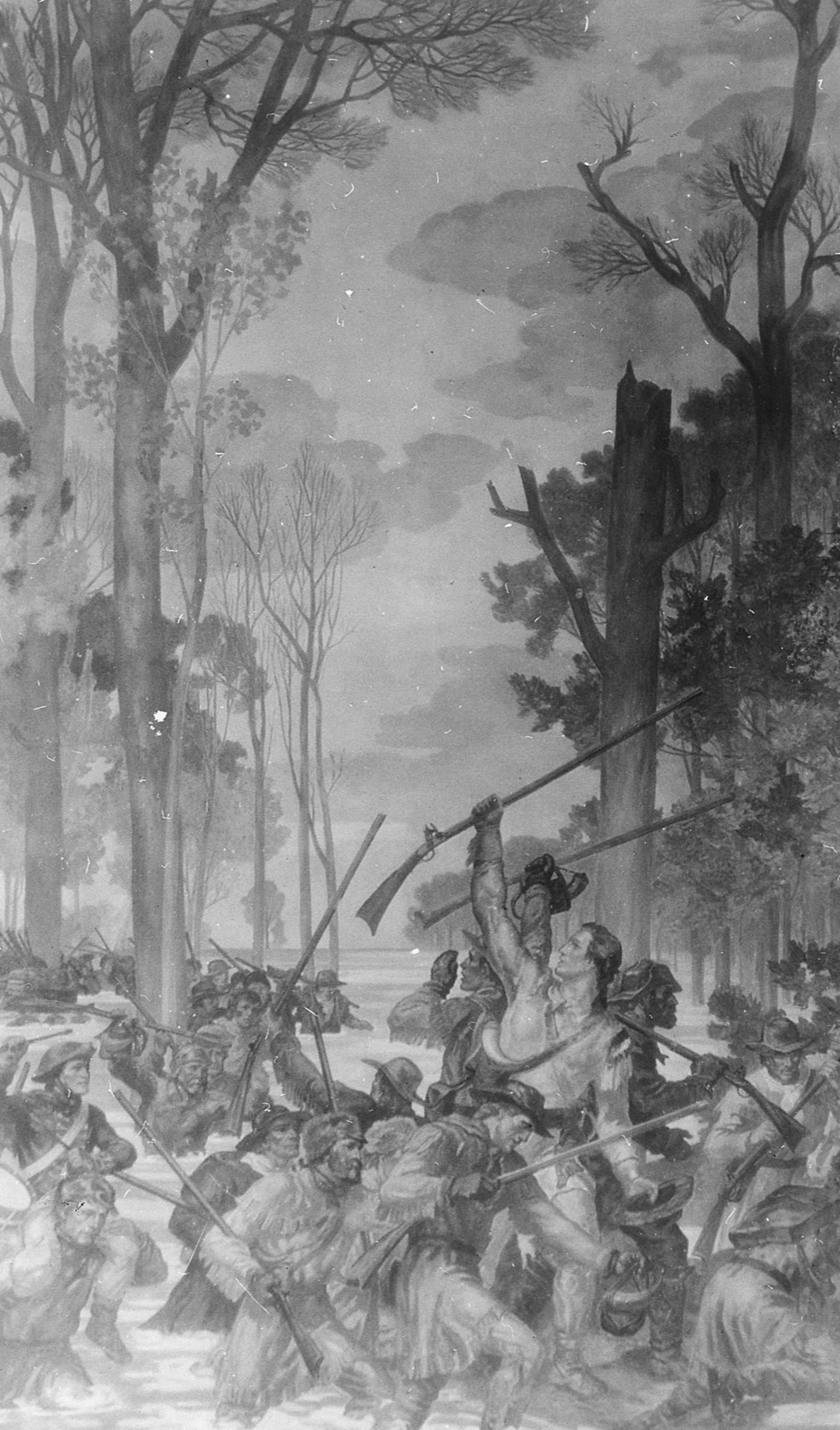
(Clark told some of this more cinematically a decade later, in a memoir written partly to salvage his reputation: the drummer boy floating across the flood on his drum, his own face blackened with wet powder and a war whoop to drive the column into the last water. The eighteen days in the flood need no embroidery; Bowman's terse journal carries the whole weight of them.)
Hamilton knew the floods. He had judged that no one could cross the drowned lands in February, and he was very nearly right. The entire value of the march was that it could not be believed, which is why nobody in Vincennes was watching the east.
From Warriors Island, Clark sent the captured duck hunter ahead with an open letter to the inhabitants: friends of the United States should stay in their houses, and anyone found in the fort or under arms would be treated as an enemy. The letter was read aloud in the public square, and nobody warned the fort. At dusk on February 23 Clark marched his men toward town in full view, at maximum theatrical scale, the companies counter-marching behind a low rise so that only their flags showed, and the column carried far more colors than a force its size rated. The town read an army several times the real number. Whatever hope Hamilton had of a warning or a militia rally died before a shot was fired.
Around eight in the evening the Americans walked into the town, and the habitants welcomed them and dug up gunpowder they had hidden from the British, replacing Clark's rain-soaked stock. Tobacco's Son, the Piankeshaw chief whose town adjoined Vincennes and who had sided with Clark the year before, offered warriors for the assault; Clark declined, politely. He wanted no confusion in the dark, and the optics of the fight, an American force taking a British fort, were part of the point.
The firing on Fort Sackville began about eight. Hamilton (British) took the first shots for "some drunken frolic of the inhabitants, but going upon the parade heard the balls sing." This was where the bluff turned into a real fight, and the frontier riflemen won it fast. The stockade was unfinished and, in Hamilton's own word, so ill set up that its gunports barely shielded the gun crews. About 14 picked marksmen under Capt. Bayley, with the rest firing in relays from houses, fences, and a natural riverbank, poured fire through those ports. Hamilton's gunners were hit at their pieces; his 3- and 6-pounder cannon (light field guns, named for the weight of ball they threw) fired high and did nothing against covered men. By morning the fort's artillery was effectively silenced. The American loss in the entire siege was one man slightly wounded.
The next morning, February 24, Clark sent a demand under a flag of truce, and it was not gentle.
I expect you shall immediately surrender yourself with your Garrison prisoners at discretion... you may expect no mercy, for by Heavens you shall be treated as a murtherer.
Hamilton's written reply was that he and his garrison were not "to be prevailed on by threats to act in a manner unbecoming the character of British Subjects," and the firing resumed. Inside the fort, the arithmetic was already against him. He assembled the garrison, and the count was merciless: of the men he could trust, the regulars were a few dozen and several of them were already wounded at the guns; the Detroit French militia, in his own account, "hung their heads," and their sergeants muttered that it was hard they should fight their own friends and relations in the town outside. He had wintered on the belief that the floods were his scouts and the re-sworn town his shield, and the firing had just told him both were gone. Hamilton privately resolved to get honorable terms if he could.
He had already shown the watching town an army that was not there. Now Clark would show the watching nations something the fort's guns could not answer, and it was the same operational logic at a harder scale: make the audience believe what you need it to believe. Around midday a British-allied war party, about 15 or 16 men, mostly Odawa and other Lakes warriors with a few French partisans, was returning to Vincennes from a raid toward the Falls of the Ohio, reportedly carrying scalps, and walked into the town not knowing it had changed hands. Clark's men ambushed them. In Bowman's flat tally: "killed two on the spot, wounded three, took six prisoners." Of the six captives, a French partisan was handed to the townspeople, and one young warrior was spared when a French volunteer in Clark's force, Lt. St. Croix, recognized his own son under the war paint and begged for his life.
The remaining four, five by some counts, were taken to the main street in front of the fort gate, in full view of the garrison, made to kneel in a circle, and tomahawked to death, and their bodies were thrown into the Wabash. Bowman wrote it without a flinch: the men "brought the Indians to the main street before the Fort gate, there tomahawked them, and throw them into the river." Hamilton's journal is the fullest account, and it is a hostile witness's account, so it is worth marking as his: the victims, he wrote, "began to sing their Death song, and were butcherd in succession." One of them, a young Odawa war chief named Macutté Mong, "having received the fatal stroke of a Tomahawk in the head, took it out and gave it again into the hands of his executioner who repeated the Stroke a second and third time," and was then dragged to the river and thrown in, with a rope around his neck, still alive. The blood, Hamilton added, "was still visible for days afterwards, a testimony of the courage and Humanity of Colonel Clarke."
Clark did it in full view of the walls on purpose, and he later said why. He believed he had "a fair opportunity of making an impression on the Indians... that of convincing them that Governor Hamilton could not give them that protection that he had made them to believe he could," and so he "Ordered the Prisoners to be Tomahawked in the face of the Garrison." It was aimed at two audiences at once: the Native nations weighing whether British protection was worth anything, and the garrison watching from the walls. The men who died were Odawa warriors from the Great Lakes country, far to the north, not from the Wabash towns next door, and that was part of the calculation: the killing was staged to teach the watching nations a lesson at the expense of men who were not their own. It worked on both audiences. This is the cost of the frontier war, made visible, and it belongs in the middle of the story, not in a footnote.
One question the records do not answer is whether Clark swung a tomahawk himself. Hamilton wrote that one prisoner "was tomahawked either by Clarke or one of his Officers," and that Clark came to the parley "all bloody and sweating," and told him, with great exultation, how he had been employed. A British officer present, Lt. Jacob Schieffelin, stated flatly that Clark wielded the weapon. Clark and Bowman recorded no such detail. Both accusers were enemies with every reason to blacken Clark, and the silence on the American side proves nothing in either direction. Historians have never resolved it, and we do not know.
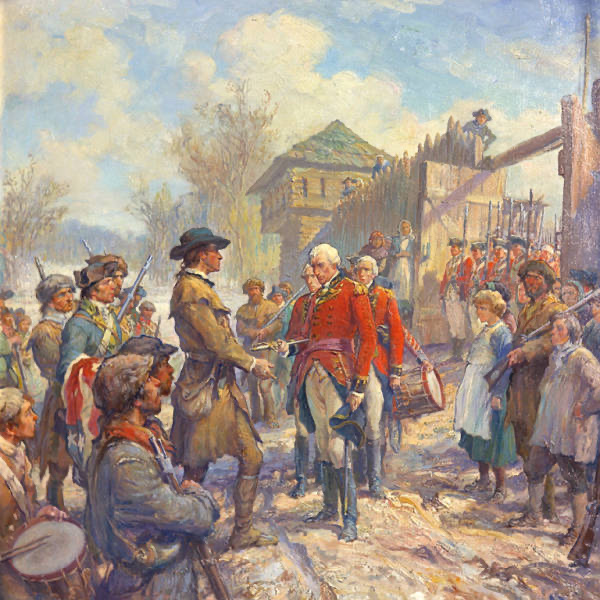
By the afternoon of February 24 Hamilton was out of moves. Seven of his regulars were wounded, his guns were useless, his militia he privately called "treacherous cowards," and no relief could reach him. He proposed a three-day truce; Clark refused it. The two men met, by Clark's and Bowman's accounts at the church of St. Francis Xavier, by Hamilton's telling before the fort gate, and Clark, still washing off blood by Hamilton's account, made plain that if he had to storm the fort, not a single man inside would be spared. Hamilton at first refused to surrender at discretion. But the arithmetic did not change, and Helm, the prisoner inside, and Maj. Hay shuttled a compromise. On the morning of February 25, by terms that let the garrison march out with their arms and the officers keep their baggage, the 79 men of Fort Sackville grounded their weapons, and the American flag went up over what Clark renamed Fort Patrick Henry.