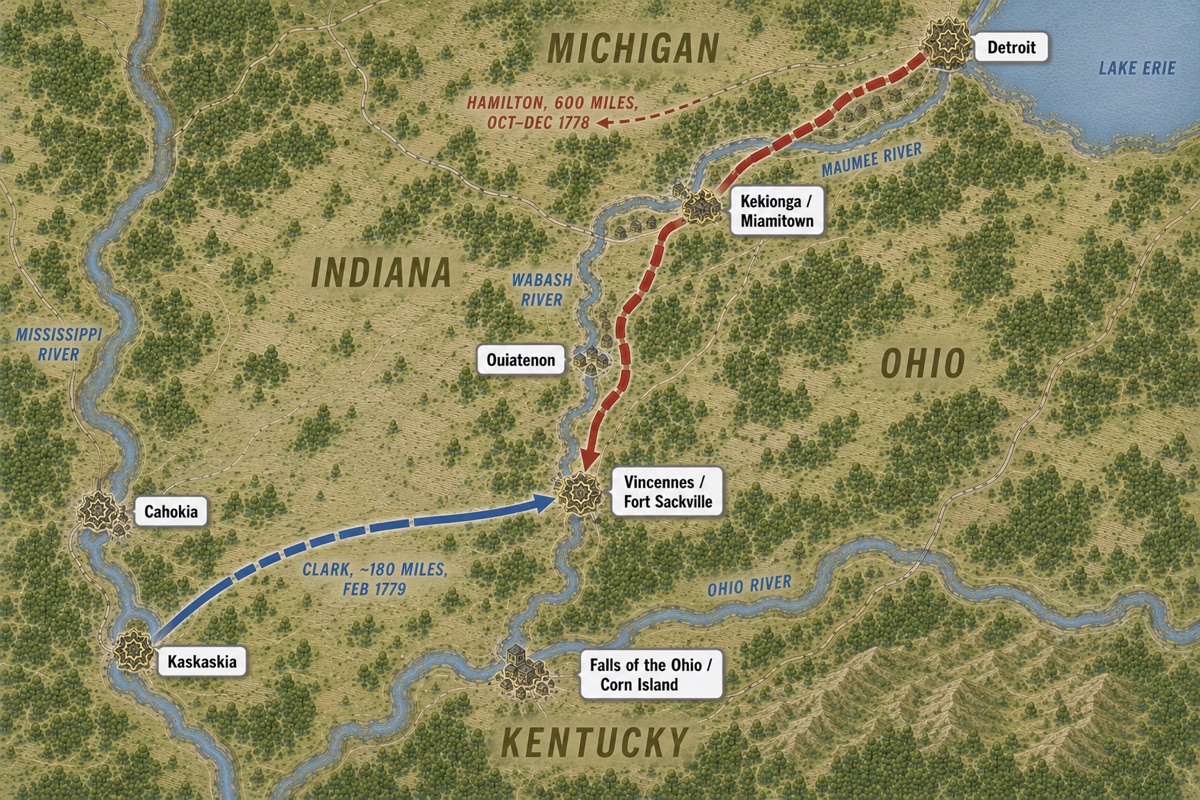
Understanding the march means understanding what George Rogers Clark (American) was trying to save, and how he had won it the first time, almost without firing a shot.
The Illinois Country was the cluster of old French villages along the Mississippi and the lower Wabash rivers, in the heart of what the eighteenth century called the West: Kaskaskia, Cahokia, and Vincennes, small French-speaking towns left over from France's old North American empire and lightly held, since 1763, by the British. These towns sat roughly 800 miles west of Philadelphia, far past the Appalachian ridge that most Americans still thought of as the edge of the world, and far beyond any battle the war had yet fought. Their people were the habitants (the French Catholic farmers and traders who had lived there for generations, under whatever flag flew). These were "the posts": the scattered fortified villages that were the only European settlements for hundreds of miles.
From Detroit, three hundred miles to the northeast at the straits between Lake Erie and Lake Huron, the British lieutenant governor Henry Hamilton (British) ran the frontier war. On orders from London, beginning in 1777, he recruited, supplied, and dispatched Native war parties (with British and Loyalist officers attached) against the Kentucky and Pennsylvania-Virginia frontiers. Hundreds of settlers, women and children among them, were killed or carried off, and Kentucky's stations lived under near-siege. The American frontier had a name for him: the Hair-Buyer General, the charge being that he paid for scalps by the piece. The record does not quite go that far, as a later section will show; for now, hold the name and what it was meant to do.
Clark was a Virginia surveyor turned Kentucky militia leader, 25 that summer and 26 by the time the march began, and his plan was to strike the source rather than keep absorbing the raids. He sold the governor of Virginia, Patrick Henry, on a stroke at the lightly held British posts of the Illinois Country, and got, that winter, a public commission to defend Kentucky and a secret one to seize Kaskaskia. In May 1778 he started down the Ohio River with about 150 recruits, based for a month at Corn Island at the Falls of the Ohio (the founding nucleus of Louisville), and shot the falls downriver (ran the Ohio rapids) on June 24 under a solar eclipse his men read as an omen (an eclipse did occur that day).
What happened next was almost bloodless. After a long overland march, Clark's men crossed the Kaskaskia River at night on July 4, 1778 and took the town and its British-appointed commandant without firing a shot. Cahokia followed days later, equally bloodless. The lever was news Clark carried in his pocket: France, the habitants' old mother country, had allied with the United States that February. The French-speaking villagers swore the American oath. Vincennes was won the same way, by a man with no soldiers at all: Father Pierre Gibault, the Kaskaskia priest, volunteered to ride over and talk the town around, and in mid-July he brought its habitants to the American oath. Vincennes had changed hands for the first time, and it would change twice more before the war was done with it. Virginia, astonishingly, claimed the whole region as Illinois County, Virginia, that fall and winter, a legal assertion that it owned this territory however thinly it could govern it.
Off the fieldThe nations caught between two empires, told wholeHamilton did not let it stand. On October 7, 1778 he left Detroit with a mixed force, a core of regulars of the King's 8th Regiment, Detroit volunteer militia, Indian Department officers, and Native allies who joined along the way, a force that grew to several hundred by the time it arrived. He moved 600 miles by the Maumee and Wabash rivers in 71 days. At Vincennes, the local militia holding the fort for the Americans melted away, and Capt. Leonard Helm (American), with only a handful of men, surrendered Fort Sackville (the British-built stockade fort beside the town of Vincennes; the town and the fort share a location but carry different names through the campaign) on December 17 with the honors of war (meaning his men were allowed to march out under arms rather than be disarmed and taken prisoner). The habitants of Vincennes swore back to the British crown. It was the second time the town had changed hands in six months, and it would not be the last.
Then Hamilton made the choice that handed Clark his opening. Rather than push on against Kaskaskia in the winter, he dismissed most of his militia and nearly all his Native warriors until spring, and settled in to rebuild Fort Sackville with a garrison of roughly 90. The plan for spring was to retake the Illinois towns and then scour Kentucky. It was sound, and it was unhurried, and it assumed he had until the weather turned.
He did not, because of a fur trader. Francis Vigo (American ally), a Sardinian-born merchant of St. Louis and a Spanish subject who leaned American, was detained by Hamilton's scouts at Vincennes, released under pressure from the town, and reached Kaskaskia on January 29, 1779 with exact intelligence: the size of Hamilton's reduced winter garrison, his cannon, and his intention to come for Clark in the spring. Clark now had the whole picture, and it left him one real choice. He could quit the country, or he could attack the British governor while the garrison was at its weakest and the season made the attack unthinkable. On February 3 he wrote the governor of Virginia what he meant to do.
I know the case is desperate; but, Sir, we must either quit the country or attack Mr. Hamilton... Great things have been effected by a few men well conducted.