By the spring of 1776 the war was a year old and still, in a strange way, undeclared. A New England army had penned the British inside Boston since the previous April, the fighting was real and the dead were real, but the official story most colonists told themselves was that this was a quarrel inside the family: aggrieved Britons demanding their rights from a king who had been badly advised. Then came a single summer that ended that story for good. Independence was voted in Philadelphia. The largest invasion force Britain had ever sent anywhere dropped anchor in New York harbor. Loyalists were hunted in the streets while their neighbors marched off to enlist under British colors. A secret American envoy was already in Paris, knocking on the back door of the French treasury. All of it happened at once, in and around one city, inside a few weeks. The year the colonies stopped arguing and started a war for a country is the year the war nearly killed the country in its cradle.
The Boston endgame
It ended where it had been stuck. Through the winter a 25-year-old Boston bookseller turned artillery colonel named Henry Knox had hauled the guns of Fort Ticonderoga, the captured frontier fort up on Lake Champlain, some three hundred miles south to the Boston lines: roughly sixty tons of cannon dragged by boat, horse, and ox-drawn sledge across two half-frozen rivers and over the Berkshire hills, the whole "noble train of artillery" arriving by late January 1776. Now Washington had heavy guns, and he had a place to put them.
The place was Dorchester Heights, the hills that looked down on Boston and its harbor from the south. The trouble was the ground, frozen too hard to dig. So General John Thomas's men brought the fort up the hill with them. The engineer Rufus Putnam had built the works in advance and out of sight, ready to carry up and set down on the bare rock: timber frames and bundles of sticks that some 2,500 troops assembled in the dark, with another twelve hundred soldiers and three hundred oxcarts hauling material, hay bales screening the road, and an artillery barrage somewhere else covering the noise. General William Howe, who had commanded in Boston since the previous autumn, woke on March 5, 1776, to a finished fortress where the night before there had been nothing, its parapets bristling with Ticonderoga's guns and looking straight down on his ships. An officer who saw it said the rebels had done more in a night than his whole army could have done in a month.
Howe first planned to storm the Heights, as the British had stormed Bunker Hill the summer before and paid in blood for it. A violent storm scrubbed the assault, and Howe chose to leave instead. On March 17, 1776, some 8,900 British troops sailed out of Boston Harbor for Halifax, in Nova Scotia, and they did not sail alone. About eleven hundred Loyalist civilians went with them: families walking away from their homes, their property, and a country that now counted them enemies. That exodus was the first tremor of a civil war inside the Revolution, neighbor against neighbor, that would run underneath everything that followed.
Everyone on both sides knew where Howe was really going. New York had the best deep-water harbor on the American coast, which to a navy is a war-winning asset; it sat at the mouth of the Hudson River, the corridor that could cut New England off from the rest of the colonies like a knife through a tendon; and the region held the strongest concentration of Loyalists in America. Within weeks Washington began marching his army down to defend it.
The armada
What came for New York that summer was the largest expeditionary force Britain had ever assembled and sent overseas. The numbers vary by source and by the week you count them, so hold them as ranges: by August something like 32,000 troops, among them roughly eight thousand German auxiliaries (soldiers hired out by their princes, principally from the territory of Hesse-Kassel, which is why Americans called all of them "Hessians"), carried and protected by a fleet usually given as some four hundred ships and ten thousand sailors. A lookout watching the masts crowd the lower bay said the harbor was filling up "like a forest."
It arrived in waves. William Howe's advance force reached Sandy Hook in late June and put troops ashore, unopposed and even welcomed, on heavily Loyalist Staten Island in early July. His older brother, Admiral Lord Richard Howe, brought the main fleet in on July 12. Hessian regiments and the troops repulsed earlier at Charleston, far to the south, kept joining through August until the whole weight of it sat in the harbor.
The Howe brothers came carrying a contradiction. Richard ran the navy and William the army, but the ministry in London had also commissioned the two of them as peace commissioners, with authority to grant pardons and talk terms. The catch was written into the commission: they could really only deal with colonists who first submitted to the Crown, and they had no power to recognize either independence or the Congress that had declared it. The brothers were not cynics about this. They were genuinely fond of America; an elder brother, George, had died fighting alongside colonial troops in 1758, and Massachusetts had paid for his memorial in Westminster Abbey. They hoped that an overwhelming show of force, plus a generous offer of pardon, would frighten the rebellion into folding without a slaughter. So they came wearing both hats at once: invade and reconcile, in the same hand.
Across the water from all that, Washington had perhaps nineteen to twenty-three thousand men on paper, heavily militia (part-time citizen-soldiers, not professionals), many of them sick, almost none of them having ever stood in a real battle. And he had to defend the unguardable. A fleet that owned the water could put men ashore on any bank it liked, which meant Washington could not mass his army anywhere: he had to hold the city on its island, the Hudson on the west, the East River on the east, and Long Island across the water all at once, never knowing which one the next landing would come at. Congress expected the city held. Any soldier who looked at the map could see it was close to indefensible. The education of George Washington as a field commander was about to happen in public, at full scale, mostly through defeat.

The pulse
Hold a single image in your head, because everything in this section happened inside about three weeks, in and around the same harbor, and the men living through it could not see how much else was moving at the same instant.
On June 28, 1776, an Irish-born private named Thomas Hickey, a member of Washington's own Life Guard (the handpicked unit that protected the commander), was hanged before an enormous crowd, reported at twenty thousand, near present-day Chrystie and Grand Streets. He was the first Continental soldier the army ever executed. Six days earlier, though no man at the gallows knew it yet, the delegates in Philadelphia had taken the vote that made everyone in the ranks below them a traitor; and across the ocean, in those same June weeks, the foreign minister of France had already sat down with a playwright to arrange the first secret guns. The rope, the Declaration, and the French money were each other's contemporaries, and not one of the actors could see the other two moving.
Hickey had been jailed for passing counterfeit money, and from his cell he let slip a conspiracy. The royal governor, William Tryon, was running things from a warship in the harbor of a city the rebels held, and the Loyalist mayor, David Matthews, had been quietly readying soldiers to switch sides the moment the British landed. That was the civil war in miniature: an entire Loyalist recruiting network operating from the deck of a ship anchored inside an American-held port. The city, half-convinced it was riddled with traitors as the enemy fleet loomed offshore, worked itself into a fever, and the fever wrote its own lurid versions: that the plotters meant to assassinate Washington, even to poison his peas. Those versions are not in the trial record. The court-martial documented a defection-and-recruitment plot, not a murder; Matthews himself later described a plan to take Washington and his guard prisoner, "which was not effected." Kidnap, not assassination. Hickey was the only person tried, and the first ships of the armada showed off the harbor within days.
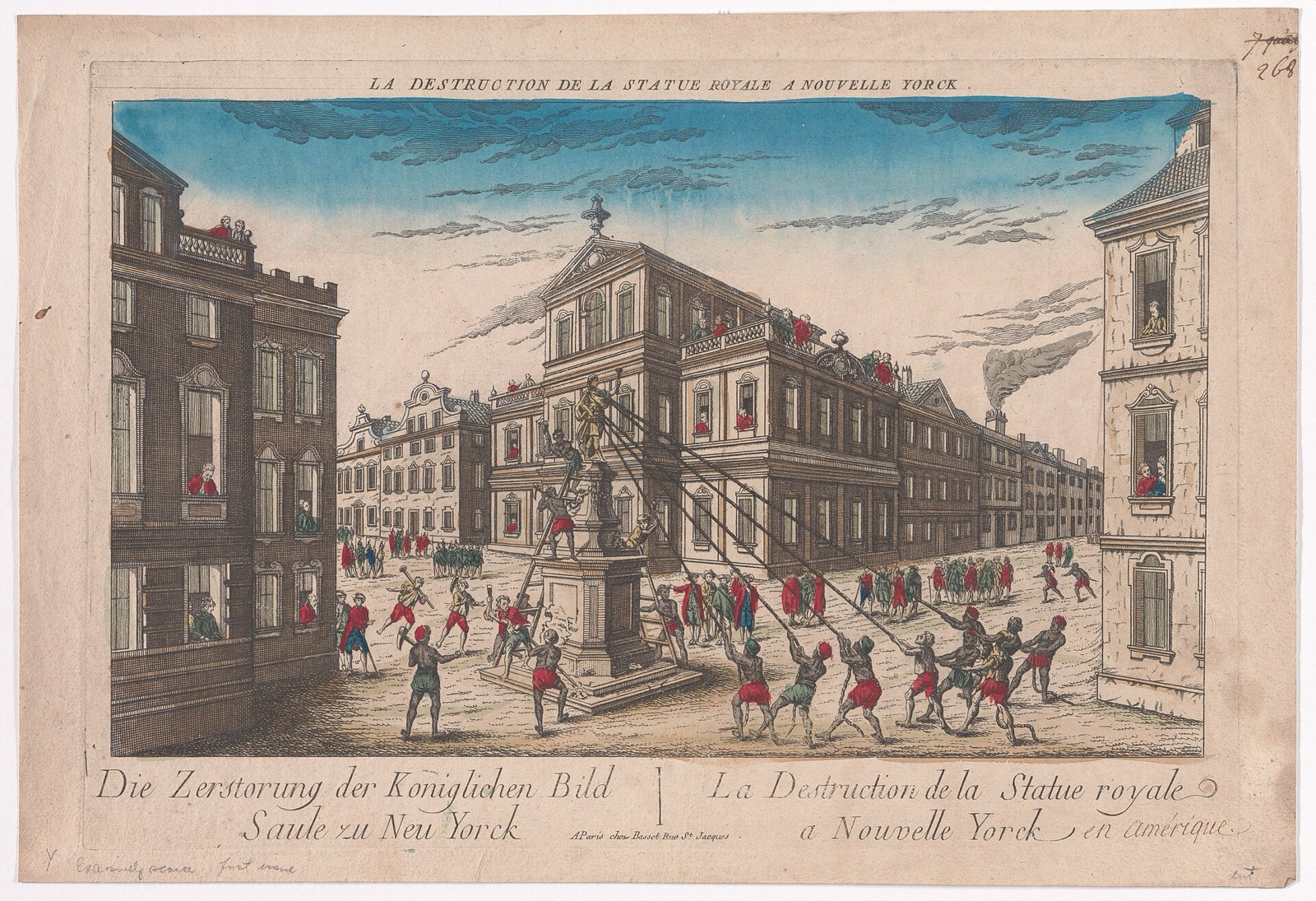
What the family quarrel had become in Philadelphia reached the army on July 9, when Washington had the Declaration read aloud to the assembled brigades at six in the evening. Until that week a Continental soldier could tell himself he was a loyal subject pressing a grievance. After it, in the cold eye of British law, he was a traitor with a gun in his hand, and the penalty for that was the rope. The men did not stop at listening. That night a crowd of soldiers and civilians swarmed Bowling Green, threw ropes around the gilded lead statue of George III that had stood there on horseback since 1770, and pulled the king down. They sawed off his head. Most of the four thousand pounds of lead went north to Connecticut to be melted into musket balls, tens of thousands of them, the king's own image fired back at his army. Three days before, on July 12, two British warships, the Phoenix and the Rose, had run up the Hudson past the American shore batteries as if they weren't there, shelling the city to prove the point that would shape the whole campaign: the water was Britain's. The king's statue came down in the same week the king's navy showed it could sail wherever it pleased, and the same harbor held both the cheering crowd and the warships' wakes. Washington publicly disapproved of the disorder while making no secret of approving the sentiment behind it.
Off the fieldThe idea of independenceA continent away, in a city none of these men were thinking about, the cause's first lifeline to Europe was already being knotted. Silas Deane, the secret envoy Congress had sent off in the spring, reached Paris on July 8, 1776, days ahead of any word that independence had even been declared, so that the man sent to win France a country did not yet know there was one. Within days he was meeting the French foreign minister, the Comte de Vergennes, who authorized arms and steered Deane toward a curious partner: Beaumarchais, the playwright who had written The Barber of Seville and who was now running a fake trading company called Roderigue Hortalez and Company, funded with a million livres out of the French treasury and later matched by Spain, all of it built to slip weapons to the Americans without France having to admit it. The same days the largest fleet in British history was filling New York harbor, the back door to the French treasury was already swinging open in Paris, and neither end of it could see the other.
The peace offer arrived folded into the same churn. Lord Howe opened with conciliatory letters addressed to "George Washington, Esq." Washington's staff refused to receive them. No rank, no recognition, no talks: to accept a letter that left off his title was to accept that he led a mob and not an army, and he would not.
A more impudent, false and atrocious Proclamation was never fabricated by the Hands of Man. — Ambrose Serle, secretary to Lord Howe, on the Declaration, 1776
Long Island and the escape
The blow fell on the army's left. Beginning August 22, Howe ferried troops from Staten Island across to Long Island, landing around Gravesend Bay, and by the 26th more than twenty thousand British and Hessian soldiers were ashore facing the American forward lines on the wooded ridge called the Heights of Guan, out in front of the main fortified camp at Brooklyn Heights (the high ground directly across the East River from the city). Four passes cut through that ridge. The Americans guarded three of them and left the easternmost, Jamaica Pass, watched by just five mounted militia officers. Local Loyalists told the British general Henry Clinton the road was open. On the night of August 26, Clinton, Lord Cornwallis, and Howe led a column of some ten thousand men through it in silence and came out at dawn behind the American left. That is the worst place an army can be caught: hit from the front and the rear at once, the men in front cannot fall back without running into the enemy now behind them, and the whole line folds in on itself.
The American forward line came apart into rout. Two generals, John Sullivan and William Alexander (called Lord Stirling), were both captured. The dispositions that lost the battle, an unwatched pass and a force divided with a river at its back, were Washington's own, and they cost him a third of his forward strength before noon. This was not Howe outwitting a fool; it was a green commander making green mistakes in front of the best army in the world.
One stand bought the rest of the army its life. Covering the retreat near the Old Stone House at Gowanus, Lord Stirling threw the rear guard of the Maryland battalion at the advancing British again and again. Tradition remembers them as "the Maryland 400," though the contingent was really nearer two hundred and sixty or seventy men, and most of them, roughly two hundred and fifty-odd, were killed or captured in those charges. A handful cut their way back. Watching from the heights, Washington is said to have cried, "Good God, what brave fellows I must this day lose!" The line is traditional rather than something we can prove he said in the moment, but the sacrifice it honors was real, and it held the road open long enough.
The full bill, again in ranges, came to something like three hundred Americans killed and well over a thousand captured (Howe reported more than a thousand prisoners), against British and Hessian losses of roughly three hundred and seventy to four hundred. Trapped against the East River, the army should have been finished. But Howe, with the lines at Brooklyn Heights in front of him, did not storm them. He halted and began the slow work of a siege instead. He had been at Bunker Hill; he remembered what storming dug-in Americans cost, and he chose patience. Whether that patience let the war slip away from Britain is one of its great unanswerable questions.
It gave Washington a night. On the night of August 29, with a storm keeping the Royal Navy out of the East River, he evacuated the entire trapped army, about nine thousand men with their field guns, horses, and baggage, across the mile-wide river in the dark. The boats were rowed in near silence by Colonel John Glover's Marblehead regiment, Massachusetts fishermen and sailors who knew water the way the rest of the army knew dry land. Toward dawn a heavy fog rolled over Brooklyn and hid the last boatloads, Washington among them, crossing with the rear. When the British walked into the lines in the morning they found the campfires still burning and no one in them, the trenches empty, an army that had been beaten and surrounded gone across a river in under thirteen hours without losing almost anyone doing it.
The BattlesLong Island: the full battle storyThe fall of New York
Before the next blow, the peace commissioners tried once more. On September 11, Lord Howe sat down with a delegation from Congress, Benjamin Franklin, John Adams, and Edward Rutledge, at the Billopp House on Staten Island. It collapsed in about three hours on the same flaw built into the whole mission: Howe could not treat with the representatives of an independent country, and the delegates would not crawl back into being subjects. The exchange that survives catches the sadness of it. Howe said that if America fell he would feel it like the loss of a brother. Franklin answered that the Americans would do their utmost to spare his lordship that mortification.
Four days later the navy put men ashore on Manhattan's east side at Kips Bay under a shattering broadside, and the Connecticut militia holding the bank broke and ran without firing a real shot. Washington galloped into the stampede and tried to stop it, by several accounts in a white fury, striking at fleeing men with the flat of his sword, riding so far forward he nearly let himself be taken. It did no good. The army gave up the city and pulled north to Harlem Heights, and Kips Bay stood as one of the most humiliating mornings of the whole war.
The next morning recovered something. A dawn scout under Lieutenant Colonel Thomas Knowlton, whose rangers numbered around a hundred and twenty, ran into British light infantry north of the city. The British chased them downhill with contempt; the Americans heard their buglers sound a fox-hunting call, the note used to signal a fleeing fox, and understood the insult. Washington turned the contempt into a trap. He sent a force around to come in behind the pursuing British and pin them between two fires; the flanking move sprang too early, but his men drove British regulars back across open ground anyway, the first time this army had ever watched redcoats give way in front of it. Knowlton was killed in the fight. The Virginia troops who had run at Kips Bay stood and fought at Harlem Heights, and that, more than the ground gained, was the point.
Days later the city burned. On the night of September 20, fire broke out in lower Manhattan and ate through something like a quarter of the built town, with estimates of the destruction running from four hundred to a thousand buildings (one careful count puts it near four hundred and ninety-three). Whether someone set it has never been settled. The British and many Loyalists were certain rebels had torched the city; people pointed to multiple separate fire-starts and to fire-fighting equipment that had been sabotaged, and recent scholarship has taken the arson case seriously again, while other historians hold that no specific accusation has ever held up. Washington, who had been forbidden by Congress to burn the city, wrote slyly to a cousin that "Providence, or some good honest fellow, has done more for us than we were disposed to do for ourselves." No one was ever convicted, and the question is genuinely open to this day.
Into that smoking city the British dragged a prisoner. Nathan Hale, a 21-year-old Connecticut captain from Knowlton's Rangers, had been caught behind the lines in civilian clothes with notes in his possession, the marks of a spy. He was hanged without trial on September 22, 1776. The line every schoolchild learns, "I only regret that I have but one life to lose for my country," needs its chain told honestly, because it is secondhand and late: it comes through Captain William Hull, who was not there, reporting what the British engineer John Montresor, who was there, told him the next day under a flag of truce, and Hull only published it decades later, in 1848. A British officer's diary written the same day records Hale dying with great composure and saying it was the duty of every good officer to obey his commander in chief and to be ready always to meet death. Brave words, but not the famous ones. The composure is documented; the immortal sentence is tradition, possibly polished in the retelling, plausibly rooted in something he really said.
Then Howe pressed his advantage by water again. He slipped up Long Island Sound and landed near Pell's Point, in Westchester north of the city, where Glover's brigade fought a sharp delaying action on October 18 that bought time. He pushed on toward White Plains, also north of the city in Westchester, where after hard fighting the British took Chatterton's Hill on the American right and Washington withdrew north once more. Howe turned back toward Manhattan, and there he collected the campaign's worst American disaster.
Fort Washington was the last American post on Manhattan, a hilltop earthwork whose garrison (the troops posted to hold it) numbered some three thousand men under Colonel Robert Magaw. On November 16 a converging assault closed in on it from several sides, the Hessians under General Knyphausen taking the bloodiest sector. The Hessians were the most professionally drilled soldiers in the attacking column, lifelong regulars, and they came up the slope in close order under fire and took the works. The cost was staggering: around fifty-nine killed, ninety-six wounded, and 2,837 men captured, along with the guns and the stores. The failure was Washington's as much as anyone's, and the chapter owes it to him to say so. He had leaned toward abandoning the fort and written as much to General Nathanael Greene, leaving the decision to him; Greene argued the fort could hold and should be held, and Magaw agreed, and Washington, on the ground in the final days with the authority to overrule them, did not. Most of those 2,800 prisoners went into the prison hulks and sugar-house jails of occupied New York, rotting ships and converted warehouses where the majority of them would die of disease and starvation over the months that followed, a horror the war's prisoner story takes up in full later on. Among the defenders was Margaret Corbin, who took her dead husband's place at his cannon and was herself badly wounded, the first woman to receive a pension from the United States for military service.
Four days later it got worse. Cornwallis crossed the Hudson with about five thousand men, scaled the Palisades (the sheer rock face on the New Jersey side of the Hudson), and Greene barely got the garrison out of Fort Lee on the Jersey shore, abandoning the cannon, the tents, and the stores. Then came the long retreat, southwest across all of New Jersey, Newark to New Brunswick to Princeton to Trenton, the army shrinking the whole way as one-year enlistments ran out and men simply went home. From thousands it dwindled to perhaps three thousand fit for duty by the time it crossed the Delaware into Pennsylvania around December 7, seizing or burning every boat for some seventy miles of riverbank so the British could not follow. Howe strung winter garrisons across New Jersey and settled in for the season. Marching in that miserable column, scribbling as he went, was a recently arrived English pamphleteer named Thomas Paine, whose Common Sense had argued the colonies into independence that winter and who was now working on the words that would put the bottom under the falling cause.
The occupied zone
In the same county, in the same season, a man might be jailed for his loyalty to the King or take up a musket for him, depending only on who held the ground that week. That is what conquest did to New Jersey through the winter of 1776, and it is the truest picture of what this war was underneath the battles: not two armies but a countryside turned against itself, every farm forced to bet on which way the line would move.
With New Jersey overrun, the Howe brothers played their reconciliation card. On November 30 they proclaimed a free pardon and royal "protection" to anyone who, within sixty days, swore allegiance to the King. Takers got a certificate promising protection to "himself, his family and property." By the Howes' own count, and the count is theirs, not a neutral tally, something like four thousand people took the oath by the end of December, around twenty-seven hundred of them in New Jersey alone. Some were men of standing: Richard Stockton, who had signed the Declaration of Independence, gave his parole under duress after being captured, a sworn promise to stop fighting in exchange for his release, though the details of his case are murky. For a few weeks it looked as if the conquest might simply absorb the colony.
The plunder undid it. Both armies stripped the countryside as they passed, but the British and especially the Hessians looted the protected and the neutral right along with the rebel, robbing the farms of the very people who had just sworn loyalty to get a paper that was supposed to stop exactly that. A British officer riding through it that November watched it happen and saw what it would cost. "The Country all this time unmercifully Pillaged by our Troops, Hessians in particular," he wrote, "no wonder if the Country People refuse to join us." That is the whole turn of the winter in one soldier's sentence: a man swore the oath, hung the certificate on his door, and a foraging party took his livestock and his fence rails anyway, and the next week he was guiding the militia to the British pickets. Protection papers that did not protect drove the undecided the other way. By late December New Jersey militia were turning out on their own and ambushing British patrols, and a lawless in-between belt was hardening around the occupied zone, the "neutral ground" between the lines that both sides' irregulars would raid for years. American troops plundered too; the difference was that the British had promised protection and then taken everything anyway, and people remember a broken promise.
The crisis of the cause
December was arithmetic, and the arithmetic was extinction. Nearly every Continental enlistment expired on December 31, 1776. This was a one-year army, and the year was up; on January 1 it could legally cease to exist, and the men shivering on the Pennsylvania bank, many of them barefoot, were free to walk home. Congress, reading the same numbers, fled Philadelphia on December 12 for Baltimore, first handing Washington full power to direct the war and, later in the month, sweeping six-month emergency authority that newspapers would call "dictatorial."
The army's most experienced professional removed himself from the board by accident. Major General Charles Lee, an ex-British officer openly contemptuous of Washington, had spent weeks dawdling instead of bringing his division to the Delaware. On the morning of December 13, having lodged carelessly three miles from his own troops at Widow White's Tavern in Basking Ridge, he was seized in his dressing gown by a British cavalry patrol (a young officer named Banastre Tarleton rode in it). That very morning he had been writing to a fellow general, Horatio Gates, that "a certain great man," meaning Washington, was "most damnably deficient." Contemporaries thought losing Lee was a catastrophe. Most historians since have judged it a quiet piece of luck: his division finally marched to join Washington, and the rival voice forever second-guessing the commander was simply gone.
Then Paine's words arrived. On December 19, 1776, his pamphlet The American Crisis appeared in Philadelphia, eight pages that opened with the sentence that has outlived almost everything else from that winter.
These are the times that try men's souls. The summer soldier and the sunshine patriot will, in this crisis, shrink from the service of his country; but he that stands it now, deserves the love and thanks of man and woman. — Thomas Paine, The American Crisis, 1776
The words reached the camps within days. Tradition says officers read the pamphlet aloud to the regiments the night before the crossing; no one at the time wrote it down. What is not in doubt is how low the cause had sunk by then. Washington himself, writing to his brother on December 18, put it plainly: "I think the game is pretty near up." He told a cousin to be ready to carry his papers out of Mount Vernon. The man who would become the symbol of American victory privately thought, that week, that he was watching the end.
Ten days
He decided to attack. On Christmas night Washington recrossed the Delaware at McConkey's Ferry (on the Pennsylvania bank, Trenton across the river in New Jersey), about nine miles above the town, with some 2,400 men, eighteen guns, and horses, packed into the big black Durham boats that hauled iron ore down the river and rowed, once again, by Glover's Marblehead fishermen who had rowed the army off Long Island and were now back at the oars, straight into a nor'easter of snow, sleet, and grinding river ice. Two supporting columns were meant to cross downstream; the ice beat both of them back, and they never made it, which left Washington's force alone on the far bank, hours behind schedule, the crossing not finished until around three in the morning. The countersign that night, written into the operation's orders, was "Victory or Death."
At dawn on December 26 the two American columns came down on Trenton and hit the roughly fourteen hundred Hessians of Colonel Johann Rall in the teeth of the storm. The fight lasted somewhere between forty-five minutes and an hour. Knox's guns swept the two main streets end to end; a Hessian counterattack into the open broke up under the fire; Rall went down mortally wounded, and the brigade laid down its arms in an orchard. The tally usually given is about twenty-two Hessians killed, eighty or ninety wounded, and some nine hundred captured, with a few hundred slipping away south. American battle casualties were a handful of wounded, among them a young lieutenant named James Monroe, a future president shot through the shoulder.
The BattlesTrenton: the full battle story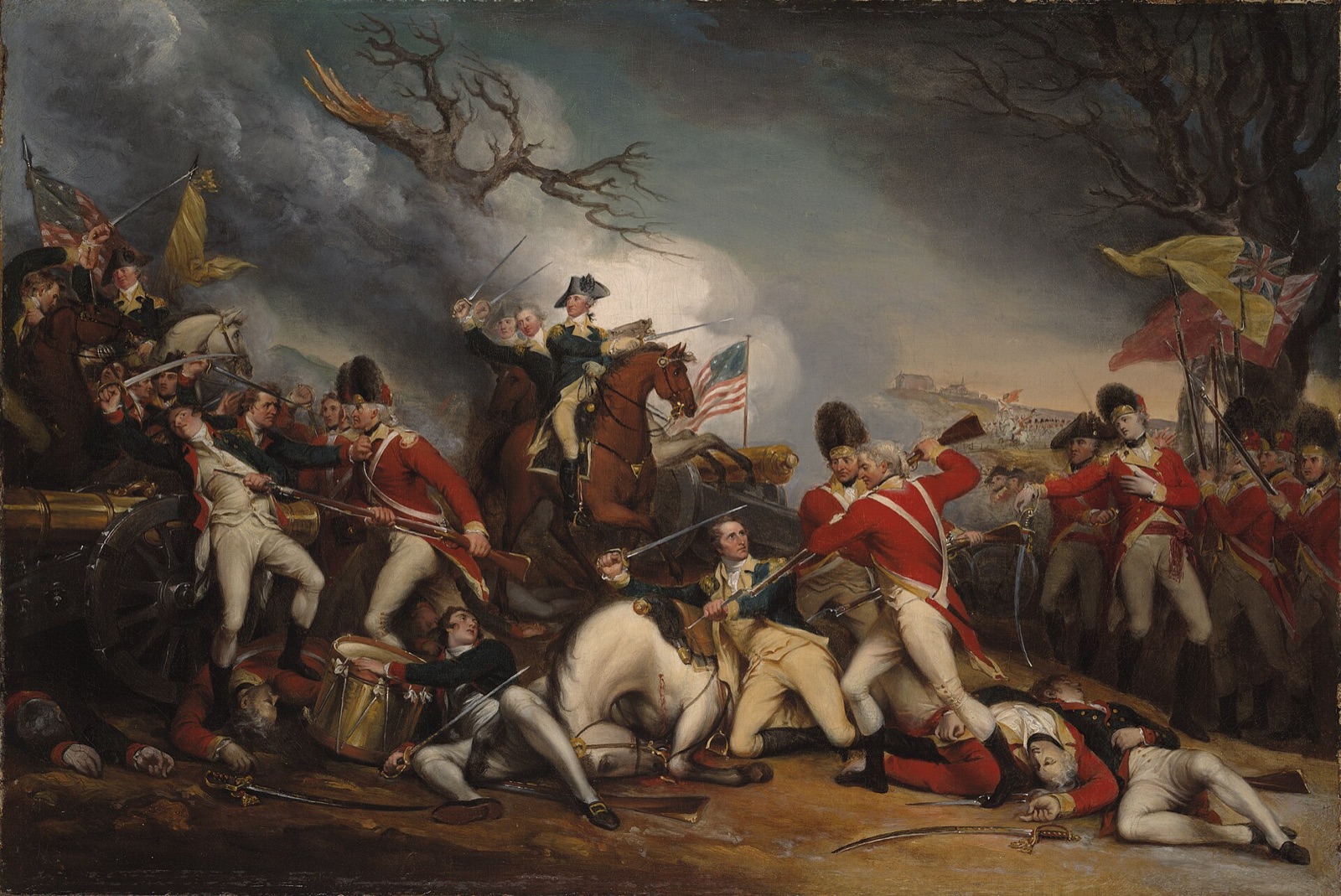
Here a myth has to die, because it has done real damage to how Americans understand that morning. The Hessians were not drunk. The story that they were sleeping off their Christmas wine is false; the careful modern work on the campaign finds no evidence of it. They were the most professionally trained soldiers in the region, and they were exhausted, worn down by weeks of constant militia alarms and night raids, including a skirmish on Christmas night itself. Each alarm meant the whole regiment had to dress, arm, and form up in the cold, over and over, until one more alarm in a blizzard seemed like nothing worth waking the garrison for. The failures were Rall's. He had refused, against orders and advice, to fortify the town, building no redoubts and no works; he treated specific warnings of an attack with public contempt while privately admitting to his superiors that his post was dangerously exposed; and he let his pickets be ground down by the very alarm fatigue that made the real attack feel routine. The story that he died with a Loyalist's unread warning note in his pocket is a later, colorful one, so let it stand as the story goes. What broke the Hessians was not rum. It was a professional garrison run ragged and led carelessly, surprised in a storm.
The week that followed was the hinge. Washington carried his prisoners back across to Pennsylvania, then crossed a third time and stood his ground at Trenton. Here was the gamble laid bare: the army was going to dissolve on December 31 in any case, so there was nothing left to lose by risking it once more. On December 30 and 31, with the enlistments expiring at midnight, he rode along the regiments and asked the men to stay six more weeks for a ten-dollar bounty. A sergeant remembered the scene decades later: the drums rolling for volunteers, no one stepping out, Washington wheeling his horse around to plead a second time, and then the men beginning to step forward one by one. The theatrical version is one old soldier's memory, but the bounty and the mass re-enlistment are solid, and they kept the army alive past the cliff of December 31.
Cornwallis came for him. On January 2 the British general marched some eight thousand men down from Princeton, fought through American delaying actions all day, and at dusk failed three times to force the bridge over Assunpink Creek, the stream that Washington had drawn up his line behind at Trenton. That night Washington left his campfires burning to fool the watchers, muffled his gun wheels, and slipped his whole army around Cornwallis's flank by back roads, marching for Princeton in the dark.
At dawn on January 3 his column ran into British brigades under Lieutenant Colonel Charles Mawhood marching the other way out of Princeton. The American vanguard under Brigadier General Hugh Mercer was overrun in the first shock; Mercer, thrown from his horse and refusing to surrender, was bayoneted seven times and left for dead (he lingered nine days and died). The American line wavered, and Washington rode straight into the gap to steady it, exposing himself to the enemy's fire to do it. Reportedly he called out, "It is a fine fox chase, my boys!" as the British broke, though that line too is tradition. The British line gave way, and the last defenders barricaded in Nassau Hall, the college's main building, surrendered.
The BattlesPrinceton: the full battle story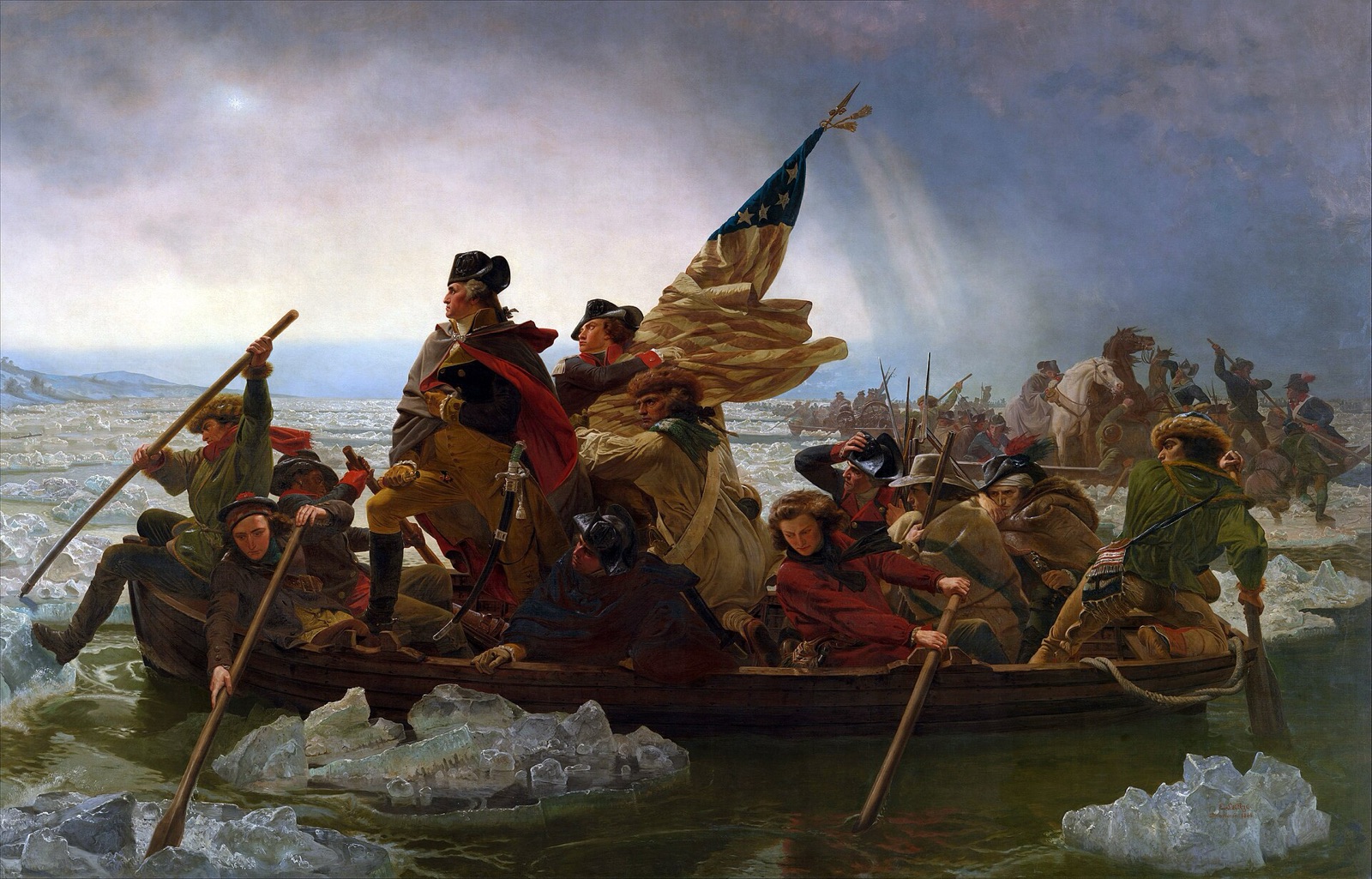
Those ten days, Trenton on December 26 through Princeton on January 3, did not win the war or even the campaign. What they did was reset it. Cornwallis pulled back, and the British grip on New Jersey collapsed to a thin corridor around New Brunswick and Perth Amboy. Washington took the army into winter quarters at Morristown on January 6, and through the cold months a running "Forage War" of militia ambushes bled the British foraging parties and kept New Jersey hostile ground. The army had not dissolved on December 31 after all. The terror of the invincible Hessian was broken. And the thousands who had taken Howe's oath of allegiance found themselves holding worthless paper as the rebels flowed back into the country the British had just abandoned.
By the second week of January 1777 the books closed on a year that had nearly ended the Revolution and instead handed it a future. Deane and Franklin were both in Paris now, and in the French ports the first ships of secret aid were being loaded, muskets and powder and brass field guns that would not land until the spring. New Jersey was rising behind the British lines. And on the Pennsylvania bank the army still existed, three thousand cold men who had agreed, six weeks at a time, to keep being an army. The cause was alive. It was alive by roughly ten days' margin, by a fog on the East River and a storm on the Delaware and a few hundred men who chose to step forward when the drums rolled, and that, in the winter of 1777, was margin enough.