Eight days after Cornwallis handed over his sword at Yorktown, the man who had won the battle wrote his governor to warn him not to celebrate. The danger now, George Washington told Thomas Nelson, Jr., of Virginia, was that a great victory would make everyone relax, and that the relaxing would drag the war out longer than fighting it would. He was right to worry. Yorktown ended a campaign, not a war. Britain still held New York City, Charleston, and Savannah, still held Canada, still had the largest navy on earth and tens of thousands of soldiers in America who had never surrendered to anyone. The Continental Army marched back north and took up its old watch on the Hudson, and for two more years two armies sat staring at each other while diplomats an ocean away wrote and rewrote a peace nobody in the camps had seen. The frontier produced the ugliest year of the whole war in those same two years. The world war kept burning and actually turned Britain's way. A New Jersey militia captain was hanged, and a young British captain drew a slip of paper marked "unfortunate," and a queen of France talked the Americans out of hanging him back. An unpaid army came closer to turning on the government it had created than at any moment of the fighting, and then stood down. The war did not end in a thunderclap. It ended in a long series of leavings, and the people living inside it could not see, until the very last of those leavings, that it was ending at all.
…my only apprehension (which I wish may be groundless) is, lest the late important success, instead of exciting our exertions, as it ought to do, should produce such a relaxation in the prosecution of the War, as will prolong the calamities of it. — George Washington to Gov. Thomas Nelson, Jr., 27 October 1781
The war that would not admit it was over
What the map said in the winter after Yorktown was that the war had years left in it. Britain garrisoned three American cities and most of a continent besides; the king's army in North America had taken a hard blow in Virginia and was otherwise intact. So Washington did the unglamorous thing. He marched his men back up from Virginia to the old lines along the Hudson River, and from the spring of 1782 he kept his headquarters in a stone farmhouse at Newburgh, New York, with the army cantoned a few miles south at New Windsor, within a long day's ride of the British lines around New York City. There the two armies sat, facing each other across a no-man's-land, for two more years.
The waiting had a texture, and the texture was the story. There were no more great battles in the north after Yorktown. Instead there were forage raids and whaleboat fights on Long Island Sound, sniping along the lawless strip of Westchester County that both sides called the neutral ground, the contested country between the lines where neither army held the ground and armed bands robbed whoever was left, and in the camps the long grind of drill, court-martial, and rumor. Every packet ship that crossed from Europe carried a new version of the peace, and none of them carried the peace itself. An army with an enemy in front of it and nothing to do but wait is an army with time to think, and what these men had most to think about was that they had not been paid.
The enemy across the lines changed its face and then its orders. Sir Guy Carleton arrived at New York in early May 1782 to replace Henry Clinton as the British commander-in-chief, and he came with instructions to stop fighting an offensive war and start preparing to leave. London had decided to quit (why it decided, and how the negotiation went, belongs to the story of the treaty itself). What the wind-down looked like from the American lines was the raids slackening, and then letters arriving from Carleton that proposed to treat the war as something already ending. Washington's posture never changed. He had said it to Nelson the week after Yorktown: do not believe it is over until it is signed.
Off the fieldThe Treaty of ParisThe frontier's worst year
For the Ohio and Kentucky country, "after Yorktown" meant nothing at all.
Five months after Cornwallis gave up his army, Pennsylvania militia under Colonel David Williamson rode to the Moravian mission town of Gnadenhutten on the Muskingum River in Ohio, where unarmed, pacifist Christian Delaware (a Native nation, converts who had taken no side in the war) were living, and on 8 March 1782, the militia having taken the town the day before, murdered ninety-six of them, men, women, and children. No one was ever punished for it. The full story belongs to the history of the Native nations in this war; the fact that matters to the shape of the war is the date.
Five months after that, Kentucky had its own disaster. On 19 August 1782 a force of British rangers and allied Wyandot and Shawnee fighters, pulling back from a failed raid on a settlement called Bryan's Station, let themselves be followed by about 182 pursuing Kentucky militia and baited them across the Licking River at a salt-lick ford. Daniel Boone, the famous frontiersman, was there as a militia officer, and he warned that the ground was an ambush. Hugh McGary spurred his horse into the ford anyway and called on every man who was not a coward to follow him (the words are tradition; the phrasing shifts from teller to teller). The trap closed in minutes. Of the roughly 182 men engaged, somewhere between seventy and seventy-seven were killed, about four in ten, including the colonels John Todd and Stephen Trigg. Among the dead was Boone's own son, Israel, shot down in the rout near his father. By the family's accounts Israel was twenty-three that summer, had been ill, and had refused both to stay home and to take a horse out of the rout, but those details come down through the family; the verified core is plain enough. Boone warned against the crossing, fought in it, and had to leave his son's body on the field, returning later to bury him. Blue Licks is often called the last battle of the Revolution. It was not quite, George Rogers Clark burned the Shawnee towns in retaliation that November, but it was among the last.
The peace being drafted in Paris had nothing in it for this war. The men fighting it were not at the table, and most of them were never even told it existed.
The global last acts
The same spring the land war in the north went quiet, the sea war produced two of the biggest battles of the age. On 12 April 1782, in the Caribbean near Guadeloupe, the British admiral Sir George Rodney shattered the French fleet of the comte de Grasse, the same admiral whose ships had sealed off Yorktown six months earlier and made the surrender possible. De Grasse's flagship, the Ville de Paris, struck her colors with the admiral still aboard; about five French ships were taken or destroyed; and the planned French and Spanish invasion of Jamaica died in the water with them. The man who had won Yorktown's sea-lock spent the next two years a prisoner-guest in England. The news reached Europe just as the peace talks were forming, and it stiffened Britain's hand, Britain would grant the Americans their independence while winning its war against everyone else, which is part of why the terms came out the way they did.
Five months later came the war's strangest set piece. Spain and France had been besieging Gibraltar, the British fortress on its rock at the mouth of the Mediterranean, since 1779. On 13 September 1782 they staged their grand assault. They had built ten floating batteries, ship-like structures engineered to be fireproof and unsinkable, with soaked timber, sand-packed hulls, and water-circulation systems plumbed through them, carrying roughly 5,260 men and well over a hundred heavy guns, and they anchored them off the fortress walls while an army waited ashore to march in over the rubble. Spectators crowded the Spanish hills to watch the Rock fall, tens of thousands of them, by some accounts as many as eighty thousand, including French princes. The British garrison under General George Augustus Eliott answered with red-hot shot, cannonballs heated in furnaces until they glowed, fired to lodge and smolder inside the "unburnable" hulls. By midnight the batteries were burning like torches on the water, visible from the hills where the crowd had come to watch the Rock fall. By morning all ten were destroyed, and British gunboats rowed into the inferno to pull some 350 enemy survivors out of the water. The assault cost the allies somewhere around fourteen to fifteen hundred men, and it decided the siege, though the siege itself dragged on formally until the peace. Eighty thousand people had come to watch the Rock fall, and it did not fall.
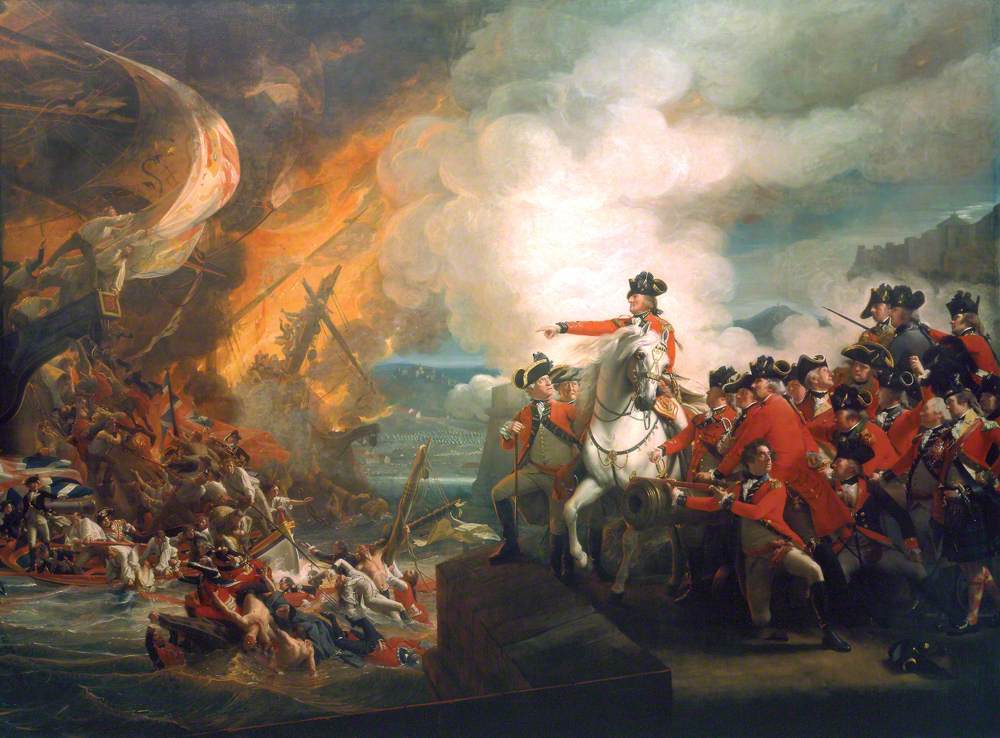
So 1782 at sea and abroad came out as a stalemate everywhere at once. Britain was winning in the Caribbean and at Gibraltar and holding in India; France and Spain were unbroken but out of winning moves; America could not touch the British garrisons sitting in its own cities. Nobody could deliver a knockout, and everybody was running out of money and reasons to keep paying for the war. Every party at the table now had better reasons to sign than to keep fighting.
The South winds down
While the north waited, a third American army was still in the field, and miserable. Nathanael Greene, the general Washington had sent south to recover the Carolinas, spent 1782 penning the British garrison into Charleston, South Carolina: his men unpaid, half-fed, sick with malaria, at times near mutiny. The fighting that was left was a war of patrols in the lowcountry heat, foraging skirmishes over rice boats and cattle and picket lines, the kind of fighting that kills men in ones and twos for ground that is about to be abandoned anyway.
It killed John Laurens that way. Laurens, a young South Carolinian who had been one of Washington's closest aides and who had spent the war pressing his state to raise regiments of enslaved men with their freedom as the bounty (that fight belongs to the larger story of slavery and the Revolution), rose from a sickbed on 27 August 1782 to join a small operation against a British foraging party on the Combahee River. He led a charge against a prepared position and fell in the first volley, twenty-seven years old, nearly a year after Yorktown and weeks before the British left his state for good. His own father, Henry Laurens, was in Europe that same season helping to negotiate the peace that would make the death pointless. Washington's verdict, written later, was that Laurens "had not a fault, that I ever could discover, unless intrepidity bordering upon rashness could come under that denomination; and to this he was excited by the purest motives." Greene's was blunter: that he had died in "a paltry little skirmish." It was not a martyrdom. It was a waste.
The South's war ended not in battles but in two departures by appointment. On 11 July 1782 the British garrison marched out of Savannah, Georgia, and sailed for New York and St. Augustine, and Anthony Wayne's Continental regulars took possession for Georgia's restored government; with the garrison went Loyalist families and thousands of enslaved people carried off still enslaved. Charleston followed on 14 December 1782, and that leaving was choreographed down to the step. By arrangement between the British general Alexander Leslie and the Americans, the British rear guard marched down to the boats at the morning gun and Wayne's advance followed them in at a deliberate distance, by agreement, no shots fired, with Greene and the governor entering in form later the same day. More than five thousand enslaved people sailed away with that garrison. The war in the South ended as a measured walk a deliberate distance behind a departing enemy.
The war almost eats one more man
In the middle of all this waiting, the war nearly killed one more man for no reason at all, and the way it almost happened, and the way it didn't, is the whole strange logic of the in-between war in one story: the old machinery of retaliation grinding on while the machinery of peace tried to shut it down.
On the same 12 April 1782 that Rodney was shattering de Grasse's fleet at the Saintes, twelve hundred miles away a New Jersey militia captain named Joshua Huddy was taken from British custody in New York by men of the Board of Associated Loyalists (the Loyalist irregular command, Americans who had stayed with the Crown and fought their neighbors) under Captain Richard Lippincott, carried across to the Jersey shore, and hanged. It was retaliation for the death of a Loyalist named Philip White in Patriot hands two weeks before. How White had actually died was propaganda on both sides, and there is no settling it. Pinned to Huddy's chest was a placard that ended "UP GOES HUDDY FOR PHILIP WHITE."
Washington's answer was retaliation in kind, and it took him somewhere the war had so far refused to go. With his officers' unanimous backing he demanded the British hand over Lippincott to be tried; when they refused, he ordered that a captured British captain be chosen by lot and hanged in Huddy's place, the lottery the only instrument the era offered for matching one death to another without naming a man to die. The trouble was that no suitable prisoner could be found who was not protected by the terms of some surrender, and so on 18 May Washington ordered the lot drawn from among the prisoners taken at Yorktown, men explicitly shielded from exactly this by the fourteenth article of the Yorktown capitulation. It was a step over a line the war had held until then, and everyone involved understood it.
On 27 May 1782, at the Black Bear Tavern in Lancaster, Pennsylvania, thirteen British captains drew lots, the slips drawn from a hat by a drummer boy in the standard accounts. The paper marked "unfortunate" came to Captain Charles Asgill of the 1st Foot Guards, nineteen or twenty years old, four months in America before he was captured at Yorktown, heir to a London banking fortune. He was held in New Jersey under sentence of death for five months while the case tangled. Carleton, now the British commander in New York and trying to end the war quietly, court-martialed Lippincott and saw him acquitted, the court finding that he had acted under the Associated Loyalists' orders; Carleton condemned the Huddy hanging and warned that executing a man protected by a surrender would destroy all future confidence in treaties. Washington, boxed in by his own order, with the precedent poisonous whichever way it went, privately looked for a way out while the sentence still stood.
The way out came from a mother and a queen. Lady Asgill, the captain's mother, appealed to the French court, and Louis XVI and Marie Antoinette directed their foreign minister, the comte de Vergennes, to intercede. Vergennes wrote to Washington on 29 July 1782, asking in the monarchs' name for the young man's life, the indispensable ally requesting mercy as a favor. Washington forwarded the letter to Congress, and in early November 1782 Congress resolved to release Asgill, as a compliment to the king of France; Washington sent him his pass, and he sailed for England within the month. The traditional American telling of all this had Asgill kept in gentlemanly comfort and Washington straining every nerve to save him, a story that forgets who ordered the drawing of the lot in the first place. Asgill himself, years later, said otherwise, claiming he had been closely confined and harshly treated, and he credited the French court, and the queen in particular, not Washington's tenderness, for his life. The arc is certain; the texture of his captivity is contested and should be left where he left it, as something he said afterward. What is not contested is that Washington had ordered a treaty-protected prisoner hanged by lot, and that nobody was ever punished for Huddy.
The army's dangerous waiting
The real crisis of these two years was not on the frontier or at sea. It was in the camps on the Hudson, where an army that had won the war was being asked to disband without its pay, and was beginning to wonder out loud why it should.
Washington had no money to give the men, so he gave them an honor instead. From Newburgh, on 7 August 1782, his general orders created a badge for enlisted men and noncommissioned officers, "the figure of a heart in purple cloth, or silk, edged with narrow lace or binding," to be awarded for any singularly meritorious action, its wearer allowed to pass guards and sentries like an officer. In the armies of Europe, medals were for officers. The point of this one was said out loud in the orders: in a patriot army the road to glory was open to everyone. Only three men are known to have received it, all of them Connecticut sergeants, Elijah Churchill and William Brown and Daniel Bissell. Then it was forgotten for a century and a half, until it was revived on 22 February 1932, Washington's two-hundredth birthday, as the Purple Heart.
The honor did not pay the men, and by the winter the men's patience was running out. In March 1783, while the floating batteries at Gibraltar had been ash for six months and the army on the Hudson was still waiting unpaid, an anonymous address circulated through the officers' camp at Newburgh, urging them to an irregular meeting and hinting that an army owed years of back pay should not meekly lay down its arms when the war ended. It was the most dangerous moment of the whole Revolution for the thing the Revolution was supposedly about: a victorious army, armed and unpaid, contemplating its own government. An army that turns on the civil power it serves is how republics die, and for a few March days the men who had fought eight years to make one looked as though they might be the ones to kill it. Washington forbade the meeting and called his own for 15 March. He spoke against the appeal, and then, taking out a letter to read to them, he reached for his spectacles and said, as one of the officers in the room recorded it afterward, that he had grown gray in their service and now found himself growing blind. Captain Samuel Shaw, who was there, wrote that "there was something so natural, so unaffected, in this appeal, as rendered it superior to the most studied oratory; it forced its way to the heart, and you might see sensibility moisten every eye." The officers stood down. The army did not turn on the government it had made. (The machinery behind the conspiracy, and what the whole episode meant, belongs to the story of how that army was built and unbuilt.)
Then the news the camps had been waiting two years for finally came. Word reached America in the late winter of the preliminary articles of peace, an agreement signed in Paris the previous November, binding in intent but awaiting formal ratification. Washington's general orders of 18 April 1783 directed that the cessation of hostilities be proclaimed to the army at noon the next day: a formal ceasefire, which meant the shooting stopped but the war was not yet legally over. The next day was 19 April 1783, eight years to the day after the firing on Lexington green. Nothing in the record says Washington chose the date for the echo. The calendar simply landed there, and that evening the proclamation was read at the head of every regiment.
The army that had held together for eight years came apart on credit. From 13 June 1783 Congress furloughed the war's enlisted men home, sent off on leave in what was, in practice, a mass discharge Congress could not afford to name, with three months' pay in promissory notes that most of them would sell at a discount, because they needed money now and the notes promised it later. Joseph Plumb Martin, an enlisted man who had been in it almost from the start, wrote of the day his regiment broke up, in the memoir he published decades afterward, that "there was as much sorrow as joy transfused on the occasion. We lived together as a family of brothers for several years (setting aside some little family squabbles, like most other families,) had shared with each other the hardships, dangers and sufferings incident to a soldier's life…"
Washington gave the country one last word while he still wore the uniform. On 8 June 1783 he sent a letter to all thirteen state governors, a circular, telling them that winning the war had been the easy part. There were, he wrote, "four things, which I humbly conceive, are essential to the well being, I may even venture to say, to the existence of the United States as an Independent Power": an indissoluble union of the states under one federal head; a sacred regard to public justice; a proper peace establishment; and a friendly disposition among the people toward one another. This was, he told them, "the moment when the eyes of the whole World are turned upon them," and according to the choices the states made now, "they will stand or fall." The general who had spent eight years keeping the army alive was telling the country, on his way out, that the army had only bought it the chance to fail on its own.
The leaving
Through 1783 New York harbor emptied itself northward. Fleet after fleet sailed carrying Loyalist refugees, around thirty thousand to Nova Scotia alone by the end of the year, people who had bet on the Crown and lost and were now leaving the country for good, founding new towns out of the camps. From the American lines the harbor was a year-long parade of other people's endings.
In the same harbor, in the same months, a joint British and American board met every Wednesday at Fraunces Tavern, on Pearl Street, to decide a different kind of ending. Carleton had taken a stand that people freed by British proclamation during the war would not be handed back into slavery, and so the board examined the claims of Black refugees to their freedom and registered the names of those it confirmed, some three thousand of them, in a ledger that came to be called the Book of Negroes, each name a documentary proof of freedom that could protect a person from being claimed as property, before the transports carried them to Nova Scotia. The room where those hearings were held over who owned whom was the same Long Room where, that December, Washington would say goodbye to his officers.
The last leaving in New York came on 25 November 1783, the day New Yorkers would call Evacuation Day, the morning the last British troops left the city for good. It was a cold, bright morning with the timetable agreed in advance. The British troops fell back through the city to the boats, and around midday a cannon shot marked the handover of a city that had been British for seven years, since the autumn the war for New York was lost. Henry Knox led the American advance down from the Bowery, and then Washington and Governor George Clinton rode in at the head of a column of soldiers and a crowd of citizens. The city they came into was scarred, burned-over districts from the great fire of 1776, wrecked churches, rotten wharves. A woman who watched the entry as a girl remembered it years later: the departing British "were as if equipped for show… with their scarlet uniforms and burnished arms, made a brilliant display. The troops that marched in, on the contrary, were ill-clad and weather-beaten, and made a forlorn appearance; but then they were our troops… and my heart and my eyes were full." The story New Yorkers told for a century afterward was that the departing garrison had nailed the Union Jack to a greased flagpole and cut the halyards, the ropes used to raise a flag, and that a young veteran named John Van Arsdale nailed on cleats, climbed the pole, and ran up the Stars and Stripes before the British fleet had cleared the harbor (the fullest version was written a hundred years later by Van Arsdale's own grandson, and it is best left as the story they told).
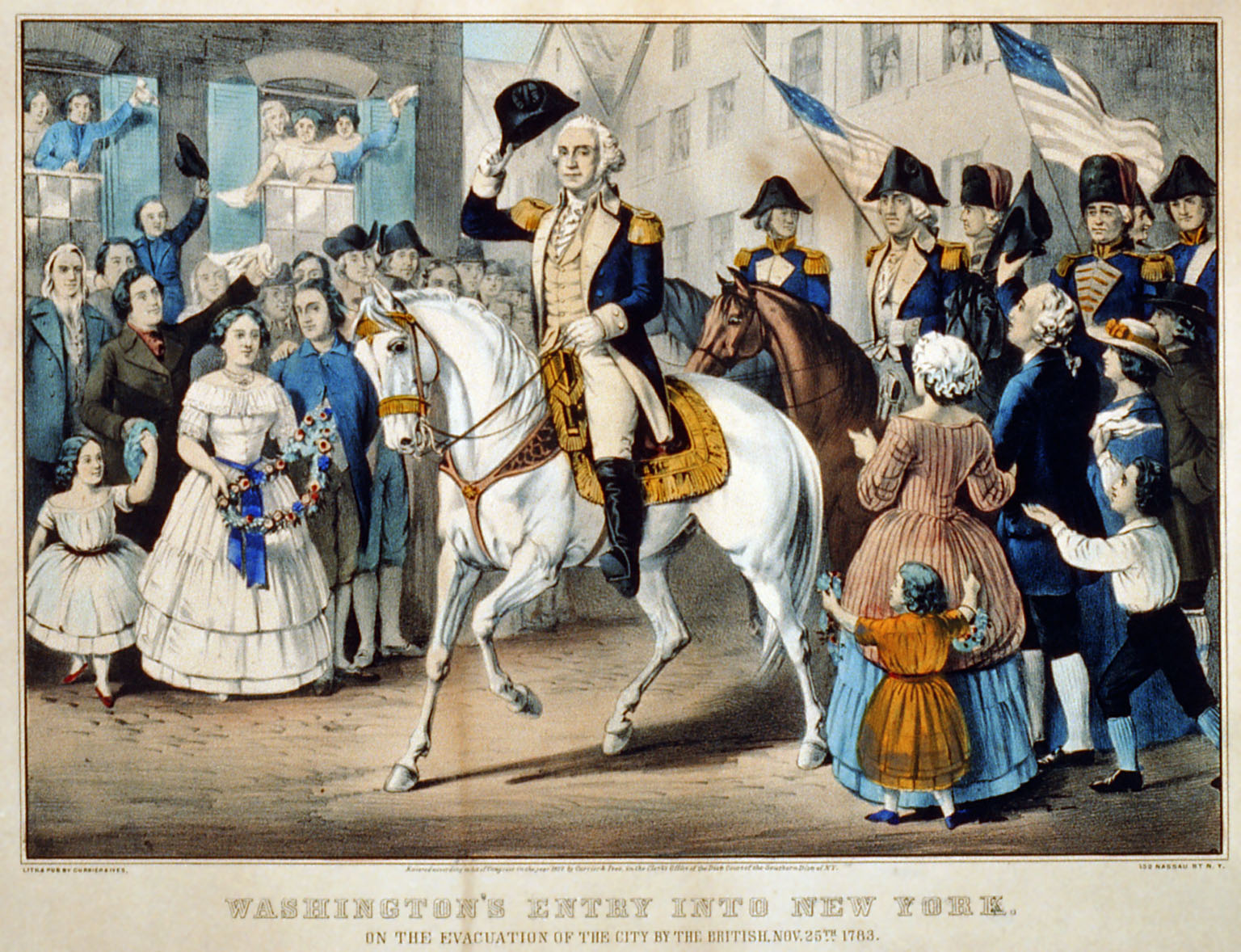
Washington did none of the things a conqueror does. There were no reprisals and no triumph theater. He had one errand left, and he stayed nine days to do it.
The goodbyes
The army got its own farewell first. On 2 November 1783, from Rocky Hill near Princeton, before the last of the men were discharged, Washington issued his Farewell Orders to the armies of the United States. The survival of the cause through eight years, he wrote, "through almost every possible suffering and discouragement," had been "little short of a standing Miracle." And of himself: "The Curtain of seperation will soon be drawn, and the Military Scene to him will be closed for ever."
…the unparalleled perseverence of the Armies of the United States, through almost every possible suffering and discouragement, for the space of eight long years, was little short of a standing Miracle… — George Washington, Farewell Orders to the Armies, 1783
Nine days after the British sailed from New York, on 4 December 1783, Washington took leave of his officers in the Long Room at Fraunces Tavern, the same room that had spent the year hearing claims to freedom. The only firsthand account of what happened there is Colonel Benjamin Tallmadge's, written into a memoir nearly half a century later, in 1830, so it comes to us through one old man's memory of a day long past. By his telling, Washington filled a glass and said, "With a heart full of love and gratitude I now take leave of you. I most devoutly wish that your latter days may be as prosperous and happy as your former ones have been glorious and honorable." Knox, nearest to him, turned; Washington, "suffused in tears," grasped his hand, and they embraced in silence, and then every officer in the room in turn. "Not a word was uttered to break the solemn silence." Most of these were men who had been with him since 1775 and 1776. Then he walked down to the Whitehall wharf between two ranks of his soldiers, boarded a barge, and waved his hat.
From New York to Annapolis the road south became a procession, town by town: escorts of light horse, bells and bonfires at New Brunswick and Trenton, a stop at Philadelphia on 8 December, then Wilmington and Baltimore. In Philadelphia he did one last piece of business that says as much about him as any speech. He sat down with the comptroller on 13 December and settled his wartime expense accounts. He had taken no salary for the eight and a half years of the war, only his expenses, and he had kept the receipts and itemized them to the end, down to the penny, the commander-in-chief of a victorious army closing his books like a clerk. He reached Annapolis, where Congress was sitting, on 19 December, and on 22 December Congress gave him a public dinner with thirteen toasts and thirteen guns.
On 23 December 1783, around noon, in the Old Senate Chamber of the Maryland State House, Washington stood before Congress to give the war back. As he read, his hands trembled, and at the passage about the officers who had served under him he steadied the paper with both hands. He read nine sentences and laid down the commission, the physical document of his appointment as commander-in-chief, that Congress had voted him in June 1775, when the army was militia on a green and he had agreed to command it. "Having now finished the work assigned me," he said, "I retire from the great theatre of Action, and bidding an Affectionate farewell to this August body under whose orders I have so long acted, I here offer my Commission, and take my leave of all the employments of public life." Eight and a half years and three days after he had accepted it, the army that began as farmers on a village green was formally out of existence, and its general was a private citizen on the road home. He left the chamber, mounted, and rode for the Potomac. He reached Mount Vernon on Christmas Eve, home for Christmas for the first time since the war began.
The arc shut
It had started on a green at dawn in April 1775, seventy-odd militiamen in the half-light of Lexington, and it ended with a commission laid on a table in a statehouse in December 1783, and a man riding down the Annapolis road toward home in the cold. In between were eight and a half years and the things this war was made of: a slip of paper marked "unfortunate" that was never used, a pair of spectacles taken out to read a letter, a badge cut from purple cloth for men who could not be paid, a harbor emptying of other people's endings, a tavern room where clerks wrote three thousand names into a ledger of who was free, and a proclamation of peace read to the regiments at noon on the eighth anniversary of the first shots. The man who rode home that Christmas Eve had warned, the week after his greatest victory, against believing the war was over. It had taken two more years to prove him right and then, at last, wrong.