Pollock and the pour
The picture most people have in their heads when they hear “Abstract Expressionism” is one man flinging paint, and the man is Jackson Pollock (1912–1956). He was a Westerner, born in Cody, Wyoming, raised in Arizona and California, and he carried a cowboy-loner persona into the New York art world, romanticizing Native American sand-painting (made by trickling colored sand onto the ground) as a model for an art made flat on the floor. The heavy drinking that would eventually kill him was already part of his life during these peak years, not just at the end. Around 1947 he did something that sounds simple and was not: he took the canvas off the easel and laid it on the floor of his barn studio on Long Island, then walked around all four sides and flung, dripped and poured thinned house enamel from a stick, letting the paint fall in long looping skeins. In his statement “My Painting” he said the floor let him feel nearer the work, able to walk around it and “literally be in the painting.”
Picture the result. Autumn Rhythm (Number 30) of 1950 is almost nine feet tall and more than seventeen wide, a wall of poured and dripped line in black, white and tan, threads crossing and looping over the whole surface. There is no figure, no horizon, no center; your eye cannot rest on a main thing because there is no main thing, the density the same in the corners as in the middle. Critics named it the all-over composition (a picture with no focal point and no hierarchy, the same all the way across, more like a field or a weather system than a scene). One: Number 31, 1950, from the same peak year, is an even denser tangle of black, white and grey drips at the same mural scale.
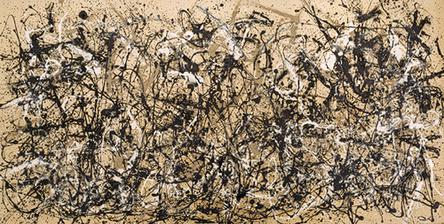
A critic’s word, one wing only
The critic Harold Rosenberg gave this kind of work a name that stuck: action painting. The phrase means what it says: the painting is the record of an action, the physical act of the artist moving and marking, frozen on the surface. The canvas, Rosenberg wrote, had become “an arena in which to act.” Two warnings, both load-bearing. First, it is a critic’s word, coined in 1952, not a name the painters chose; Pollock never called himself an action painter. Second, it describes this wing only. The color-field painters are not action painters, and calling them that gets the whole movement wrong. And the legend oversells the originality: pouring paint had been tried before, and the deeper idea, letting the unconscious and chance compose, came straight from Surrealist automatism. What Pollock did was build a whole new way of painting out of it, at a scale and commitment nobody had matched. That is the claim, and it is plenty.
The Woman, and the girders
The gesture wing was not all abstraction. Willem de Kooning (1904–1997), a Dutchman who had stowed away to America in 1926, kept the human figure when nearly everyone dropped it. His Woman I (1950–52) is a ferocious, toothy, more-than-life-size female figure built of slashing, scraping strokes, the paint dragged and reworked over months until the whole surface looks fought-over. It scandalized both camps at once: the avant-garde thought he had betrayed abstraction by keeping a recognizable woman, traditionalists thought the woman a monstrous insult to painting. He had managed to be figurative and abstract in the same picture, and to make everyone angry, which is one definition of being ahead of your time.

Franz Kline (1910–1962) went the other way, into pure black-and-white abstraction at the scale of a wall. His Chief (1950) looks like a few enormous brush-marks, thick black girders of house-paint crossing a white ground, blown up so large they read like architecture or the skeleton of a bridge. The title is the name of a locomotive Kline knew as a boy, and the pictures have that heavy, mechanical weight, as if a single calligrapher’s stroke had been enlarged until you could walk into it. Pollock’s web, de Kooning’s slashing figure, Kline’s black beams: three painters who agreed only that the act of painting, the gesture itself, was now the thing worth putting on the wall.