Rothko’s rectangles
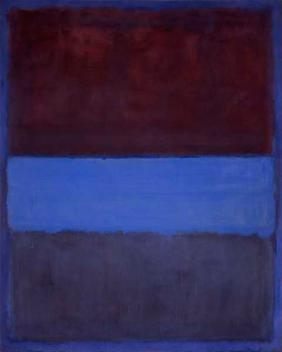
The other half of Abstract Expressionism looks like the calm after Pollock’s storm, and it is just as radical. The color-field painters (the term means painting built from large, simple, mostly unbroken areas of color rather than from gesture or drawing) wanted not the trace of a frantic act but stillness, vastness, and a kind of glow. Their patron saint is Mark Rothko (1903–1970). A mature Rothko is two or three soft-edged rectangles of color, stacked and hovering on a larger field of a different color, the edges feathered so the blocks seem to float and pulse rather than sit flat. No. 61 (Rust and Blue) (1953) stacks a band of rust and a band of deep blue on a brooding grey-mauve field, the kind of layered, smoldering color he meant you to stand inside.
The point was scale and closeness. Rothko made the canvases big and wanted them hung low and seen from a few feet away, so the color fills your whole field of vision and you stand inside it rather than in front of it. He hated being called an abstractionist or a colorist; he insisted his real subject was raw human emotion, tragedy and ecstasy and doom, and that a person who wept in front of his paintings had understood them better than one admiring the color relationships. The rectangles were the door, not the subject. You can read the man straight off the canvas: over the years his palette darkened with his mood, from the glowing orange-and-yellow of the mid-1950s to the near-black of his last work as his depression deepened, so the pigment itself becomes a record of where he was.
Walking away from the money
Two stories show how seriously Rothko meant it. In 1958 he took a lucrative commission to paint murals for the Four Seasons, an expensive restaurant in the new Seagram Building, worked over a year on dark, wine-colored canvases built around looming portal shapes, then walked away from the money and pulled the commission, unwilling to let his art hang as decor for rich diners. He later gave nine of the Seagram murals to the Tate in London, where, by a grim coincidence, they arrived on 25 February 1970, the day he was found dead in his studio, having taken his own life. His final project was the Rothko Chapel in Houston, an eight-sided, octagonal room holding fourteen of his canvases, nearly black, made not as pictures to look at but as an environment to sit inside: a place, not a painting.
The zip and the cliffs
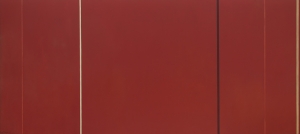
If Rothko was the wing’s mystic, Barnett Newman (1905–1970) was its theorist of the void. His whole art turns on a single device he called the “zip”: one thin vertical band of color running the full height of the canvas, dividing and charging an otherwise empty field. He found it in 1948 in a modest maroon canvas, Onement I, split top to bottom by a single ragged orange stripe (the title is an old root of “atonement,” the state of being made one). The masterpiece is Vir Heroicus Sublimis (1950–51), a vast red field nearly eight feet tall and almost eighteen wide, crossed by a few thin zips, meant to be stood in front of so close it fills your sight. The Latin means roughly “man, heroic and sublime,” and that is the claim: that an abstract American painting could reach the sublime (the old idea of a beauty so vast it tips past pleasure into awe and dread). Newman wrote the wing’s credo in 1948 and titled it, with no hedging, “The Sublime Is Now.”
The most extreme of the field painters, and arguably the first of them to the pure field, was Clyfford Still (1904–1980). He arrived at the large vertical color-field format early, in the early-to-mid 1940s, before either Rothko or Newman had settled into theirs, which makes him a founder of color-field painting and not merely its hermit. His canvases are huge and dark, built from torn, ragged vertical sheets of thick paint that look like cliffs or peeling bark, with bright flashes of color stranded and violent against the charcoal dark, like a torn map of a country that does not exist. He despised the market, hoarded most of his own output, and arranged for it to go to a single dedicated museum (now in Denver) rather than be scattered and sold. Three painters, one wing: Rothko’s floating veils, Newman’s single charged line, Still’s torn cliffs, all aiming at stillness and immensity, the same towering ambition as the gesture painters pointed the opposite way. Not the record of an act. The field itself.