The teacher who let go of the wheel
Most movements grow out of one circle. This one grew out of two, and they did not fully merge until a train wreck and a dead painter pushed them together.
The first circle formed inside the École des Beaux-Arts, the State art school in Paris, in the studio of a teacher named Gustave Moreau. Moreau painted lush, jewel-encrusted mythological scenes that have almost nothing to do with what his students became, and that is exactly the point: he was unusually willing to leave his pupils alone. Where the academy drilled students to sand every brushstroke smooth and copy the approved masters, Moreau told them to go to the Louvre, yes, but also to go look at the street, and to paint how they actually saw. Through his studio in the 1890s passed Henri Matisse, and around him a knot of friends, Albert Marquet, Charles Camoin, Henri Manguin, Jean Puy. These were the patient, schooled half of the future band, men who had been drilled in the academy and were now being quietly let off the leash, as against the self-taught street painters down the river at Chatou. Their wildness, when it came, would be the wildness of trained painters deciding to misbehave on purpose.
A derailment near the river
The second circle had no school at all. In 1900, on a stalled train near Chatou (a riverside town just west of Paris, where the Seine loops through boating country), two young men got to talking after a derailment: André Derain and Maurice de Vlaminck. They took a studio together on the riverbank and painted the Seine side by side. Vlaminck was the opposite of the Moreau crowd, self-taught, broke, a part-time racing cyclist and novelist who was loudly proud of never having set foot in a proper art school and was hostile to museums on principle. Derain was younger, more curious, the one who would eventually carry messages between the two worlds.
The dead Dutchman who lit the fuse
What welded the two circles was a show of a man who had been dead eleven years. In 1901 the Bernheim-Jeune gallery in Paris mounted a retrospective of Vincent van Gogh (a retrospective being a backward-looking survey of a whole career, usually staged after the artist is gone). For the young painters it was a detonation. Van Gogh had used color as raw feeling, a sky clawed in churning blue, a wall slapped down in acid yellow, color cranked far past what the eye reports because the emotion demanded it. Vlaminck came out of that room saying, in his famous remark, that he loved Van Gogh more than his own father. And it was at the Van Gogh show that Matisse met Derain, the introduction that would, four years later, take the two of them to a fishing port and make the movement.
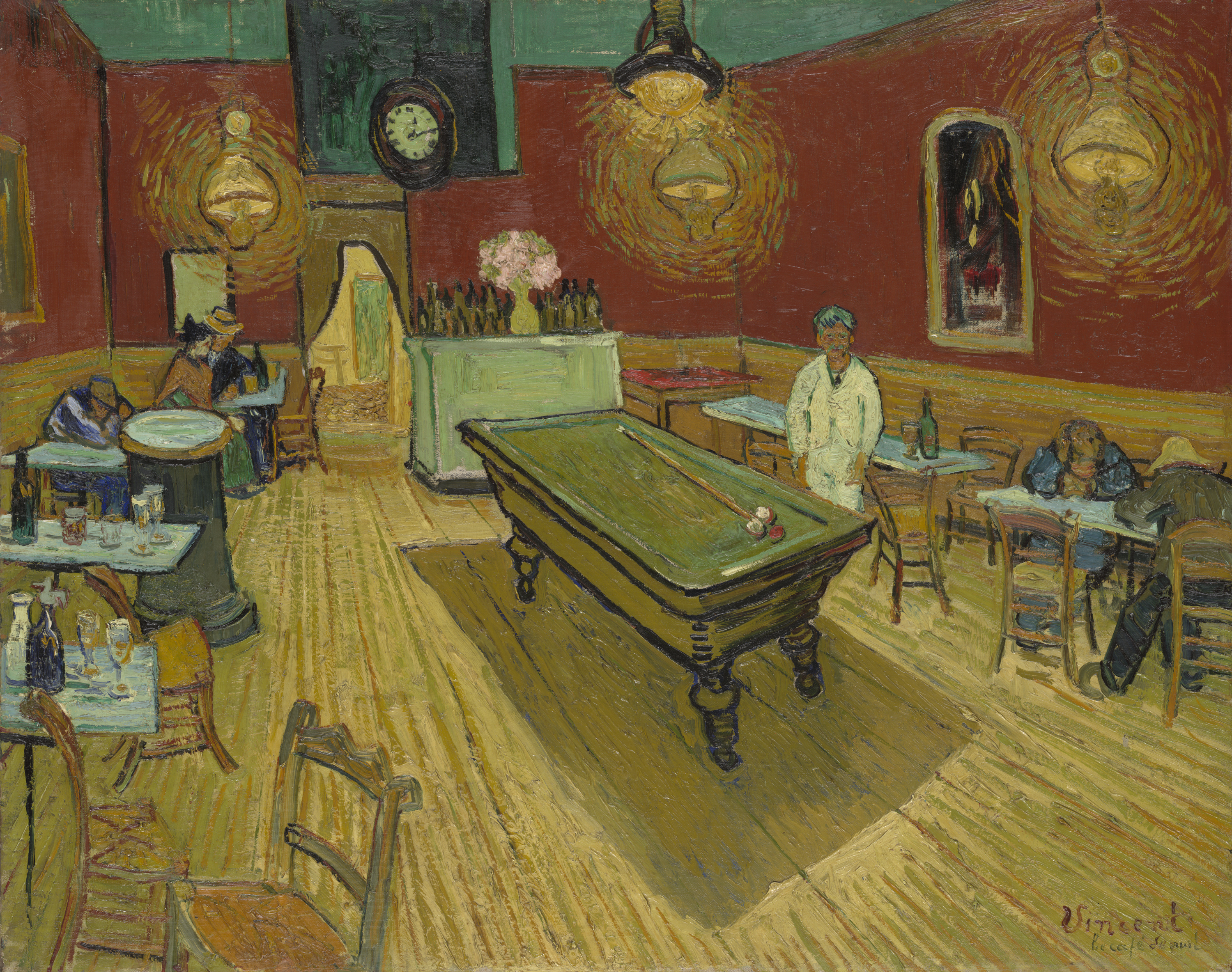
Van Gogh was one of three dead or fading fathers feeding the fuse. The second was Paul Gauguin, who had laid color down in flat unbroken areas of hot, saturated, almost arbitrary hue, a method he called Synthetism(boiling a scene down to a few simplified flat shapes and bold colors rather than copying every detail). Many of those flat-color pictures came out of Tahiti, where Gauguin had gone by way of France’s colonial Pacific empire, painting the islands and their people through a romanticizing, outsider’s lens. It is worth saying plainly, because the Fauves and their admirers rarely did: the “freedom” the young French painters inherited from him as a purely formal trick (color let off the leash) reached them carrying a colonial context none of them named. Gauguin’s flat saturated patches shaped Derain in particular. The third influence was the most disciplined of all, and Matisse went and lived inside it for a summer.
The summer of dots
In the summer of 1904 Matisse went south to Saint-Tropez and spent it with Paul Signac, the surviving champion of a method called Divisionism (the technical name) or pointillism (the nickname that stuck), the system Georges Seurat had invented in the 1880s of building a picture entirely out of small separate dots of pure, unmixed pigment placed side by side so the eye fuses them. Matisse tried it wholesale. The picture that came out, Luxe, calme et volupté (1904), is a beach scene of bathers stippled all over in tidy dots of pure color.
It matters because of what Matisse did next. He kept the lesson and threw away the rule. The lesson was the pure unmixed color, pigment straight and bright, never muddied toward a “realistic” tone. The rule he ditched was the tidy little dots and the patient optical science behind them. What if you kept the pure tube color but laid it on in big, loose, emotional strokes, with no obligation to describe the real light at all? That question is Fauvism, one summer early, still in Matisse’s head. The next summer he took it, and Derain, to the Mediterranean and answered it on canvas.
