MODERN · MOVEMENT · 6 OF 10

Futurism

1909–1918 · ~9 years
Boccioni, The City Rises (detail), 1910 · Museum of Modern Art, New York

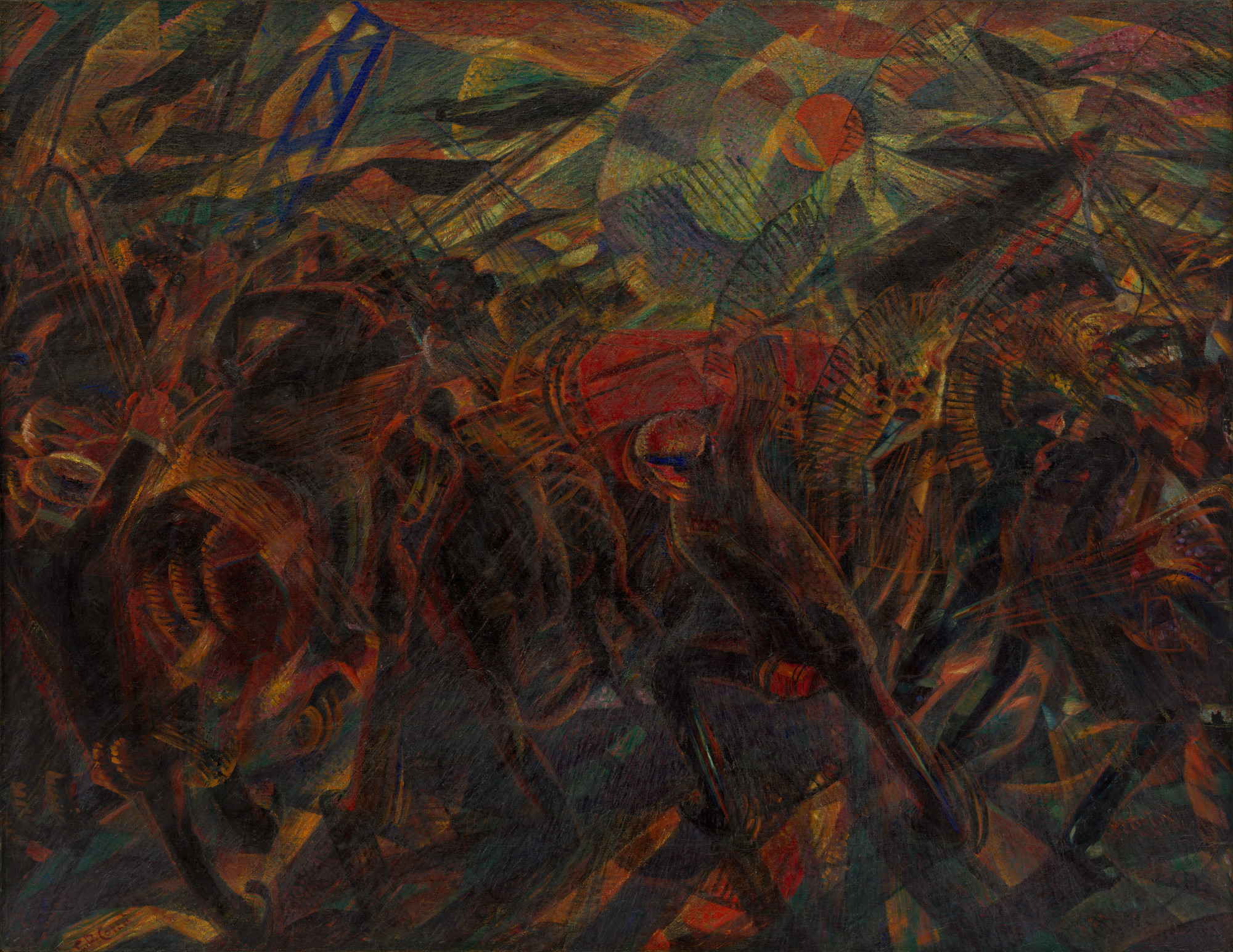
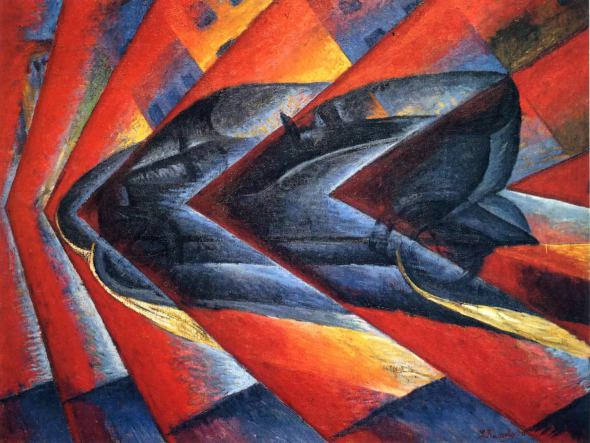
In 1909 Filippo Tommaso Marinetti launched Futurism the way other people launch a product: with a press release. The art came later, when he went and recruited the painters, who then taught Western painting something it had never managed, how to show motion happening over time, the dog’s legs blurred into a fan, the building site churning, the body dissolved into lines of force. Their subject was the machine age at full throttle, the car and the tram and the electric light and the crowd. It is also the movement whose founder glorified war as the world’s only hygiene and went on to help write the founding manifesto of Italian Fascism, so the story has to carry both halves at once.

Read the Futurism story6 chapters · 1909–1918
Why it was a break
vs
Before · Pellizza da Volpedo, The Fourth Estate (1901)
How painting handled a moving crowd: freeze it. The workers stride toward you, but the canvas holds them in one posed, monumental instant, the way a photograph stops a clock. (It is also the Italian Divisionist tradition the Futurists came out of.)
After · Balla, Dynamism of a Dog on a Leash (1912)
What Futurism did instead: a dachshund’s legs and the leash multiplied into a fan of repeated shapes, painting movement happening across time instead of a single frozen instant.

For as long as there had been painting, a picture froze a single instant. A horse, a dancer, a train were each caught in one fixed pose, in one fixed light, the way a photograph stops a clock. Even the most modern pictures, the bright Impressionist boulevards, the wild Fauve colors, the early Cubist still lifes, showed a world that was standing still, however oddly. And the proper subjects of serious art were still the old ones: the nude, the portrait, the landscape, the myth.

Look at Balla’s dachshund instead. The little dog trots along a sunlit path at the end of a lady’s leash, and Balla paints not one dog but the smear of a dog in motion: the four legs multiplied into a blur, the swinging leash repeated into a fan of arcs, the lady’s own feet stuttered into a row of steps. Nothing is frozen. The picture is trying to show the same legs in many positions at once, time itself laid out across the canvas.

Two moves stack to make it. First, the Futurists borrowed Cubism’s trick of breaking an object into faceted planes, but aimed those planes at speed and motion instead of a static studio object; they thought Cubism, for all its cleverness, stood perfectly still. Second, they threw out the old subjects entirely and painted the machine age, the car, the tram, the arc-lamp, the construction site, the rioting crowd, as the only fit subjects for modern art. Motion and the machine become the content.

The manifesto

“A roaring motorcar, which seems to race on like machine-gun fire, is more beautiful than the Winged Victory of Samothrace.”

“We wish to glorify war, the sole cleanser of the world, militarism, patriotism, the destructive act of the libertarian, beautiful ideas worth dying for, and scorn for woman.”

“We wish to destroy museums, libraries, academies of any sort, and fight against moralism, feminism, and every kind of materialistic, self-serving cowardice.”

— Founding and Manifesto of Futurism, Filippo Tommaso Marinetti · 20 February 1909 · front page of Le Figaro, Paris

Most movements get named after the fact, by a critic, usually as an insult. Futurism arrived as a press release. In 1909 a poet who had never picked up a brush bought the front page of a Paris newspaper and announced a movement, then went and found the painters.

The manifesto is gorgeous, brutal, and not safely quotable. It wants to burn the museums; it calls a racing car lovelier than a Greek goddess; and in the same breath it glorifies war as the world’s only hygiene and preaches scorn for woman. Those last lines are not a youthful slip you can skip past. Marinetti meant them.

Ten years later he helped write the founding manifesto of Italian Fascism and served Mussolini for the rest of his life. The manifesto that launched a thrilling revolution in art is the same document that turned art into a recruiting poster for war. Both halves are true at once, and the page below is where you can read it whole.

Read the Manifesto of Futurism (MoMA, Words in Freedom)
How the influence flowed
Grew out of
Italian Divisionism
gave: separated strokes of pure color
Cubism
gave: the fractured, faceted plane
The machine age
gave: the subject, car, tram, electric light
Marinetti’s politics
gave: nationalism and the cult of speed
Futurism1909–1918
Led to
Vorticism
took: machine art and the manifesto (BLAST)
Constructivism
took: the machine and the speed-line
Dada
took: the manifesto as a weapon
Noise music
took: Russolo, sound from the machine age
Futurism grabbed Cubism’s fractured planes and Divisionism’s broken color, taught painting to show speed and the machine, and made the manifesto-launch the weapon of the avant-garde, so that nearly every later movement that announced itself with a printed manifesto is downstream of Marinetti’s Le Figaro stunt.
The details
~9 yrs
First phase
Milan
Centered on
vs
futurists
The Futurists
Marinetti · Boccioni · Balla · Carrà · Severini · Russolo
Not a quiet studio circle but a one-poet publicity machine and the young painters he recruited, united by a single demand: paint speed, the machine and modern life, and do it louder than anyone.
past
The dead weight of the past
The museums · The academies · The Greek statue · The nude
Everything the manifesto wanted demolished: the museums Marinetti called graveyards, the academic ladder, the old subjects (the nude, the myth, the portrait), and the idea that a Greek statue could be lovelier than a racing car.
Meanwhile, elsewhere
Other movements in the same years
1911 · Paris
Cubism
While Marinetti shouts, Picasso and Braque are quietly inventing Cubism a few streets away. The 1911 Paris trip is where the two movements collide.
1914 · Europe
The Great War
Futurism’s worship of speed and violence lands in the exact years Europe arms for the First World War. The Futurists campaigned for Italy to join, then died in it.
1911 · Munich
Der Blaue Reiter
Kandinsky, Marc and Klee push toward spiritual abstraction. Where the Germans sought the inner and spiritual, the Italians worshipped the outer and mechanical.
9 featured works
Canonical works · 27
1910PerfumeRussolo
1910Riot in the GalleriaBoccioni
1910The City RisesBoccioni
1911Le BoulevardSeverini
1911Modern IdolBoccioni
1911MusicRussolo
1911States of Mind: Those Who GoBoccioni
1911States of Mind: Those Who StayBoccioni
1911Street LightBalla
1911The RevoltRussolo
1911The Street Enters the HouseBoccioni
1912Dynamism of a DancerSeverini
1912ElasticityBoccioni
1912Girl Running on a BalconyBalla
1912MateriaBoccioni
1913Dynamism of an AutomobileRussolo
1914Abstract Speed + SoundBalla
1914Interventionist DemonstrationCarrà
1914La Città Nuova (the power station)Sant’Elia
1914La Città Nuova (the stepped house)Sant’Elia
1915Charge of the LancersBoccioni