The train ride that changed the look
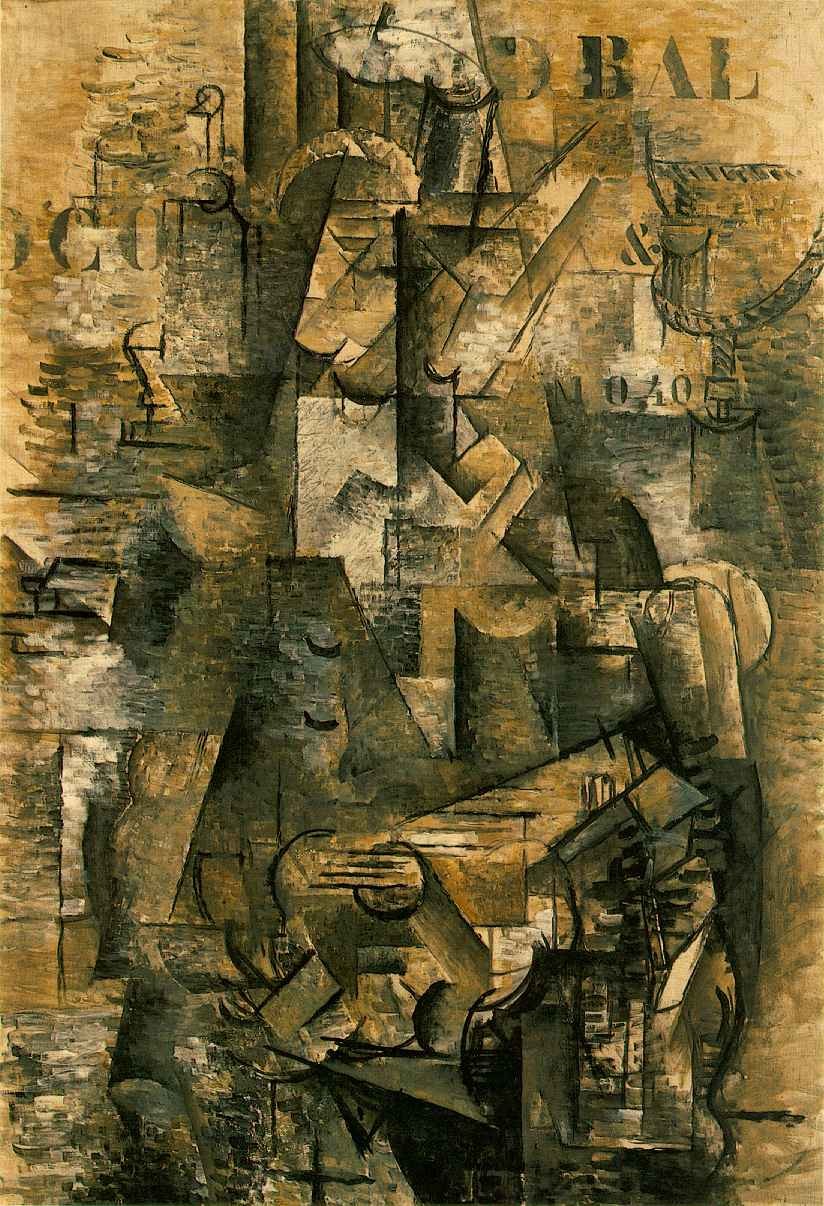
The single most important journey in Futurist history is a train ride to Paris in the autumn of 1911. Severini was the group’s man in France; he actually lived in Paris, among the painters, and he understood that his Milan friends, for all their noise, had not yet seen the most advanced painting in Europe. So he brought Boccioni, Carrà and Russolo to the city and introduced them to Pablo Picasso and Georges Braque, and to Cubism, the movement (covered in full in this era’s Cubism reads) that had found a way to break an object into faceted, overlapping planes and show it from several angles at once.
The encounter rewired them. The Futurists looked at that fractured surface and saw exactly the tool they had been missing. Several of them went home and reworked canvases they had already started, breaking their shimmering Divisionist surfaces into hard Cubist planes. The look of mature Futurism, the thing you picture when you hear the word, is born in the months after this trip.
“Cubism stands still”
But they did not simply copy. The Futurists picked a fight with their own teachers, and the fight is the key to the whole movement. Cubism, they complained, was motionless: it took its broken planes and aimed them at a guitar, a bottle, a newspaper, a person sitting still in a studio. The Futurists wanted to aim the same broken planes at the opposite target. They wanted to use fracture not to anatomize a still thing but to depict motion, the rush and blur of a thing moving through space and time. Same tool, opposite job. The way the Futurists told it, with the swagger they told everything, Cubism had invented a marvelous machine and then wasted it painting a fruit bowl.
So the debt is real and it is large, the biggest single visual debt Futurism owes anyone, and it is only honest to say so plainly rather than pretend the Italians invented the fractured plane. What the Italians added was time. They took Cubism’s still, faceted space and set it spinning.
Futurism goes international
They announced the result with another piece of theater. In February 1912 the First Exhibition of Futurist Painting opened at the Bernheim-Jeune gallery in Paris, one of the city’s leading dealers in modern art, then toured to London, Berlin, Brussels and beyond. It put Futurism in front of the whole international avant-garde at once, and provoked the obvious charge, which was half fair: that the Italians were just Cubist imitators who had arrived late and turned up the volume. The Futurists’ answer was the one they always gave. Yes, we took your planes. No, we are not doing your painting. You froze the world. We are going to make it move.
The tour did real work. The London leg in particular is where Futurism lit a fuse under the English avant-garde: a young painter named Wyndham Lewis saw the show and the noise around it, and within two years he had launched his own hard-edged, machine-worshipping British movement, Vorticism, with a magazine called BLAST (1914). It is the clearest case of Futurism’s most durable export, which was never really a style but a method: the manifesto, the scandal, the touring provocation, copied movement by movement across Europe.
