Boccioni’s The City Rises
Start with the building site. Boccioni’s The City Rises (1910) is his first big Futurist canvas, almost ten feet wide, and it shows the modern city under construction, which is to say it shows the city literally rising. In the foreground a huge red dray-horse, an enormous working draft animal, strains and rears, and around it men haul and heave, and the whole surface, horse and men and scaffolding and dust, dissolves into one churning, swirling surge of labor and energy. You do not read it as a horse and some workers. You read it as force. The subject is not a scene; the subject is the energy of a city being built.
The States of Mind triptych
Then the railway station. Boccioni’s States of Mind (1911) is a set of three panels about a parting at a train station, and it tries to do something almost impossible: to paint feelings as movement. Stand in front of the first panel, The Farewells, and you are inside the goodbye: a steam-choked platform, embracing couples half-dissolved in the churn, and floating through the fog a giant locomotive number stenciled on the side of the engine, a banal stamped numeral turned into the one solid thing in a swimming world. The second panel, Those Who Go, drives the departing passengers into hard slanting streaks, faces and window frames smeared sideways by the speed of the carriage. The third, Those Who Stay, drops into long, sagging verticals, like a downpour of grief. Three kinds of motion for three states of feeling. Emotion painted as direction.

Balla’s dog
Now the famous one, and the easiest to read on a phone. Balla’s Dynamism of a Dog on a Leash (1912), painted while he was staying out in the Tuscan countryside, shows a little dachshund being walked along a sunlit path, and it is the single clearest demonstration of what painted motion even means. Balla does not paint one dog; he paints the blur of a trotting dog, the four short legs smeared into a fan, the swinging leash repeated into a stack of arcs, the lady’s walking feet stuttered into a little row of steps. It is what your eye actually does when something moves too fast to fix, multiplied and laid out on the canvas. A camera could freeze that dog in one crisp instant; what a camera cannot do, and what Balla is after, is to hold all the instants at once. This is the Futurist image that held.
Carrà’s Funeral of the Anarchist Galli
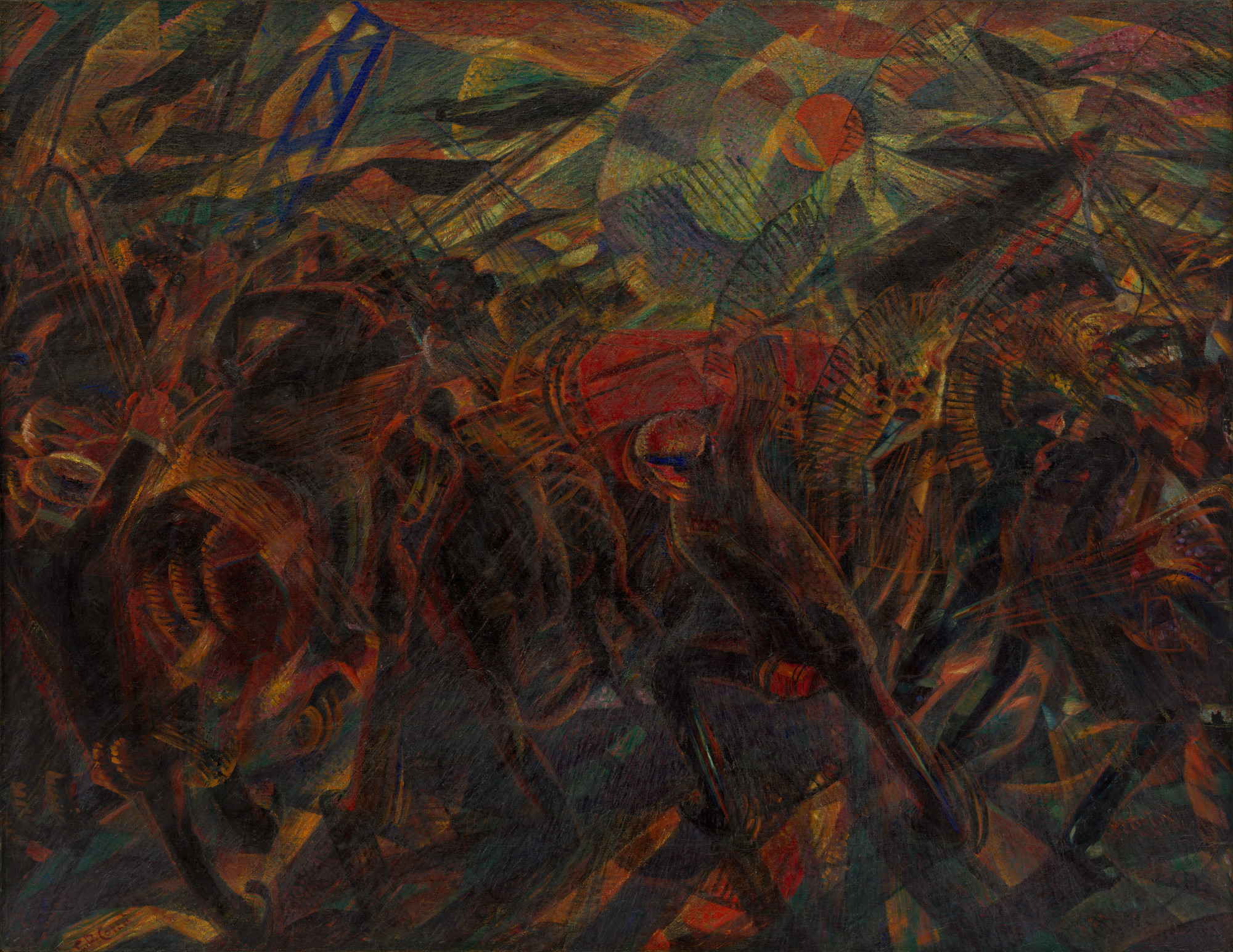
If Boccioni took the machine city and Balla took the trotting dog, Carrà took the mob. His Funeral of the Anarchist Galli (1910–11) paints a real event he had witnessed: the funeral of Angelo Galli, an anarchist worker, which the police tried to break up, so that the mourners’ procession turned into a brawl. Carrà gives you the clash itself, a storm of red flags and black-clad bodies and raised poles, everything tilted and slashing, the violence rendered as so many lines of force crossing and colliding. It is the third of the Futurists’ chosen modern subjects, alongside labor and travel: political violence in the street, painted with the same churning energy as the building site.
The cyclist, and the figure made of wind
Push the idea further and the subject starts to disappear into pure energy. Boccioni’s Dynamism of a Cyclist (1913) takes a man on a bicycle and abstracts him almost out of existence: no clear face, no clear wheel, just a tight knot of slashing blue and ochre wedges leaning hard to one side, the body and the machine and the rushing air fused into one diagonal streak of effort. What you are looking at is a picture made almost entirely of what the Futurists called lines of force, the imaginary lines along which a moving thing’s energy seems to travel and bend the space around it. The man has become his own speed. By the time Balla paints Abstract Speed + Sound (1913–14), even the body is gone; there is no car and no rider left at all, just the swoosh of speed and the wedge of noise it leaves behind.
Unique Forms of Continuity in Space
And then the single most famous Futurist object, which is not a painting at all. Boccioni, never content to stay in one medium, had written a Technical Manifesto of Futurist Sculpture in 1912, arguing that statues too should be opened up and set in motion instead of standing there like polished idols, and Unique Forms of Continuity in Space (1913) is that argument made solid. It is a striding human figure remade as flame and wind made solid, the muscles peeled back and pulled out into wings and ridges of motion, as if the figure were leaving streaks of its own movement in the air as it walked. Italy put it on the twenty-cent euro coin. One honest footnote: Boccioni made the work in 1913, but he made it in plaster, and that original plaster survives in São Paulo, Brazil. Every famous bronze you have seen is a later, posthumous cast, the earliest from 1931, fifteen years after Boccioni was dead. So when people say “Boccioni’s 1913 bronze,” they are using shorthand: the sculpture is 1913, the bronze is posthumous.
