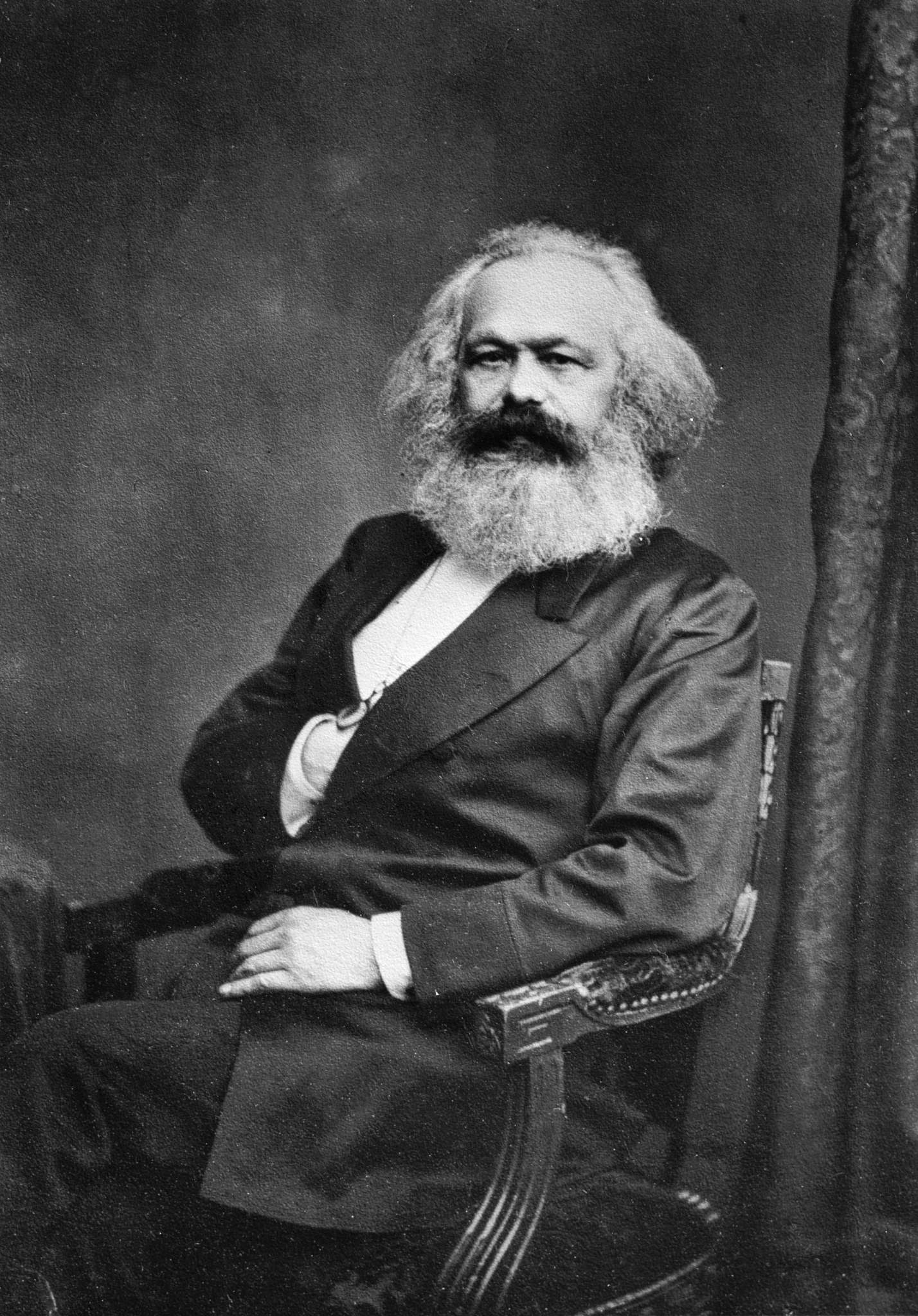
Marx
Hegel had made history the grand self-development of Spirit, ideas working themselves out across the centuries. Karl Marx took that engine, the dialectic, and turned it upside down: it is not ideas that drive material life but material life that drives ideas. The way human beings produce their food, their goods, their shelter, and the classes that grow up around who owns the means of doing it, that is the ground floor of every society, and everything else, its law, its politics, its religion, its philosophy, is built on top and shaped by it. From that one inversion he drew a reading of all recorded history as the history of class struggle; a theory of how wage labor under capitalism leaves the worker estranged from his own product, his own activity, and his own nature; an account of how the market makes human relations look like relations between things (commodity fetishism); and a charge that the ruling ideas of any age are the ideas of its ruling class. He framed the whole project with a single line that is the hinge of his life: the philosophers have only interpreted the world; the point is to change it. He is held here at the altitude of that philosophy, the critique of how societies are actually built and how they actually change, not at the altitude of the states later founded in his name, which did things he did not live to see and did not prescribe.