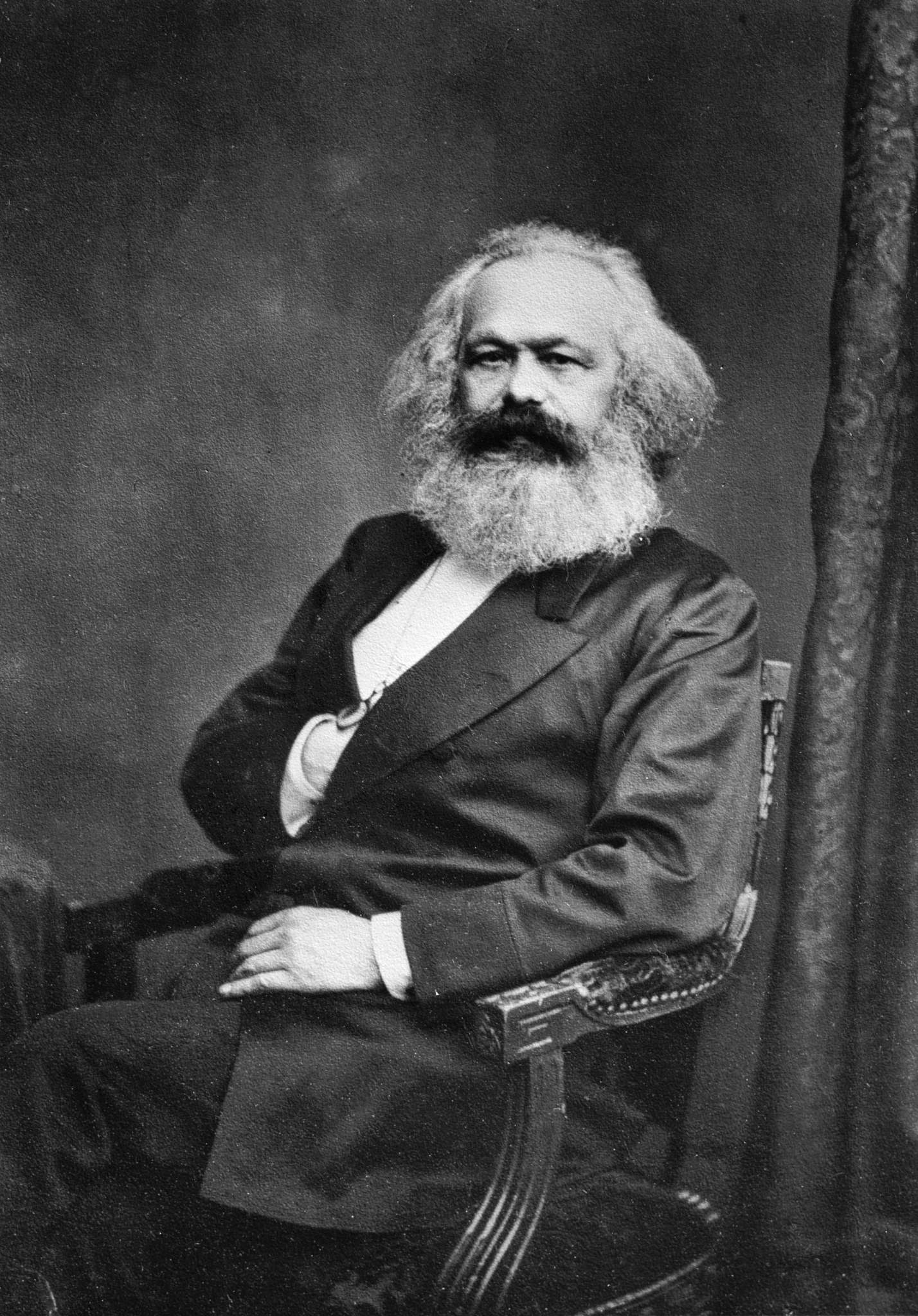
For most of the 1850s and 1860s a stateless German exile walked most mornings from a cramped flat in Soho to the Reading Room of the British Museum, took his seat under the great dome, and read. He read political economy, factory inspectors' reports, Blue Books of parliamentary statistics, the published accounts of mills and mines and the men who ran them. He was poor in a way that is hard to overstate: behind on the rent, dunned by creditors, pawning the family's coats and the children's shoes, burying child after child for want of a doctor and a warm house. He was also, by the standard of sheer ambition, writing the most consequential work of the century. His name was Karl Marx, and the book he was assembling in that reading room was Capital.
He had not started out poor or marginal. He was a doctor of philosophy, a brilliant student of Hegel, a newspaper editor before he was twenty-five. But everywhere he went, his politics got the paper shut down and got him thrown out of the country, until he ran out of countries that would have him and landed in London, the one capital of Europe that did not bother to expel its radicals. There he stayed, for thirty-four years, watched by no police worth mentioning and read by almost no one, grinding out the analysis of the economic system whose engine room, the dark factories of industrial Britain, sat conveniently all around him.
He did not do it alone, and the partnership is one of the most remarkable in the history of thought. Friedrich Engels, the son of a wealthy textile manufacturer, spent twenty years working in his family's firm in Manchester, a business he found loathsome, partly so that he could send Marx the money that kept the Marx household alive. Engels was no mere checkbook. He had written his own searing book on the industrial poor, he argued out the central ideas with Marx in thousands of letters and several jointly written books, and after Marx died he assembled the unfinished second and third volumes of Capital from a mountain of his friend's notes. The standard, self-effacing line came from Engels himself: that Marx was the genius and he the second fiddle. The work is unimaginable without both.
This is the story of what that work claimed. It begins with a young man turning his old teacher Hegel upside down, and it ends with a charge that has not stopped echoing: that philosophy until now had only described the world, and the real task was to change it. In between is a theory of how every human society is built, what industrial work does to the people who do it, why a coat in a shop window can come to seem more real and more powerful than the labor that made it, and whose interests are quietly served by the ideas an age calls common sense. He is taken here as a philosopher, which is what he was trained as and what these ideas are. What was later built in his name is a separate question, and the last chapter faces it squarely.
The break
Hegel's system deserves its full strength before Marx turns it over (the Hegel read walks it whole). Hegel had argued that the deepest reality is not dead matter but Geist, Spirit, a single vast mind-like process coming, over the whole course of history, to know itself. History was not a chaos of accidents; it was rational, a development, the slow growth of the consciousness of freedom, and its driving force was at bottom ideal, a matter of ideas, of self-consciousness, of mind. Material events, wars, economies, institutions, were the outward expression of an inner movement of Spirit. The engine that drove this development was the dialectic: the way a stage of thought generates its own internal contradiction, breaks down, and gives way to a richer stage that preserves what was true in the old one. The dialectic was the most powerful idea Hegel left behind, and Marx never stopped admiring it.
Marx's break is to keep the engine and throw out what it ran on. He agreed with Hegel that history develops through contradiction, in stages, by a that can be understood, not by random drift. What he rejected was the claim that the contradictions are contradictions of ideas, that Spirit is in the driver's seat. By Marx's own famous image, he found the dialectic standing on its head, and turned it the right way up, set it back on its feet. With Hegel, Marx held, the movement of thought was treated as the maker of reality, and the actual material world was reduced to a mere appearance of thought. Marx reversed the order of cause. The material world is not the expression of mind; mind is the expression of the material world. The contradictions that drive history are not contradictions between ideas but contradictions between real human groups over real things: who owns the land, who owns the tools and the factories, who works them, who keeps what the working produces.
Set the two side by side and the inversion is exact. For Hegel, to explain why a society thinks and believes and worships as it does, the route runs through the development of its ideas, its stage in the career of Spirit. For Marx the route runs the opposite way: it starts from how that society makes its living, who controls the means of making it, and which class therefore holds power, and from that it explains the society's religion, its laws, its philosophy, its common sense. A society's economic life is the foundation; its ideas are built on top and bear the marks of the builders. This is why Marx could say, with a straight face, that he had learned everything and nothing from Hegel: everything, because the dialectical engine of development-through-contradiction is Hegel's; nothing, because he had ripped it out of the realm of Spirit and bolted it into the realm of bread, labor, and class. The whole of what follows, historical , alienation, commodity fetishism, ideology, grows from that single turn of the wrench.
Chapter 1
Trier to the British Museum
"The philosophers have only interpreted the world, in various ways; the point, however, is to change it."
Karl Marx was born on 5 May 1818 in Trier, an old town in the Rhineland, then the western edge of the Kingdom of Prussia. His father, Heinrich Marx, was a respected lawyer descended from a long line of rabbis, who had converted from Judaism to Lutheran Protestantism in order to keep practicing law under Prussian rules that barred Jews from the profession. The household was comfortable, liberal, and bookish. Marx was sent to university first at Bonn and then at Berlin, ostensibly to study law, and there he fell in with the circle that would set the course of his life: the Young Hegelians, a group of radical thinkers who took the master's philosophy and pushed it in a critical, anti-religious, politically charged direction Hegel himself would not have gone.
He took his doctorate in 1841 from the University of Jena with a dissertation on the natural philosophy of two ancient Greek atomists, Democritus and Epicurus, but an academic career was already closing to him; the Prussian state was purging radicals from the universities, and a known Young Hegelian had no future in a lecture hall. So Marx turned to journalism. He became editor of the Rheinische Zeitung, a liberal newspaper in Cologne, and wrote with enough bite about censorship, poverty, and the Prussian authorities that within a year the authorities shut the paper down. It was the first of many such expulsions. The pattern of his life was set early: a brilliant, combative writer whose words got him driven from one jurisdiction to the next.
In 1843 he married Jenny von Westphalen, the daughter of a Prussian baron and his childhood sweetheart, a woman of intelligence and nerve who would share his exile and his poverty for the rest of her life. The couple moved to Paris, then the gathering place for radical exiles from across Europe, and there, in 1844, Marx met the man who would become his lifelong collaborator and benefactor: Friedrich Engels. Engels was the son of a prosperous textile manufacturer with mills in Germany and in Manchester, and he had just written, out of what he had seen of the English factory towns, a devastating account of the industrial poor, The Condition of the Working Class in England. The two men found they had reached the same conclusions independently, and they began a partnership of arguing, writing, and money that lasted until Marx's death.
The expulsions continued. Pushed out of Paris in 1845, Marx settled briefly in Brussels, where he and Engels wrote the manuscript later known as The German Ideology, working out the materialist conception of history (a publisher was never found in their lifetime, and Marx later remarked that they abandoned it to the gnawing criticism of the mice). When revolutions broke out across Europe in 1848, the moment seemed at hand. On the eve of it, commissioned by a small group of radical workers called the Communist League, Marx and Engels published a short, blazing pamphlet meant to state the movement's aims: The Communist Manifesto (the Manifesto is its own read). The 1848 revolutions failed within a year, the old order reasserted itself, and Marx was expelled yet again, this time from the continent for good.
In 1849 he arrived in London, and there he remained for the last thirty-four years of his life. England did not expel its radicals, which made it a refuge, but it offered Marx nothing else. The family lived for years in genuine poverty in cramped Soho lodgings, kept afloat by Engels (who had gone back, grimly, into the hated family firm in Manchester precisely to send Marx an income), by occasional journalism, and by pawnshops. The poverty was not abstract. Several of the Marx children died young, of illnesses that better food and warmer rooms might have prevented, and Marx grieved them with an anguish his letters record. Through all of it he kept his seat in the Reading Room of the British Museum, reading the entire literature of political economy and the raw statistics of British industry, building the work that would consume the rest of his life.
That work was Capital (Capital is its own read). The first volume appeared in German in 1867; Marx never finished the rest, and after his death Engels assembled the second and third volumes from his friend's mountain of manuscripts and notes, an act of editorial devotion that took years. Marx died in London on 14 March 1883, stateless and, outside a small circle, not yet famous. He was buried in Highgate Cemetery, and Engels gave the graveside speech, claiming for his friend two great discoveries, the law of development of human history and the inner workings of the capitalist mode of production. The fame, and the revolutions made in his name, came after he was in the ground and could neither bless nor disown them.
Chapter 2
Standing Hegel on his feet
"The history of all hitherto existing society is the history of class struggles."
The single move from which the rest of Marx descends is the inversion of Hegel (the chapter on the break states it; here it becomes a working method). Hegel had history driven by Spirit, by the development of ideas and consciousness. Marx insisted on the reverse: that the foundation of any society is not its ideas but its material life, the concrete business of how human beings produce the things they need to stay alive. A people must eat, clothe themselves, and find shelter before they can do philosophy or politics or art, and the way they organize that producing, the tools they use, the labor they do, and above all who owns the means of doing it, is the ground on which everything else is built. Marx called this base the mode of production, and the doctrine built on it is historical materialism: the claim that to understand a society one starts from its economic foundation and works upward, not from its ideas and works down.
The architecture has a name worth stating plainly: base and superstructure. The base is the economic foundation, the forces of production (the tools, machines, land, skills, and labor a society has for making things) together with the relations of production (the social arrangements of ownership and class that organize the making, who is master and who is servant, who owns and who works). On top of this base rises the superstructure: the legal system, the political state, the dominant morality, religion, and philosophy. Marx's claim is that the superstructure is not independent. It grows out of the base and is shaped to serve it. The laws of a slave society protect slaveholding; the religion of a feudal society sanctifies the lord and counsels the serf to be patient; the common sense of a capitalist society treats the buying and selling of human labor as natural and free. The base does not strictly dictate every detail of the superstructure, but it sets the terms, and when the base changes, the superstructure is eventually forced to change with it.
A worked example makes the order of cause concrete. Medieval Europe believed, deeply and sincerely, that a peasant owed labor and loyalty to his lord and that this arrangement was ordained by God. The idealist account, Hegel's kind, would explain the belief by the development of religious and moral consciousness in that age. Marx flips it. The reason that belief held, he argues, is that medieval society was built on an agricultural economy in which a small class owned the land and a large class worked it, and a body of ideas that made the lord's ownership look natural, sacred, and permanent was exactly the body of ideas that society needed to keep running smoothly. The belief did not float down from heaven; it grew up from the manor. Change the economic base, replace the manor with the factory and the lord with the capitalist, and within a few generations the sacred duties of serf to lord look like quaint superstition, and a new common sense, about free labor, free contracts, and the sanctity of private property, takes their place, because the new base needs new ideas.
The engine that moves one mode of production to the next is class struggle, and this is where the Manifesto opens with its hammer-blow: the history of all hitherto existing society is the history of class struggles. Marx's claim is that in every settled society past the most primitive, the people split into classes defined by their relation to production, those who own the means of producing and those who must work for the owners, and that the interests of these classes are genuinely opposed, not by malice but by structure. The owner's gain and the worker's loss are two sides of the same arrangement. History moves when the way a society produces outgrows the class arrangement laid over it: the rising class, whose hands are on the new forces of production, eventually breaks the power of the old ruling class, as the merchant and manufacturing bourgeoisie (the owning, capital-holding middle class) broke the power of the feudal aristocracy. For Marx the same logic pointed forward: industrial capitalism was producing, in the mass of factory workers, the proletariat (the class that owns no means of production and lives only by selling its labor), the class he expected would in turn break the power of the bourgeoisie.
The strongest version of historical materialism is not the crude caricature that ideas don't matter or that everything is reducible to money. It is the claim that ideas have roots, that no morality or law or philosophy drops from the sky fully formed, that each grew up inside a particular way of organizing human production and bears the marks of it, and that the most powerful single question about why an age believes what it believes is how that age makes its living and who controls the making. It is a demand to look under the ideas for the interests, under the timeless-sounding principle for the very dated economic arrangement it happens to protect. Whatever else one thinks of it, that demand reshaped history, economics, sociology, and politics, and the habit of asking who benefits from a given piece of accepted wisdom is Marx's even in the mouths of people who have never read a word of him.
Chapter 3
Alienated labor
"These labourers, who must sell themselves piecemeal, are a commodity, like every other article of commerce, and are consequently exposed to all the vicissitudes of competition, to all the fluctuations of the market."
Beneath the economics sits a moral vision of what work does to the worker, and Marx set it out early, in a set of notebooks he wrote in Paris in 1844 and never published, known now as the Economic and Philosophic Manuscripts. Because no public-domain English translation of these notebooks exists, what follows paraphrases their argument in plain prose rather than quoting them. The idea at their center is alienation, or estrangement: the condition in which something that is properly part of a person, that comes out of him and belongs to him, is turned into something separate, foreign, and standing over against him as an alien power. Marx's claim is that wage labor under capitalism alienates the worker in four connected ways, and the four together describe a kind of self-loss built into the work itself, not into any particular cruel boss.
The first is alienation from the product. The worker makes a thing (a chair, a length of cloth, a finished part), and the thing does not belong to him. The moment it is made it belongs to the owner, who sells it; the worker faces the products of his own hands as another man's property and another man's wealth, an external world of objects he created and cannot have. Marx draws the bitter consequence: the more the worker produces, the richer the world of things confronting him grows, and the poorer he himself becomes, because all that wealth piles up on the other side of a line he cannot cross. His own creation comes back at him as a power that dominates him rather than as something that is his.
The second is alienation from the act of laboring. It is not only the finished product that is taken; the very activity of working is no longer the worker's own. He does not labor to express himself or because the task is his; he labors under another's direction, at another's pace, on another's design, only to earn the wage that keeps him alive. So the work feels not like part of his life but like the price he pays to have a life in his off hours. Marx puts it sharply: the worker is at home only when he is not working, and when he is working he is not at home. The activity that should be the fullest expression of a human being becomes a stretch of time to be endured and escaped, something done for someone else and felt as a loss of self while it lasts.
The third is the deepest and the most distinctly Marxist: alienation from what he calls the worker's species-being. By this Marx means the thing that distinguishes human beings from animals, namely that humans are the species that consciously and freely shapes the world, that produces according to a plan, that can build a cathedral or a poem or a city because it can imagine the thing before making it and labor toward it deliberately. Free, conscious, creative production is, for Marx, the human essence, what humanity is at its best. Alienated labor turns this on its head. It reduces the very activity that makes us human, productive work, to a mere means of physical survival, no different in kind from an animal eating to live. The capacity that should be the highest exercise of being human is degraded into something done only to keep the body going, and so the worker is estranged from his own humanity, from the species-wide power that should be his birthright.
The fourth follows from the other three: alienation from other people. If a man is estranged from his product, his activity, and his own nature, he is also estranged from the other human beings around him, because the system sets them against each other. The worker confronts the owner who commands his labor and pockets his product as an alien and opposing power; he meets his fellow workers as competitors for scarce jobs and wages; the warm web of human relations that work could be, people making things together and for each other, is replaced by a cold grid of buying, selling, and command. A worked instance carries all four at once: a man tends a machine in a mill all day, making cloth he will never wear and could not afford, on a schedule and a design he had no part in setting, to earn the wage that lets him survive until he must return tomorrow, surrounded by others in the same position whom the wage makes his rivals. He has made wealth and stayed poor, given his days and felt them as lost, used his human powers as a beast uses its body, and found his fellows turned into competitors. That, Marx says, is not a personal misfortune. It is the normal, designed condition of labor under this system.
The strongest version of the alienation argument is not a complaint that work is hard or that bosses can be unkind. It is the claim that a particular way of organizing production, one in which a person sells his labor by the hour to an owner who keeps both the product and the direction of the work, systematically severs human beings from their own creations, their own activity, their own nature, and one another, and that it does this regardless of how decent any individual employer happens to be. The cruelty, on this view, is structural, written into the wage relation itself. Whether one accepts the diagnosis or not, it reframed an entire conversation: it made it possible to ask not just whether workers are paid enough but whether the very shape of modern work does something to the people who do it, and that question outlived every prediction Marx got wrong.
Chapter 4
The magic of the commodity
"A commodity appears, at first sight, a very trivial thing, and easily understood. Its analysis shows that it is, in reality, a very queer thing, abounding in metaphysical subtleties and theological niceties."
In Capital, the great work of his London decades, Marx moved from the moral language of alienation to the cool dissection of how the capitalist economy actually works, and he began, deliberately, with the smallest unit of it: the commodity, any ordinary thing made to be bought and sold. The book opens by calling a commodity, at first sight, a trivial thing, and then announcing that on analysis it turns out to be a very queer thing, abounding in metaphysical subtleties and theological niceties. The joke is real but the point is serious. Marx is going to show that the most everyday object in a market society, a coat, a sack of grain, hides inside it a piece of social machinery that no one sees and that quietly governs the lives of everyone who buys and sells.
The first key is the labor theory of value, which Marx took over from the classical economists before him and put to his own use. The question is what fixes the value of a thing, why a coat trades for so many yards of cloth or so much money. Marx's answer, at the philosophical level that matters here, is that the value of a commodity is set by the amount of human labor congealed in it, specifically the socially necessary labor time, the average labor a society needs to make such a thing under normal conditions. The value of the coat is, in this sense, frozen human effort. A thing is worth what it is worth because of the work that went into it, and when two commodities exchange in fixed proportions, what is really being measured against each other, underneath the prices, is quantities of human labor.
From this comes the idea with the strange theological name: commodity fetishism. The word fetish meant, in Marx's day, an object that people credit with a power it does not really have, a carved thing treated as a god. Marx's charge is that commodities in a market are exactly such false gods. What is really going on when goods are made and exchanged is a vast web of relations between people: this person's labor, that person's labor, the whole society's work divided up and coordinated through the market. But that is not how it appears. It appears instead as a set of relations between things, with the goods themselves seeming to have value the way an apple has a color, as a natural property baked into the object. The core of it, in Marx's own words from Capital: "A commodity is therefore a mysterious thing, simply because in it the social character of men's labour appears to them as an objective character stamped upon the product of that labour." The human relationship is disguised as a thing's property.
The sharpest line names the reversal precisely. The relation of producers to the sum total of their own labor, Marx writes, is presented to them as a social relation existing not between themselves but between the products of their labor: a definite social relation between men, that assumes, in their eyes, the fantastic form of a relation between things. A worked example makes the conjuring trick visible. Two people meet in a market: one has wheat, one has cloth, and they exchange. What is actually happening is that the labor of the farmer and the labor of the weaver are being measured against each other and coordinated, a relation between two working human beings. But neither experiences it that way. Each experiences a relation between two objects, so much wheat is worth so much cloth, as if the wheat and the cloth had values of their own, struck a bargain between themselves, and left the people merely to carry out what the goods had decided. The price seems to come from the thing, not from the human labor and the human society standing behind it. The makers have built a world of products that now appears to rule over its makers, the social relation hidden inside the object and the object set up in its place as a little god with a will of its own.
This is alienation translated into the language of economics, and the link is exact. In the early notebooks the worker's product confronts him as an alien power; in Capital the whole world of commodities confronts the whole society as a system of alien powers, prices rising and falling, markets booming and crashing, as if by laws of nature, when in truth every bit of it is the congealed and disguised activity of human beings. Marx's deeper claim is that this is not an illusion in people's heads that clearer thinking could dispel; it is a real appearance generated by a real arrangement, the arrangement in which independent producers make things privately and only connect through buying and selling. So long as society is organized that way, human labor will keep showing up as the value of things, and human relations will keep wearing the mask of relations between commodities. The fetish is not a mistake to be corrected by argument. It is produced, every day, by the market itself.
Chapter 5
The ruling ideas
"The ruling ideas of each age have ever been the ideas of its ruling class."
If a society's economic base shapes its ideas, then the ideas a society holds most sacred deserve a hard, suspicious look, and Marx gave the whole problem a name: ideology. In its sharpest Marxist sense, ideology means a body of ideas that presents itself as neutral truth, common sense, the way things simply are, while actually serving the interests of a particular class, usually the class on top. The Manifesto states the thesis in a single line: the ruling ideas of each age have ever been the ideas of its ruling class. The point is not that the powerful sit down and consciously invent lies to fool the masses. It is subtler and more disturbing than that. The class that controls the means of producing things tends also to control the means of producing ideas, the schools, the pulpits, the presses, the courts, and so the ideas that get manufactured, taught, and absorbed as obvious are, with great regularity, exactly the ideas that make the existing order look natural, just, and permanent.
Marx and Engels worked the idea out most fully in The German Ideology, the unpublished manuscript of 1845 and 1846; since no public-domain English translation of it exists, its argument is given here in paraphrase. The core thought is that the class which has the means of material production at its disposal has control at the same time over the means of mental production, so that the thoughts of those who lack the means of mental production are, on the whole, subordinated to it. The dominant ideas of any epoch, in this account, are nothing more than the dominant material relationships grasped as ideas, the ruling class's grip on the economy expressed in the realm of thought. The class doing the ruling, having to present its own particular interest as the common interest of everyone, dresses up arrangements that happen to suit it as eternal laws of reason, nature, or God.
A worked example shows the mechanism without needing any conspiracy. Take the idea, treated for most of the nineteenth century as plain economic common sense, that an employer and a worker meet in the labor market as two free and equal parties striking a fair bargain, each free to walk away. On the surface it is even true: no one is legally chaining the worker to the factory. Marx's point is what the comfortable phrase free and equal quietly hides, that one party owns the mills and the other owns nothing but his own two hands and an empty stomach, so that the worker's freedom to walk away is the freedom to starve, and the bargain is struck between a man who can wait and a man who cannot. The idea of the free contract is not simply false; it describes something real. But it foregrounds the formal freedom and buries the substantive inequality, and in doing so it makes the whole arrangement look fair. That, Marx says, is ideology working as designed: a partial truth, sincerely believed, that happens to serve the people on top by making their advantage invisible.
Religion gets the same analysis, and it is the source of his single most quoted phrase, that religion is the opium of the people, written in an early essay. The line is almost always wielded as a simple sneer, and it is more than that. In its setting Marx calls religion the sigh of the oppressed creature, the heart of a heartless world, the soul of soulless conditions, and then the opium of the people. Opium, in the nineteenth century, was the common painkiller; the image is of a drug that genuinely dulls real suffering. Marx is saying that religion is a true expression of real misery and at the same time a consolation that makes the misery bearable, and so easier to endure rather than to end. A promise of reward in heaven is a balm that also keeps the suffering poor quiet. The criticism of religion, for Marx, was never the main event; it was the doorway to the criticism of the earthly conditions that make people need it, the warm-up for the real work of changing the world that produces such suffering in the first place.
The strongest version of the theory of ideology is not the cynical claim that all ideas are lies or that no one ever believes anything sincerely. Quite the opposite: it depends on the ideas being sincerely held, on the powerful and the powerless alike genuinely taking the reigning common sense for plain truth. The claim is that beliefs have a social function as well as a content, that an idea can be honestly believed by everyone and still, quietly, do the work of holding a particular order in place and a particular class on top, and that the test of an idea is therefore not only whether it is true but whose interest it serves and what it makes look natural that is actually the result of a struggle. That habit of suspicion, the reflex to ask of any piece of received wisdom who benefits from my believing this, is one of Marx's most durable bequests, and it is now so deep in the modern mind that people deploy it constantly without ever knowing whose tool they are using.
Chapter 6
The point is to change it
"The philosophers have only interpreted the world, in various ways; the point, however, is to change it."
In 1845, in a notebook, Marx jotted eleven terse remarks on the philosopher Ludwig Feuerbach, and the eleventh became the most famous sentence he ever wrote and the hinge of his whole project: the philosophers have only interpreted the world, in various ways; the point is to change it. (Marx never published the notes; Engels printed them, lightly edited, in 1888 as an appendix to his own book on Feuerbach, which is why the canonical English wording is the one given here.) The line is a verdict on the entire tradition that ran from the Greeks down to Hegel. Philosophy, on Marx's charge, had been content to understand the world, to describe it, interpret it, contemplate it, find it rational, and had treated that understanding as the goal and the end. Marx declares that finished. Understanding the world is only worth anything as a step toward changing it, and a philosophy that interprets and stops has failed at the one task that now matters.
This is what separates Marx from every thinker in this sequence before him, and it is genuinely a philosophical claim, not a turn away from philosophy. He is making an argument about what thought itself is for. The whole apparatus, historical materialism, alienation, the analysis of capital, the theory of ideology, is not built to give a satisfying picture of how societies work and leave it framed on the wall. It is built to expose the workings of the present order so precisely that the order can be overturned and a different one put in its place, one in which the producers own what they produce, labor is no longer estranged, and human relations stop wearing the mask of relations between things. Marx called the goal communism, and held it at the level of a philosophical idea: the abolition of the division between owners and workers, of the private ownership of the means of production, and so of the class struggle that he thought had driven all history to that point. He wrote remarkably little about how such a society would actually be run, and what he did write was sketchy and scattered. The bulk of his work is diagnosis of capitalism, not blueprint of what comes after.
That reticence matters enormously for the question that hangs over his name, which is the gap between what Marx the philosopher actually argued and what was later done in his name. In the century after his death, revolutions claiming his authority seized power across a third of the world and built one-party states, command economies, secret police, gulags, and famines, killing on a scale that puts Marx's name on some of the worst of the twentieth century. The honest account has to hold two things at once and refuse to collapse them. First, those states genuinely claimed him, drew on his vocabulary, and read themselves as the fulfillment of his prophecy; the connection is real and cannot be waved away. Second, the specific apparatus of the twentieth-century communist state, the vanguard party seizing power, the dictatorship run through it, the secret police, the terror, the planned economy of an agrarian empire, was the work of later men in later conditions Marx did not live to see, did not describe, and in several respects argued against. He expected revolution to come in the most advanced industrial societies, by the mass of an already-formed working class, not in a peasant empire seized by a small disciplined party; that model is the contribution of Lenin and those after him, not of Marx.
So the fair statement is narrow and it is firm: Marx supplied a critique of capitalism, a theory of history, and a goal stated at the level of philosophy, and he supplied the inspiration and much of the vocabulary that later revolutionaries used. He did not supply, because he largely did not write, the institutions through which those revolutionaries actually ruled, and the crimes committed by states flying his name belong, as crimes always do, to the people who committed them, in the conditions where they acted. To read the gulag back into the British Museum reading room is to credit Marx with prescribing what he did not prescribe; to pretend the connection is imaginary is to ignore that the men who built those states sincerely believed they were building his. Both errors are common. Neither survives an honest look at what he actually wrote.
Held at the altitude of philosophy, where his real work lives, what Marx left is not a finished doctrine but a set of permanently uncomfortable questions, and they outlasted the regimes that abused his name. The questions are these. How much of what an age calls truth, justice, and common sense is quietly shaped by who owns what? What does the daily experience of selling one's labor do to the human being who has to do it? Why does a market make human relationships appear as relationships between things and prices, and who is served by that appearance? And is the task of thought, in the end, to understand the world or to change it? The questions land with force even on a reader who accepts none of his economic predictions, many of which failed, which is why a thinker so often pronounced dead keeps being read. He turned his old teacher Hegel upside down to ask them, and the West has not put them back down since.