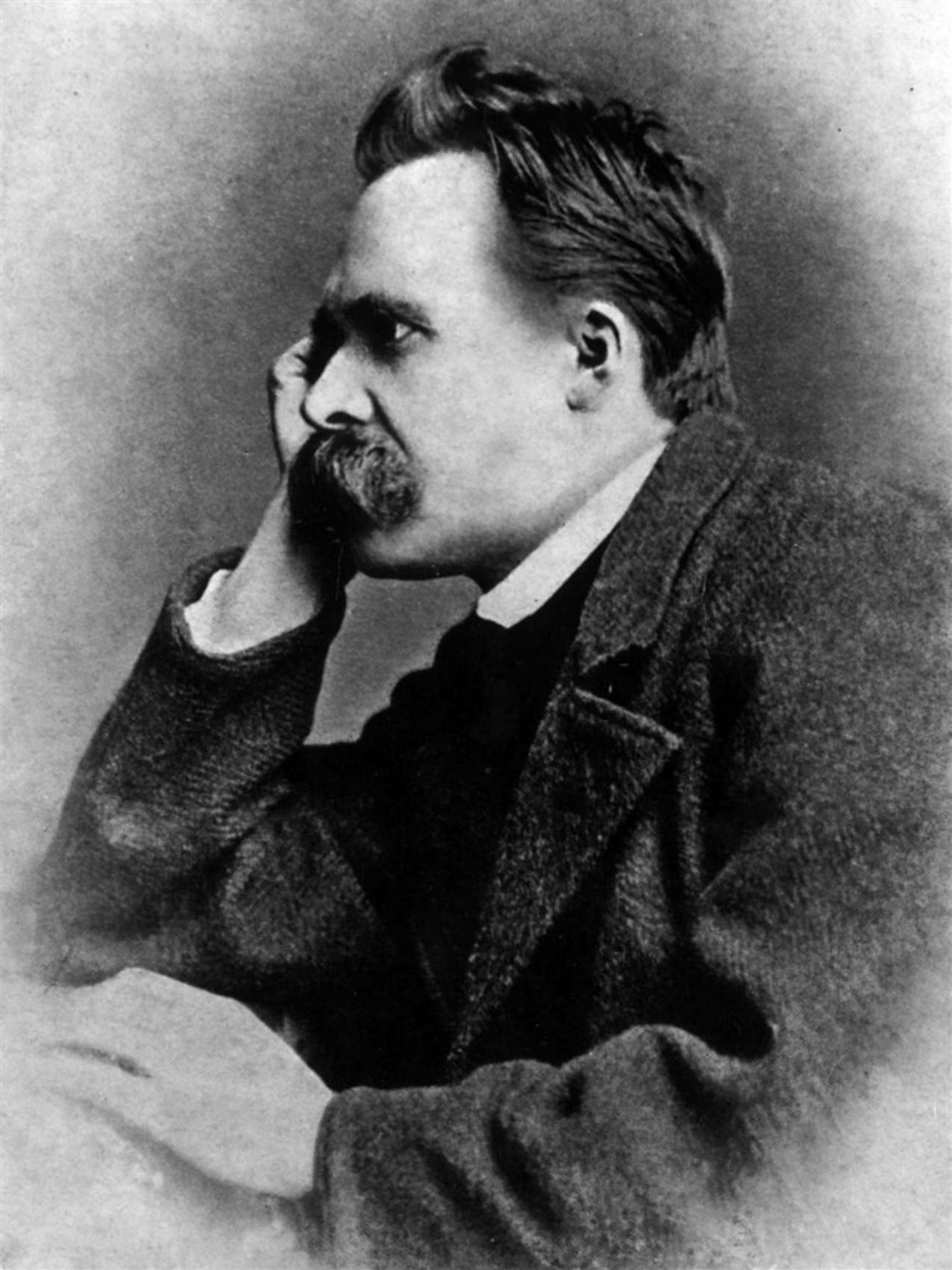
Most of what attaches to his name (the death of God, the Übermensch, the moustache, the posters on dorm-room walls, the way it gets dropped to sound dangerous) sits on top of someone much smaller and stranger. Underneath is a sick young man in a rented room in the Swiss Alps, writing by hand because his eyes can no longer bear print, stopping every few hours to vomit from a migraine, alone, with no university behind him and almost no readers in front of him. That is who actually wrote the books.
Friedrich Nietzsche was a prodigy. He was so gifted at classical philology (the painstaking scholarly study of ancient Greek and Latin texts) that the University of Basel made him a professor at twenty-four, before he had even finished his doctorate; Leipzig simply mailed him the degree on the strength of his published work. He was among the youngest people, if not the youngest, ever handed such a chair in the German-speaking world. And then, having reached the top of the profession before he was thirty, he walked away from it. By thirty-four his health had broken so badly he could no longer teach, and he resigned.
What followed was the strangest productive decade in the history of philosophy. For about ten years (1879 to 1888) he had no job, no institution, no home. He moved with the seasons between cheap boarding houses, summers in the mountain village of Sils-Maria in the Swiss Engadin, winters on the Italian Riviera, carrying a trunk of books and a worsening body. He was nearly blind in one eye, crippled by migraines and stomach illness, often desperately lonely (the woman he loved, Lou von Salomé, had turned down his proposal). And in those rooms, in that condition, he wrote the books the twentieth century could not get out of its head.
Then, in January 1889, in a square in Turin, at the age of forty-four, his mind gave way. He never recovered. He spent the last eleven years of his life unable to speak coherently, cared for first by his mother and then by his sister, who took his manuscripts and his legacy and did terrible things with them. He died in 1900 having no idea that he had become famous, or what he had become famous for.
The man in between the prodigy and the wreck: what he actually saw, why it frightened him, and why he thought facing it without flinching was now philosophy's whole job.
The break
The thing he broke from was not stupid, and it had held for two thousand years. For almost the whole history of the West, serious people assumed that values (good and evil, right and wrong, meaning, purpose) had a foundation. Something outside us guaranteed them. For most of that history the guarantor was God: an act was good because it accorded with the will or the order of a real divine being, and that being underwrote the whole moral structure the way bedrock underwrites a building. When God's authority started to loosen, the Enlightenment did not abandon the demand for a foundation; it looked for a replacement. Reason would ground morality (Kant had argued the moral law was carved into every rational mind), or Nature would (the way things naturally are tells us how we ought to live), or History would march toward it. The shared assumption under all of these, religious and secular alike, was that our values are anchored: that 'good' points at something real and external, not just at what we happen to prefer.
Nietzsche's break is to say: the anchor is gone, and almost nobody has felt it drag loose. He takes for granted that the Enlightenment has already done the demolition work. The credibility of the Christian God, as a literal foundation for European life, has effectively collapsed. That is old news to educated people. His point is the consequence they have not drawn. The morality of the West did not float free of its theology; it grew up inside it, borrowed its authority from it, assumed it at every turn. So when the theology goes, the morality cannot simply carry on as before with its certainties intact; it has lost the ground it was standing on. Pull out the guarantor, and the whole structure of values hangs in midair. The name for that condition is nihilism: the state in which there is no longer any ground for saying that anything matters or has worth. Nietzsche is not 's cheerleader. He is its first clear-eyed diagnostician, and he is terrified of it. He thinks it is the danger that has to be gone through and overcome, not the destination.
The break is a method, not just a mood. The old way of doing took our values as given and asked which ones were true, or how to justify them. Nietzsche stops asking whether our values are true and starts asking where they came from: what kind of people, in what condition, with what needs and resentments, invented 'good' and 'evil' in the first place, and what those people were really up to. This is the genealogical method: investigate the history and psychology of a value the way a detective investigates a paternity claim, to expose the lineage the value would rather nobody looked at. It is a deliberately deflating move. Instead of assuming our morality came down from heaven (or from pure reason), it asks what very human, very earthly process actually produced it, and whether, once the parentage is visible, the inheritance is still worth keeping. That question, turned on our deepest moral feelings, is the engine of his hardest book, and it is the lasting tool he handed the century after him.
Chapter 1
The prodigy who walked away
"From the military school of life. — That which does not kill me, makes me stronger."
That epigraph is the most quoted sentence he ever wrote, and it usually travels in a form he did not write: a gym-poster reassurance that suffering is secretly good for a person. What is actually on the page does two things the paraphrase throws away. First, it is real: genuinely Nietzsche's, from Twilight of the Idols (1888), in Anthony Ludovici's public-domain translation, and not one of the dozens of fake one-liners that circulate under his name. Second, the tag in front of it ("From the military school of life") is load-bearing. He is not promising that all pain ennobles, or that whatever hurts a person is good. He is stating a narrow, hard principle of training: the hardship a person survives can leave them stronger, the way a brutal drill does. Coming from a man whose own body was a daily torture chamber, it is less a slogan than a clenched-teeth report from the field. That gap, between the real, careful Nietzsche and the loud caricature stamped over him, runs through almost everything most people have absorbed about him, and it is downstream of what was done to his books after he could no longer defend them.
The vitals first. Friedrich Nietzsche was born on 15 October 1844 in Röcken, a village in the Prussian province of Saxony (now part of Germany). His father, Carl Ludwig Nietzsche, was a Lutheran pastor, so the future announcer of the death of God grew up in a parsonage, the son and grandson of clergymen. His father died when Friedrich was four, of a brain disease that nineteenth-century medicine could only half-name. Scholars sometimes note, carefully, the resonance between losing a pastor-father in childhood and later writing the death of God; it is a suggestive thread, not a cause, and does not bear much weight. The boy was a prodigy at the elite boarding school of Schulpforta (1858 to 1864), gifted at ancient languages and at music (he composed all his life), and he carried both gifts into the university.
Two encounters made the young scholar into a philosopher. The first, around 1865, was a book. In a second-hand bookshop in Leipzig he found a copy of Arthur Schopenhauer's The World as Will and Representation and read it obsessively. Schopenhauer (the gloomy heir of Kant, who returns in chapter four) taught that underneath the orderly world of appearances there churns a single blind striving force, the will, and that to be alive is therefore to suffer, because the will is always wanting and never at rest. Nietzsche later called this his formative encounter, his first real teacher; he would spend years repudiating Schopenhauer's pessimism while quietly keeping the idea of a deep driving force. (The bookshop story is well-sourced but comes partly from later recollection, the kind of origin tale people polish in memory.) The second encounter, in 1868, was a man: Richard Wagner, whose friendship and rupture are half of the human story.
The speed of the career is genuinely startling. In 1869, at twenty-four, Nietzsche was appointed Extraordinary Professor of Classical Philology at the University of Basel, among the youngest, if not the youngest, ever appointed to such a chair in the German-speaking world. He had not finished his doctorate; Leipzig awarded him an honorary one on the strength of his published work, skipping the usual requirements, so that he arrived at Basel already a professor. He took Swiss citizenship, renouncing his Prussian one, a detail worth holding, because the man the German nationalists would later claim had deliberately stopped being a German subject. In 1872 he published his first book, The Birth of Tragedy, arguing that Greek tragedy was born from the tension between the Apollonian (order, clarity, beautiful form, the art of the sculptor) and the Dionysian (chaos, music, ecstasy, the dissolution of the self). The book ended by hailing Wagner's music as the rebirth of the Dionysian spirit, and his fellow classicists were appalled: a young star philologist had written a wild, half-mystical, Wagner-worshipping manifesto instead of sober scholarship. A devastating published attack followed; his career as a philologist never recovered. (He himself later turned on the book's Wagnerian and Schopenhauerian overlays, adding a self-critical preface in 1886; he did not spare even his own first work.)
The Wagner friendship is the emotional center of his young life, and its breaking is the first of the great ruptures. For years Nietzsche was dazzled: Wagner combined musical genius with vast philosophical ambition and overwhelming force of personality, and he was, like Nietzsche, a Schopenhauer enthusiast. Nietzsche visited the Wagners constantly at their Swiss estate, Tribschen, between 1869 and 1872, and treated Wagner as something close to a second father. Then it soured. After the first Bayreuth Festival in 1876 (Wagner's grand festival theatre, his life's monument), Nietzsche was deeply disappointed by the spectacle and increasingly repelled by what surrounded it: Wagner's German nationalism, his antisemitism, and his drift toward a showy Christian religiosity (Wagner was at work on the openly Christian Parsifal). The public break came with Human, All Too Human (1878), a cool, aphoristic, sceptical book that Wagner received as a betrayal. Nietzsche spent his last sane year (1888) firing two pamphlets directly at his old idol. The break from Wagner was, for him, the break from Romanticism itself, and a rehearsal for breaking with everything he had once leaned on.

Then the body began to win. Through his Basel years Nietzsche was wracked by migraines, by eyesight so bad he was nearly blind in one eye, and by relentless stomach and digestive illness. By 1879 he could barely teach; he resigned his professorship at thirty-four and took a modest pension. What looks at first like a catastrophe turned out to be the making of the philosopher. The decade that followed (1879 to 1888) was the strangest and most productive of his life. Free of the university, he became a wanderer with no fixed home, moving by season between Swiss and Italian boarding houses, travelling light, writing in furious bursts between bouts of illness. The little mountain village of Sils-Maria, above St. Moritz, became his summer refuge from 1881 on; he said his best thoughts came to him there. In a single decade of this, sick, poor, and largely unread, he produced The Gay Science, Thus Spoke Zarathustra, Beyond Good and Evil, On the Genealogy of Morality, Twilight of the Idols, and the rest. The strangeness of the books is not separable from the strangeness of the life that made them.
And then, on 3 January 1889, in Turin, it ended. Nietzsche caused a public disturbance in the Piazza Carlo Alberto; the police were called; his friends Franz Overbeck and Peter Gast came and took him north to a clinic. In the days around the collapse he sent a handful of deranged, beautiful little letters (the Wahnbriefe, the "madness letters"), signed "Dionysus" and "the Crucified," to friends and to people he barely knew. Those letters survive in archives; that much is documented. The famous version, in which he collapses while flinging his arms around a horse being flogged in the square, is apocryphal. Its only source is an unnamed journalist who reported it after Nietzsche's death in 1900, tracing it back through hearsay to an unnamed policeman who supposedly told the story to Nietzsche's landlord: thirdhand gossip, told post-mortem, and scholars consistently flag it as legend, not fact. The documented event is the breakdown itself. Its cause is medically unresolved. It was long blamed on syphilis, never proven; more recent medical research has proposed a hereditary degenerative brain disease (CADASIL) or other conditions. Nobody knows. He would spend the next eleven years incapacitated, which is where chapter six picks up. What he saw before the lights went out comes first, because the sanest thing he ever wrote is also the most frightening.
Chapter 2
The death of God
"God is dead! God remains dead! And we have killed him! How shall we console ourselves, the most murderous of all murderers? ... who will wipe the blood from us?"
This is the centerpiece, and his most famous line is also his most misunderstood; getting it wrong is getting him wrong. "God is dead" gets read as a triumphant atheist's boast, the rationalist spiking a football, announcing that he has seen through the whole religious business and is pleased about it. That is the opposite of what the passage does. Nietzsche is not bragging that he has stopped believing. He takes for granted that European culture has already stopped believing. The Enlightenment (the long philosophical movement that ran from roughly Descartes through Hume and Kant) did that demolition generations ago, and to him it is old news. His subject is the part nobody has faced: what happens to a civilization's entire sense of good and evil, meaning and worth, once the God it was all secretly resting on is gone. As the break laid out, the morality grew up inside the theology and borrowed its authority. Take the God away and the values do not stay standing on their own; they hang in the air with nothing under them. That condition (nihilism, the loss of any ground for saying anything matters) is the catastrophe he is staring at. The way he stages it is a parable.
The passage is The Gay Science §125, and it is a parable. A madman lights a lantern in broad daylight, runs into the marketplace, and cries out that he is seeking God. The crowd around him are not pious (they are exactly the modern people who have already quietly stopped believing), and they laugh at him: Did God get lost? Did he emigrate? Is he hiding? The madman rounds on them, and the laughter dies. In Thomas Common's public-domain English: "God is dead! God remains dead! And we have killed him! How shall we console ourselves, the most murderous of all murderers? ... who will wipe the blood from us?" That is not a victory speech. It is a man looking at a wound the size of the sky and asking, in horror, who could possibly clean it. He calls the deed a murder, and not a small one: the most murderous of all murderers. The crowd laughs because they think the death of God is a small, private matter, a polite loss of faith over the dinner table. The madman is the only one who grasps that it is the largest single event in the history of the West, and that they did it themselves without understanding what they were doing.
The most important line in the whole parable is the one people skip: the madman concludes that he has come too early. "This tremendous event is still on its way," he says; the deed is done, but the news has not arrived. That is the entire diagnosis in one image. The killing of God is already an accomplished fact (the foundations are already gone), but the consequences have not reached people yet, the way the light of a star that died long ago is still travelling toward the eye. They are living in a world whose floor has already been pulled out, and they have not yet started to fall. He smashes his lantern and falls silent; later, the story says, he wanders into churches and sings a requiem for the dead God. The point of the parable is not 'there is no God, hurrah.' The point is: something irreversible and enormous has happened, almost no one has noticed, and when they do notice, the question of what to stand on will be the only question that matters. The horror is the content. Flatten it into a boast and the philosopher is lost entirely.
The death of God appears in The Gay Science three times, in three registers, so the single famous line is really one beat of a sequence. The quiet first announcement comes earlier, at §108: God is dead, "but as the human race is constituted, there will perhaps be caves for millenniums yet, in which people will show his shadow. — And we — we have still to overcome his shadow!" (Common). That is the slow part: even after belief goes, its after-image lingers in our habits and morals for ages, and Nietzsche thought we would be fighting God's shadow (inherited values that still assume the God that is gone) long after the funeral. Then comes §125, the public, horrifying announcement. And then, added in the second edition (1887), the constructive turn at §343.
§343 is where, very carefully, he turns toward what might come after. He calls the death of God "the most important of more recent events" and says it "already begins to cast its first shadows over Europe" (Common). And then he gives the section a strange, ironic title: "What our Cheerfulness Signifies." Why cheerfulness, in the middle of a catastrophe? Because for a particular and rare kind of mind (he calls them free spirits) the very destruction of the old horizon is the thing that opens a new one. If no value is handed down from above any longer, then the work of making values falls to human beings, from nothing, with no cosmic backing and no safety net. To most people that is pure dread; to the free spirit it is, terrifyingly, an opening: "a new dawn," he calls it, with the sea suddenly open in every direction and no shore in sight. But (and this is the whole hinge of his project) the dawn is for the few who can bear it, and the dread comes first. He is not announcing universal good news. He is naming an almost unbearable task: create the values the dead God used to guarantee, and stand behind them yourself. The rest of his philosophy is the attempt to work out who could possibly do that, and how.
Chapter 3
Master and slave morality
"The revolt of the slaves in morals begins in the very principle of resentment becoming creative and giving birth to values — a resentment experienced by creatures who, deprived as they are of the proper outlet of action, are forced to find their compensation in an imaginary revenge."
The genealogical method applied to its most explosive material, in Nietzsche's most sustained and systematic book: On the Genealogy of Morality (1887). The move: do not ask whether 'good' and 'evil' are true; ask where they came from, who invented them, in what condition, and what they were really doing. The First Essay of the Genealogy runs that investigation on the very words 'good' and 'evil,' and its answer is that those words have a hidden history most of us would rather not look at. Understanding it requires holding two different value systems apart, because Nietzsche's whole claim is that they have different parents.
The first he calls master morality, and the key to it is that it is first-person and affirmative. The strong, the noble, the flourishing look at themselves, at their own vigour and confidence and fullness, and they call that 'good.' 'Good' just means noble, like us, the way we are. And then, almost as an afterthought, they call whatever is unlike them (the poor, the common, the weak) 'bad,' where 'bad' (in the German, schlecht) carries no venom at all; it just means low, common, not us. There is no resentment in it, because the masters are not reacting to anyone. They are naming the world in their own image, out of an overflow of self-regard. Nietzsche puts the contrast sharply in the Genealogy: "every aristocratic morality springs from a triumphant affirmation of its own demands" (Samuel). It says 'yes' to itself first, and everything else is a footnote.
The second system, slave morality, is born later and in reaction, among the people the strong have trampled, and this is the move that makes the book serious rather than just provocative. The weak cannot win by force; the masters have all the force. But there is another way to win. They can win by revaluation: by inventing a new scale of values on which they come out on top. They take the masters (strong, proud, dangerous) and rename them not 'good' but evil, the new word, loaded with menace and moral guilt. And they take their own condition (the meekness and patience and restraint that were forced on them by their powerlessness) and rename that 'good,' a virtue, the thing God loves. Out of this inversion, Nietzsche argues, comes the entire vocabulary of pity, humility, and equality as moral ideals. In his words, "the slave morality says 'no' from the very outset to what is 'outside itself,' 'different from itself,' and 'not itself': and this 'no' is its creative deed" (Samuel). Where the master's morality starts with a 'yes' to himself, the slave's starts with a 'no' to his enemy, and builds its 'good' out of the negation.
The steelman is worth staying with, because it is a genuine moral achievement and Nietzsche half-knows it. The slave revolt is not just sour grapes. It is the powerless inventing, out of nothing but their own situation, a whole new way of valuing the world: one in which strength is not the highest thing, in which the victim has dignity and the conqueror has guilt. That took enormous creativity; it is, on Nietzsche's own account, a triumph of the human imagination. And it worked: he thinks the slave revolt won. Christianity, and after it the modern ideals of democratic equality and universal compassion, are on his telling its victorious children. The morality most of us breathe every day (that the meek are blessed, that all people are equal in worth, that pity is a virtue) is, in his genealogy, the slave's morality, grown so total that we mistake it for simple obvious truth. We are living inside the value-vocabulary the resentful invented, and we no longer remember that anyone invented it.
One concrete line shows the move at work. The Sermon on the Mount opens with the Beatitudes: "Blessed are the meek, for they shall inherit the earth," and a string of blessings on the poor, the mourning, the persecuted. Run that sentence through the genealogy. A worldly aristocracy would never have produced it: to the strong, meekness is simply weakness, a lack, nothing to envy and certainly nothing to crown. The Beatitude takes exactly the trait that powerlessness forces on a person (meek because one cannot be otherwise) and re-labels it the highest blessing, the thing that wins the earth and the kingdom in the end. The reward is deferred to a world the strong do not control, where the present order is quietly reversed: the last shall be first. On Nietzsche's reading that is the slave revolt in a single beat: not a lie, and not nothing, but a revaluation, the weak rewriting the scoreboard so that their condition comes out on top. He does not need to invent the mechanism; he just points at a sentence two billion people consider obviously holy and asks where it came from.
The engine of the whole thing is one word, which Nietzsche keeps in French on purpose: ressentiment. He uses the French word deliberately to mark it as a technical term, not ordinary English resentment. Ordinary resentment is a passing flash of irritation that vents and is gone. Ressentiment is a chronic condition: a hostility that cannot discharge itself in action (because the person is too weak to strike back) and so turns inward, festers, and becomes creative. Blocked from revenge in the world, it takes its revenge in the realm of values instead, generating a whole imaginary moral order in which the enemy is damned and the self is saved. That is the line in the chapter epigraph: the slave revolt begins "in the very principle of resentment becoming creative," among creatures "deprived... of the proper outlet of action" who find "their compensation in an imaginary revenge" (Samuel). The values are real, the achievement is real, and the soil they grew from is a bottled, festering hostility that could never hit back.
This is exactly where he gets misread. The crude version is: Nietzsche thought weak people were bad and strong people were good, and he despised the meek. That is wrong, and it is wrong in a way that matters. His claim is genealogical, not a scorecard. He is naming where our values came from, not handing out grades for who deserves to win. His real target is never 'the weak' as a class of people; it is life-hating morality, by which he means any value system that secretly says 'no' to existence, that prizes weakness, sickness, and self-denial because they are weakness, that would rather the world be smaller, no matter who holds it. And that life-denial can be held just as easily by the powerful as by the powerless; a smug, comfortable, life-fearing aristocrat is as much his enemy as any monk. His exemplar is not the political strongman crushing people; it is the artist or thinker who creates out of genuine, overflowing strength and says 'yes' to the world. The uncomfortable question he is actually pressing is this: does a person hold their deepest moral commitments because they have examined them and freely affirm them, or because they absorbed them in their sleep, from a tradition shaped by a resentment that was never even theirs? That question lands on everyone, wherever they sit. It is meant to.
Chapter 4
Will to power, and no facts only interpretations
"Nature's conformity to law,' of which you physicists talk so proudly, ... exists only owing to your interpretation and bad 'philology.'"
Two of his ideas are abused more than any others (the will to power and the line about no facts, only interpretations), and both abuses come from quoting him loosely, or quoting things he never published. Both require careful custody: getting the ideas right, and flagging plainly where a famous 'Nietzsche' is not actually Nietzsche. The will to power comes first, and its crude reading (a lust to dominate other people, the philosophy of the bully) is exactly backward.
The will to power is, first of all, his correction of Schopenhauer. Schopenhauer's blind 'will to live' was a single striving force churning through everything, whose only goal is to persist, and whose churning is the source of all suffering, so that the wise response is to quiet the will, through art, compassion, and a saint's renunciation of desire. Nietzsche keeps the idea of a deep driving force and rejects both halves of the rest. The basic drive in life, he argues, is not mere survival (survival is only a frequent side-effect) but expansion: the urge to discharge strength, to overcome resistance, above all to overcome oneself. And the right response is not to flee the drive but to turn into it, to affirm life rather than renounce it. In Beyond Good and Evil §13, in Helen Zimmern's public-domain translation, he writes that a living thing seeks "above all to discharge its strength — self-preservation is only one of the indirect and most frequent results thereof." His own examples are telling: the artist straining against a hard form, the thinker mastering a problem, the person conquering something in themselves. The will to create is the model, not the will to rule. (The published version of the idea is a claim about psychology and life; the most sweeping metaphysical formulation, that the world 'seen from within' simply is will to power, BGE §36, survives mainly as a paraphrase rather than a direct quotation.)
Nietzsche himself is the worked case, because his own life runs the idea move by move. By the time he wrote Beyond Good and Evil, Nietzsche was nearly blind in one eye, laid out for days at a stretch by migraines, and so sick in the stomach that ordinary work was a daily fight; he wrote in short bursts between bouts of illness, often unable to bear the light or the strain of print. On any account that takes self-preservation as life's basic drive, the comfortable move was obvious: rest the eyes, spare the body, stop. He did the opposite. The drive that ran the show was not the drive to stay comfortable or even to stay well but the drive to make the thing: to force one more book out of a failing body and extend his strength onto the page, with his own health spent as the fuel. That is will to power with nothing sinister in it and no one being dominated: a living thing discharging its strength and overcoming resistance, where the stiffest resistance is its own ruined body, and self-preservation is exactly the side effect that gets sacrificed. It is the precise case BGE §13 describes: strength seeking to discharge itself first, survival trailing as an afterthought. The bully who wants to rule other people is, by this measure, the weaker figure: he needs the others, and his power runs outward toward control rather than back onto himself. The artist or thinker mastering a hard form, spending themselves to bring something into being, is the truer picture of the drive.
The most important custody warning belongs here: The Will to Power is not a book Nietzsche wrote. There is a famous, fat volume with that title on the shelf, and it is constantly cited as his masterwork, his real system, the place where he says what he 'really' meant. It is nothing of the kind. The Will to Power (Der Wille zur Macht) was assembled after his collapse, out of fragments from his unpublished notebooks, by his sister Elisabeth, published in 1901 and expanded in 1906, when Nietzsche himself was either incapacitated or dead. He never assembled it, never authorized it, never saw it. Worse, she selected and ordered the fragments to support a nationalist reading he did not hold (chapter six is the full story). The scholarly editors of his notebooks (Mazzino Montinari above all, the Italian scholar who spent decades reconstructing what Nietzsche actually wrote) regard the book as a distortion; Montinari at his sharpest called it a forgery. The Will to Power cited as Nietzsche's settled philosophy is usually his sister's scrapbook. The concept of the will to power is genuinely his, published in his own books; the book by that name is not.
The second idea is perspectivism, and again the custody matters. The version most people have heard, "there are no facts, only interpretations," is real Nietzsche writing, but it comes from his unpublished notebooks (the Nachlass, 1886–87), not from any book he chose to release; the notebook wording runs closer to "facts are precisely what there is not, only interpretations." It is genuine, and it is private. The published perspectivism, the version he stood behind in print, is sharper and more careful, and it is in Beyond Good and Evil §22. There he goes after the physicists who think they are reading nature's own statutes straight off reality. As an "old philologist," he says, he cannot resist pointing out their bad reading: "'Nature's conformity to law,' of which you physicists talk so proudly, ... exists only owing to your interpretation and bad 'philology'" (Zimmern). What we call the 'laws of nature,' in other words, are not a text read off the world; they are an interpretation, shaped by the grammar and the needs of the interpreter. There is no view from nowhere: every claim is made from some standpoint, by some creature with some drives.
Two guardrails, because perspectivism is the single easiest idea here to wreck. First, it does not mean lazy , the notion that 'every opinion is as good as every other.' Nietzsche believed nothing of the kind; he thought some interpretations were richer, more honest, more life-affirming, and he attacked the ones he judged impoverished and life-denying with great violence. Denying a God's-eye view (the imaginary single standpoint outside all perspective, from which things could be seen as they simply are) is not the same as saying all views are equal. Second, perspectivism does not refute itself by being just one more interpretation: Nietzsche cheerfully grants exactly that. In the same passage he anticipates the objection (but isn't perspectivism itself also only an interpretation?) and answers, in effect, well, so much the better. It does not claim to be the one true reading; it only refuses to let any other claim that crown. And this is the quiet engine under the death of God: once the one guaranteed standpoint above all the others, God's, is gone, the claim that any human morality is objectively, cosmically true loses its last support. Whose perspective, he presses, is being smuggled in as 'the view from nowhere'? Usually it is someone's, with something to gain.
Chapter 5
What comes after: the overman and the eternal return
"I teach you the Superman. Man is something that is to be surpassed."
If the death of God is the wound, these are his two attempts at an answer: the two hardest, most loaded ideas he had, and the two most disfigured after his death. The whole problem, again, is the one §343 named: with no values handed down from above, a person has to make them, from nothing, and stand behind them with no cosmic backing. Who could do that? His name for the answer is the Übermensch, and the word itself is a minefield. Thomas Common's 1909 English renders Übermensch as "Superman." He was not wrong in 1909, but the word now drags a caped comic-book character (1938) behind it, which is a disaster, since the comic figure is a super-powered alien, exactly the biological-superman misreading Nietzsche's idea is not. The modern preference, used here, is "overman." Where the epigraph quotes Common's "Superman," then, the sense is "overman," and what the sentence actually says is: "Man is something that is to be surpassed."
The whole idea is folded into that sentence. "Man is something that is to be surpassed" is Common's exact word, not the "overcome" that sometimes circulates (that is the copyrighted Kaufmann wording). The point is self-overcoming: a human being is not a finished thing to be admired but a stage to be gone past, a bridge rather than a destination. Zarathustra puts it in images: "Man is a rope stretched between the animal and the [overman] — a rope over an abyss," a "dangerous crossing" (Common); what is great in a person is "that he is a bridge and not a goal." The overman, then, is whoever can do the thing the death of God demands: bear the loss of the old foundation without flinching, create new values out of the wreckage, and affirm life completely. What it is not matters just as much, because everything in chapter six depends on it. It is not a race, not a biological type, not a master race, not a political program, and not a description of someone who already exists. It is an existential possibility: a challenge held out to the reader, a type of person who could exist if anyone climbed that high. It is a dare, not a pedigree.
The second idea is his strangest, and it works as a thought experiment run on oneself. It is called the eternal recurrence (or eternal return), and it appears first in The Gay Science §341 under the title "The Heaviest Burden." Nietzsche frames it as a test. In a person's loneliest moment a demon steals up and tells them this: that this life, this one, exactly as it has been lived, down to every pain and every joy and every petty thought and sigh, every smallest detail in the identical order, will have to be lived again, and again, innumerable times, forever, with nothing new in it ever. The eternal sand-glass of existence is turned over and over, and the person with it, a speck of dust. Would the thought crush them to the ground? Or could they, in some tremendous moment, answer the demon: thou art a god, and never did I hear anything more divine?
Why it is the heaviest burden is the philosophical content, not the science-fiction premise. (Whether Nietzsche literally believed time loops back on itself is contested and, for our purposes, beside the point: he sketched some arguments for it in his notebooks, but in the published text it works as a test, and the test does not need the cosmology to be true.) The weight comes from what the thought strips away. Every ordinary consolation a person uses to bear a bad stretch of life is some version of this will pass, and afterward I will be different and wiser. Eternal recurrence blocks every one of those exits at once. There is no 'afterward': the self who lives it all again is exactly this self, unchanged, the regrets and failures and humiliations all included, returning in the same order forever. No edited replay. No 'next time I'll do better.' No progress to a better state on the far side. To affirm the thought, a person cannot quietly hope the worst parts get fixed; they have to will this life, this exact one, down to its ugliest hour, and want it back unaltered an infinite number of times. That is the maximum possible weight a question can put on a life: not 'was it nice enough to repeat?' but 'can it be affirmed whole, with nothing taken out?'
The person who could hear the demon and say yes, again, and again has reached what Nietzsche calls amor fati, Latin for 'love of fate.' It is the affirmation the overman is built for, and it is the positive heart of his whole philosophy, the answer to the nihilism the death of God threatens. It is not grim resignation, not gritted-teeth endurance, not 'whatever happens, happens.' It is active love of one's actual life, all of it, with nothing edited out: wanting it, in his phrase, to be no different, not forward, not backward, not in all eternity. (That formulation comes from The Gay Science §276; its exact Common wording is held here as paraphrase rather than quoted blind.) This is what the eternal recurrence is for: it is the instrument that measures whether a person has achieved amor fati. Answered honestly, the demon's question tells a person whether they are affirming their life or merely surviving it.
One last phrase belongs here, because it gets handed to Nietzsche whole and it is not entirely his: "become who you are." He uses it (in The Gay Science §270 and elsewhere) as an imperative for self-creation: not a call to discover a fixed self that was always there, but a call to make oneself into what one has it in one to become. But he is quoting, and transforming, a far older line. It is from the ancient Greek poet Pindar, in the Pythian Odes (II.72, c. 476 BC): "become such as you are, having learned what that is." The credit runs in a chain: Pindar first, Nietzsche the modern popularizer. He did not coin the line; he charged it with new meaning. The same care about where a line actually came from matters most for what was done to his name after he could no longer speak (chapter six).
Chapter 6
The wreck and the theft
"... it would perhaps be useful and fair to banish the anti-Semitic bawlers out of the country."
This chapter is the hardest to write honestly, because the most influential misreading in the history of philosophy happened to the very man this whole arc has been climbing toward, and both the worshippers and the prosecutors have an interest in flattening him. It begins with the silence. After the Turin collapse on 3 January 1889, Nietzsche never recovered. He spent eleven years incapacitated, cared for first by his mother, Franziska, in Naumburg until her death in 1897, and then by his sister, Elisabeth, who moved him to Weimar and, by several accounts, displayed him to visitors like a relic while he sat uncomprehending. He died on 25 August 1900, of pneumonia and a stroke, with no idea that he had become famous or what for. Everything that made him famous, and infamous, was now in the hands of people who could write back, while he could not.
The theft has a name, and it is his sister's. Elisabeth Förster-Nietzsche (1846–1935) had, in 1885, married Bernhard Förster, a schoolteacher and a virulent antisemitic agitator who had organized a petition against Jewish influence in German schools, exactly the kind of man Nietzsche despised. Nietzsche broke with her over the marriage and mocked Förster by name in his letters to others. The couple emigrated to Paraguay to found Nueva Germania, an 'Aryan' German colony; it failed, and Förster killed himself there in 1889, the same year as Nietzsche's breakdown. Elisabeth came home, and from 1894 took control of the Nietzsche-Archiv. For the next four decades, until her death in 1935, she controlled the manuscripts, the publication, and the public image of a brother who could not contradict her.
What she did with that control is documented, and it is the reason chapter four issued its warning. She assembled The Will to Power out of fragments from his unpublished notebooks, selecting and ordering them to support a nationalist, proto-fascist reading, and published it as though it were his crowning system. It is not a book Nietzsche wrote; it is her construction from his unpublished notes, and it became one of the main channels through which a falsified Nietzsche reached the twentieth century. Her motive is where honesty cuts both ways: the distorting effect is not in dispute, but the intent still is. Some scholars read deliberate falsification; others read a true believer's instinct to bend a beloved brother toward her own politics. The fair thing to ship is the documented effect, and to hold the motive open. What is not open is that the Nazis later embraced this curated version (Hitler attended Elisabeth's funeral in 1935), and that what they embraced was her Nietzsche, not the one in his published books. He did not endorse them; she handed them a forgery, and they were glad to take it.
Against that stands what the man himself actually put in print, and the contrast is sharp. In Beyond Good and Evil §251, Nietzsche lists "the anti-Semitic folly" among the German national stupidities, and recommends, in Helen Zimmern's public-domain translation, that "it would perhaps be useful and fair to banish the anti-Semitic bawlers out of the country." The same section praises Jewish intellectual vitality (he calls the Jews "the strongest, toughest, and purest race at present living in Europe"). His published philosophy held German nationalism in open contempt and prized what he called the "good European," the mind that stands above national feeling. (There is also a much-repeated postcard in which he reportedly wrote that all antisemites ought to be shot, real but informal; the published work, and his break with his sister, carry the weight, and the postcard is only color.) The honesty runs the other way as well: his record on the Jews is not spotless, since some early letters carry casual anti-Jewish stereotyping, which historians read as thoughtless decoration rather than conviction. But the ideology that claimed him after his death ran directly against his documented, published positions. The overman was never an Aryan superman; that reading is Elisabeth's, not his.
The genuinely difficult surface in his own work is his remarks on women. Scattered across Beyond Good and Evil (especially Part 7), Thus Spoke Zarathustra, and the Genealogy, Nietzsche wrote about women in a register that ranges from performative provocation to passages that read as plain contempt. In Beyond Good and Evil §232 he writes, in effect, that truth has from the first been alien and repugnant to woman, whose real art is the lie and whose chief concern is appearance and beauty, a line his admirers and his critics still fight over. Some of his readers argue these are deliberate provocations, or jabs at the shallow feminism of his contemporaries rather than at women as such; others read them as straightforward misogyny. The passages are genuinely contested, and the right thing to do is neither to explain them away ('he was only being ironic') nor to make them the whole man ('he was a misogynist, full stop'). They are a real and difficult part of his work, and an honest read names them rather than tidying them out of frame: the same honesty just demanded of the people who would draft him as a proto-Nazi, and of the admirers who would rather skip the women entirely.
The theft is not the last word: the genuine inheritance is enormous, and it is nothing the Nazis touched. Nietzsche became one of the headwaters of twentieth-century thought along three great channels. Through : he and Kierkegaard (the era's other great solitary, and Marx's contemporary on the religious-crisis side rather than the political one) are the two ancestors of the twentieth-century existentialists (Sartre, Camus, de Beauvoir) wrestling with how to live and make meaning once the old guarantees are gone. Through depth psychology: his ressentiment, his account of values masking hidden drives, and the will to power as a force beneath the surface of the mind run straight into Freud and Adler (Alfred Adler, the psychologist who broke from Freud to found his own school, acknowledged the debt directly; Freud, who owned his volumes, claimed implausibly not to have read him). And through : his perspectivism and his suspicion of grand, view-from-nowhere truths fed Foucault (who took the genealogical method and turned it loose on prisons, madness, and sexuality) and, after him, Derrida, Rorty, and Lyotard, and the whole modern critique of grand narratives. That is the actual afterlife of the man in the boarding houses: not a master race, but a method and a question handed to everyone who came after. He had announced, in the parable of the madman, that he came too early, that the news of the death of God had not yet arrived. The twentieth century is, in large part, the news arriving. And the question he left ringing in it, what does a person build, and become, when the floor under every value is gone, is the one this whole thousand-year arc, from Thales to here, finally runs out onto, unanswered, which is exactly where he wanted to leave us: not with a doctrine nailed to a door, but with the hardest question still open, and the work of answering it ours.