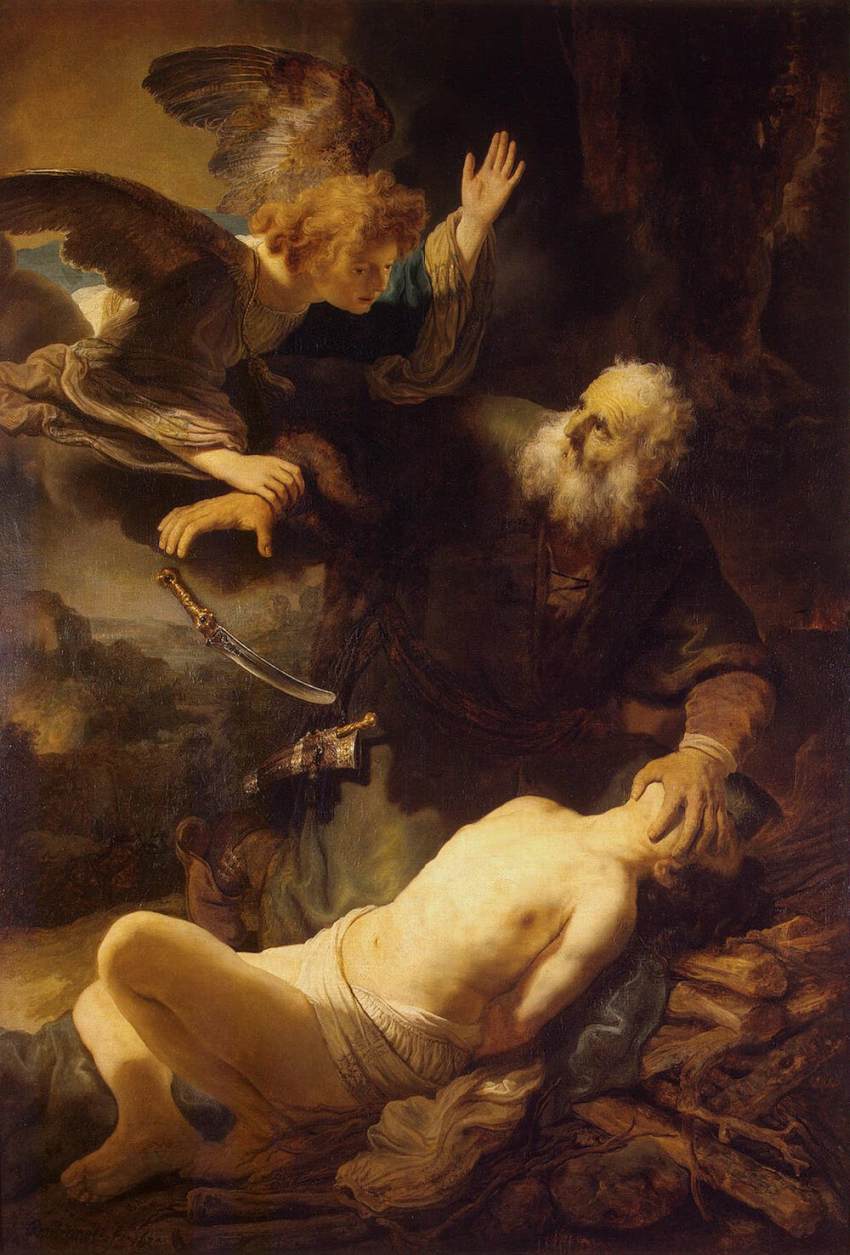
On 16 October 1843 a small book appeared in Copenhagen titled Frygt og Bæven, Fear and Trembling, with a subtitle calling it a dialectical lyric. The name on the title page was not Søren Kierkegaard's. It belonged to a fictional author, Johannes de silentio, which is Latin for John of the Silence, and the choice of name is the first thing the book says. The man telling this story announces in his own pages that he is not a believer, that he cannot perform the movement he is about to describe, that he stands outside faith looking in and reporting what he sees with admiration and terror. The book about the father of faith is narrated by someone who confesses he does not have it.
The story it cannot stop circling is one of the oldest in the Hebrew Bible, Genesis 22. God speaks to Abraham, an old man who waited a lifetime for a son and was promised that through that son his descendants would outnumber the stars, and tells him to take the boy, Isaac, to a mountain in the land of Moriah and offer him there as a burnt sacrifice. Abraham does not argue. He rises early, splits the wood, saddles the donkey, and travels three days with his son and two servants. He builds the altar, binds the boy, lays him on the wood, and raises the knife. Only then does an angel call out and stop his hand, and a ram appears in a thicket to be killed in the boy's place. The tradition reads it as the supreme test passed, faith proven.
What the silent author will not let pass is the three days. The ending is known, the boy lives, but Abraham did not know it on the road. For three days he rode toward that mountain in the full belief that at the end of it he would tie up his own child and cut his throat because God had asked. That is the state the book lives inside, and it has a plain description in any human language. A man who sets out to kill his son is not a hero of faith to the village he comes from. He is a murderer, and the love he feels for the boy does not soften the word, it sharpens it. The scandal the book refuses to smooth over is exactly this: the act that faith honors is the same act that condemns as the worst a father can commit.
Out of that scandal the book builds a single demolition. It was written into the teeth of Hegel, whose philosophy had taught educated Denmark that the highest thing a person can do is rise out of his private self and find his truth in the shared ethical life of family, society, and state, the universal order in which the lone individual is a lower, incomplete stage. Abraham wrecks that picture. He acts as a single individual, in a private relation to God that no community can see into, and in doing so he sets himself above the universal order rather than dissolving into it. If Abraham is the father of faith, then faith is precisely the thing Hegel's system has no room for: the individual standing higher than the universal, alone, unable to explain himself to anyone.
The break
The view the book breaks from had a confident, polished form in 1843, and most of educated Copenhagen held some version of it. From Hegel it had learned that morality reaches its truth not in the private conscience of an individual but in what Hegel called ethical life, the concrete web of duties a person has as a member of a family, a citizen of a society, a subject of a state. On this picture the bare individual, standing on his own feelings, is something low and one-sided. He becomes fully real, fully rational, only by rising out of his private self and taking his place in the larger order, where his will and the shared will line up. Faith, in the genteel theology that went with this, was not a scandal at all. It was religion folded comfortably into good citizenship, the reasonable capstone of a well-ordered moral life.
On that picture Abraham is simply unintelligible, and the silent author drives straight at the discomfort. If the highest thing is to merge with the universal moral order, then a man who hears a private voice telling him to kill his son and obeys it has not risen above morality, he has fallen below it into madness or crime. There is no public reason he can give. He cannot stand before the elders and say his sacrifice serves the nation or the law, because it serves nothing anyone can see; it answers only to a command between him and God that no one else can hear. By Hegel's own measure Abraham should be condemned, not canonized. Either the tradition is wrong to call him the father of faith, or Hegel's measure does not reach the thing faith actually is.
The book takes the second road, and that is the break. It argues that faith is not the ethical order completed but a movement that goes beyond it, what it names a teleological suspension of the ethical: the single individual, for the sake of a higher end (a telos) that is God, sets the universal moral law aside, not by ignorance and not by sin, but in obedience to something higher than the universal itself. In that movement the individual does not dissolve into the order. He stands, terrifyingly, above it, in an absolute relation to the absolute that no community mediates and no rule contains. Where Hegel had made the individual the lower term, the book makes the individual of faith the higher one, and pays the full price of saying so.
The price is that faith, so understood, can never be made comfortable or general. It cannot be taught from a pulpit as a lesson, cannot be reduced to a moral, cannot be shared as a public reason, because the moment it could be explained in terms everyone accepts it would have collapsed back into the universal and stopped being faith. The believer is left where Abraham was left: alone on the road, holding a certainty he cannot communicate, doing a thing that to every witness looks like the opposite of holiness. The book's whole achievement is to make that loneliness vivid and to refuse every move, Hegelian or homiletic, that would talk it away. Faith is kept as a paradox, and the reader is left holding it.
Chapter 1
The man who could not understand it: the pseudonym and the scandal
"What Tarquinius Superbus said in the garden by means of the poppies, the son understood but the messenger did not."
Kierkegaard did not sign the book. He gave it to a fictional author named Johannes de silentio, John of the Silence, and that decision is not a literary game played at the edge of the work. It is built into the argument. The man telling the story of the father of faith says, inside the book, that he himself is not a man of faith, that he cannot make the movement he is describing, that he can admire Abraham and be horrified by him but cannot follow him up the mountain. The book about the highest reach of belief is narrated from just outside belief, by a witness who is honest about standing on the far side of a wall he cannot climb.
The choice is exact, not modest. A believer narrating Abraham would smooth the road, because to him the ending is secured and the terror has a known resolution. The silent author has no such comfort to lean on, so he is forced to feel the full weight of the three days, the part where Abraham does not yet know there is a ram. By refusing to speak in his own voice as a Christian, Kierkegaard keeps the scandal from being defused in advance. The pseudonym is a way of holding faith at arm's length so that it can be seen as the strange and frightening thing it is, rather than the familiar thing a churchgoer is trained to nod at.
The epigraph on the title page is borrowed from the older writer J.G. Hamann, and it sets the book's method before a word of argument begins. It tells of Tarquin the Proud, who answered his son's secret question about how to take a city by walking through a garden and silently striking the heads off the tallest poppies with his cane. The son understood: kill the leading men. The messenger who carried the report saw only a man knocking down flowers and understood nothing. The point is that the same act can carry a meaning available only to the one who holds the secret, and be opaque to everyone else. That is the condition of Abraham, and of faith, and the reason the author signs himself silence: the deepest thing here cannot be passed along like a message. It can only be shown, and missed.
The story the book will not leave alone is Genesis 22, and it earns its force by being told straight, without the haze of familiarity. Abraham is old. He and his wife Sarah waited until they were past hope for a son, and Isaac is that son, the child of the promise, the one through whom God swore Abraham's line would become a great nation. Then God tells Abraham to take that very son to a mountain and burn him as an offering. There is no recorded protest. Abraham gets up early, cuts the wood, loads the donkey, and walks three days with the boy beside him, the knife and the fire in his own hands, the wood on Isaac's back. At the top he builds the altar, ties up his son, lays him on the wood, and lifts the blade.
Strip the rescue away for a moment, the way those three silent days strip it away for Abraham, and the plain description is unbearable. A father is about to kill his child, deliberately, with planning and travel and the gathering of materials, and he intends to do it out of love and obedience. Every moral vocabulary a human community has ever spoken has one word for the man who carries out that intention, and the word is murderer. The love he bears the boy does not excuse the deed; it is what makes the deed monstrous. A father who kills a son he hated would be a different and lesser horror. Abraham means to kill the son he loves more than his own life, and to do it as worship.
There the scandal sits, and the book refuses to dissolve it. Either Abraham is the father of faith, in which case faith can require a man to do what ethics calls the worst of crimes, or Abraham is a would-be murderer who happened to be interrupted, in which case the tradition has spent three thousand years honoring a monster. The silent author will not let the reader take the usual third option, the one the sermons take, which is to admire Abraham warmly while quietly assuming the deed would not really have been wrong because God would not really have asked. He insists that Abraham believed he was going to kill Isaac, and that this belief, held and acted on, is the very thing faith is being asked to mean.
Chapter 2
Four Abrahams, and a eulogy: the Exordium and the praise of the father of faith
No one was as great as Abraham, and no one is able to understand him.
The book opens not with a thesis but with a man who cannot get the story out of his head. In the opening section, the Exordium (the word means an opening, an attunement, the tuning of an instrument before the music), the author describes someone who heard the tale of Abraham as a child and grew more and more amazed by it as he aged, and who now retells it to himself again and again, unable to rest in it. Each time he tells it, it comes out differently, because each time he tries to imagine what could actually have been going on inside a father riding three days to kill his son, and each imagining breaks down in a different place. The result is four short variant versions of the same morning on the road to Moriah.
In one telling, Abraham, to spare Isaac the horror of believing his own father a murderer, turns his face savage and claims the command as his own monstrous will, so that the boy will keep his faith in God by losing his faith in his father; better that Isaac think Abraham a brute than that he think God cruel. In another, Abraham obeys and is given back his son, but something in him is broken by the journey, and he can no longer find joy; the test is passed and the man is hollowed. In another, he is tormented afterward by guilt, unable to understand how a father could ever have been willing, even at God's word. In another, the boy himself glimpses his father's clenched hand and despairing face, and it is Isaac whose faith is wounded. None of the four is the Abraham of scripture, who simply obeys and receives his son and is at peace. Each is the author's confession that he cannot reach the real one.
That is the function of the four retellings. They are not interpretations offered as correct; they are failures laid out on purpose, four imaginable human beings any of whom is understandable, none of whom is Abraham. A father who explains the command away, a father who is destroyed by obeying, a father who is racked with guilt, a son whose trust is shattered: each of these the silent author can follow, because each keeps Abraham inside the bounds of recognizable human response. The scriptural Abraham keeps none of them. He obeys with full intent, gets the boy back, and rejoices, untroubled, as though the three days had cost him no faith at all. It is exactly the parts that make him incomprehensible that the four variants keep failing to supply.
After the four attempts comes the Eulogy on Abraham, a formal speech in praise, and it changes register from puzzlement to reverence. Its argument is built on a definition of greatness. A person is great in proportion to the thing he wrestles, the author says: great against the world by force, great against himself by self-mastery, but greatest of all against God by powerlessness, by a love that holds on while it lets go. By that measure Abraham is the greatest of all. He is great by the very thing that makes him impossible, his readiness to give up the one thing that gave his whole life meaning, the son who was the promise, at the command of the God who had made the promise, and to do it expecting nothing and yet somehow still expecting everything.
The eulogy's sharpest move is to insist that Abraham's greatness lies in a contradiction he held without resolving. He drew the knife fully meaning to use it, and at the same time he believed he would not lose Isaac, that the promise would somehow stand. He gave the boy up entirely and expected to keep him, both at once, with no compromise between the two and no relaxing of either. A man who held back a little, who half-believed God would intervene and so never truly let Isaac go, would be a smaller figure, safer and emptier. Abraham's enormity is that he let go all the way and held on all the way in the same act. The eulogy ends by conceding that no one can understand him, and treating that very unintelligibility as the proof of how high he stands.
Chapter 3
Resignation, the absurd, and the knight who looks like a tax collector
The knight of faith gives everything up and then receives it back whole, on the strength of the absurd.
Before the three formal problems, the book lays its central machine on the table in a section with a deliberately undignified name, the Preliminary Expectoration (an expectoration is a clearing of the throat, a coughing-up; the author is spitting out what he has to say before the real dialectic begins). Its task is to draw the distinction the whole book rests on, between two movements a person can make when life demands he give up the thing he loves most. The first the author calls infinite resignation. The second he calls faith. They look alike from outside and could not be further apart, and almost everyone who thinks he has faith has in fact stopped at resignation.
The worked example is a love story scaled down from a mountain to a parlor. A young man falls in love with a princess, and the love fills his whole life, but it is impossible; she is beyond his reach and he will never have her. The first movement, infinite resignation, is the response of a certain kind of strong soul. He does not pretend the love away or shrink it into a passing fancy. He keeps it at full size, eternal, the meaning of his life, and in the same motion he gives up entirely on ever possessing her in this world. He renounces the finite girl and keeps the infinite love, carrying it as a pain transfigured into something noble. He has made peace with loss by relocating the whole thing out of reach, into eternity, where no one can take it from him because he no longer expects to have it here.
Resignation, the author insists, is already a high and rare achievement, and it is as far as philosophy and ordinary courage can go. It is the movement of the tragic hero and the Stoic and the disappointed idealist; it gives up the world with dignity and holds onto meaning by ceasing to want anything the world can hand over. But it is not faith, and the gap is precise. The knight of infinite resignation has surrendered the finite for good. He gets the eternal love but he does not get the girl. He has made the loss permanent and beautiful, and he expects nothing more from this life, which is exactly why he is at peace: he has stopped hoping for the impossible thing.
Faith makes one more movement, and it is the one the author says he cannot make himself. The knight of faith does everything resignation does, gives the princess up completely, lets her go into eternity, holds the loss as total, and then, in the same breath, expects to get her back. Not in heaven, not as a consolation, but here, in this finite life, whole. He believes the impossible thing will be his after all, and he believes it without taking back one inch of the renunciation. The author has a name for the strength this runs on. It is not reason, which says the thing is lost. It is by virtue of the absurd: the believer holds, against all calculation, that for God the impossible is possible, and so he gets the finite world back precisely after he has given it up for good.
This is the form of Abraham's act, lifted clear of the love story. Resignation alone would have had Abraham give Isaac up to God and grieve him as gone, a son surrendered to a higher claim, mourned and released. That is a movement a strong and pious man could make. Abraham makes the second movement on top of it. He raises the knife fully resigned, Isaac genuinely given up, and at the same time he believes he will keep his son, that the boy will come back down the mountain with him, that the promise will hold even through the killing. He gives Isaac up and expects Isaac back, both completely, on the strength of the absurd. The ram in the thicket is what the absurd looks like from outside: the finite handed back after it was wholly let go.
The most startling image in the section is the author's portrait of what such a knight of faith would look like if one walked down the street. He would not look like a poet or a mystic or a man marked by some visible suffering. He would look like a tax collector. He would resemble, exactly, the comfortable middle-class shopkeeper who takes his Sunday walk, enjoys his dinner, putters about ordinary pleasures with evident satisfaction, and seems to belong entirely to the finite world of small contentments. The knight of resignation is recognizable by a certain noble melancholy; he wears his renunciation. The knight of faith wears nothing. He has the whole finite world back, and he holds it as lightly and gladly as a man enjoying a roast, so that he is invisible, indistinguishable from the most ordinary citizen, the last person anyone would suspect of standing in an absolute relation to the absolute.
Chapter 4
Problema I: the teleological suspension of the ethical, Abraham against Agamemnon
Either there is a suspension of the ethical for the single individual, or Abraham is lost.
The back half of the book poses three questions, the Problemata, and the first is the one the title of the movement names: is there such a thing as a teleological suspension of the ethical? Behind the technical phrasing is a blunt either-or. By every account of morality the author is working against, above all the Hegelian one, the ethical is the universal: the body of duties that hold for everyone and admit of no exception, the order in which a person finds his highest task by submitting his private self to the shared law. On that account, an individual who places himself above the universal, who treats his own private relation to God as higher than the moral law everyone shares, is simply in the wrong. He has sinned, and the only way back is to surrender that private exception and rejoin the universal.
If that account is the whole truth, the author says, then Abraham is finished. Not a hero, not a saint, but a man who set his private voice above the moral law and tried to kill his son. There is no softening it. So the question is forced into a corner: either there is a teleological suspension of the ethical, a point at which the single individual stands, for the sake of a higher end (a telos) that is God, above the universal law that would otherwise bind him absolutely, or Abraham is not the father of faith but a murderer, and the faith that honors him is a lie. The book has already spent half its length making sure the reader cannot wave this away, and now it makes the suspension the only alternative to condemning Abraham outright.
To show how strange Abraham's case is, the author sets beside him a figure the moral order can absorb without trouble: the tragic hero. His central example is Agamemnon. The Greek fleet lies becalmed at Aulis, unable to sail for Troy, and the seer declares that the goddess will release the winds only if Agamemnon, the commander and the king, sacrifices his own daughter Iphigenia. Agamemnon does it. He kills his child, and the deed, monstrous as it is, is comprehensible and even admirable to his people, because he kills her for the nation, for the army, for a public end that the whole community can see and weigh and honor. He gives up his daughter to a higher duty that is still a duty, a claim of the universal upon him as king.
That is the line the author draws, and it is the heart of the chapter. The tragic hero stays inside the ethical the entire time. Agamemnon sacrifices a lower duty, his love for his daughter, to a higher duty, his obligation to his people, and both duties belong to the shared moral world; the community grieves with him and understands him, because they can see the public good his terrible act serves. He has a name available to everyone: he is a hero. The same structure holds, the author notes, for the others he names, Jephthah, who sacrifices his daughter to fulfill a vow made to God for victory, and the Roman Brutus, who condemns his own sons to death for conspiring against the state. Each gives up a child to a recognized higher claim of the universal, and each remains, for that reason, intelligible and admired.
Abraham fits nowhere in that frame, and the contrast is exact. He is not sacrificing a lower duty to a higher one within the moral order, because there is no public end his act serves. No nation is saved, no vow to the community is kept, no state protected. Iphigenia dies for the fleet and the whole army can see why; Isaac is to die for nothing anyone can point to, for a private command between Abraham and God that no third person heard or can verify. Agamemnon can explain himself to his people and be understood. Abraham can explain himself to no one, because there is nothing in the shared moral vocabulary that his act translates into except the word the village would use: murder. The tragic hero stays within the universal and is honored by it; Abraham steps outside it entirely.
So if Abraham is justified at all, it cannot be as a higher kind of tragic hero, because the tragic hero never leaves the ethical and Abraham has left it. He can be justified only if there is a relation higher than the universal, a relation of the single individual to God in which the individual stands, for that one purpose, above the moral law itself. That is the teleological suspension of the ethical: not the law overruled by a higher law, which is all the tragic hero does, but the whole universal order suspended for the sake of a single person's absolute relation to the absolute. The book does not pretend this is comfortable. It states it as the only thing that keeps Abraham from being a criminal, and lets the reader feel how much it costs to grant it.
Chapter 5
Problema II: an absolute duty to God
Faith is the paradox that the single individual stands in an absolute relation to the absolute.
Problema II reverses the question and asks it from God's side: is there such a thing as an absolute duty to God? The question sounds like one a pious reader would answer yes to without thinking, and that is the trap. In the moral philosophy the author is contesting, God and duty had been quietly fused. To do one's duty to God just was to do one's ethical duty, to be truthful, just, loving, faithful to family and neighbor and state; God was the name for the moral order seen as a whole, and there was no separate channel to him that ran outside or against that order. On that view there is no duty to God over and above the universal, because God simply is the universal raised to its highest expression.
If that fusion holds, the author points out, then the phrase duty to God is empty, a decorative way of saying duty. And if it is empty, then once again Abraham is condemned, because everything Abraham does that matters happens precisely in the gap between God and the universal. The command to kill Isaac is not the moral law speaking; it is the opposite of the moral law. For Abraham to have an absolute duty to God in this case is for him to owe God something that cuts directly against what ethics demands. So the question is not the soft one it first appears. It asks whether a person can stand under a claim from God that overrides the entire shared moral order, and whether obeying that claim can be right rather than mad.
The book's answer is its central formula, and it states it as a paradox it does not try to relieve: in faith, the single individual stands in an absolute relation to the absolute. The ordinary, healthy relation a person has to God runs through the universal: a man serves God by being good to the people around him, by taking his place in the moral order, so that his relation to God is mediated, carried through his relations to everyone else. The knight of faith has a relation to God that is not mediated by anything. It is direct, absolute, between this one individual and God alone, and because it is unmediated it can come into collision with the universal and override it. That is what an absolute duty to God means, and the author does not soften the consequence: it makes the single individual, in this relation, higher than the universal.
The cost is stated with deliberate harshness, because the author wants no one slipping past it. Inside the moral order, love of God and love of neighbor coincide; to love God is to do right by people. In Abraham's case they tear apart. The absolute duty to God can require the believer to do, toward the person he loves most, the very thing love forbids. Abraham's duty to God commands the death of the son his whole heart is bound to. The author puts it in a form meant to scandalize: in the moment of the absolute duty, what the moral order calls Abraham's love for Isaac becomes, by ethics' own lights, something like hatred or murder, because it is willing the boy's death. The paradox is that this willing is, at the same time, the highest expression of love, since it is offered to God in obedience and in the faith that Isaac will be restored.
And this is why faith cannot be turned into a lesson or a public proof. A duty everyone can see and check is a universal duty, mediated through the shared order; the moment Abraham's duty could be laid out and justified before the community, it would have rejoined the universal and stopped being the absolute, unmediated thing it is. The believer is therefore permanently exposed. He has no external mark, no argument, no witness that distinguishes his absolute relation to God from simple delusion or crime. From outside, the man obeying an absolute duty to God and the man who has lost his mind look identical. Faith carries no credential. It is the single individual, alone with the absolute, holding a duty he cannot show to anyone, and that exposure is not a flaw in the account; it is the truth the account is trying to tell.
Chapter 6
Problema III: the silence of Abraham, and what the book leaves standing
Abraham cannot speak; that is his agony, for what he could explain would no longer be Abraham.
The third and longest problem asks why Abraham kept silent. On the road to Moriah he says almost nothing. He does not tell Sarah where he is going or why. He does not tell the two servants. When Isaac, carrying the wood, asks where the lamb for the offering is, Abraham answers only that God will provide it, which is true and tells the boy nothing. He explains himself to no one across three days. The author wants to know whether this silence was justified, and the question is sharper than it sounds, because the moral order generally demands the opposite. To be ethical, in the world the book is arguing against, is in part to be disclosed, to be able to give one's reasons, to make oneself understood and accountable to others. Concealment is morally suspect. Abraham conceals everything.
The author's answer is that Abraham is silent not because he chooses secrecy but because he cannot speak, and the difference is everything. He cannot speak in the sense that matters, which is to make himself understood, because what he would have to say cannot be said in any language the listener shares. If he told Sarah he was going to kill Isaac because God commanded it, the words would carry no meaning that could justify him; they would land as the raving of a murderer or a madman, because the absolute relation to God that makes his act what it is cannot be put into the universal terms that speech runs on. To explain himself, Abraham would have to translate his private relation to God into a public reason, and the instant he could do that, it would no longer be the private absolute relation, and he would no longer be Abraham. His silence is the silence of something that genuinely cannot be communicated, not something withheld.
Here the contrast with the tragic hero returns and completes itself. Agamemnon can speak. He can stand before the army and explain that he sacrifices Iphigenia for the fleet, and his words reach his listeners, who grieve with him and understand. The tragic hero is never alone, because his deed lives inside the universal and the universal has words for it; speech binds him to his people even in his agony. Abraham has no such words and so no such company. His deed lives outside the universal, where language cannot follow, and that is why he is alone in a way the tragic hero never is. The agony the author dwells on is not only that Abraham may kill his son, but that he must do it in a solitude no speech can break, unable to be understood by the wife, the servants, the boy, or anyone who will ever hear the story.
This is what the pseudonym and the poppies on the title page (Chapter 1) were preparing all along. Faith is an indirect thing; it cannot be handed over as a message and received intact, the way the messenger failed to receive what Tarquin's poppies told the son. The whole book is built to honor that, which is why it never states faith as a doctrine the reader can carry off and repeat. It circles Abraham, retells him four ways, sets him against Agamemnon, names the absolute relation, and at every turn insists that the thing itself stays just out of reach of the saying. Johannes de silentio, John of the Silence, is the only honest narrator for a subject whose deepest truth is that it cannot be spoken, only shown and missed.
What the book leaves standing is a paradox held open on purpose, and a permanent objection to a certain confidence about faith. It refuses the Hegelian comfort that the individual is fulfilled by dissolving into the moral order, by planting a single man who stands above that order in fear and trembling and calling him the father of faith. It refuses the genteel pulpit comfort that faith is reasonable and mild, by insisting that real faith wears the face of the thing ethics condemns, and that the believer is as exposed and unintelligible as a murderer. And it refuses to resolve any of it, because to resolve it, to give faith a public justification, would be to abolish the very thing being described. The reader is left holding what the silent author held: a man on a mountain with a knife, honored for three thousand years, who cannot be understood, and a definition of faith that begins where understanding stops.