Why a narrow ravine almost beat a whole army
Major General Philip H. Sheridan’s (North) plan depended on speed, hitting Lieutenant General Jubal A. Early (South) before he could concentrate, and his army’s approach to Winchester from the east ran through a bottleneck that turned speed into a snarl.
It started well. Around two in the morning, Brigadier General James H. Wilson’s cavalry (North), the mounted, fast-moving troops who scout and screen and seize ground ahead of the foot soldiers, pushed out from the east, secured the crossing of Opequon Creek, and rode up the Berryville Pike (the road running west from the town of Berryville into Winchester) to grab the high ground beyond. So far, perfectly. The trouble was the road itself. West of the creek the Berryville Pike threaded the Berryville Canyon, a narrow ravine a couple of miles long that was the only practical way for Sheridan’s infantry (his foot soldiers, the bulk of his army) to get from the creek to the open ground east of town. One road, one canyon, a whole army that needed to pour through it.
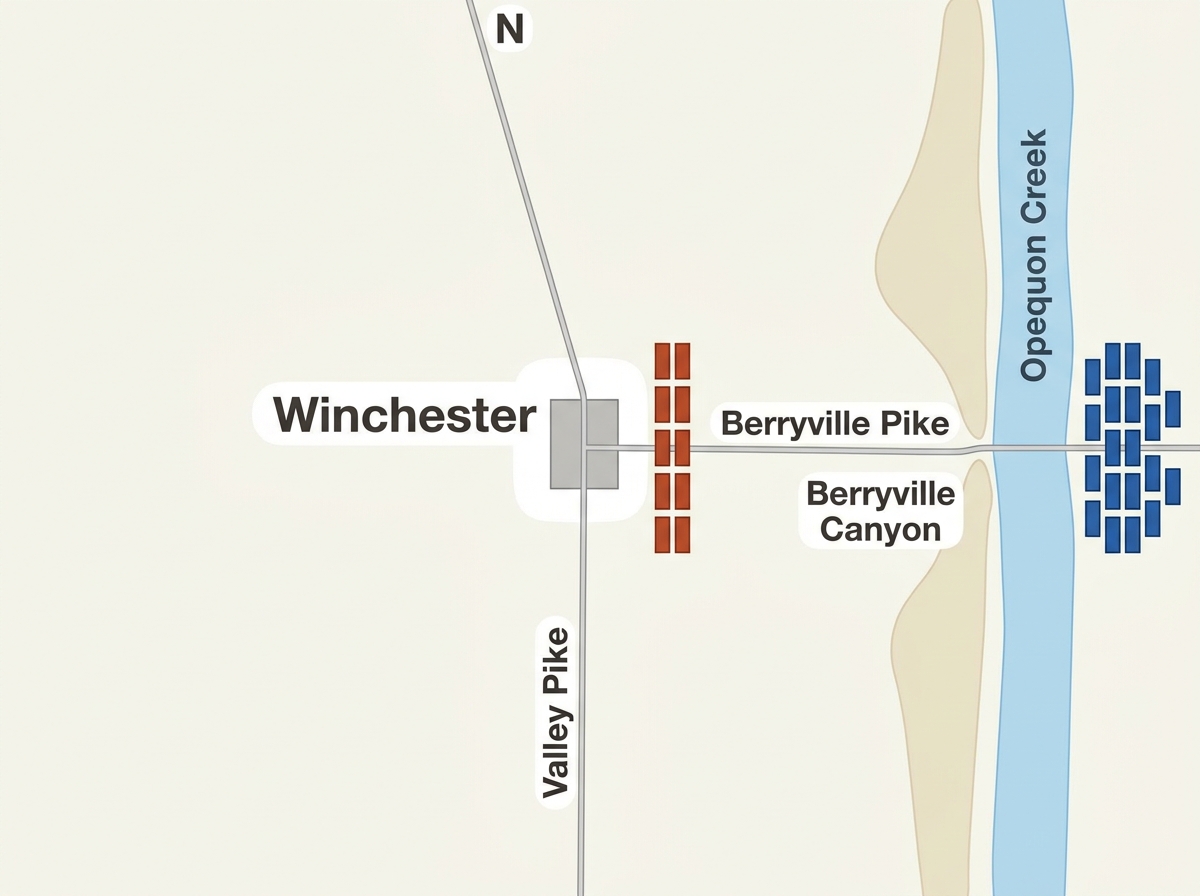
And it choked. The VI Corps (a corps being one of the big building-block formations an army is divided into, tens of thousands of men under one general) reached the canyon first, around five in the morning, under Major General Horatio G. Wright (North), a different Wright entirely from Rebecca Wright the schoolteacher, no relation, just the same common surname. But instead of shoving its fighting men through, Wright’s corps pushed its wagons and artillery into the defile ahead of the infantry. Then it got worse: ambulances carrying wounded men back out of the canyon met the wagons grinding their way in, head to head, in a ravine with no room to pass. The result was a monumental traffic jam, a clot of wagons, guns, and ambulances plugging the one road the army had to use. Brigadier General William H. Emory’s XIX Corps (North), Sheridan’s second big infantry corps, queued up behind Wright, could not even enter the canyon until around nine in the morning. Sheridan’s attack, the surprise blow against a scattered enemy, was delayed by more than two hours.
Those two hours were the difference between a pounce and a brawl. While the Union army stood jammed nose-to-tail in a ditch, Early used the gift of time to do the one thing Sheridan had attacked to prevent: he pulled his dispersed divisions in toward Winchester, the thin line in front of the town thickening hour by hour as fresh divisions tramped up the pikes and fell into place. The army Wilson had caught spread thin was, by the time the Union infantry finally cleared the canyon, concentrated and waiting. A clogged road had erased the whole advantage Thomas Laws had bought. The easy victory was gone before a real shot of the main battle had been fired, and what remained would have to be taken the hard way, head-on, against an enemy who was now ready.