The fight that broke the campaign goes by two names, because each side wrote its own history. The Union called it the Battle of Mansfield, after the De Soto Parish (parish being Louisiana’s word for county) town it was fought about three miles below. The Confederates called it the Battle of Sabine Crossroads, after a road junction near the field. The National Park Service keeps a third name, Pleasant Grove, for the rear-guard stand at the end of the day. Same ground, same afternoon.
The man waiting for Banks was Major General Richard Taylor (South), commanding the small Confederate Army of Western Louisiana. He was the son of a U.S. president, Zachary Taylor, and himself one of the wealthiest sugar planters and slaveholders in the state. Taylor had been falling back for weeks, badly outnumbered if you counted every soldier on both sides. But Taylor had been counting something else: not the totals, but the road.
Everything here turns on one narrow road. Banks’s army was advancing north toward Mansfield and Shreveport up a single stage road that ran through dense pine forest, a kind of forest tunnel, trees crowding both shoulders, no room to spread out. An army that size needs room to deploy its strength side by side; on one track through the woods it can only go in a long thin file, and that is exactly what Banks’s did. His column, the army strung out in marching order, ran for two to three miles or more: the cavalry division (a mounted division, here a force of roughly 3,300 to 3,500 horsemen) under Brigadier General Albert L. Lee (North) at the very head, then behind it the army’s wagon train of somewhere around 320 to 350 supply wagons clogging the single lane, hauling the food and ammunition and the speculators’ hopes, and only then the infantry, miles back, packed nose to tail and unable to get past the wagons in front of them.
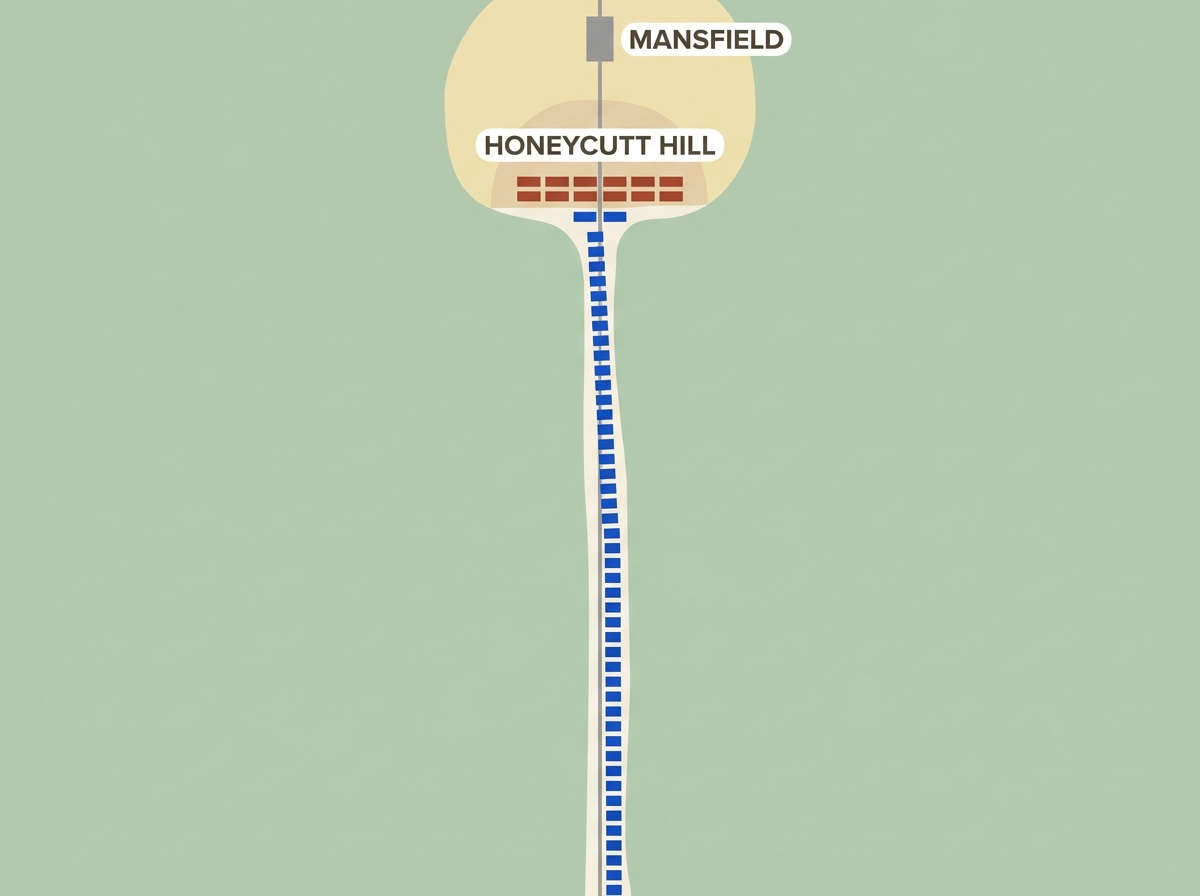
Banks may have had 20,000 to 30,000 men in the expedition, the sources scatter badly, but the number that decided the day was the number he could actually get into the fight, and that was only about 12,000. One officer described the army as having almost a day’s march between its advance guard and its rear. The wagons were a cork in a bottle. Taylor had only some 8,800 to 11,000 men total, but he could bring nearly all of them to bear on the front of Banks’s column, the part that had emerged from the woods. At the point of contact, it was the Union infantry that was outnumbered, roughly two to one. The army that was smaller everywhere managed to be bigger in the one place that mattered. A single narrow road through the pines let a smaller force rout the head of a larger one.
About noon, Lee’s cavalry van (North) shoved back the Confederate skirmishers (the thin screen of troops sent out ahead of a line) and rode out of the tree line into a large clearing, open farmland about three miles south of Mansfield, with a low rise called Honeycutt Hill in the middle of it. Lee deployed his troopers across the rise and sent back for infantry. He had already warned Banks, in effect, that they could not push on without bringing on a full battle in which they would be soundly beaten. Banks decided to fight there anyway.