They went up. Without orders, on their own initiative, the Army of the Cumberland began climbing Missionary Ridge: first a few color-bearers (the soldiers who carry the unit’s flag, and so lead where it goes) and knots of men scrambling up out of the deadly trenches, then whole regiments, then the entire line, surging up the slope toward the top. As they climbed they took up a cry, the name of the field where they had been humiliated two months before: Chickamauga! Chickamauga! This was the army that had run at Chickamauga, and it was running uphill now, into the fire, with something to settle.
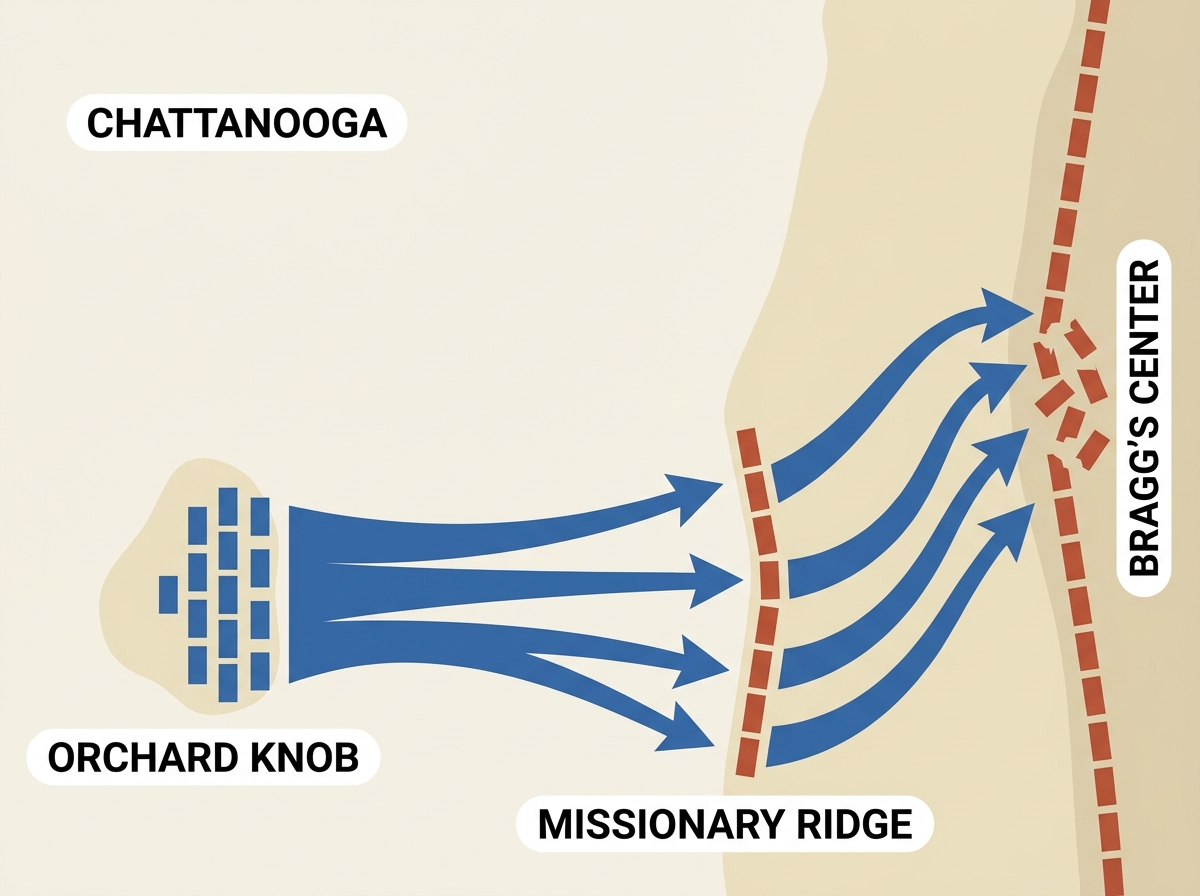
On Orchard Knob, Grant watched his plan dissolve into something he had not authorized and could not stop. He had ordered a diversion against the base. His army was storming the mountain. He turned, stunned, to the men around him and demanded to know who had ordered those men up the ridge. Maj. Gen. George H. Thomas (North) said it had not been him. Grant turned to Maj. Gen. Gordon Granger (North), his corps commander on that part of the field. Granger had not ordered it either, and his answer is the line the whole battle carries:
“When those fellows get started, all hell can’t stop them.”
Maj. Gen. Gordon Granger (North), to Grant
And nothing did stop them. Up on the crest, the badly-sited Confederate line met exactly the catastrophe its placement invited: the blind spots had let the Federals climb out of the defenders’ fire, the thin reserveless line had nothing behind it to plug a break, and the men coming up were past stopping. The divisions of Maj. Gen. Philip Sheridan (North) and Brig. Gen. Thomas J. Wood (North) crested the ridge near the center and broke through. The first crack, near Bird’s Mill Road, opened around 5 p.m., and from there it spread in both directions like a seam tearing, Brig. Gen. August Willich (North) and Brig. Gen. William B. Hazen (North) rolling the broken Confederate line up north to south, peeling off regiment after regiment.
This was the sector held by Maj. Gen. John C. Breckinridge (South), the center of the ridge, commanded by a man who had been Vice President of the United States only a few years earlier and was now watching his line evaporate under him. (On the north end, Lt. Gen. William J. Hardee’s (South) sector around Tunnel Hill, with Cleburne, was still holding; it was the center that gave way.) By around six in the evening the whole Confederate line had unraveled. Bragg’s veterans, men who had won at Chickamauga and besieged this very army, turned and ran off the back of the ridge they had been told was impregnable.
The Arithmetic of a Rout
The numbers tell the shape of it. At Missionary Ridge that day, roughly 56,000 Union troops faced about 44,000 Confederates. To read the losses you have to know what “casualties” means, because it is not just the dead: it counts everyone an army loses to a fight, the killed and the wounded and the captured and the missing all together. The Union, charging uphill into prepared positions, took most of its loss in wounded men shot on the slope: about 5,824 casualties, with 753 killed, 4,722 wounded, and 349 missing. The Confederate total ran higher, about 6,667, but the breakdown tells the story. Only 361 killed and 2,160 wounded, and 4,146 captured. When an army loses far more men captured than killed or wounded, it did not get ground down in a stand-up fight; it came apart and let the enemy scoop up whole bodies of men where they stood. That is the arithmetic of an army that broke and ran, leaving some 40 cannon abandoned on the crest. Whole regiments simply surrendered as the line dissolved: about 700 of one Confederate command (Holtzclaw’s) gave up at the south end. Bragg’s army fled east across Chickamauga Creek and kept going, southeast toward Dalton, Georgia.
One soldier, watching the rout, called it the death-knell of the Confederacy.