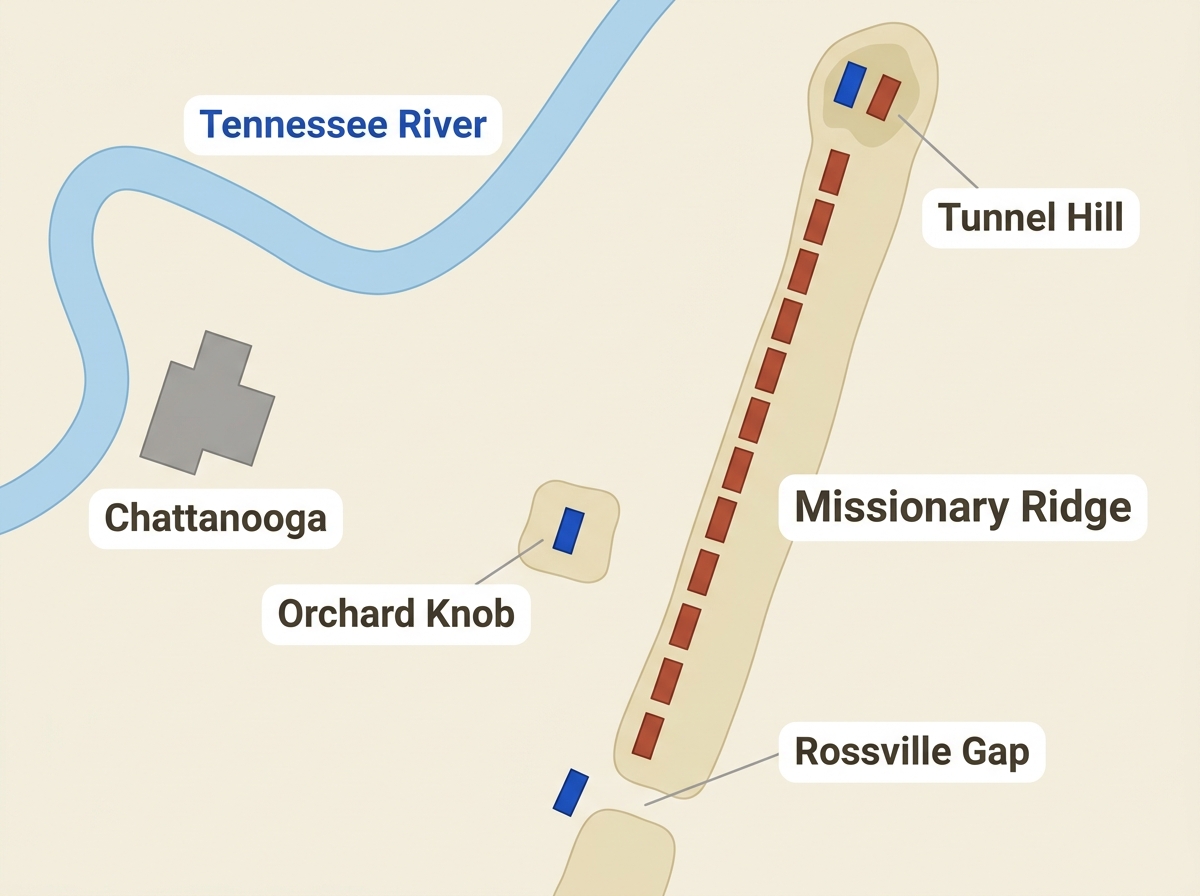
By late November 1863, two armies were staring at each other across a valley in southeastern Tennessee, and the one on the high ground was slowly winning a war of patience. The city of Chattanooga sits on the south bank of the Tennessee River, hemmed in by mountains, and it had a value out of all proportion to its size: it was the rail gateway into the Deep South. The railroads that ran out of it pointed straight at Atlanta and the cotton-and-plantation interior beyond, the economic core of the rebellion. The Confederacy had seceded and built its armies for one overriding reason, to protect and extend the enslavement of four million Black people, and Atlanta was the rail-and-supply heart of that economy. Whoever held Chattanooga held the door to it.
The Union army was inside the city, and it was trapped. Two months earlier, in September, the Army of the Cumberland (one of the United States’ named field armies in the West) had been beaten at Chickamauga, driven back into Chattanooga in a near-rout that only Maj. Gen. George H. Thomas (North) had kept from becoming a catastrophe, holding the rear line so stubbornly he came out of it called “the Rock of Chickamauga.” The victorious Confederates under Gen. Braxton Bragg (South) had followed the beaten army to the edge of the city, climbed the heights around it, and settled in to starve it out. By November the besieged Federals (the Union troops) had nearly chewed through their rations, until a daring nighttime operation in late October cracked open a supply route, the “Cracker Line,” and got food and men flowing back in. The crisis eased. But the Confederates still sat on the mountains, and the city was still a cage.
Western TheatreChickamauga: the defeat that trapped the army in ChattanoogaThen Maj. Gen. Ulysses S. Grant arrived. Lincoln had consolidated the western armies under one commander after Chickamauga, and Grant, fresh off the capture of Vicksburg that summer (the Mississippi River fortress whose fall split the Confederacy in two), was that man. He came to Chattanooga to break the siege, not survive it. By late November he had three full armies gathered around the city and a plan to drive Bragg off the heights for good.
Western TheatreVicksburg: the victory that made Grant the man for the jobThe chief obstacle was the longest of the heights: Missionary Ridge, a steep, narrow spine of high ground running north to south a couple of miles east of the city, its crest rising several hundred feet above the valley floor. Bragg’s whole army was strung along the top of it, facing west across the valley toward the trapped Union lines. To a Federal soldier looking up from the bottom, it looked unassailable.