In the summer of 1758 the British were done losing. For three years the war in North America had gone badly, a string of frontier disasters that began at the Monongahela and never quite let up. Then a new minister, William Pitt, took hold of the war from London and changed how it was fought, pouring men and money into the colonies and aiming three great blows at New France all at once: one at Louisbourg, the French fortress guarding the mouth of the St. Lawrence; one at Fort Duquesne in the west; and one straight up the middle, at the French fort the British meant to use as a doorway into Canada itself.
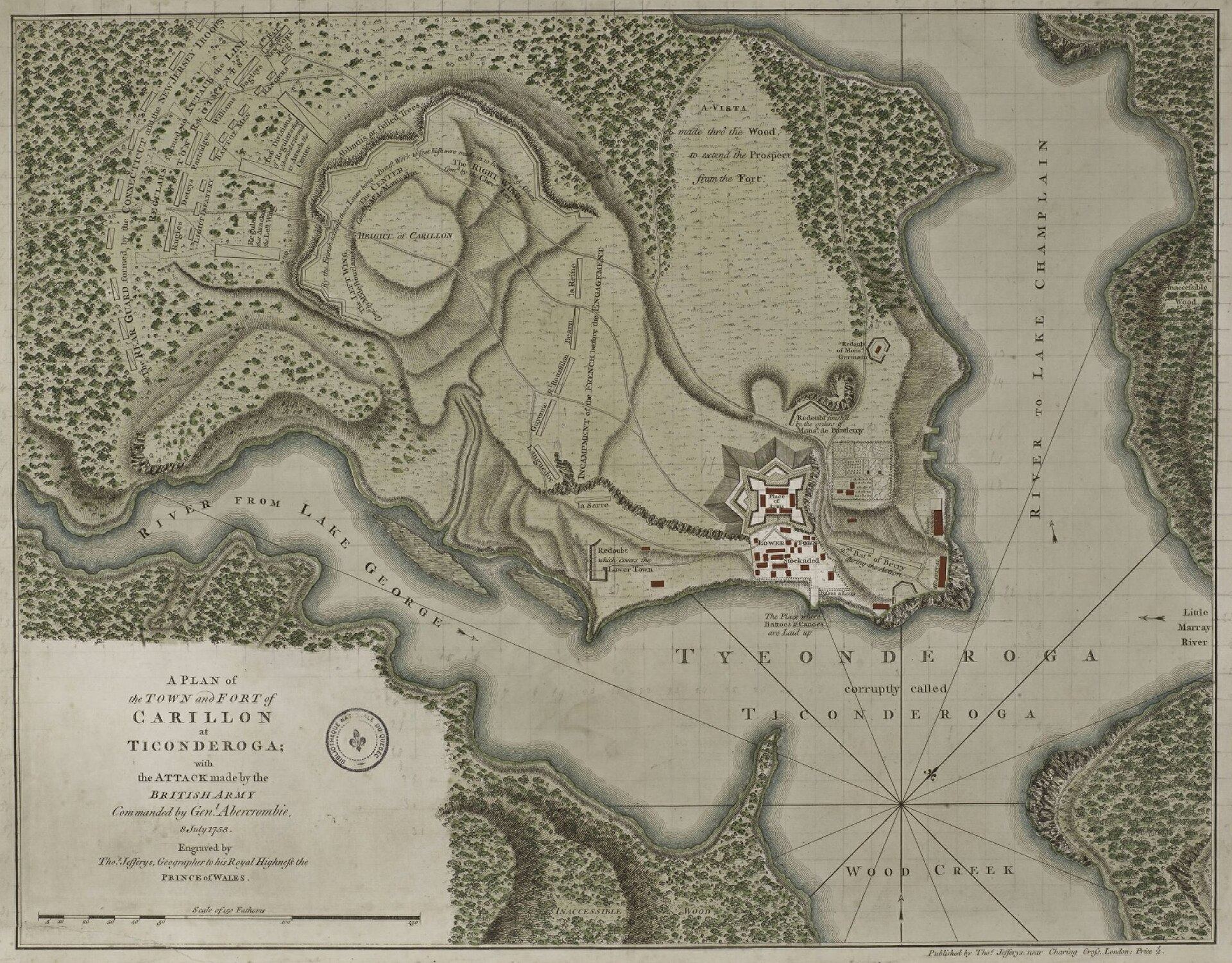
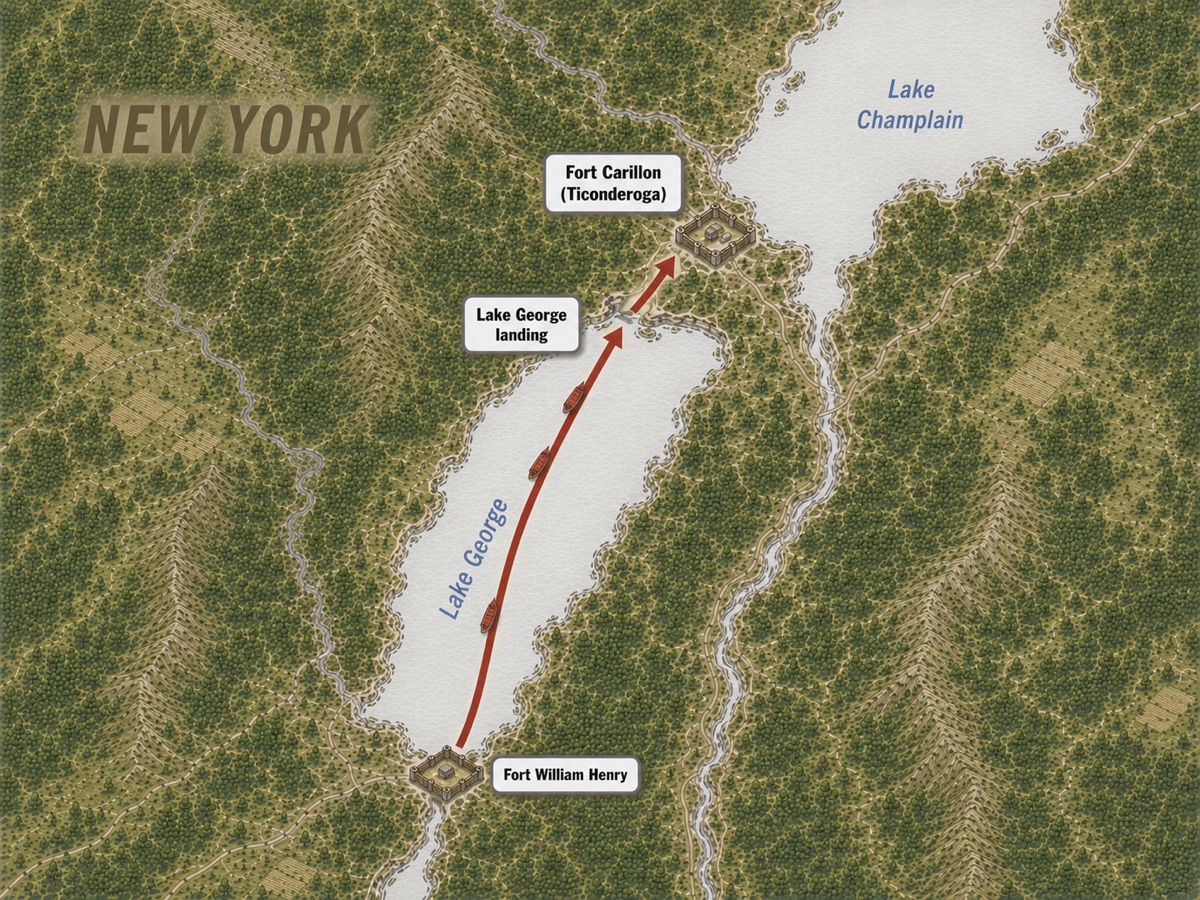
That middle blow aimed at Fort Carillon, the French stronghold the British would later rename Ticonderoga, in what is now upstate New York. It sat on a narrow neck of land between two lakes, on the portage (the carrying-place where travelers dragged their boats overland between the two lakes) where the waters of Lake George spill down a short river into Lake Champlain. This was the most important corridor on the continent for a war between Britain and France: the long water highway running from the British colonies up to the French heart of Canada. Hold Carillon and you held the gate. Take it, and the road to Montreal and Quebec lay open. The French knew it, and so did the British, and so the largest army ever yet assembled in North America gathered at the south end of Lake George to come and take it.
It was an enormous force, something like fifteen to sixteen thousand men: roughly six thousand British regulars (the king’s professional, full-time soldiers) and nine to twelve thousand provincials and rangers (the part-time troops raised in the colonies, and the irregular scouts who fought in the woods). They had artillery, the heavy guns that knock down forts and breastworks. They had boats by the hundred. Against them the French could field only a fraction of that number. On paper it was no contest at all.
The man in command was Major General James Abercromby (British), a careful, unimaginative officer who owed his post more to seniority than to genius. But the soul of the army was his second, Brigadier General George Augustus, Lord Howe (British), young, brilliant, and beloved by his men as Abercromby was not. Howe had thrown out the heavy European habits that did not work in the American forest. He cut down the soldiers’ coats and the barrels of their muskets, made officers carry their own packs, fed everyone the same rations, and learned to move and fight the way the rangers did. James Wolfe, who would die taking Quebec the next year, called him “the very best officer in the King’s service.” It was Howe, far more than Abercromby, that the army trusted to bring it through.
On July 5 the army went up the lake, a spectacle nobody who saw it ever forgot: a thousand boats and more strung out across the water for miles, banners flying, oars flashing, the whole great force gliding north under the mountains toward the French fort at the far end. They landed at the north end of Lake George and started overland through the woods toward Carillon. And then, on July 6, with the campaign barely begun, it lost the one man it could not lose.
Pushing through dense forest, a British column blundered into a French detachment that had gotten lost in the same woods. A short, confused fight broke out among the trees, a skirmish at a place called Bernetz Brook, sometimes Trout Brook. It was over quickly, and it cost the French only a couple hundred men. But in the first moments of it a bullet found Lord Howe and killed him instantly. The effect on the army was instant and total. One who was there wrote that with Howe’s death “the soul of General Abercromby’s army seemed to expire.” The man who knew how to handle this army in this country was dead in the first skirmish, and command now rested entirely with Abercromby, who did not.
the soul of General Abercromby’s army seemed to expire