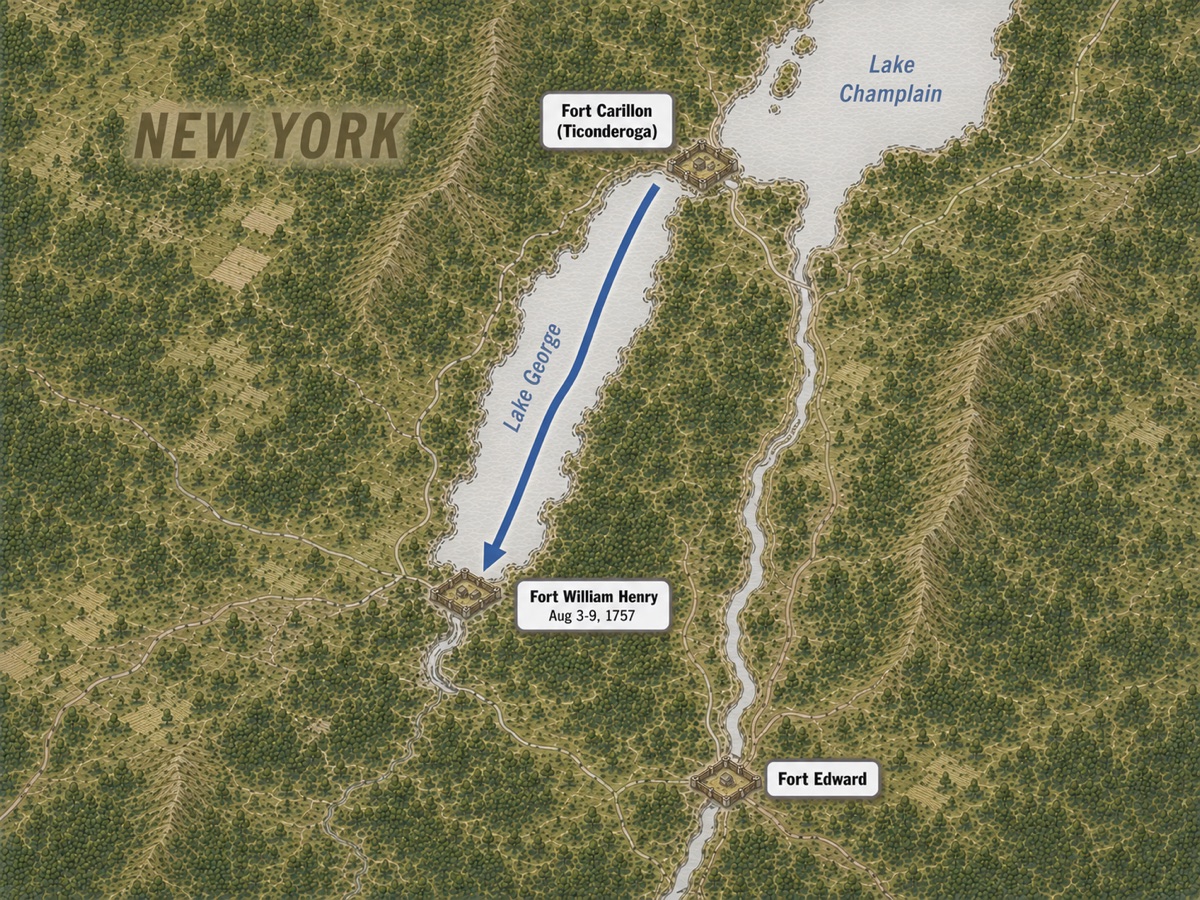
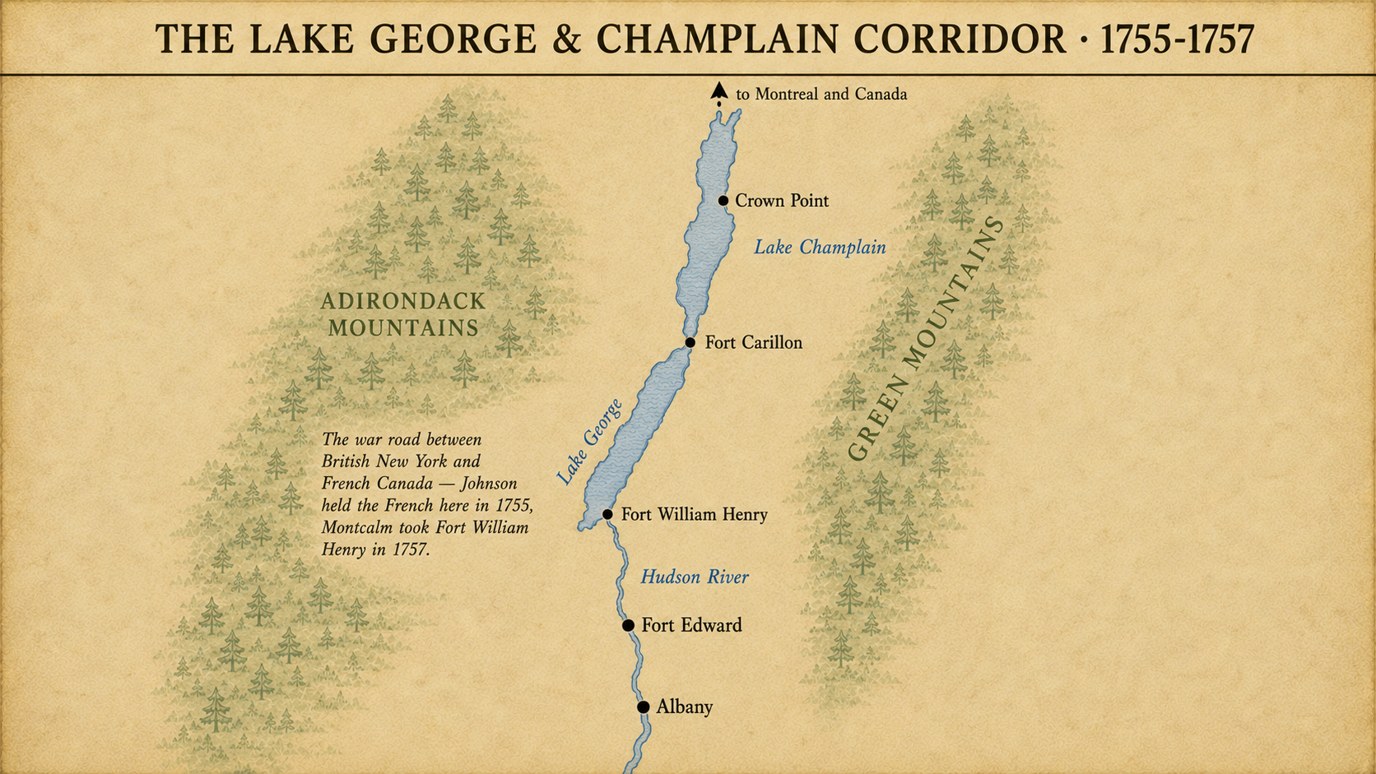
There is a narrow seam of water and land running from Albany north to Montreal, a chain of rivers and lakes threaded through the mountains, and for most of a century it was the only practical road by which a European army could march from the British colonies into the heart of French Canada, or the other way around. The Hudson River carried you up from Albany. Then came a portage, then Lake George, then Lake Champlain, then the Richelieu River, and at the far end, Montreal. Whoever held this Lake George–Champlain corridor held the door between the two empires. So both sides nailed forts across it, like men slamming bolts on a contested gate.
Fort William Henry was one of those bolts. The British built it in the fall of 1755 at the southern tip of Lake George, the work of an engineer named William Eyre of the 44th Foot, on the orders of Sir William Johnson, who had just won the Battle of Lake George there that September and wanted to plant the victory in timber and earth. They named it for a son and a grandson of King George II, Prince William, Duke of Cumberland, and Prince William Henry, Duke of Gloucester. Sixteen miles (26 km) to the south, on the Hudson, sat its larger partner, Fort Edward. Together the two forts were supposed to be the British south anchor of the corridor: hold these, and a French army could not come down the lake and out into the colonies. Lose them, and the road to Albany lay open.
The BattlesLake George (1755), the victory the fort was built to keepThat was the theory. The trouble, in August 1757, was that the man who could decide whether Fort William Henry lived or died was not inside it. He was sixteen miles away at Fort Edward, and his name was Brigadier General Daniel Webb (British). Webb commanded the troops who would have to march north to break any siege. Inside Fort William Henry and its outlying entrenched camp were perhaps 2,300 to 2,500 men under Lieutenant Colonel George Monro (British) of the 35th Foot, a mix of British regulars, provincials raised in Connecticut, New Jersey, and Massachusetts, some men of the 60th Royal Americans, and several hundred sick, including cases of smallpox. They were a garrison, not a field army. If a serious force came down the lake, they could hold the walls only as long as relief was coming. Everything turned on Webb.
And a serious force was coming down the lake. From Fort Carillon, the French stronghold to the north that the British called Ticonderoga, Major General the Marquis de Montcalm (French) was moving south with roughly 7,600 to 8,000 men, carried by some 250 bateaux (flat-bottomed boats) and about 150 canoes: around 3,000 French regulars, around 3,000 Canadian militia, a full siege train of heavy cannon, and nearly 2,000 Native allies. That last number was the one that should have frightened the British most, because it was the largest Native force assembled in the whole war.
It is worth slowing down on who those allies were, because the popular memory of this campaign turns them into a faceless horde, and they were nothing of the kind. They came from no fewer than thirty to thirty-three distinct nations, gathered into two broad groups. One was made up of the so-called far nations of the pays d’en haut, the Great Lakes upper country: roughly 979 warriors who were Ottawa, Ojibwe, Menominee, Potawatomi, Winnebago, Sauk and Fox, with a few Miami and Delaware and around ten Iowa among them. Some of these men had travelled close to 1,500 miles to be there. The other group, around 820 warriors, came from the mission or domiciled communities nearer the French settlements, Native peoples who had settled near the French towns, many of them Catholic converts: Nipissing, Abenaki, Caughnawaga Mohawk from Kahnawake, Huron-Petun, Malecite, and Mi’kmaq. The Great Lakes war leader Charles de Langlade helped bring the far nations together. Each of these peoples had its own reasons for marching, its own leaders, its own understanding of what it was owed for coming. They were not Montcalm’s instrument. They were his allies, which is a different and more complicated thing, and the difference is the whole story of what was about to happen.
So the pieces were set. A fort that could only survive if relieved. A general sixteen miles away who held the relief in his hands. And coming down the lake, the largest army New France would ever field, with the largest Native force of the war at its head.
Off the fieldThe contest for Native alliances