When the British colonists named their war, they named it for their enemies: the French and Indian War. But that name hides the most important thing about it. The "Indians" were not one enemy. They fought on every side of the war, and most of all they fought for themselves, for nations that had held the interior of the continent for far longer than either European empire had existed. Britain won the war in 1763. And almost the moment it did, the Native nations of the Great Lakes and the Ohio Valley rose against the victor in the largest coordinated war for their own land and sovereignty that North America had yet seen.
To understand why, you have to understand what Britain's victory took away.
A Game With Two Empires, Then One
For generations the nations of what the French called the pays d'en haut (the "upper country," the Great Lakes interior) had survived by a simple, brutal piece of statecraft: they played two European empires against each other. France and Britain both wanted the interior. Neither could hold it alone. Both needed Native allies, Native guides, Native warriors, and Native permission to trade. That need was leverage. A nation that France treated badly could lean toward Britain, and the reverse, and so neither empire could simply take what it wanted. The balance kept the interior in Native hands.
The British conquest of New France (France's North American colony, centered on the St. Lawrence River) smashed that balance. Quebec fell in September 1759 after the battle on the Plains of Abraham. Montreal capitulated in September 1760, ending French Canada in all but name. And on February 10, 1763, the Treaty of Paris formally handed Canada and every French claim east of the Mississippi to Britain.
For the nations of the interior, this was a catastrophe before a single shot of the new war was fired. With France gone, there was no second empire to lean toward. The diplomacy that had protected them for a century evaporated overnight. They now faced a single victorious power that had decided it had won them, too, as if they had been French property to hand over.
Off the fieldThe Contest for Native AlliancesAmherst Pulls the Alliance Apart
The man in charge of that single power was General Jeffery Amherst, the British commander-in-chief in North America. He looked at the Native nations and saw conquered subjects, not allies, and he changed three things that mattered enormously.
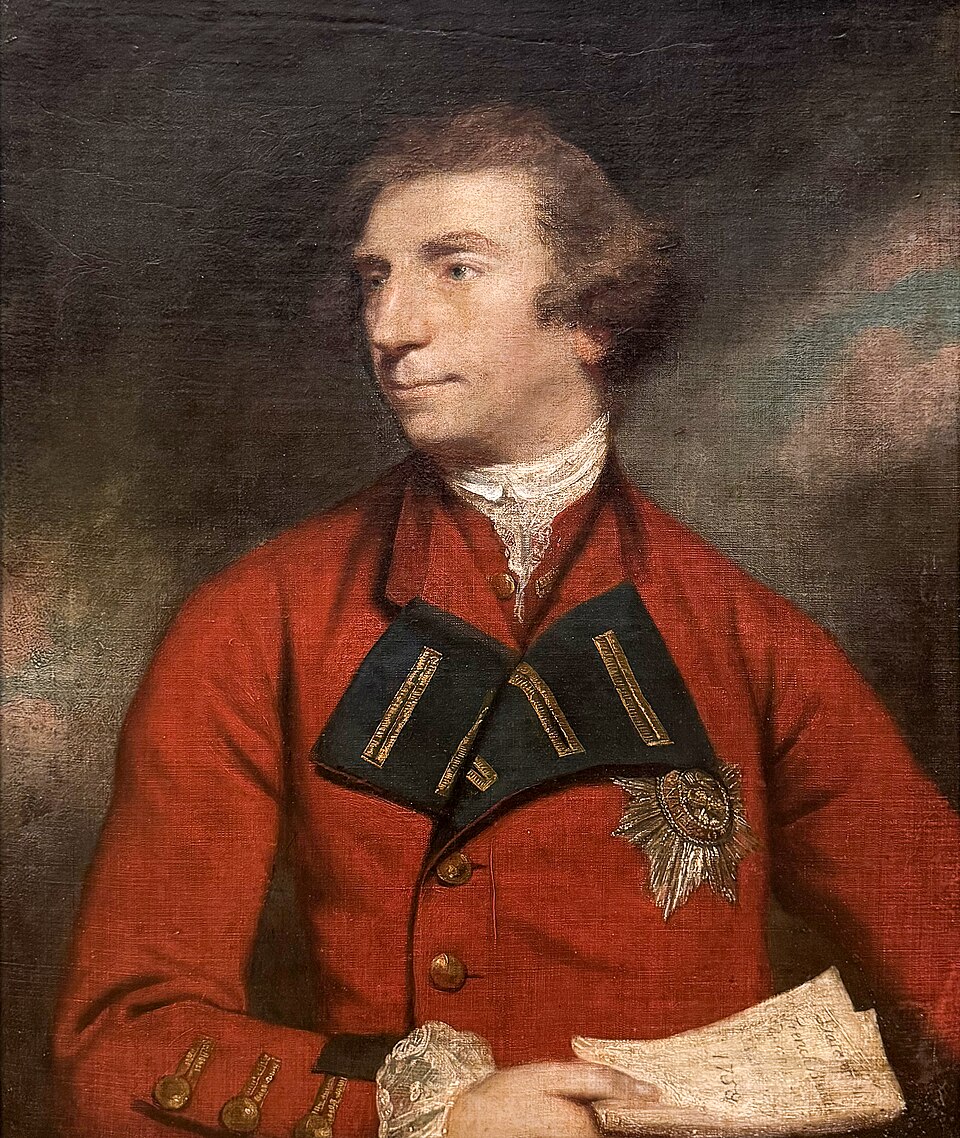
First, he ended the gift-giving. In Native diplomacy, the annual presents (guns, knives, ammunition, tobacco, clothing) were not bribes and were never understood as bribes. The giving of gifts was the alliance. It renewed the relationship every year, an act of respect that said the parties were still bound to each other. The French had practiced it for generations because they understood what it meant. Amherst looked at the same gifts and saw money spent buying good behavior, and around 1761 he started shutting it off. Many of the nations read this exactly as it was meant: the British now looked on them as a conquered people rather than as friends.
Second, he restricted the sale of gunpowder and lead shot. This was not a small economy measure. Native men hunted with guns. Powder and shot were the foundation of the food supply and of the fur trade that bought everything else. Cutting them off threatened survival itself, and to the nations it looked like the first step of something worse, a prelude to further conquest. In an August letter to William Johnson (the superintendent of Indian affairs), Amherst told him to stop "purchasing the good behavior of the Indians" and to keep ammunition out of their hands, plainly afraid they would turn the powder back on the British.
And third, where the policies could be argued as economy or caution, this last thing could not: he made no secret of his contempt. British officers barely bothered to hide it, and the nations said openly that they were being treated no better than slaves or dogs.
"extirpate this execrable race." — Jeffery Amherst, July 16, 1763 (writing to Colonel Henry Bouquet)
That word, "extirpate," meaning to wipe out completely, was not a slip of temper. It came in the middle of a written plan we will return to. For now it is enough to know the temper of the man who held the interior in his hand.
The Prophet
Into that anger came a voice that gave it shape. Neolin, whose name meant "the Enlightened One," was a Lenape (Delaware) holy man. Around 1761, after a long fast and a season of dreaming, he said he had traveled in a vision to the Master of Life, the being his people understood as the one who had thought the world into being.
The Master of Life, Neolin said, was angry. The people had grown dependent on European goods, on rum, on the trade that bound them to strangers, and they had forgotten how to live. The way back was to turn away from all of it: reject the trade goods, put down the alcohol, return to the old ways their grandparents had known, and drive the British out. Neolin's message wove together Christian and traditional threads, and it spread fast across the Ohio and the Great Lakes. It gave the coming rising something an empire could not match: a reason that reached past politics into the spirit.
The words that survive come to us secondhand. A French chronicler at Detroit wrote down the vision as Pontiac (Obwandiyag) of the Odawa recited it to a war council in 1763, retelling the prophet's journey to rally warriors. So this is the Master of Life, as remembered by Neolin, as recited by Pontiac, as written down and translated by a colonial hand. It is not a transcript. But its force comes through anyway.
"This land where ye dwell I have made for you and not for others. Whence comes it that ye permit the Whites upon your lands? ... Before those whom you call your brothers came on your lands, did you not live by bow and arrow? You had no need of gun nor powder ... and yet you caught animals to live upon." — the Master of Life, as recited by Pontiac from Neolin's vision, recorded at Detroit, 1763
A Coalition, Not a King
History gave this war one man's name, "Pontiac's War," and the name is misleading. Pontiac (Obwandiyag) was a war chief of the Odawa (Ottawa) and one of the most prominent figures of the rising at Detroit. He was not its supreme commander, because there was no supreme commander. This was a broad, decentralized coalition of many nations, each rising for its own reasons across a thousand miles of country. Among them were the Odawa, the Ojibwe, the Potawatomi, the Wyandot (Huron), the Lenape (Delaware), the Shawnee, and the Seneca/Mingo, along with the Miami, the Wea, the Kickapoo, the Mascouten, and others. Leaders rose with them: Guyasuta (Seneca/Mingo), and Charlot Kaské (Shawnee), the most uncompromising of all, who would later cross the Mississippi rather than make peace.
On April 27, 1763, Pontiac held a war council on the Ecorse River, about 10 miles (16 km) southwest of Fort Detroit. He stood and retold Neolin's vision, and turned the prophet's spiritual message toward war.
"It is important for us, my brothers, that we exterminate from our lands this nation which seeks only to destroy us." — Pontiac, war council, April 1763 (a translated summary of the recorded speech)
On May 1 he walked into Fort Detroit with about fifty Odawa, supposedly to dance for the garrison (the soldiers posted to hold the fort), in fact to count its soldiers and study its walls. On May 7 he came back to seize the fort by surprise, and found the commander, Henry Gladwin, waiting and warned. The surprise failed. So Pontiac settled in for a siege instead, and the war was on.
Eight Forts in a Summer
Then the British chain of forts began to fall, post after post, faster than any messenger could carry the news. In a matter of weeks the coalition took about eight of the roughly twelve British posts strung across the Great Lakes and the Ohio. Almost none of them fell to a frontal assault. They fell to nerve and deception, to garrisons that opened their gates because they had no idea the war had reached them.
Sandusky, in Ohio, fell on May 16 when Wyandots gained entry under cover of a friendly council, then killed some fifteen soldiers and burned the place. St. Joseph, in Michigan, went on May 25 to Potawatomis using the same trick, most of its fifteen-man garrison killed. At Fort Miami, in Indiana, on May 27, the commander was lured outside by a Miami woman and his nine men gave up. Ouiatenon, also in Indiana, fell on June 1 when Weas, Kickapoos, and Mascoutens took its roughly twenty men without a drop of blood. Venango, in Pennsylvania, fell in mid-June with its entire garrison of about a dozen killed by Senecas. Le Boeuf burned on June 18, though most of its dozen men escaped toward Fort Pitt. Presque Isle held two days against some 250 warriors before surrendering on June 19 and 20.
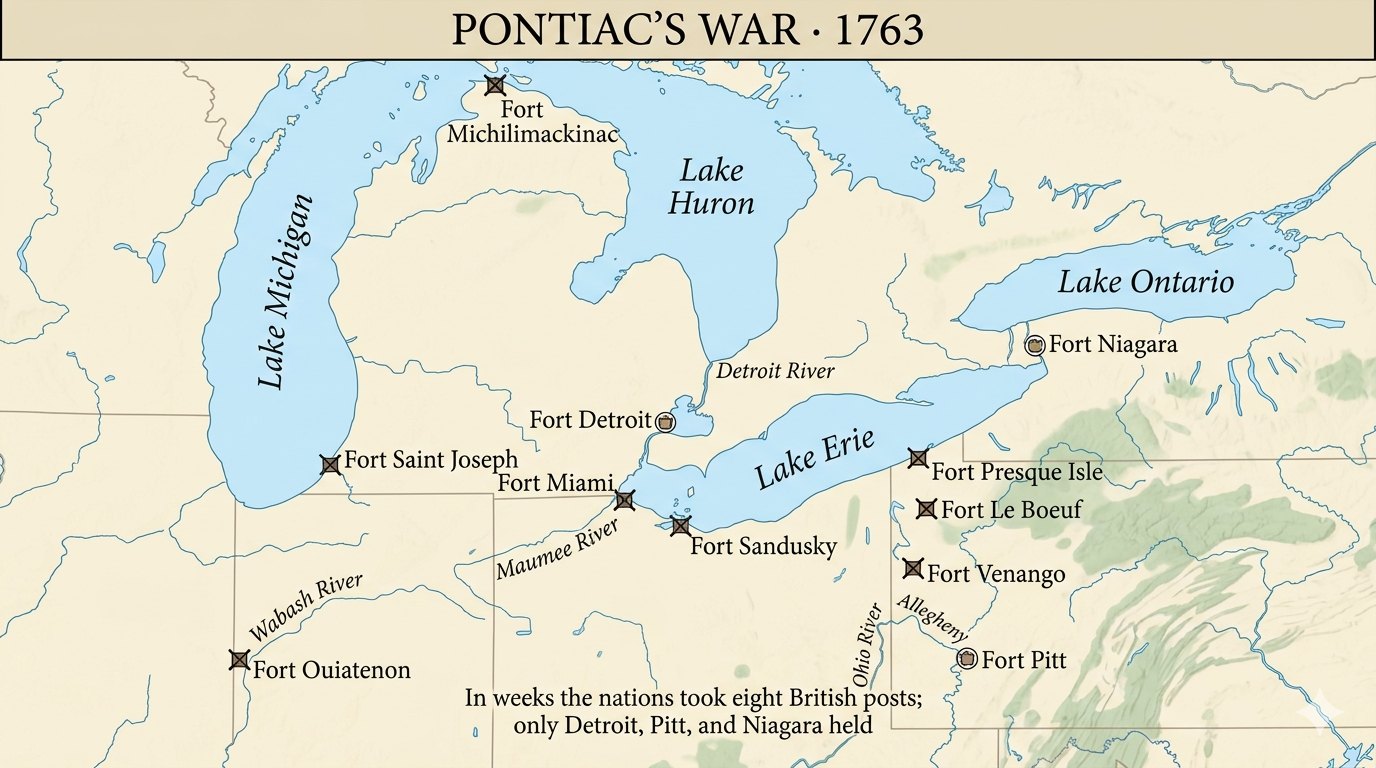
The most famous capture of all came at Fort Michilimackinac, on the strait between Lakes Michigan and Huron, in early June. The Ojibwe staged a game of baggataway (the stick-and-ball game the French called lacrosse) outside the walls to mark the king's birthday. The soldiers came out to watch, gates open, guard down. A player sent the ball arcing toward the palisade, and the players sprinted after it as if it were nothing but the game. At the wall, the women who had been standing by handed the warriors the weapons they had carried in hidden under their blankets, and the players became a war party in an instant. Roughly half the thirty-five-man garrison was killed; the rest were taken. It worked because the British could not imagine the people they had insulted were already at war with them.
The Two That Held
Two prizes did not fall: Fort Detroit and Fort Pitt, the largest and most important posts on the frontier. Both went under long, grinding sieges, and around both the war turned its ugliest.
At Detroit the siege had begun around May 9. It dragged through the summer. On the night of July 31, a British captain named James Dalyell led about 250 men out of the fort in a sortie meant to break the encirclement. The coalition was ready. They ambushed the column at a creek called Parent's Creek, killed roughly twenty British including Dalyell himself, and left the water running red. Colonists called the place Bloody Run ever after. It was a clear coalition victory, and it changed nothing decisive: the garrison held. Pontiac kept the siege up until October 31, when word came that the French would send no help after all, and his warriors melted away to the winter hunting grounds. The longest siege of the war ended not in a storm but in a slow draining of hope that France would ever return.
Fort Pitt, where the Ohio's three rivers meet, was besieged from about June 22. Inside its walls were some 550 people, more than 200 of them women and children, packed together under the command of Captain Simeon Ecuyer. And inside the crowded fort, smallpox was already loose.
The Blankets
What happened next at Fort Pitt is one of the documented attempts by a European power to use disease deliberately as a weapon of war.
During a parley on June 24, 1763, the British handed the besieging Lenape (Delaware) emissaries a few items taken straight from the fort's smallpox hospital. The trader William Trent wrote it down in his journal without a flicker of shame.
"Out of our regard to them, we gave them two Blankets and an Handkerchief out of the Small Pox Hospital. I hope it will have the desired effect." — William Trent's journal, 1763
This was not one trader's improvisation. The supply invoice billed the items as having been "taken from people in the Hospital to Convey the Smallpox to the Indians," and the fort later reimbursed Trent for them, which means the command signed off on it on paper. And independently, weeks later, the commanding general was putting the very same idea into his own letters. Around early July, Amherst wrote to Colonel Henry Bouquet:
"Could it not be contrived to send the small pox among the disaffected tribes of Indians? We must on this occasion use every stratagem in our power to reduce them." — Jeffery Amherst to Colonel Henry Bouquet, c. July 1763
Bouquet wrote back that he would try to spread it by means of blankets that might fall into Native hands, while taking care not to catch it himself. Amherst replied on July 16 approving the plan, in the letter with the word "execrable race" in it. The gift at the fort on June 24 and the general's letters in July were separate events, and it matters that they were. The act on the ground happened, and the man at the top of the army independently endorsed exactly the same tactic in writing. Neither one is in doubt.
What is debated is whether these particular blankets did anything. Smallpox was already circulating among the nations around Fort Pitt that spring and summer, which means the epidemic that followed cannot be cleanly pinned on the gift. The infected material may also have been too old to carry the disease at all. The historian Philip Ranlet argues there is no evidence the scheme actually worked; other scholars think it may well have. So the honest line is this: the British tried to use smallpox as a weapon, and their commanding general put it in writing, and whether these specific blankets spread the disease is something historians still argue over. The intent is not in question. Only the result is.
The Conestoga
The army's intent to wipe out Native people was on paper, in Amherst's letters and the blanket invoice. That same winter, on the Pennsylvania frontier, colonists carried it out against a Native town that had nothing to do with the war at all.
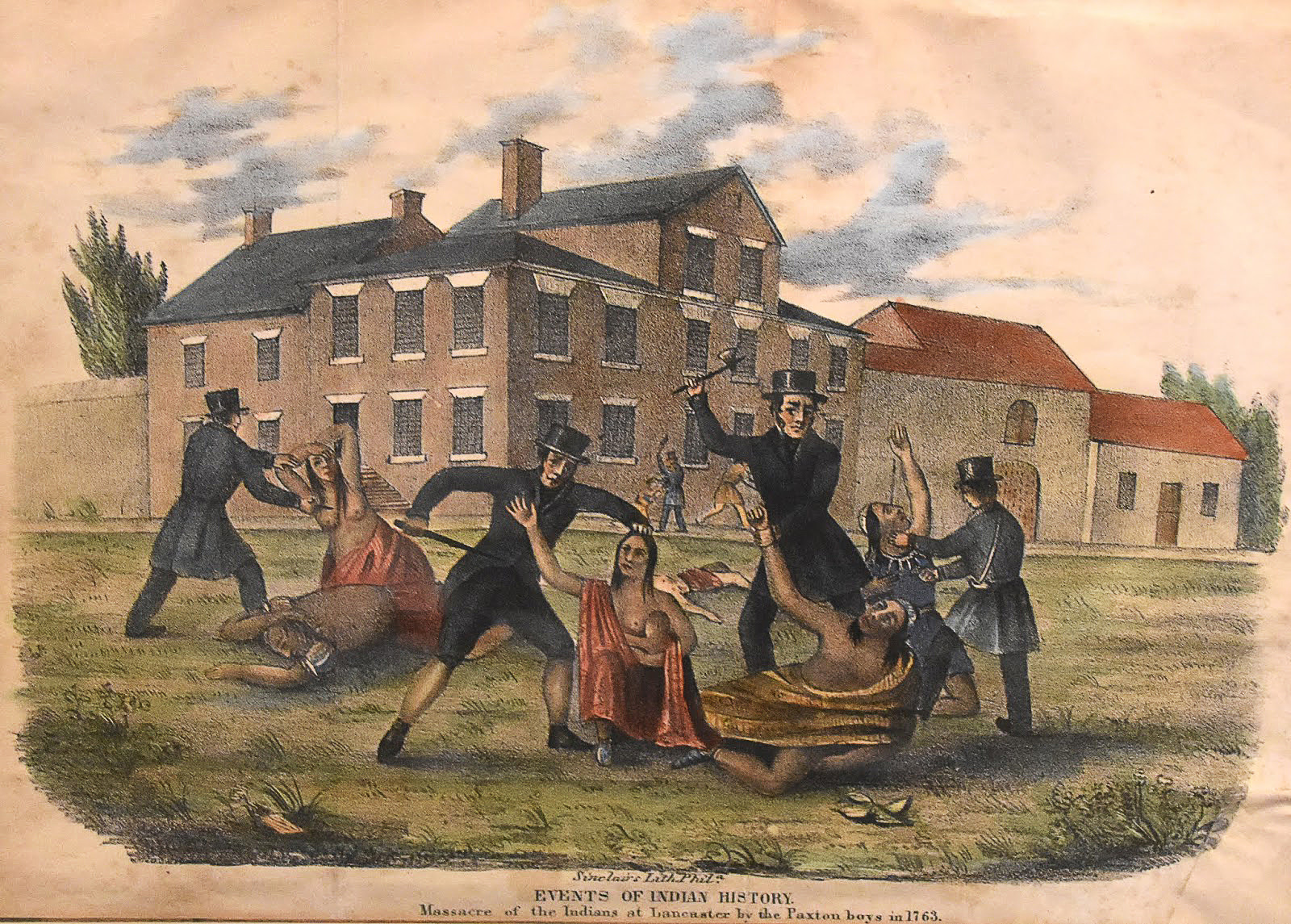
The Conestoga were a small community descended from the Susquehannock, living near Lancaster, Pennsylvania, under the colony's protection in a relationship that ran back to a treaty with William Penn. They had lived peacefully alongside their colonial neighbors for decades, and they stayed neutral through both the Seven Years' War and Pontiac's War. They were not combatants. They were not part of the rising. By 1763 they could no longer even hunt safely to feed themselves, for fear of being mistaken for hostile warriors. Against them came the Paxton Boys, a vigilante mob of Scots-Irish frontiersmen from the Paxtang hill country northwest of Lancaster. In the frontier panic the war had whipped up, they blamed all Native people indiscriminately and made no distinction between the nations actually at war and the neutral, peaceful Conestoga. Their justification, that the Conestoga were secretly aiding the Lenape and Shawnee raiding the frontier, was fabricated.
On December 14, 1763, about fifty Paxton Boys rode into Conestoga Town, killed and scalped the six people they found there, and burned the village. The roughly fourteen survivors, who had been away, including women and children, were placed for their safety in protective custody in the Lancaster workhouse. It did not save them. On December 27 the Paxton Boys broke into the workhouse and murdered them all, about twenty Conestoga dead in total, and the community was ended. In February 1764 several hundred Paxton Boys marched on Philadelphia meaning to kill the Native people sheltering there too. A delegation led by Benjamin Franklin met them and turned them back, on a promise that their grievances would be heard. No one was ever convicted of the murders. The accusation that the Conestoga had been spies was never anything but a lie. The empire had written down its wish to be rid of Native people; here, in the same months, settlers made it real against a town that had only ever kept the peace.
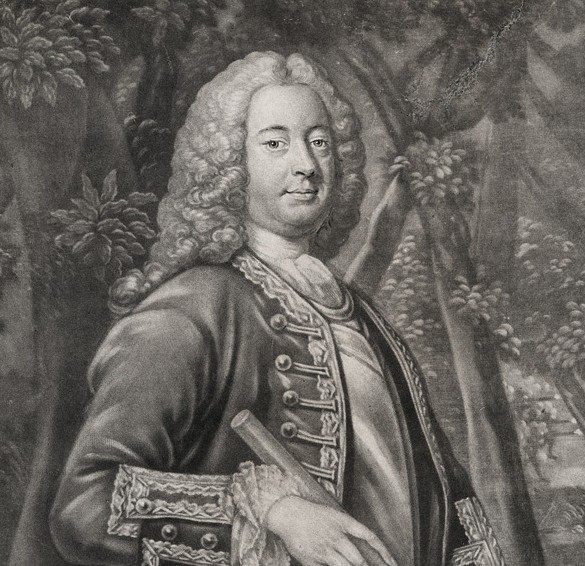
Relief finally fought its way through to Fort Pitt. Colonel Bouquet, marching some 500 men toward the fort, was intercepted about 25 miles (40 km) east of it by a force of Lenape, Shawnee, Mingo, and Wyandot warriors. Over two brutal days on August 5 and 6, at a place called Bushy Run, Bouquet won by faking a retreat that drew the warriors into a charge, then turning on them. The victory cost him dearly, around fifty killed and sixty wounded, close to a quarter of his men, but it broke the intercepting force, and around August 20 the siege of Fort Pitt lifted.
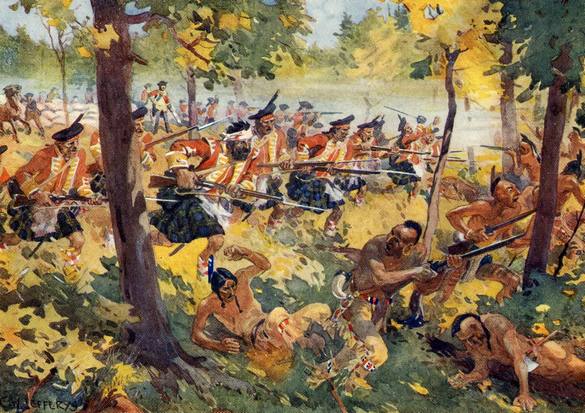
The fighting did not stop neatly even then. On September 14, at the Niagara portage (the overland carry of boats and goods between two stretches of water), Senecas ambushed a supply train and the troops sent to save it, killing more than seventy soldiers and teamsters at a spot the colonists named Devil's Hole. It was the deadliest single British loss of the war, and proof that the rising was nowhere near contained.
Nobody Could Win
By the end of 1763 the war had settled into a fact neither side could change. The nations could not take the two great forts or push the British out of the interior. The British could not conquer the nations, and could not even keep their own posts safely supplied. It was a stalemate, and the stalemate is what forced Britain to do something it would never have done from a position of comfort: back down.
Amherst was recalled to London in the autumn of 1763 and replaced as commander by General Thomas Gage. And Sir William Johnson, the same superintendent Amherst had ordered to cut off the gifts, was now authorized to restore them, to bring back the gift-giving and the patient diplomacy that the old commander had abolished. This was a deliberate, conscious reversal. The rising had proven that the alliance system could not simply be cancelled by decree, that the relationship the French had understood and Amherst had despised was the only thing that had ever made the interior governable at all.
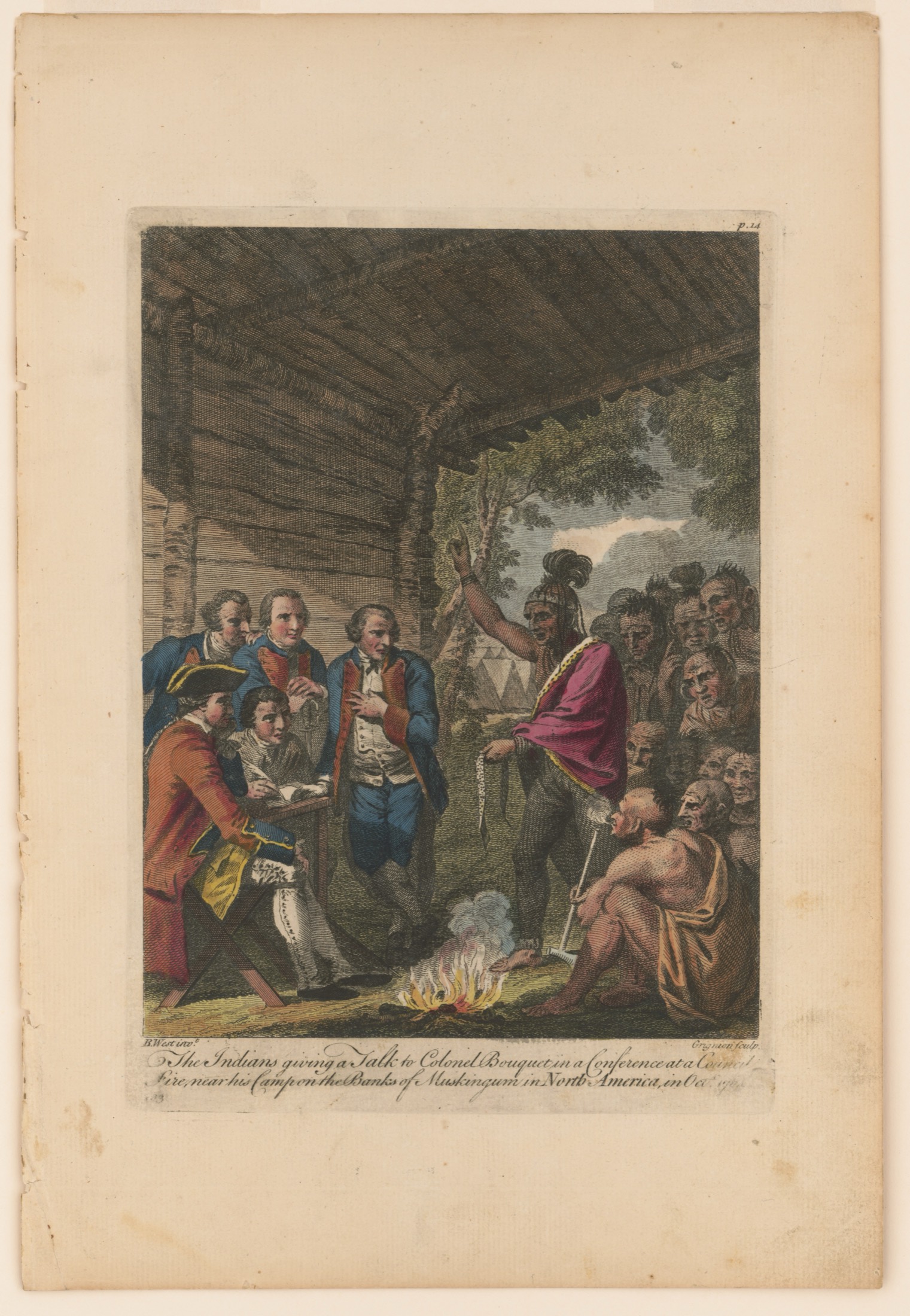
The peace came in pieces over the next two years, and it did not come all at once or in unison. The coalition nations made terms on their own timetables, and resistance lingered in the Illinois country into 1764 and 1765, where the British had not yet taken the last French fort. The Shawnee leader Charlot Kaské rejected any accommodation, sought French help as far away as New Orleans, and finally crossed the Mississippi with other refugees rather than live under British rule. The peace, like the war, was a coalition's, not a king's. At a great congress at Niagara in July and August 1764, Johnson met with around 2,000 Native people and began rebuilding relations nation by nation. That October, Bouquet marched into the Ohio country to the Muskingum River, where the Ohio nations agreed to peace and returned more than 200 captives. And on July 25, 1766, at Fort Ontario at Oswego, Pontiac himself made a formal peace with Johnson. The terms: no land was ceded, no prisoners were surrendered, no hostages were taken. Johnson treated Pontiac with exceptional deference. For a war the colonists called a rebellion, it ended remarkably like a peace between powers.
The Line on the Map
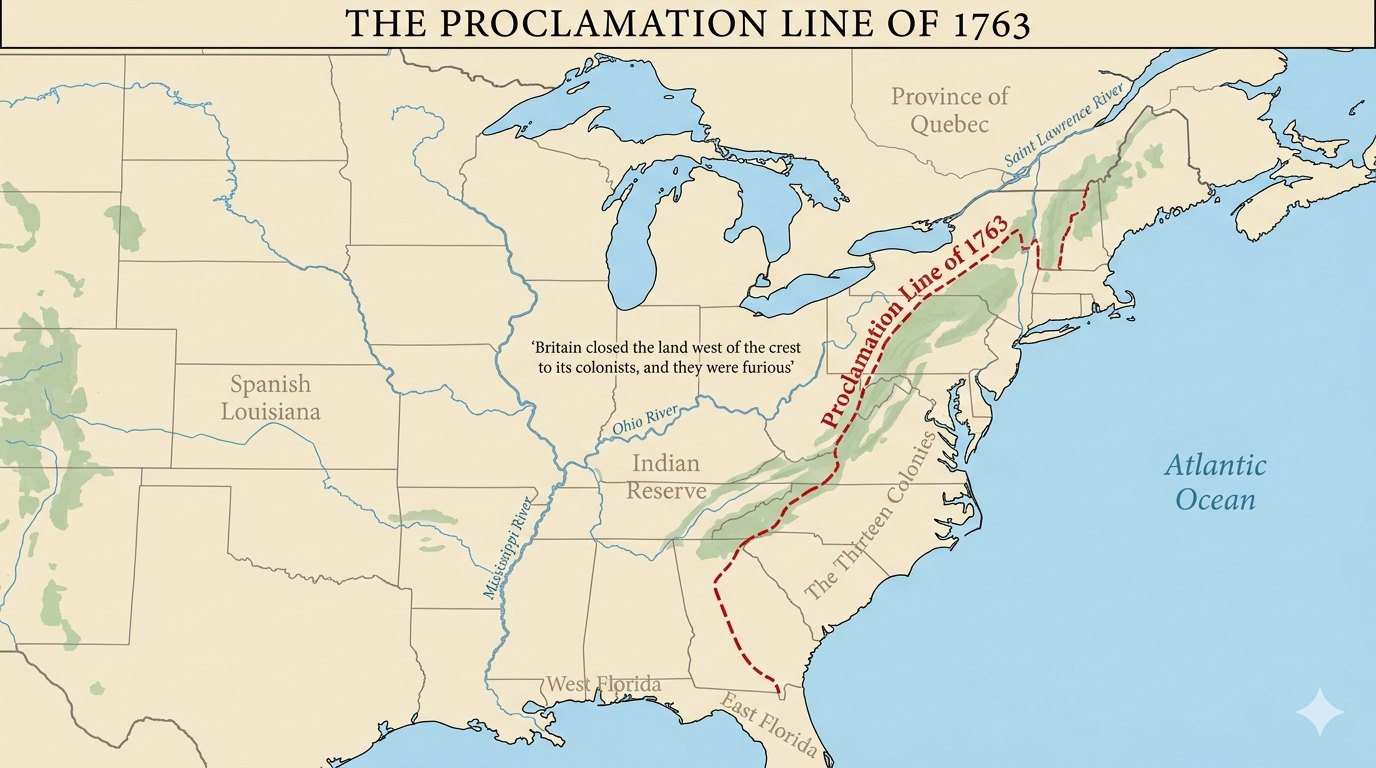
The other concession came from the king himself. On October 7, 1763, with the war still raging, George III issued the Royal Proclamation of 1763, partly to calm the frontier and reassure the very nations who were burning his forts.
The Proclamation drew a line. It ran along the crest of the Appalachian Mountains, following the watershed: rivers that drained east to the Atlantic marked land open to colonists, rivers that drained west to the Mississippi marked country reserved to the nations. West of that line, colonial settlement was barred outright, creating a vast "Indian Reserve." And to close the usual back door, it forbade private citizens from buying Native land at all; only the Crown could purchase it.
"...the several Nations or Tribes of Indians with whom We are connected, and who live under our Protection, should not be molested or disturbed in the Possession of such Parts of Our Dominions and Territories as, not having been ceded to or purchased by Us, are reserved to them ... as their Hunting Grounds." — Royal Proclamation of 1763
To settlers and land speculators (the investors who bought up frontier land cheap to resell it dear), the line was a wall thrown across their futures, and they were furious. The Proclamation ordered anyone who had already settled west of it to "forthwith to remove themselves," which almost nobody did. George Washington, who had been promised some 20,000 acres of western bounty land for his service in the war, called the line a temporary expedient and quietly told his land agent to keep securing western tracts anyway. Virginia's land companies lobbied to push the boundary west.
And that was the problem with the line: it could not be enforced. There was no army standing along a thousand miles of mountains, and settlers crossed it the moment they pleased. Later treaties shoved the boundary steadily west, opening Kentucky and what is now West Virginia. The Proclamation became one more grievance the colonists carried toward their own revolution, a king telling them where they could not go.
Off the fieldThe Treaty of Paris & the Proclamation LineWhat the Rising Won, and What It Could Not Stop
What the rising achieved was real. The nations forced the most powerful empire on earth to back down. Amherst was gone. The gift-giving and the diplomacy were restored. A royal line was drawn, on paper, to protect Native land. Pontiac made peace ceding nothing. In the long arc of these contests, this was the first great multi-nation resistance that did not end in outright defeat, a precedent that later confederacies under leaders like Joseph Brant and Tecumseh would build upon.
But underneath the concessions lay a catastrophe that no treaty could touch, because it was structural and it was permanent.
The French counterweight was gone for good. The single thing the entire war had been about, the ability to balance one empire against another, was lost and would never come back. From now on the nations of the interior faced one power, alone, with no one to lean toward when that power turned on them. The Proclamation Line that was supposed to hold settlers back was ignored from the day it was signed, and the dispossession the rising had been fought to stop simply went on, slower than before but unbroken.
The cost had fallen on everyone. The fighting killed around 400 British soldiers, with perhaps another 50 captured and killed. On the frontier, the British agent George Croghan estimated some 2,000 settlers killed or captured and around 4,000 driven from their homes, whole farming communities along the Pennsylvania and Virginia frontier emptied out. More than 200 Native warriors were killed in the fighting, and far more would have died if disease took the toll some intended. These were not abstractions. They were burned cabins and missing children on one side and bodies left on the portages and around the forts on the other.
Off the fieldThe Contest for Native AlliancesWhat has to be held onto is whose war this was and what it was about. The nations had never been conquered, never been consulted, and never agreed to belong to anyone. When the Treaty of Paris handed their country from one king to another as if it were a French estate, they answered with the largest war they could mount, not as rebels against a rightful master but as nations defending their own land against an empire that had simply decided it owned them. They won the battle to be treated as nations again. They could not win the longer war over the land itself, because the empire that had once needed them no longer did, and the settlers behind it never stopped coming.
Off the fieldWar Finance & the Road to Taxation