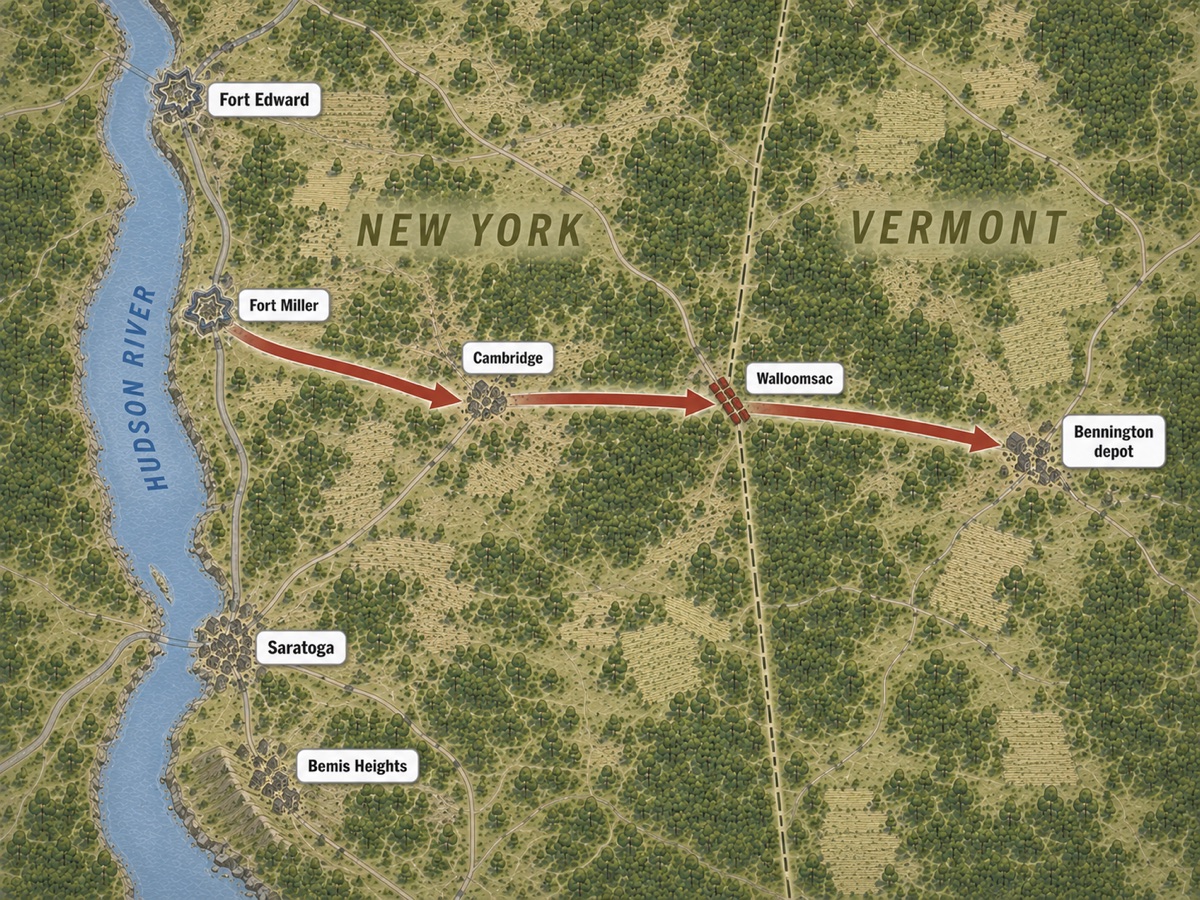
In the high summer of 1777 the British war plan was an army moving south. Lieutenant General John Burgoyne (British) had brought an invasion force of about 7,500 to 8,000 men down from Canada, taken Fort Ticonderoga (the fortress on the route south from Canada) on the way, and pushed on toward Albany on the Hudson River in New York. On a map it looked unstoppable. In a ledger it was in trouble, because an army has to eat, and Burgoyne's was now sitting at the end of a supply line that ran roughly 150 miles back through wilderness to Canada. His deputy quartermaster (his supply officer), Captain John Money, ran the arithmetic: under the best conditions the carts and boats on hand could bring only about four days' worth of provisions forward to Fort Edward (the army's forward depot on the Hudson) at a time, and as little as one day's worth at worst. Just shifting the army's depots 13 miles down the river toward Saratoga was estimated at some fifteen days of hauling. The army was short of carts, short of draft animals, short of boats. It could fight anything in front of it and was slowly being defeated by its own wagon train.
Burgoyne would say it himself, in a letter to the government in London written four days after the raid that came of all this had already failed. What he needed was transport and food on the hoof, a way to stop living off distant supply depots (his "magazines," in the language of the day).
The possession of the cattle and carriages would certainly have enabled the army to leave their distant magazines, and to have acted with energy and dispatch.
And there was one more shortage, almost comic if the raid it spawned had not ended with most of a thousand men dead, wounded, or captured. The army's German cavalry, the Brunswick dragoon regiment Prinz Ludwig (dragoons were heavy cavalry; Brunswick was one of the German states whose troops served with the British army in this war), had no horses. None. An entire regiment of horsemen had been walking from Canada in their high riding boots, carrying their long, straight broadswords on foot. Mounting them was written into the expedition's purpose, right alongside seizing draft horses, cattle, carts, and flour.
So a raid was born. The original idea, associated with Major General Friedrich Adolf Riedesel (the Brunswick officer commanding the army's German division), aimed at the Connecticut River valley, horse country. Burgoyne redirected the strike at Bennington, a town in the Hampshire Grants (the disputed frontier territory that is now Vermont), after intelligence reached him that the rebel supply depot there was lightly held, by reportedly only about 400 demoralized militia (militia were part-time citizen soldiers, farmers and tradesmen called out from home for an emergency, not professional troops). The depot was real enough: corn, flour, cattle, and horses, gathered for the American army. The rest of the intelligence was a disaster in two layers. The first layer said the depot was weak. The second said the countryside was thick with friendly Loyalists (Americans who sided with the king) who would rise and join the column as it marched. Both were wrong.
The man sent to do it was Lieutenant Colonel Friedrich Baum (German, in British service), commander of those horseless dragoons. His column, about 800 men at the start and growing as Loyalist volunteers attached themselves along the way, was a strange force: somewhere around 170 to 205 dismounted Brunswick dragoons, the very men the horses were for, marching in their boots; a few hundred Loyalists, Canadians, and Native warriors; and a sprinkling of British marksmen, German light infantry, and German gunners with two light cannon. By the standard account Baum himself spoke no English, and roughly half his column did not either. Orders moved through translation. This was the instrument Burgoyne sent into a countryside he had been told was friendly.
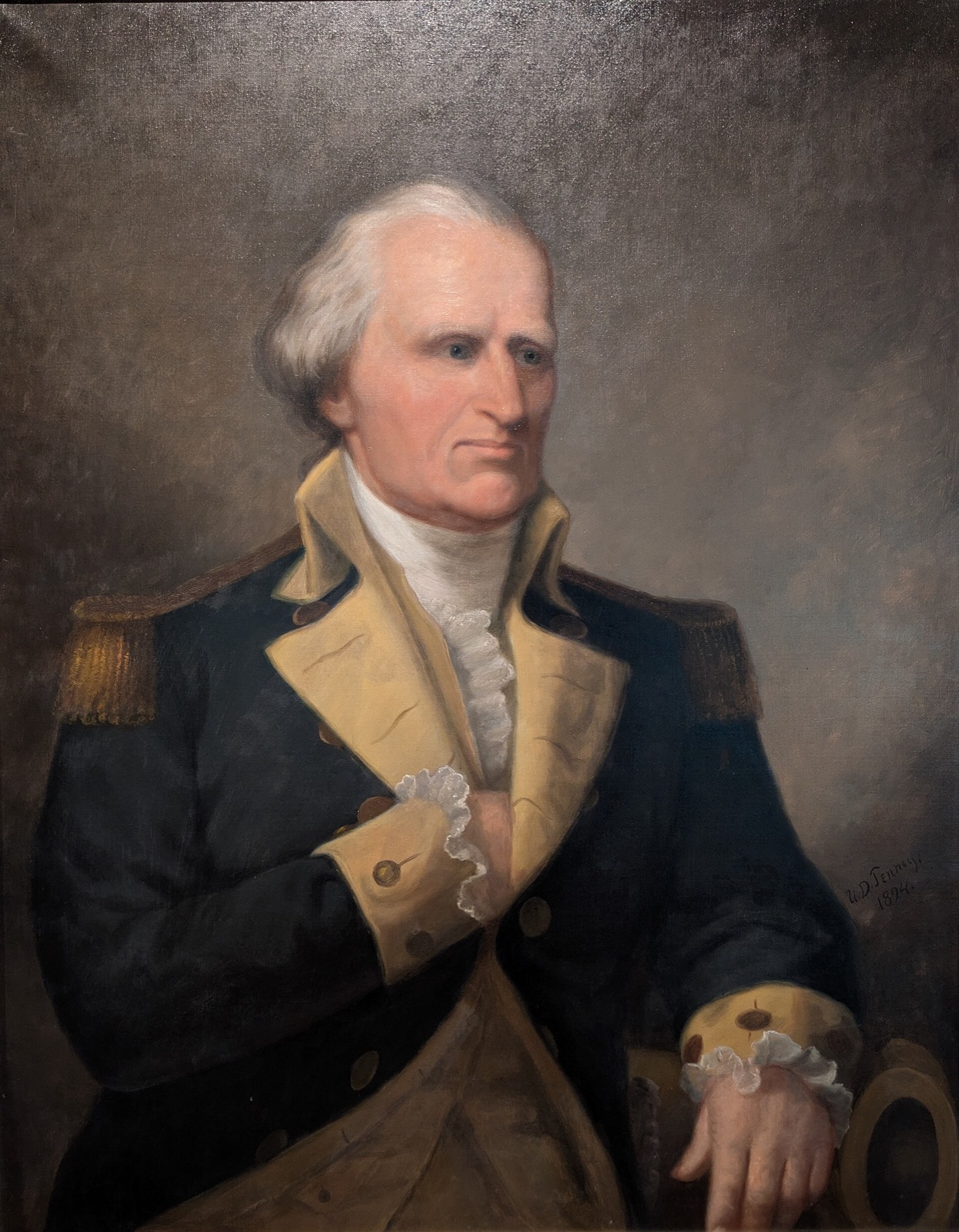
What was actually waiting at Bennington was John Stark (American). Stark was a New Hampshire man, a veteran of the French and Indian War's ranger companies (light troops trained for scouting and woods fighting), and the colonel whose regiment had held the rail fence at Bunker Hill in 1775 and wrecked the British flank attack there. He was also, by the summer of 1777, one of the angriest officers in America. That winter the Continental Congress had promoted junior officers to brigadier general over his head, and Stark had resigned his commission in the Continental Army (the new full-time American regular army, run by Congress) and gone home, declaring, as the story was told, that an officer who would not stand up for his own rights ought not to stand for the rights of his country. When New Hampshire raised a militia brigade in July 1777, about 1,500 men gathered in roughly a week, Stark agreed to command it on one condition: he answered to New Hampshire alone, not to Congress and not to Continental generals. Days before the battle that independence got its test, when orders came for him to march his brigade to the Hudson and join the main American army. He refused, and stayed to cover Bennington.
In the second week of August, Baum's column left the British camp on the Hudson and marched east through Cambridge, New York, about 25 miles of road toward the depot. On August 14, at a mill on a branch of the Walloomsac River (the small river the battle would be fought along), his advance guard ran into Stark's scouting parties, who fired, fell back, and broke down the bridge behind them. Baum could count. The force in front of him was not 400 demoralized militia. He sent a rider back to Burgoyne asking for reinforcements, kept advancing a little farther, and then stopped, dug in, and waited for help on a hill above the river, about 10 miles short of Bennington.