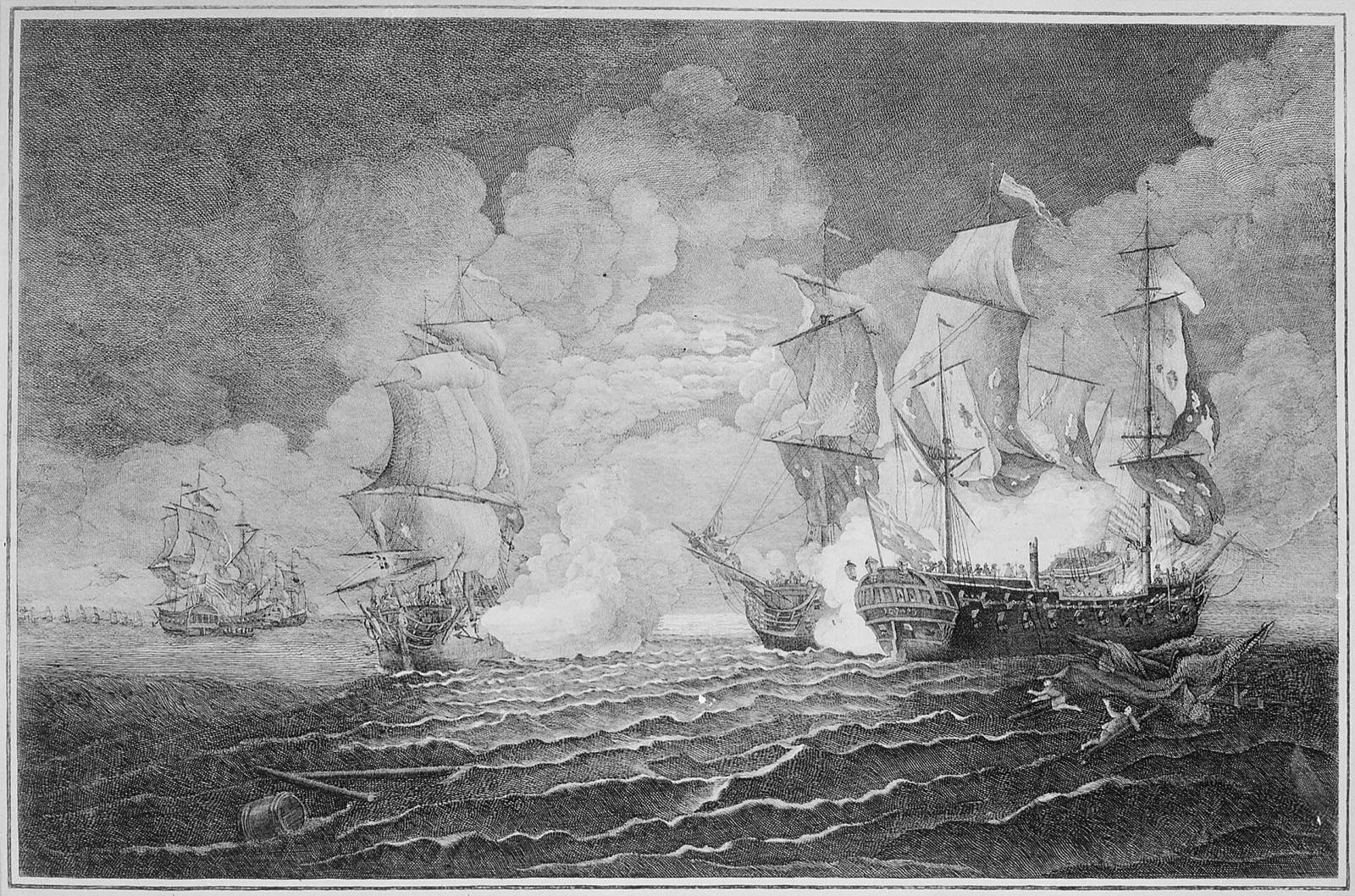
The American navy never tried to win the war at sea, because it could not. Britain owned the ocean. The Royal Navy moved British armies across it, supplied them, and blockaded the American coast, and the handful of ships the Continental Congress could float were never going to fight that fleet for command of the water. A naval squadron was a handful of ships sailing together; Britain's fleet was hundreds of warships, the sea itself. So the American naval war became something else: commerce raiding (preying on merchant shipping), privateering (private armed ships licensed to take enemy vessels for profit), and, above all, propaganda. The job was to make the ocean expensive and embarrassing for Britain, to carry the war to her own coasts and humiliate her there, until a real navy joined the fight. France had allied with the Americans in 1778; Spain came in during the summer of 1779; and that summer a combined Franco-Spanish fleet was maneuvering in the English Channel in an invasion scare. Britain's home coasts were already jumpy before John Paul Jones (American) ever appeared off them. His cruise landed on nerves that were frayed before he arrived.
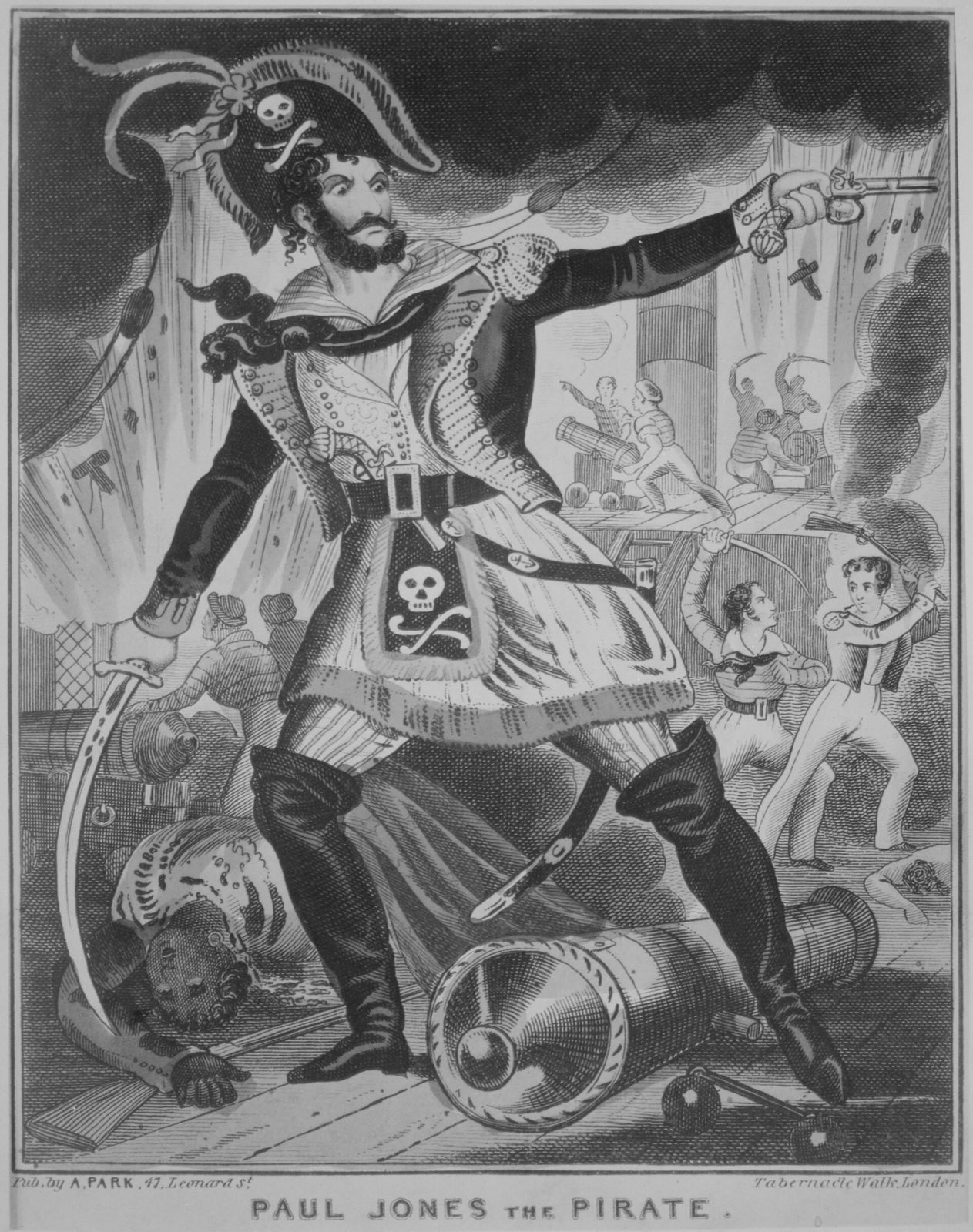
Jones was the man for that kind of war, and he was not an easy man. He had been born plain John Paul in 1747, a gardener's son on the Solway coast of Scotland, the same firth he would one day raid. He went to sea at about thirteen, rose to merchant captain, and added "Jones" to his name after a bad business in 1773: he killed a mutinous sailor at Tobago, in the West Indies, called it self-defense, and fled to America rather than stand trial. In the Continental Navy he made himself its most aggressive captain, and to the British press its favorite villain. They drew him in the print shops as "Paul Jones the Pirate," a brigand under no lawful flag. The legal charge was simpler than the moral one. Britain had not recognized the United States as a nation, and so did not recognize a Continental Navy commission as a lawful flag at all. To British admiralty law Jones sailed under no recognized authority, which made him a pirate by their definition, and that was not just Grub Street talk: it was the position of the British government, which would later demand he be handed over as a pirate wherever he turned up. The reputation was not entirely unearned. In 1778, in the small warship Ranger, he had carried the war into British home waters: a night raid on the harbor of Whitehaven, on England's own northwest coast, the first hostile landing on English soil in roughly a century, materially trivial but loud out of all proportion; a bungled attempt the same day to kidnap a Scottish earl as a hostage, which ended with his crew, against his wishes, making off with the family silver as the only prize on offer, and Jones later buying it back at his own expense and returning it with a famously florid apology letter that did his own reputation no harm at all; and, the next morning, the capture of a Royal Navy warship off the Irish coast in about an hour, an American beating a British warship in a fair fight. He was vain, prickly, chivalrous, and ferociously brave, all at once.
France had bought him his ship. It was a tired one: an old East Indiaman, a merchant ship built in 1765 for the long trade run to India, worn out from two voyages to China, that Louis XVI's government purchased and handed to Jones early that year. Jones renamed her Bonhomme Richard, "Good-man Richard" or "Poor Richard," in honor of Benjamin Franklin, the American minister in Paris, whose Poor Richard's Almanack circulated in France under that name. She mounted about forty guns, an awkward mix that included six old eighteen-pounders (cannon throwing an eighteen-pound iron ball, the heaviest aboard) crammed into a low battery near the waterline. She was old and slow, and Jones's own report would call her "the good old Ship." Around her sailed a small squadron, all under American colors and all paid for with French money: the Continental frigate Alliance (a fast new American warship of 36 guns, given to the cause by France) under the French captain Pierre Landais; the French Pallas (32) under Denis-Nicolas Cottineau; and the small brig Vengeance (12). They had sailed from France in August 1779 with one weakness baked in from the start. Before leaving, the captains had signed an agreement that left each of them nearly independent of Jones, who was commodore (the squadron's commander) in little more than name. He could give orders. Whether his captains obeyed them was, by the paperwork, up to the captains. He had accepted those terms to get the cruise; the French money came with strings, and a man impatient to sail rather than haggle had signed them. He got both the cruise and the strings. Hold onto that. It explains the worst thing that happened in the battle.
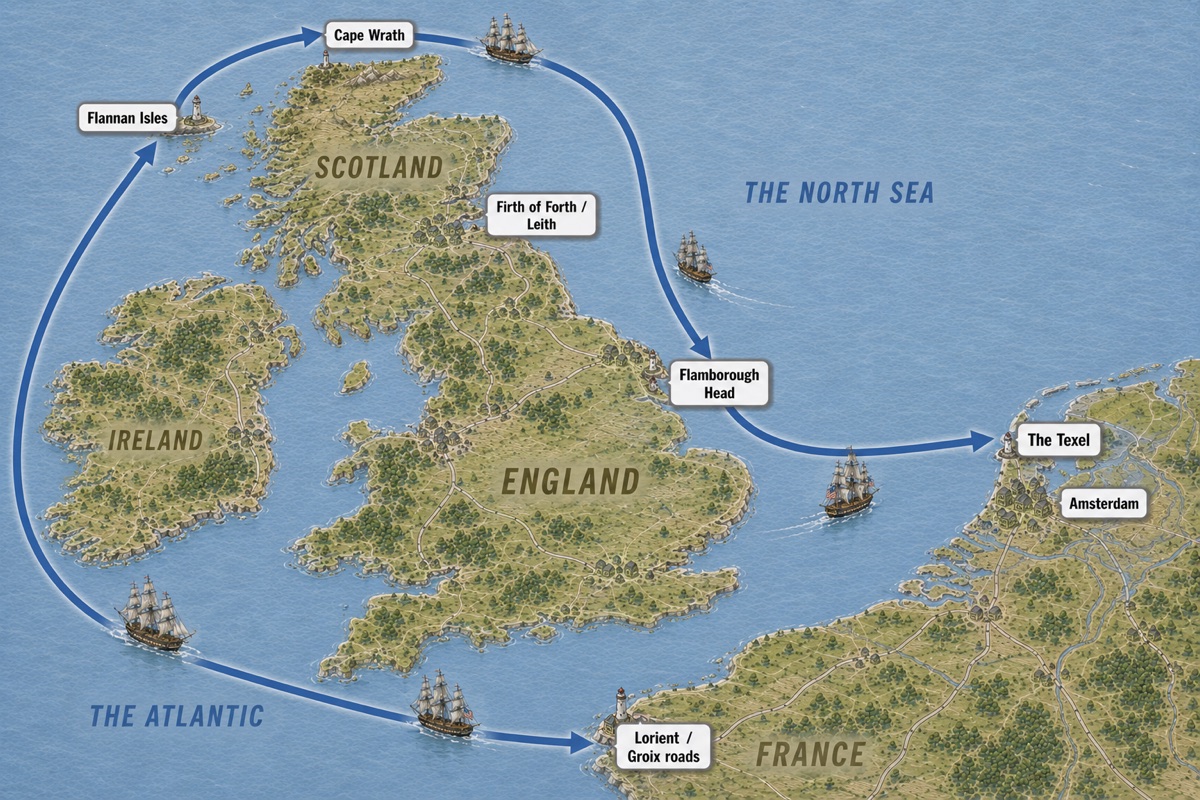
The cruise was the noose drawn around Britain. Jones took the squadron counter-clockwise around the whole of the British Isles, up the west coast of Ireland, around the top of Scotland past Cape Wrath, then down the eastern coast, taking and sinking prizes (captured enemy ships) as he went and throwing every coastal town into alarm. In mid-September he sailed up the Firth of Forth (the long sea inlet that runs into the heart of Scotland's east coast as far as Edinburgh) meaning to descend on Leith, the port of Edinburgh, and got within cannon shot before a gale blew the squadron back out to sea. By September 23 he was off Flamborough Head, a great chalk headland on the Yorkshire coast in England's northeast. And there, late in the afternoon, the topsails of a large convoy came rounding the Head: more than forty merchant ships out of the Baltic, carrying timber, masts, hemp, and tar, the raw materials of British sea power, the very stuff the Royal Navy was built and rigged from. Losing that convoy would have genuinely hurt Britain. Guarding it were two warships: the brand-new HMS Serapis (British), a powerful frigate of 44 guns launched only that March, under Captain Richard Pearson (British), and the smaller hired ship Countess of Scarborough of 20 guns. Jones signaled a general chase, and his tired converted merchantman bore down on the most powerful warship he had ever faced.