In the summer of 1777 Britain had two armies in America and two plans that had remarkably little to do with each other. One army, under General John Burgoyne, was coming down from Canada toward Albany, New York. The other, the main army under General Sir William Howe (British), the commander in chief in America, was going after Philadelphia, the rebel capital and the largest city in America. Howe hoped that reaching for the capital would force George Washington (American), commander of the Continental Army (the rebels' regular army, as opposed to part-time militia), into the decisive battle the British wanted. Howe had told his superiors in London he intended Pennsylvania; London approved, while hoping he could somehow still cooperate with Burgoyne; no order ever required him to go north. So when Howe went south, Burgoyne's army was on its own. Who deserves the blame for that, Howe, London's sloppy coordination, or Burgoyne's own overconfidence, is an argument historians have been having for two and a half centuries. The fact pattern is not argued: Howe sailed away, the northern army went unsupported, and that fall it surrendered at Saratoga.
The war story1777: two British armies, two separate warsAnd he did sail, which was the strange part. Rather than march overland across New Jersey (where Washington had spent the spring sparring with him without ever offering battle), Howe put his army to sea. On July 23, 1777, a fleet of more than 260 ships carrying some 16,000 to 17,000 troops stood out from Sandy Hook, New York. The obvious route ran up the Delaware River, the water highway straight to Philadelphia, and the fleet duly reached the mouth of the Delaware around July 30. There it stopped. Admiral Richard Howe, the general's brother, and his captains judged the river approach too risky: the Americans had forts and underwater obstructions called chevaux-de-frise (rows of sunken, iron-tipped spikes designed to tear out a ship's hull) below Philadelphia, and no safe landing place within reach. So the fleet turned around and sailed the long way, down the coast and up Chesapeake Bay (the next great bay to the south) instead.
The voyage was brutal. All told the army spent about 34 days at sea, packed into transports in midsummer heat, through thunderstorms and contrary winds. Only about three weeks' forage (animal feed) had been loaded, and hundreds of horses died or were dying when the fleet finally anchored; the dead ones went overboard. When the army landed at Head of Elk, at the top of the Chesapeake near present-day Elkton, Maryland, on August 25, 1777, it stood roughly 45 to 50 miles from Philadelphia. Six weeks after leaving New York, seasickness and dead horses included, it was barely closer to the capital than when it started.
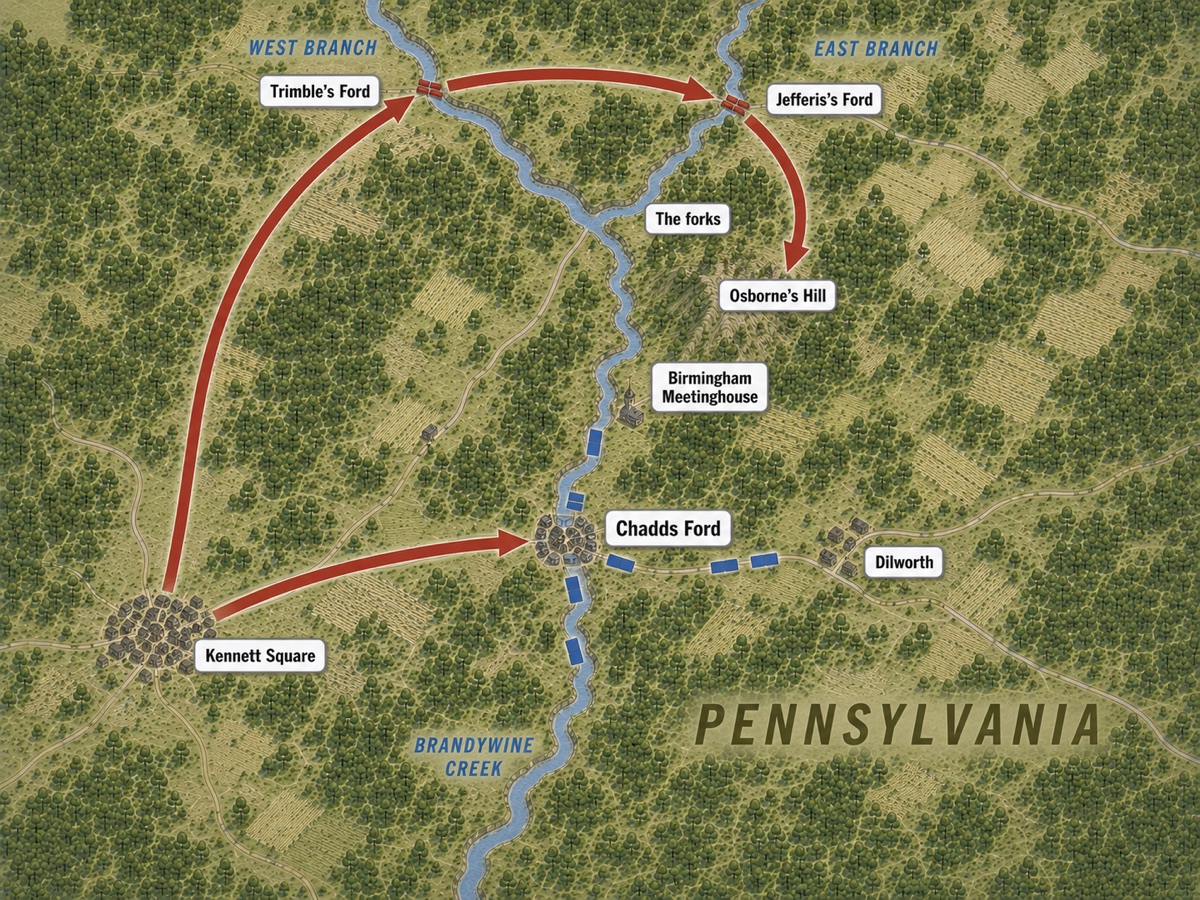
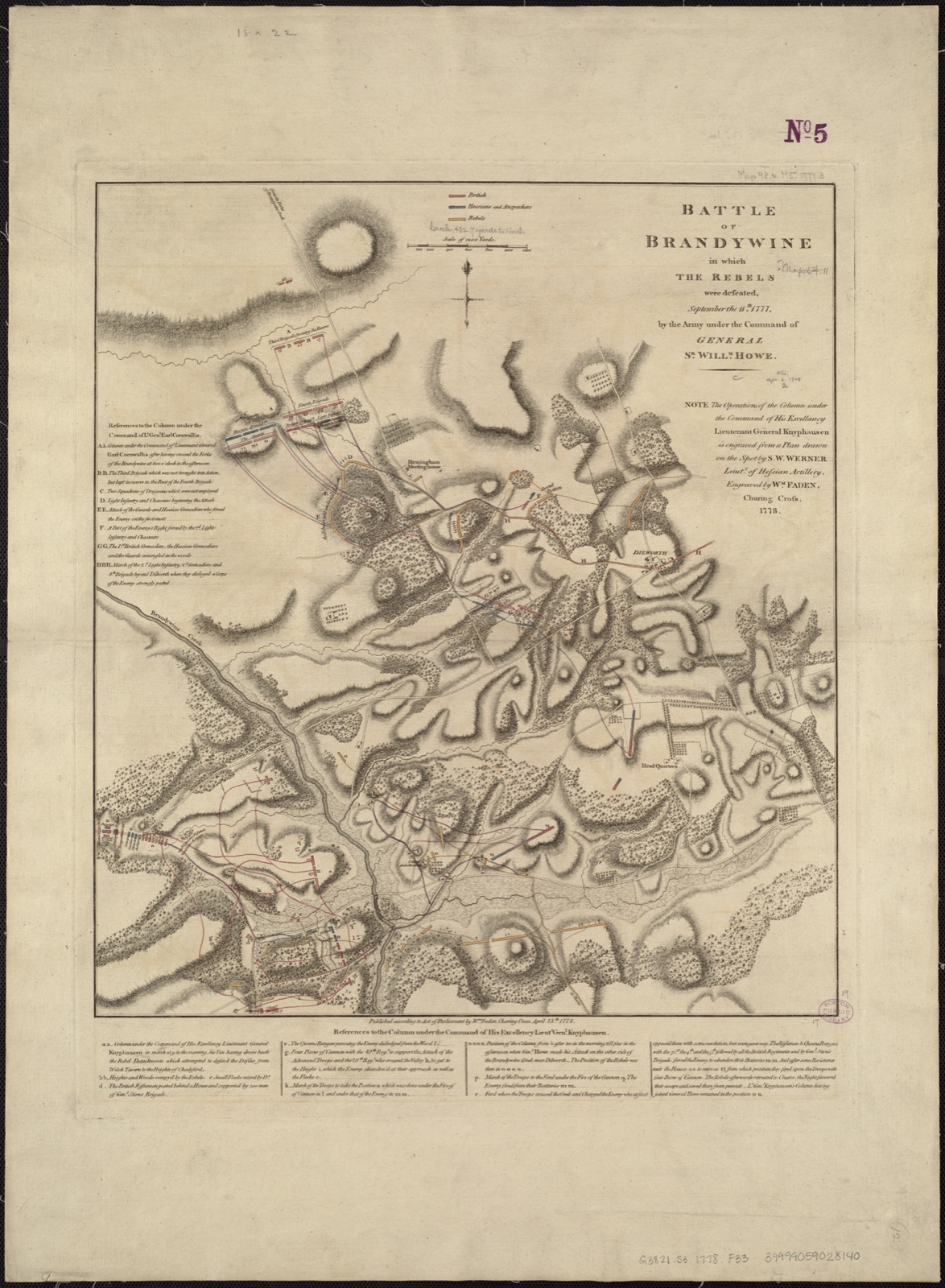
Washington, who had been tracking the fleet's reported positions all summer, marched south to meet it. On September 3 his light troops (fast-moving soldiers used for scouting and skirmishing) under William Maxwell skirmished with the British and Hessian (German troops in British service) advance guard at Cooch's Bridge, Delaware, the only Revolutionary War battle fought in that state. The British pushed on northeast into Pennsylvania, and by September 10 Howe had his headquarters at Kennett Square, a crossroads town about seven miles west of a creek called the Brandywine. Washington had already pulled his army back behind that creek and dug in on the east bank. It was the last good defensive line in front of the capital: lose the Brandywine and there was nothing but open country between Howe and Philadelphia, 25 miles to the northeast.
The Brandywine had no bridges along this stretch in 1777. An army, with its guns and wagons, could only cross at fords, the shallow places where men could wade. That made the creek a wall with a handful of doors, and Washington's plan was simply to hold the doors. The main door was Chadds Ford, where the Great Road (the main highway from Kennett Square toward Philadelphia, also called the Nottingham Road) crossed the creek. Washington put his strength there: Nathanael Greene's division at the ford itself, Anthony Wayne's division and Maxwell's light infantry covering it, and his own headquarters at the Benjamin Ring house nearby. Downstream, where the banks ran steep and an attack seemed unlikely, about a thousand Pennsylvania militia under John Armstrong watched Pyle's Ford. Upstream the doors kept coming: Brinton's Ford, Jones's and Painter's Ford, Wistar's Ford, Buffington's Ford. John Sullivan's division held that right wing, with Hazen's brigade strung out at the farthest crossings. Buffington's Ford sat at the forks of the Brandywine, the spot where the creek splits into an East Branch and a West Branch, and Washington believed it was the last usable crossing. Above the forks, he thought, the wall had no more doors.
It did. Only a few miles farther north, Trimble's Ford crossed the West Branch and Jefferis's Ford crossed the East Branch, and nobody was guarding either one. Washington's maps were poor, he had been in this stretch of country for only a few days, and the local intelligence he leaned on failed him. Howe had the opposite problem solved for him: this corner of Pennsylvania held plenty of Loyalists (Americans who sided with the king), and local Loyalist guides who knew every road and crossing rode with the British army. The same countryside was also Quaker country, one of the most thoroughly Quaker landscapes in America: Kennett, Birmingham, and the townships around them were communities of Friends (Quakers), pacifist by conviction, and the war was about to march straight across their farms and meetinghouses.
If this is starting to sound familiar, it should have sounded familiar to the Americans too. Thirteen months earlier, at Long Island, Howe had pinned Washington's front with a demonstration (a noisy fake attack meant only to hold the enemy's attention) and marched a massive column through an unguarded pass around the American flank. Now Washington was standing behind a wall with an open door at the far end of it, facing the same general. When the British vanguard (the column's leading troops) poured through the narrow defile (a tight pass with no room to deploy) at Jefferis's Ford the next day, the Hessian captain leading it, Johann Ewald, could hardly believe what he was looking at, and said so in his diary.
I do not understand why the pass has been left wide open for us where a hundred men could have held up either army the whole day.