By five o’clock on June 17, 1775, the British army held the hill above Charlestown, and then it counted. General Thomas Gage, the British commander at Boston, reported the cost in his official casualty return (the army’s formal report of killed and wounded): 1,054 casualties, 226 killed and 828 wounded, out of somewhere between 2,200 and 3,000 men engaged across the day, roughly forty to fifty percent of everyone who fought. It was the bloodiest single battle the British army suffered in the entire eight-year war, and the worst of it was concentrated where eighteenth-century armies could least afford it. About a hundred of the casualties were officers, men who had led from the front up a hill three times, and that one afternoon’s toll was a measurable share of all the British officers lost in the whole war.
American losses were lighter and were never counted cleanly: somewhere around 420 to 450 in all, with perhaps 115 killed (some counts run to 140), around 270 to 305 wounded, and about 30 captured, most of the prisoners wounded men, of whom 20 died. Joseph Warren, the Boston physician and patriot leader who had refused command and fought in the redoubt (the Americans’ dirt fort) as a volunteer, was among the dead. So, by tradition the battle’s last casualty, was Major Andrew McClary of New Hampshire, killed by a cannonball at the Neck (the one land exit from the battlefield peninsula) after the action was over.
The men who had won the battle described it like men who had lost one. Major General Henry Clinton (British), who had crossed the water to rally the third assault, wrote that evening.
A dear bought victory, another such would have ruined us.
William Howe (British), who had led every assault on foot and watched every member of his personal staff killed or wounded around him, wrote home days later that “the success is too dearly bought,” and of watching his line stagger back down the hill, “there was a moment that I never felt before.” Many contemporaries and many historians since have read the rest of Howe’s war through that moment: the next year, commanding at the Battle of Brooklyn, he declined to storm fortified American lines he might have carried, and the missing killer instinct kept showing up after that. Bunker Hill as the wound that made Howe cautious is an interpretation, widely held and impossible to prove, but the moment itself is in his own hand.
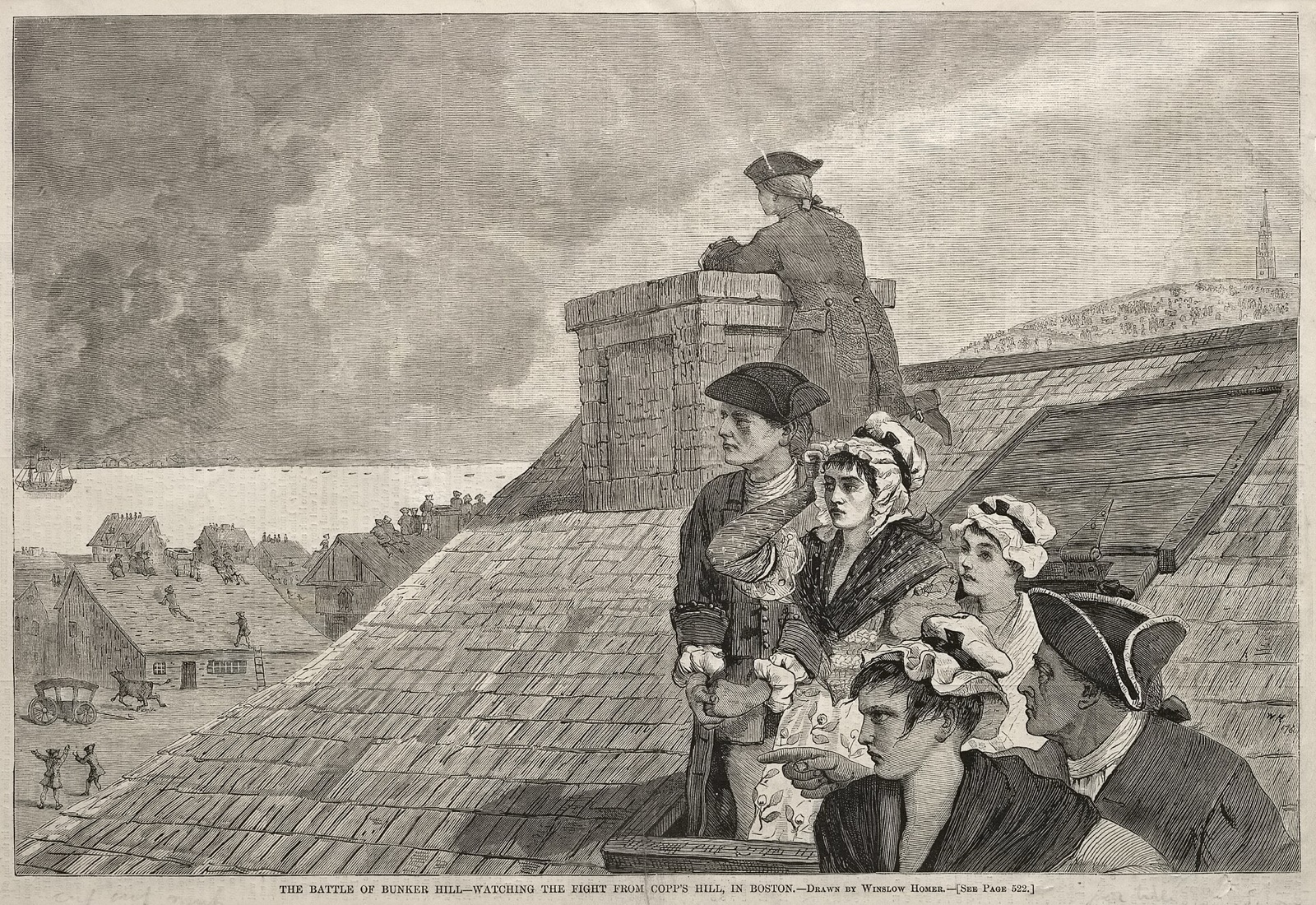
In London the numbers landed like a verdict. Gage’s report and private letters, saying in substance that the loss was greater than the army could bear, and that the rebels had shown a spirit they had never shown against the French, ended his command: he was recalled within weeks, and Howe succeeded him in October. The government stopped pretending this was a police action and accepted that it was a war requiring a real army, and the news from Charlestown helped feed the Proclamation of Rebellion that August (the king’s formal declaration that the colonies were in open revolt). The hill itself turned out to be the cheapest part of the lesson. The British fortified the peninsula, held it for nine months, and gave it back without a fight when they evacuated Boston on March 17, 1776, a position bought with a fifth of an army and then handed over. Charlestown, burned to the ground in mid-battle, was a ruin, and its people were refugees for years.
The Americans drew their own lesson, and it was dangerously seductive: militia (part-time citizen soldiers) behind earthworks (walls of fresh-dug dirt) could maul British regulars (professional full-time troops). It was true, that day, on that ground, and it bred a faith in untrained men and fresh dirt that the campaigns of 1776 around New York, at Long Island and Kip’s Bay, would punish brutally. A little over two weeks after the battle, on July 3, George Washington took command of the American army besieging Boston, camped at Cambridge just west of the city, and inherited both halves of it: an army convinced of itself, and an army nearly out of gunpowder.
Off the fieldWashington takes command: an army from nothingWarren’s story had one more chapter. Ten months after the battle, days after the British sailed away, his family and friends went out to the battlefield and opened the shallow mass grave where a British burial party had dumped him. The body was unrecognizable, except for the teeth. Before the war his friend Paul Revere had made Warren a dental prosthesis, a false tooth of ivory fastened in with silver or gold wire, and Revere identified him by his own handiwork. It is commonly cited as the first forensic dental identification in American history. Warren was reburied with honors, and then reburied again and again as Boston grew, coming to rest at last in Forest Hills Cemetery in 1856.
The hill got its monument, a granite obelisk raised between 1825 and 1843, and the monument completed the joke history had started: the Bunker Hill Monument stands on Breed’s Hill, where the battle was actually fought, the wrong-hill confusion fossilized in stone. Somewhere under its shadow, presumably, still lies the unmarked grave of Asa Pollard, the first man killed, buried without ceremony so the men around him would keep digging.