On March 17, 1776, the British army sailed out of Boston. George Washington, commanding the rebel army besieging the town, had put cannon (the guns hauled overland from Fort Ticonderoga, a captured British fort in upstate New York) on Dorchester Heights, the high ground overlooking the harbor, and the British position became untenable overnight. General William Howe (British), commanding the garrison, evacuated to Halifax, Nova Scotia, to refit (rest and resupply). He did not sail home. Both sides knew exactly where the war was going next: New York.
New York was worth more than Boston ever was, for three reasons. First, its deep, sheltered harbor was an ideal base for the Royal Navy, and Britain's navy was the one weapon the Americans could not answer at all. Second, the Hudson River: control that corridor, with a second British force coming down from Canada to meet the first, and you sever New England, the engine of the rebellion, from the colonies to the south. Third, New York's population was believed to be far more Loyalist (loyal to the king) than New England's. London endorsed the strategy, and the largest force Britain had ever sent abroad began assembling to carry it out.
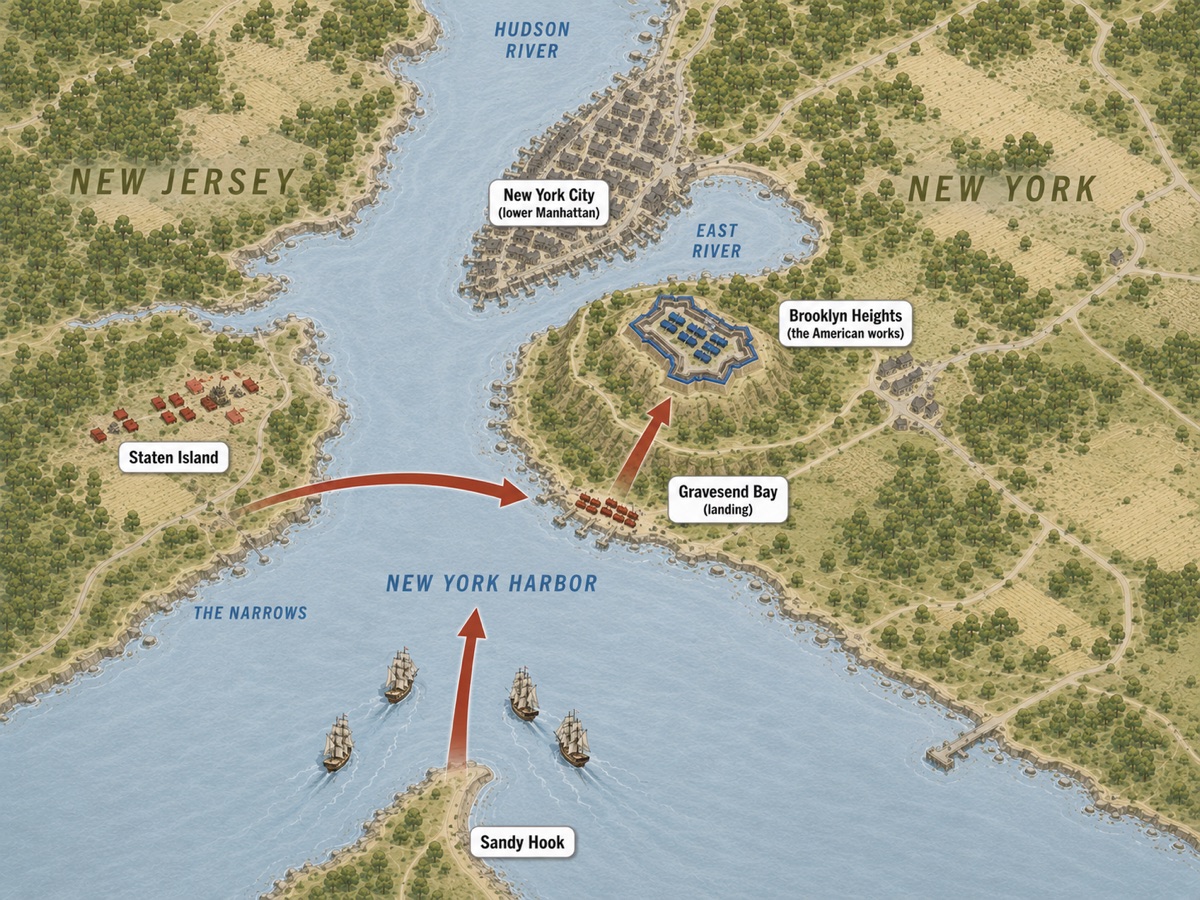
Washington saw all of it coming and marched his army from Boston to New York that spring, arriving on April 13. The problem was that the city could not really be defended. Charles Lee (American), the general who had begun laying out the defenses earlier in the year, said so plainly: against a navy, New York was indefensible, but it could be made expensive. And abandoning one of America's greatest cities without a fight was politically unthinkable for a cause that needed people to believe it could win, so the Americans dug anyway, to make the British pay: fortifying Manhattan and, crucially, Brooklyn Heights, the high ground on Long Island that commands New York City (the city of 1776 sat only at the southern tip of Manhattan island) across the East River (the tidal channel, about a mile wide, separating Long Island from Manhattan). The lesson of Bunker Hill the year before (the fight outside Boston where the British stormed an American-held hill and bled terribly taking it) was burned into both armies: whoever holds the heights commands the town.
The war storyThe whole 1776 campaign: the war for the North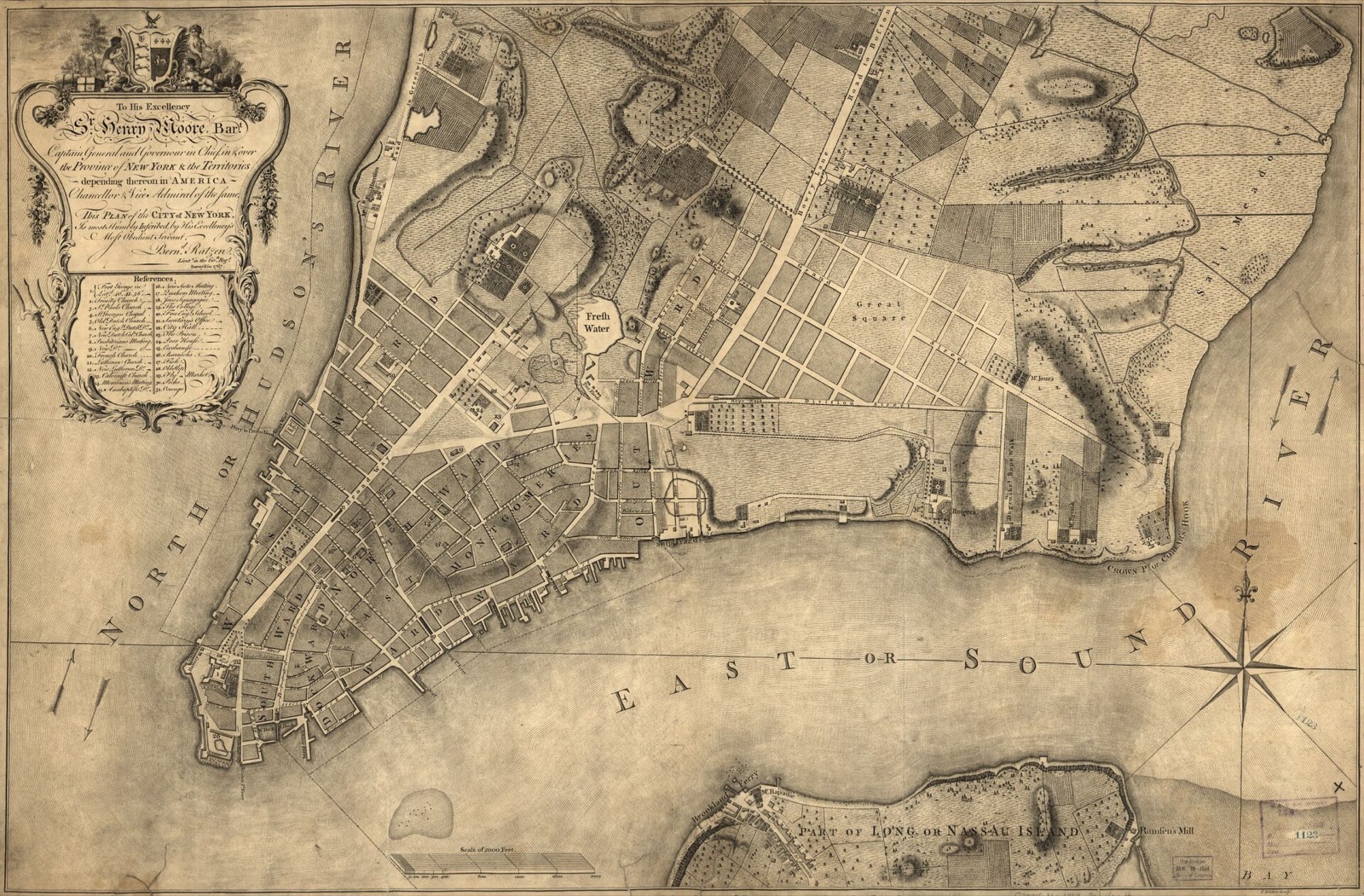
Then the ships came. Howe arrived off Sandy Hook (the spit of New Jersey shore at the harbor's entrance) in late June and landed unopposed on Staten Island (the island at the mouth of the harbor, across the water from Long Island) on July 2 and 3, with more than 9,000 troops and some 130 ships, on the very days that Congress in Philadelphia voted for and then declared independence. His brother, Vice Admiral Lord Richard Howe (British), arrived on July 12 with about 150 more ships. Through July and August it never stopped: every few days more sails standing in past Sandy Hook, more masts crowding the water off Staten Island. General Henry Clinton (British) brought his troops back from a failed attack on Charleston, South Carolina, and there came regiment after regiment of hired German professionals, called Hessians because most came from Hesse. By mid-August the count stood at roughly 32,000 troops and 10,000 sailors on a fleet of 400 ships, several dozen of them warships. It was the largest expeditionary force Great Britain had ever sent overseas, and the largest fleet ever seen in American waters. Daniel McCurtin, a Maryland rifleman watching from Manhattan as the first fleet came in, thought the bay looked like "a wood of pine trees trimmed," he wrote in his journal.
I thought all London was afloat.
The Howe brothers came with two jobs. They commanded the invasion, and they were also peace commissioners, empowered to issue pardons to rebels who submitted. The July peace feelers went nowhere, partly over protocol: Washington's staff refused letters addressed to "George Washington, Esq., etc., etc.," an address that denied his rank and, with it, the legitimacy of everything he represented. Meanwhile the Declaration of Independence was read aloud to the army in New York on July 9, and that night a crowd pulled down the gilded equestrian statue of King George III on Bowling Green, at the foot of Manhattan. The statue, famously, was melted into musket balls.
Against the armada Washington had perhaps 19,000 to 23,000 men, most of them raw Continentals (the regular soldiers of the new national army) and militia (part-time citizen soldiers), many of whom had never been under fire. Worse, he was defending an archipelago, a cluster of islands, against an enemy with total command of the water, which meant the blow could land almost anywhere. So he split the army between Manhattan and Brooklyn, and even after the British began landing on Long Island he held troops back in Manhattan for days, suspecting the landing was a feint (a fake attack meant to draw his army out of position).
The defense's bad luck ran deeper than that. Nathanael Greene (American), the general who had built the Brooklyn works and knew the ground, went down with a raging fever in mid-August and was evacuated to Manhattan. John Sullivan (American), just back from the collapse of the American invasion of Canada, took over on August 20. Then Israel Putnam (American), the Connecticut folk hero of Bunker Hill, superseded Sullivan in overall command on Long Island on August 24, three days before the battle. Three commanders in ten days, and the ground belonged to none of them. Sullivan kept command of the forward line.
On August 22, covered by the warships, about 4,000 British troops under Clinton and Lord Cornwallis (British) crossed the Narrows (the channel between Staten Island and Long Island, the harbor's gate) and landed unopposed at Gravesend Bay, on the southwestern shore of Long Island. By noon some 15,000 men and 40 guns were ashore. Pennsylvania riflemen under Colonel Edward Hand skirmished, burned the grain stores, and fell back; Cornwallis pushed up to the village of Flatbush. On August 25 about 5,000 Hessians crossed, bringing the invasion force to roughly 20,000.
Between those beaches and the American works (the forts and trenches) at Brooklyn stood the Heights of Guan, a long wooded ridge that an army could cross only at the passes (the gaps where roads ran through it). There were four. The Gowanus Road ran along the shore at the western end; Flatbush Pass and Bedford Pass cut through the center; and far to the east, 3 miles from the main American line, lay the Jamaica Pass. The Americans put 3,000 to 4,000 men on the ridge to hold the first three. The Jamaica Pass, the open back door, was watched by five militia officers on horseback.