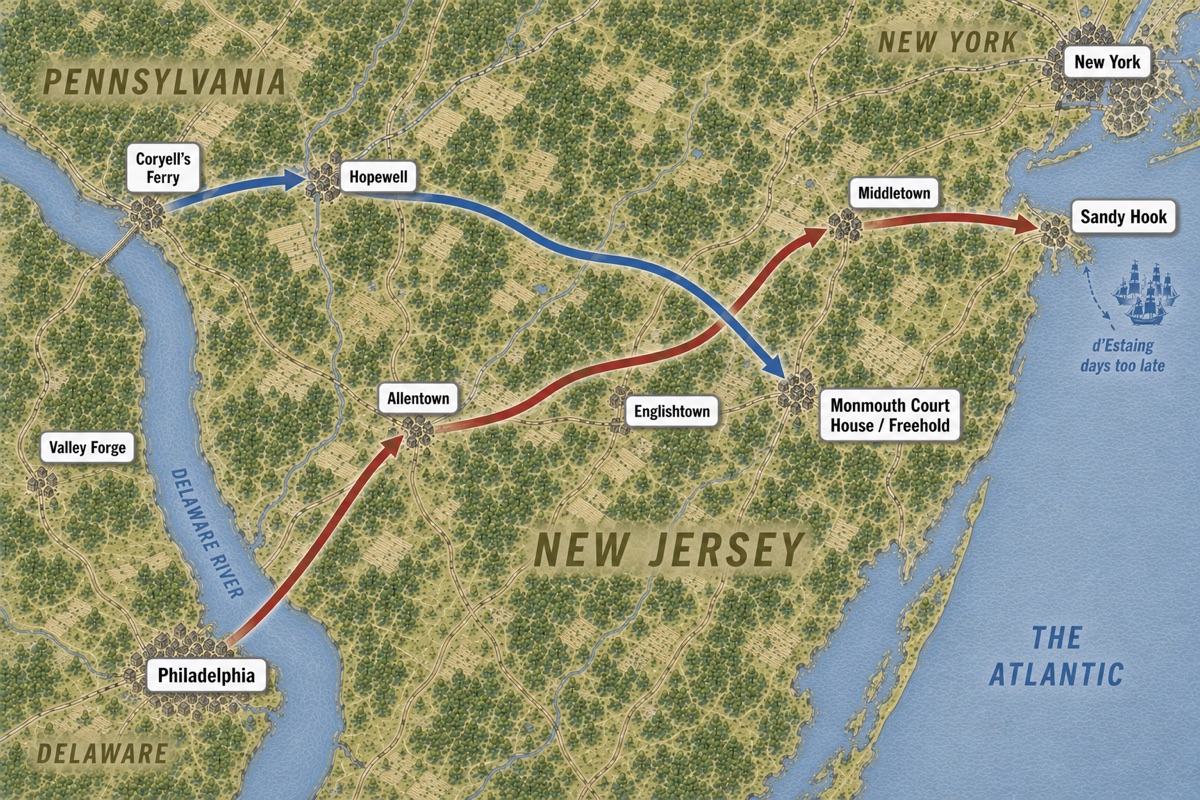
In the winter of 1778 the war stopped being only an American war. On February 6, France and the United States signed treaties of alliance and commerce, and the news that reached London turned the whole conflict on its head. Britain was now facing a global war, in the Caribbean, in home waters, in India, against the one navy that could rival its own, and it could no longer pour everything into crushing the rebellion. London's orders followed: abandon Philadelphia, the rebel capital the British had taken with such effort the autumn before, pull back and consolidate the army at New York, and send troops off to defend the West Indies and Florida. The man who had to carry it out was new to the job. Sir Henry Clinton (British) had just succeeded Sir William Howe as commander in chief in May, after Howe resigned, and his first major act was a retreat.
Off the fieldThe French alliance: the diplomacy that changed the whole warIt was not a simple one. Clinton did not have enough ships to move the whole army, its horses, and thousands of Loyalist refugees (Americans loyal to the King, who could not stay behind once the British left) by sea. So he sent the refugees and the heavy equipment by water and marched the army itself overland across New Jersey, the long way around the bottom of the colonies toward New York. The last British troops left Philadelphia on June 18. What started up the roads was less an army than a slow-moving town: roughly 20,000 people in all, with a baggage train of about 1,500 wagons that stretched the column to some twelve miles. Clinton put it in two divisions, Lord Cornwallis (British) with the elite first division of about 10,000 fighting men, and the German general Wilhelm von Knyphausen (German, in British service) with the second, escorting the train.
The march was wretched, and New Jersey made it worse on purpose. A heat wave settled in, with temperatures again and again above 90 degrees; the roads were sandy; thunderstorms broke over the column; and the local militia (part-time citizen soldiers) felled trees across the road, burned the bridges, and spoiled the wells ahead of the advance. At points the army made barely six miles in a day. Desertion bled it the whole way: some 256 of the German auxiliaries slipped off during the campaign, many of them men who had married or put down roots in Philadelphia and would not leave.
All of this was an opening, and Washington meant to use it. George Washington (American), commander of the Continental Army (the rebels' full-time regular army, as opposed to the part-time militia), brought his army out of Valley Forge as Philadelphia emptied, crossed the Delaware upstream at Coryell's Ferry, and moved east through Hopewell, shadowing Clinton's column from the north with more than 12,000 Continentals and militia. The army he was marching was not the army that had stumbled out of Brandywine and Germantown the previous fall. It had spent the winter at Valley Forge being remade.
Off the fieldAn army from nothing: the winter at Valley Forge that built the force at MonmouthThat winter is the thing braided through everything that happened at Monmouth, so it is worth a moment. The army had nearly come apart at Valley Forge, cold and hungry and unpaid. What it gained there was drill. A former Prussian officer named Friedrich Wilhelm von Steuben (American, by then), whom Benjamin Franklin's recruiting had quietly promoted from captain to "lieutenant general" on paper, arrived in February, drilled a single model company by hand, and then cascaded one standardized system of marching, maneuver, and bayonet work through the entire army. About half the men in the ranks now were recruits who had enlisted only since January. There were no seasoned veterans to carry them; there was only the training. Monmouth would be the first major battle this retrained army fought, and the question hanging over it, though no one put it quite this way at the time, was whether a year-old army of farm boys could stand in an open field against the best regular infantry in the world.
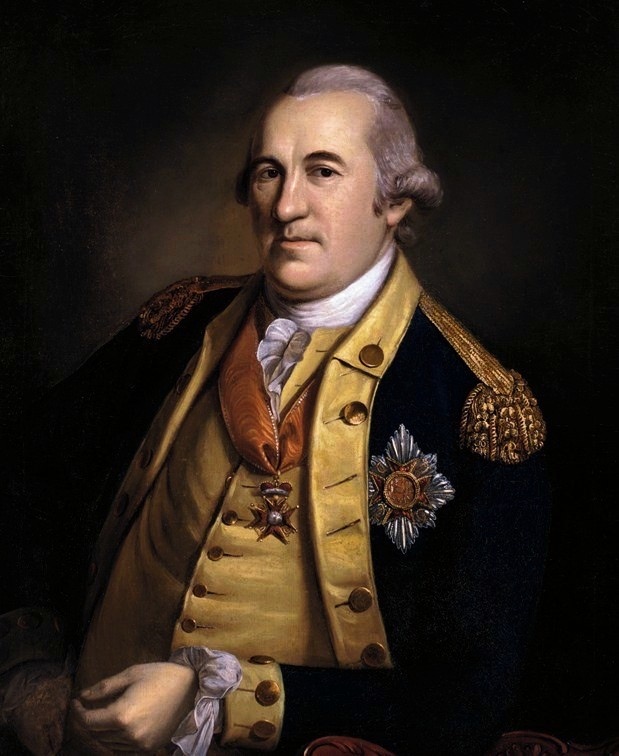
Not everyone thought it should try. On June 24, at Hopewell, Washington put the question to a council of war (a formal meeting of his senior generals; eighteenth-century commanders often polled their officers before a major decision, though the commander was not bound by the vote): attack the British column, or shadow it and let it go? The loudest voice against attacking belonged to the army's most experienced soldier. Charles Lee (American), newly returned from sixteen months as a British prisoner and the senior major general under Washington, argued hard against bringing on a general action. The army, he said, was no match for the British in open battle; France was in the war now, which meant time was on the American side and there was no reason to risk the army on a gamble; the right course was to let Clinton march away, to build him, in the phrase of the day, a "bridge of gold" to cross by, making the retreat so uncontested that the British would simply march off without another battle, and only nip at the edges of his column. Lee reportedly called a general action "criminal."
Lee was not a coward and not a fool, and this is the place to be fair to him, because the page that follows will not be kind. He was English-born, a professional to his bones: a British regular in the last war, a soldier of fortune afterward in Portugal and Poland, an aide to a Polish king, a man who had settled in Virginia in 1773 and brought to the Continental Army more formal military experience than anyone in it, Washington included. His caution at Hopewell was a professional's caution. He genuinely doubted the new army, and he genuinely thought the alliance had made big risks pointless. His preferred approach, a war of harassment, hitting the British from cover and letting time and France do the work, had real strategic logic, and a real strand of modern scholarship thinks he was at least half right. The council compromised: a strong harassing detachment, no general action.
would have done honor to the most honorab[le] society of midwives, and to them only
The younger generals were furious. Nathanael Greene (American), Anthony Wayne (American), the Marquis de Lafayette (American), and Washington's aide Alexander Hamilton all pressed to strike the column anyway. Hamilton wrote afterward, with the contempt of a young man for his elders, that the cautious council "would have done honor to the most honorab[le] society of midwives, and to them only," and named Lee the prime mover of the timidity. Within two days Washington came around to the young men. He enlarged the advance force into a real vanguard, with orders to attack the British rear once it moved.
And here the command arrangement turned into something close to farce. Washington offered the vanguard, the forward striking force, then about 4,000 men sent ahead to hit the British rear while the main army followed, to Lee, as the senior officer's right. Lee turned it down: it was beneath his rank, he said, a detachment, not a wing. So Washington gave it to the twenty-year-old Lafayette instead. Then the force grew, to four and a half or five thousand men, with Wayne's and other detachments folded in, and at that size it was no longer beneath a major general's dignity. Lee changed his mind and claimed it back by seniority. Washington, awkwardly, let him, and on June 27, near Englishtown, Lee superseded Lafayette. So the man who would lead the attack on the morning of June 28 was the one general officer on record as opposing the attack in the first place.