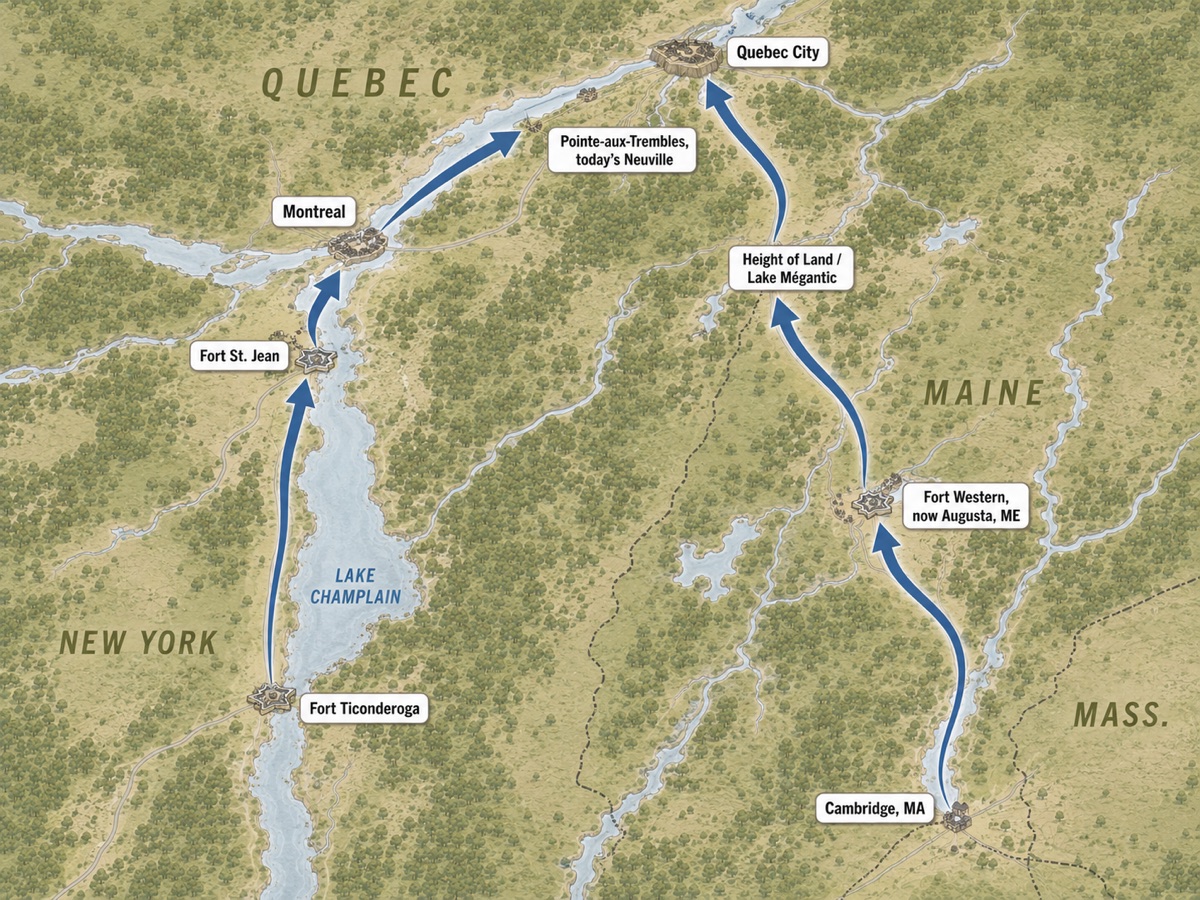
In the spring of 1775 the war between Britain and its thirteen rebellious American colonies (it had broken out in Massachusetts that April) was a few weeks old and already pointing north. In May, American raiders (Benedict Arnold was a co-captor) seized Fort Ticonderoga, the old fort at the southern end of Lake Champlain, and with it the great water highway that runs from New York up the lake toward the heart of Canada. By late June, Congress (the Continental Congress, the thirteen colonies' joint assembly in Philadelphia, acting as their rebel government) had authorized an invasion. The hope was double. Militarily, Canada was Britain's back door, the base from which a British army could come down the lakes whenever it pleased; close the door and the war stayed in the thirteen colonies. And politically, the thirteen thought a fourteenth might want to join: the Province of Quebec was a conquered French country, British for barely a dozen years, and surely, the thinking ran, its people would rise to throw the conqueror off. Two American armies went north that fall to find out.
The war storyOutbreak: the year the standoff became a warThe first went up the lake. Its commander was Brigadier General Richard Montgomery (American), an Irish-born professional who had spent sixteen years as a British regular (a full-time professional soldier), fighting in Britain's previous war against France in North America (Louisbourg in 1758, the Lake Champlain front in 1759), before being passed over for promotion, selling his commission, and emigrating to New York, where he married Janet Livingston of the powerful Livingston clan and wanted nothing more than to farm. He accepted a commission in the new Continental Army (the joint army Congress had created out of the colonies' militias) reluctantly, writing that the will of an oppressed people must be obeyed. Janet remembered, years afterward, what he promised her at their parting.
You shall never blush for your Montgomery.
His campaign nearly died of slowness. The siege of Fort St. Jean (the British post barring the river route to Montreal) ate from mid-September to early November, which is to say it ate the campaigning season. But when St. Jean fell, Montreal fell with it, without a fight, on November 13. The governor of Canada, Guy Carleton, slipped out of the city ahead of the Americans and went downriver (northeast, down the St. Lawrence toward the sea) in a small boat with muffled paddles (by some tellings disguised as a civilian), making for the one place still worth holding: Quebec, the walled capital on the cliff above the St. Lawrence River.
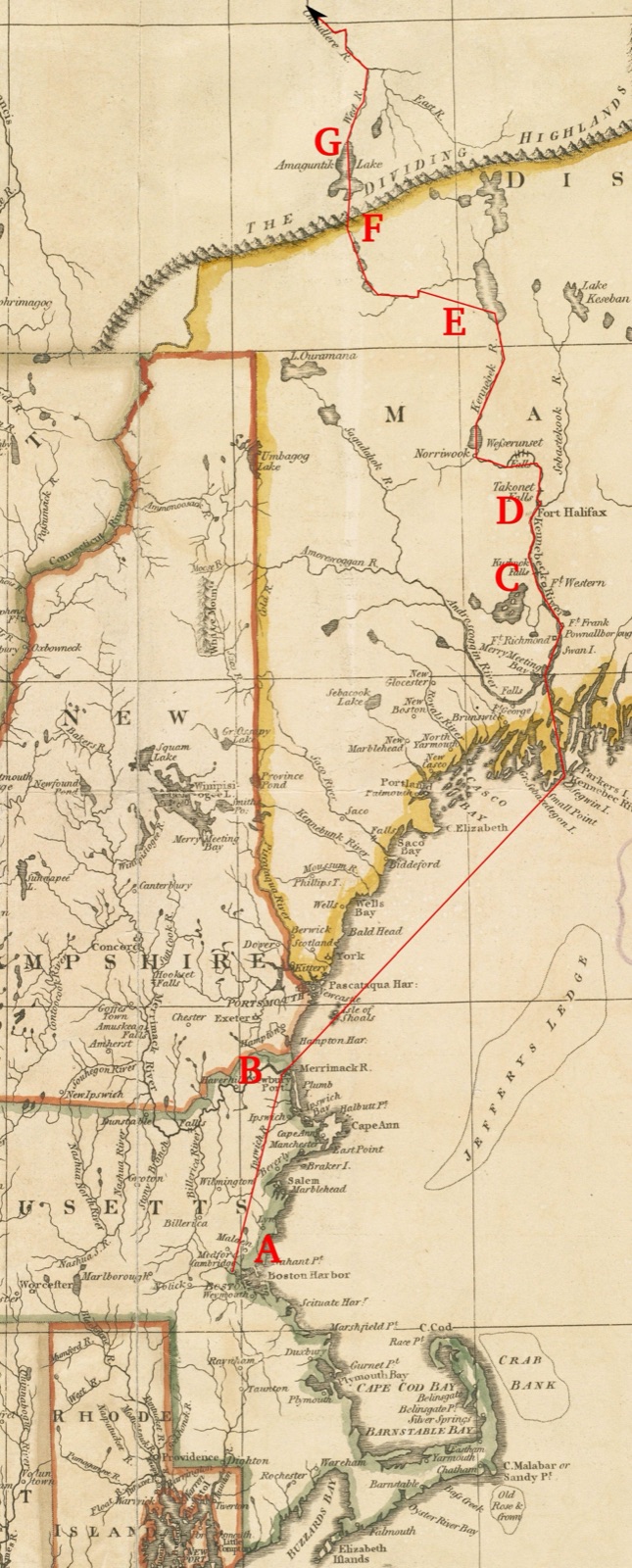
The second army did not go up the lake. Colonel Benedict Arnold (American), a New Haven merchant-captain with a gift for audacity, had left Cambridge, Massachusetts in mid-September with about 1,100 men to reach Quebec the hard way: up the Kennebec River through the Maine wilderness, over the watershed, and down the Chaudière to the St. Lawrence, a route far longer and crueler than his maps claimed. The bateaux (flat-bottomed riverboats) had been hammered together from green timber and leaked from the first day, drowning the food and the gunpowder. The men dragged them through the bogs at the Height of Land and forded freezing rivers. A quarter to a third of the force gave up the attempt: Lieutenant Colonel Roger Enos turned back with his rear division, roughly 300 men, and most of the remaining food went with him. The rest kept walking. They boiled and ate their shoe leather, their cartridge boxes, their candles, and at least one dog (Captain Dearborn's Newfoundland is the famously attested one). In mid-November about 600 scarecrows came out of the woods onto the bank of the St. Lawrence opposite Quebec. The march made Arnold's name; the newspapers of the day called him the American Hannibal.
What the march did not make was a siege. Arnold crossed the river on the night of November 13 to 14 and paraded his ragged men before the walls, and the walls declined to be impressed. He had no artillery that could dent them, ammunition for maybe five rounds a man, and a third of his muskets ruined by the journey. He pulled back about 20 miles (32 km) upriver to Pointe-aux-Trembles and waited. Montgomery came down from Montreal and joined him on December 2 and 3 with about 300 men and captured supplies; among his aides was a nineteen-year-old volunteer named Aaron Burr (a name with a long future). Together they had perhaps 900 to 1,200 effectives (men actually fit for duty), and they put Quebec under what was called a siege and was really a blockade (they could not break the walls, only seal the roads and try to starve the city out): a few light guns firing from batteries (emplacements where cannon are grouped and mounted; theirs were built of packed ice and snow), which the walls shrugged off.
Inside those walls, the city had been getting ready for weeks. Lieutenant Colonel Allan Maclean (British) had slipped in ahead of the Americans in mid-November with about 200 of his Royal Highland Emigrants, the garrison's professional backbone. Carleton arrived from Montreal on November 19, and on November 22 issued a proclamation: anyone unwilling to bear arms had days to get out of the city. The militia rolls grew. By December the garrison stood at about 1,800 men, a scratch force but a real one: a few regulars, Maclean's Emigrants, marines, 400-some sailors off the ships wintering in the harbor, and a majority of militia, French-speaking and English-speaking both, behind walls mounting some 150 cannon, with food for months. And Carleton knew this ground better than almost any officer alive: sixteen years earlier he had been General Wolfe's quartermaster general in the campaign that took this city from France, and he had been wounded on the Plains of Abraham doing it. Now he would defend the city he had helped conquer, and his plan was simple and correct. Never come out.
That left the Americans with arithmetic instead of options. Smallpox was already appearing in their camps. No reinforcement could reach them before spring, and when the ice broke it would be the king's ships that came up the river first. Above all there was the clock: most of Arnold's men had enlisted only to the end of the year, and at midnight on December 31 their enlistments expired and they could lawfully shoulder their packs and walk home. Attack before New Year's, or watch the army dissolve. It was a calculation, made by capable men who were out of alternatives. Montgomery, for his part, had no illusions left; Congress promoted him to major general on December 9, though the news never reached him, and his December letters wished the whole business well over and sighed for home. The army waited for the one thing the plan required: a black night and foul weather, to hide the columns from the gunners on the walls.