By the start of 1775 the quarrel had a shape. Boston was a garrisoned town under boycott, held by an army that could not safely leave it. The countryside around it had quietly stopped obeying the royal government and started arming. Three thousand miles away, ministers in London were sure the colonists would back down the moment troops marched, the way they always had. And in the colonies, men who had watched Britain repeal the Stamp Act and gut the Townshend duties were just as sure the same firmness would work again (Chapter 3). Both sides were wrong at the same time: a standoff became a shooting war that became a continental siege, while a congress swore loyalty and raised an army, an invasion froze in the Maine woods, a royal governor offered freedom to the enslaved of rebel masters, and a king declared his subjects rebels before their plea for peace had even landed.
Off the fieldThe bill from the last warOff the fieldThe Stamp ActA town held, a countryside arming
General Thomas Gage held Boston with about four thousand regulars, the professional, full-time soldiers of the British army, as distinct from the part-time militia he was up against. He was, on paper, the most powerful man in British North America: commander in chief of the army on the continent and, since the spring of 1774, royal governor of Massachusetts as well. In practice his authority stopped at the edge of town. The port had been closed by Parliament's punitive Coercive Acts (Chapter 4), the harbor was idle, and the seventeen thousand townspeople lived elbow to elbow with the troops sent to discipline them. Out past the city limits, Gage governed almost nothing at all.
Off the fieldThe Boston MassacreOff the fieldThe tea and the Intolerable ActsThe boycott was the visible half of it. The Continental Association, the trade ban the First Continental Congress had agreed the previous fall, had taken effect on the first of December and was being enforced house by house. Local committees of inspection checked who was still buying British goods and published the names of those who were. A shopkeeper who broke ranks did not just lose customers; he was a marked man, named in the papers, cut by his neighbors, sometimes dunned as a friend to the King. This was the first edge of a split that would harden into something darker than a boycott. The men who stayed loyal to the Crown, the Loyalists, were not foreigners or soldiers but the colonists' own neighbors and kin, and over the next year that fracture would turn whole counties into a war within the war. Imports from Britain did not just dip in 1775; they nearly stopped.
The invisible half was the government that had grown up to replace the one Gage no longer ran. Massachusetts had simply built another. The Massachusetts Provincial Congress, an unauthorized assembly that first met in October 1774, governed the countryside through a Committee of Safety with the power to call out the militia. The word "militia" needs to be said precisely, because the myth has sanded it smooth. These were not farmers who would someday grab a musket off the wall. They were organized town companies with a system behind them that ran back to the 1600s: officers elected, musters held, alarm networks rehearsed. The Provincial Congress had told each town to enroll a faster tier inside that system, roughly a quarter to a third of the rolls, sworn to turn out "at a minute's warning." Those were the minute companies. And the Congress was stockpiling what an army needs to fight, muskets and powder and cannon, much of it inland at Concord and Worcester, where Gage's troops would have to march to reach it.
London answered the First Continental Congress that same winter, with three documents in three months that show a government still trying to win the argument and lose as little as possible. Lord North's Conciliatory Resolution, proposed in late February, offered any colony that taxed itself for its own defense and government a way out of being taxed by Parliament. It was a carrot with strings: Parliament kept the right, the colonists did the paying, and it pointedly dealt with colonies one at a time rather than recognize the Congress at all. The New England Restraining Act, in late March, was the stick: it choked New England's trade down to Britain, Ireland, and the British West Indies and barred New Englanders from the rich North Atlantic fisheries. And underneath both, a secret letter. Lord Dartmouth, the minister for the colonies, had written Gage in late January telling him the province was in rebellion in all but name and ordering him to act, the first step being to arrest the principal men of the Provincial Congress before they could organize further. The obvious targets, though the letter did not name them, were John Hancock and Samuel Adams. The letter reached Gage on the fourteenth of April. Four days later he moved, not against the leaders, but against the powder at Concord.
Lexington green, before sunrise
On the night of the eighteenth of April, Gage sent about seven hundred men, his grenadier and light-infantry companies, the army's elite assault troops drawn out of their regiments for the job, under Lieutenant Colonel Francis Smith, with Major John Pitcairn of the marines leading the advance. They were to cross the Charles River by boat and march on Concord to seize the stores. It was meant to be quiet. It was not quiet for long.
Dr. Joseph Warren, the patriot leader running Boston's intelligence inside the occupied town, learned the regulars were moving and sent the warning out two ways at once, so that one man's capture could not stop it. William Dawes went out over the narrow neck of land south of town, "by land." Paul Revere was rowed across the Charles to Charlestown, "by sea." The lanterns in the steeple of Old North Church, one if the troops went by land and two if by water, were not the message. They were the backup, a signal Revere had arranged with Charlestown in case he could not get out of Boston himself. He got out, and carried the warning in person.
Revere never said "the British are coming." Everyone in the story was British; the troops were "the regulars" or "the King's troops." At the parsonage in Lexington where Hancock and Adams were sleeping, around half past midnight, when a sentry told him to stop making such a racket, Revere by the sentry's later account shot back: "Noise! You'll have noise enough before long. The regulars are coming out!" He and Dawes roused the two men, then rode on toward Concord with a third man, Dr. Samuel Prescott, a local physician heading home. A British patrol caught them in Lincoln. Prescott jumped his horse over a wall and got away, and it was Prescott, not Revere, who carried the alarm into Concord. Dawes escaped too but lost his horse and turned back. Revere was taken, questioned at gunpoint, and let go on foot without his horse. He walked back to Lexington and was on the green at dawn, helping carry a trunk of Hancock's papers out of danger. What put thousands of men on the roads by morning was not any of the three riders but the alarm network they fed into, the bells and signal guns and dozens of other riders the towns had built in advance.
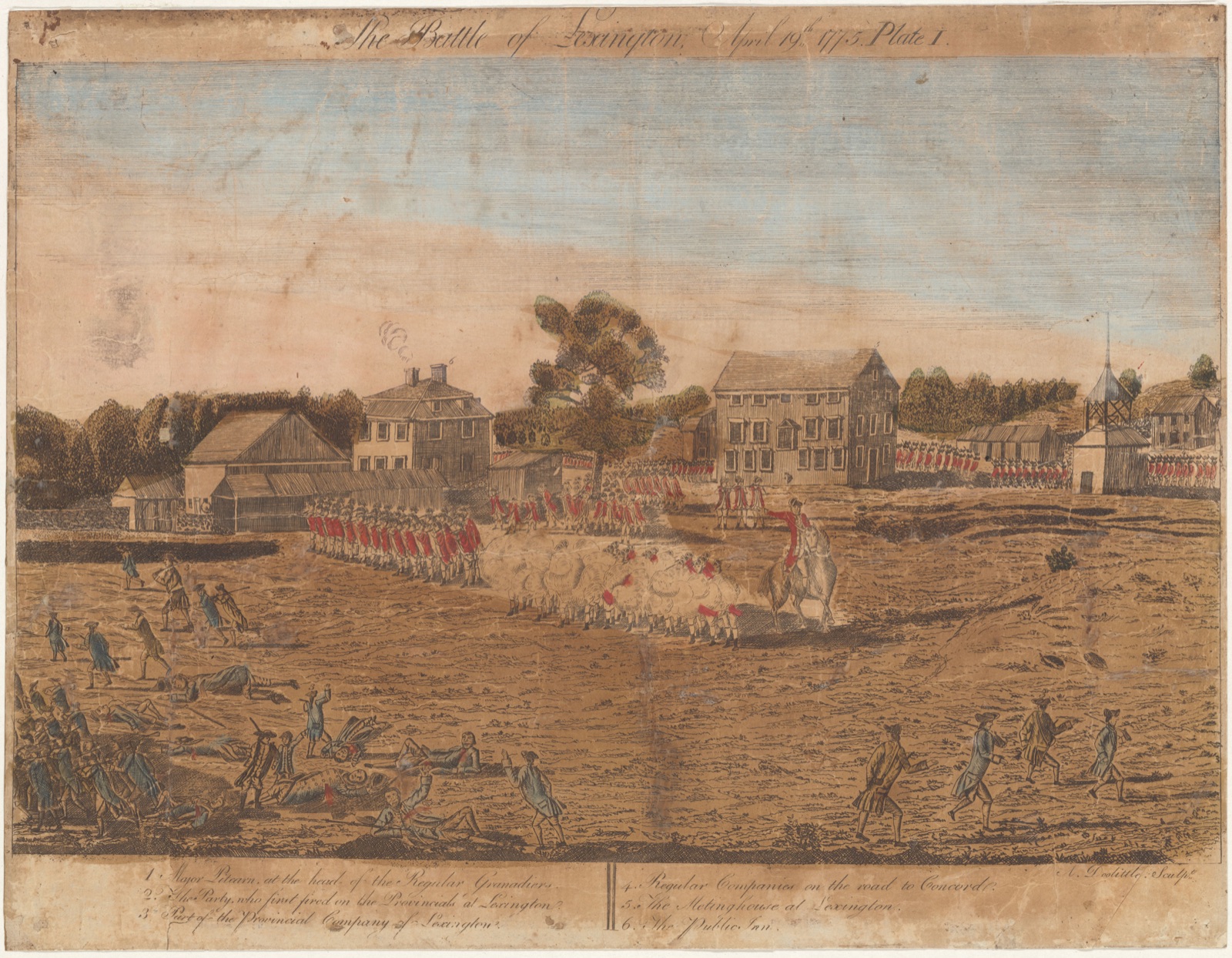
Around five in the morning, in the gray before sunrise, Captain John Parker had about seventy-seven militiamen drawn up on Lexington green as Pitcairn's lead companies came into sight. Parker said afterward, in a sworn deposition, exactly what he had intended. He had gathered his men "to consult what to do," and "concluded not to be discovered, nor meddle or make with said Regular Troops (if they should approach) unless they should insult or molest us," and on their "sudden Approach" he "immediately ordered our Militia to disperse and not to fire." A British officer, probably Pitcairn, rode forward shouting at the militia to disperse, by colonial accounts calling them rebels. The militia were beginning to file off the green. They were not laying down their arms, and they were not firing, when a shot was fired.
Nobody knows who fired it. That is not a gap to be filled with the likeliest guess. It is the fact. A regular, a militiaman, an onlooker, an accident in the dark of early morning, no one has ever established which, and both sides swore on paper that the other had started it, because both sides understood within hours that the answer mattered. After that single unaccountable shot the regulars fired in volleys and went in with bayonets. When it was over, in a matter of minutes, eight Americans were dead and ten wounded, against one lightly wounded regular. The column re-formed and marched on to Concord.
I immediately ordered our Militia to disperse and not to fire. — Capt. John Parker, sworn deposition, 25 April 1775
The bridge, and the long road back
At Concord the soldiers found that the warning had done its work. Most of the stores had been moved or hidden over the preceding weeks (Revere had ridden out to Concord on the eighth of April; the Provincial Congress had been scattering its supplies for a month). The regulars burned what gun carriages and materiel they did turn up, and when the town house caught fire by accident, they actually helped put it out. But the militia massing on the high ground across the river could only see the smoke, and they read it as the town being put to the torch.
A little after nine thirty, at the North Bridge, roughly four hundred militia came down toward the ninety or so regulars holding the crossing. The regulars fired first there, killing two men, one of them Captain Isaac Davis of Acton. Major John Buttrick gave the order to return fire, by the accounts of men who were there crying out for them to fire, for God's sake. The volley killed three regulars and drove the rest back across the bridge. It was the first time in the war that Americans fired on the King's troops in ranks, under orders, on purpose. (The line about a "shot heard round the world" came sixty-two years later, from a poem by Ralph Waldo Emerson; nobody said it that morning.)
That was the curtain-raiser. The battle was the road home. Around noon the exhausted column started back toward Boston, sixteen miles of road that turned into a sixteen-mile ambush. Militia companies kept arriving in relays from town after town, eventually three to four thousand men, and fired from behind stone walls and trees and houses, then fell back and fired again. There were vicious fights at Meriam's Corner, at a bend the soldiers called the Bloody Angle, and worst of all at Menotomy, now Arlington, where the killing went house to house. At Lexington the column, near collapse, was met by a relief brigade of about a thousand fresh men and two cannon under Brigadier General Lord Hugh Percy, which roughly doubled the force and very likely saved it. Percy's disciplined withdrawal got the survivors to Charlestown and under the covering guns of the warships in the harbor by dark, the naval cannon keeping the pursuing militia at a distance.
The BattlesLexington & Concord: the full battle storyThe day's full butcher's bill came to 273 British casualties, 73 killed, 174 wounded, and 26 missing, out of something under eighteen hundred men engaged across the whole running fight. The Americans lost about ninety-three, with 49 killed. A force sent to confiscate some powder had marched into the countryside and been mauled coming home by an army nobody in London believed existed.
The Atlantic race
The Provincial Congress understood the stakes of that single unanswerable shot before the smoke had cleared. Within days it was taking sworn depositions from the men who had been on the green and at the bridge, Parker's among them, all built to establish one thing: that the regulars had fired first. It bundled them with an address "To the Inhabitants of Great Britain." This was not grief written down. It was a propaganda operation, organized and already days old, and it was going to London by the fastest boat the patriots could find.
The boat was a sixty-two-ton schooner out of Salem, the Quero, under Captain John Derby, sent across the Atlantic in ballast, weighted but carrying no cargo at all so she could run light and fast. She sailed on the night of the twenty-eighth or twenty-ninth of April, days after Gage's own official dispatches had left on a heavier, slower ship, the Sukey. Derby made the crossing in about four weeks and reached London at the very end of May. He put the American account into the London press while the government had nothing at all to set against it, because Gage's report was still at sea. For nearly two weeks the only version of events Britain could read was the patriot version: the King's troops had fired first, on the King's own subjects, who had been standing peaceably on their own village green. The Sukey did not dock until around the ninth or tenth of June, and by then the framing was set. The first battle of the war was over the powder at Concord. The second was over who got to say what had happened, and the patriots won it before the army in Boston knew the race had started.
A fort, a congress, the same morning
The militia who had chased the regulars back to Boston did not go home. Within days, men from Massachusetts, Connecticut, New Hampshire, and Rhode Island converged on the town and dug in, ringing it from Roxbury around to Chelsea. The numbers swung wildly week to week as men came and went, but the besieging force is usually put somewhere between fifteen and twenty thousand, against Gage's four thousand. This was now a siege, the slow strangling of a fortified place by sitting around it and cutting it off, and it would not lift for eleven months. Loose command settled on Artemas Ward, the senior Massachusetts general who had been coordinating the lines since the days right after Lexington. The Siege of Boston had begun, and almost nobody outside the lines yet grasped that the colonies had an army.
In the dark before dawn on the tenth of May, far to the northwest, that army acted on its own. Fort Ticonderoga sat on Lake Champlain, a decayed old fort holding heavy artillery and barely fifty British soldiers who had no idea a war had started. Ethan Allen and his Green Mountain Boys, a frontier militia out of the disputed New Hampshire Grants that would later become Vermont, came at it, and so did Benedict Arnold, who carried a Massachusetts colonel's commission for this exact mission but had no men of his own that Allen's would obey. The two could not agree on who was in command, so they simply went through the gate side by side. The garrison surrendered without a shot, not one man killed on either side. Allen later wrote that he had demanded the fort "in the name of the Great Jehovah and the Continental Congress," though that line comes from his own memoir four years on, in a book in which Ethan Allen is the hero and Arnold nearly disappears; a man who was there remembered something more like "Come out, you old rat." The real prize was not the line. It was the cannon, which would matter enormously eight months later.
Because the same day, in Philadelphia, the Second Continental Congress gaveled into session. It had been called months earlier as a routine follow-up, and now it opened three weeks into a shooting war that no congress had voted for, in a country it did not govern, on the very morning that a King's fort fell to men acting in the Congress's name without the Congress having the faintest idea it was happening.
Breed's Hill
Through the spring the siege held its breath. On the twenty-fifth of May, HMS Cerberus reached Boston with reinforcements and three major generals, William Howe, Henry Clinton, and John Burgoyne, pushing the garrison to perhaps six thousand and bringing fresh men eager to break out. When word reached the American lines that the British meant to seize the high ground on the Charlestown peninsula, the besiegers moved first. On the night of the sixteenth of June, Colonel William Prescott took about twelve hundred men onto the peninsula to fortify Bunker Hill, and dug in instead on Breed's Hill, lower, closer to Boston, more provocative and harder to hold. Whether that was an order, a council's decision, or a mistake in the dark has never been settled. By daylight they had thrown up an earthen redoubt, a square dirt fort roughly a hundred and thirty feet on a side. The battle would take its name from the hill they were told to fortify, not the one they did.
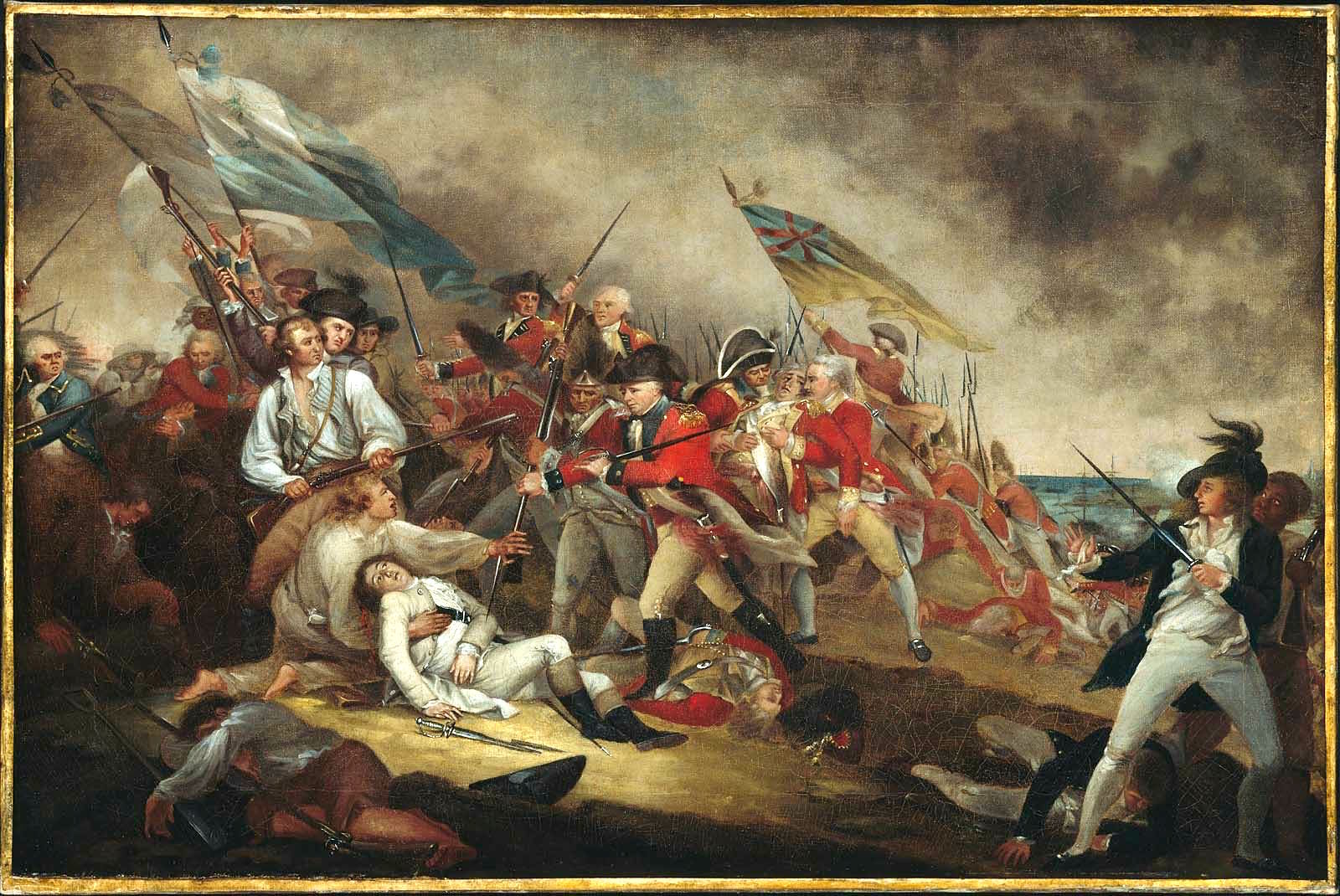
On the afternoon of the seventeenth, somewhere between two and three thousand British under Howe crossed the water and came up the slope. Charlestown itself burned during the battle, set alight by heated shot, cannonballs deliberately fired red-hot from the ships and shore batteries to start fires, hundreds of buildings gone. The defenders, militia rotating in and out across the field, threw back two frontal assaults with point-blank volleys. By the third assault the men in the redoubt were down to their last rounds, scraping cartridge boxes and prying powder out of the dead, and when the bayonets came over the wall there was nothing left to answer them with. The redoubt fell as the ammunition ran out. The Americans pulled back off the peninsula. The British held the ground. (The order to hold fire "until you see the whites of their eyes" belongs to the legend of this battle, not its record; the phrase is older than the war, and no one can say who said it, if anyone did.)
The ground was the British achievement. The cost was the British shock. Out of somewhere between twenty-four hundred and three thousand men engaged, they lost 1,054, with 226 killed and 828 wounded, a staggering share of them officers. The Americans lost something in the range of four hundred and twenty to four hundred and fifty. And among the American dead was Dr. Joseph Warren, the man who had run the spy network and sent Revere and Dawes out in April, now a newly commissioned major general, who had gone into the redoubt as a volunteer and was killed in the retreat.
Both sides learned the wrong lessons in opposite directions. Henry Clinton wrote that night that it had been "a dear bought victory, another such would have ruined us." Gage told the minister at war days later that the loss "is greater than we can bear," and added that these people had shown a spirit they had never shown against the French. London's takeaway was realistic: this would be a real war, and it would need a real army. The American takeaway was seductive and dangerous: militia behind earthworks could shred British regulars. Both lessons would shape the next year. After Breed's Hill the siege simply set, neither side able to break the other, the garrison inside Boston growing hungrier and sicker as the year wore on.
The BattlesBunker Hill: the full battle storyA dear bought victory, another such would have ruined us. — Maj. Gen. Henry Clinton, the evening of 17 June 1775
An army adopted, a peace begged
The Congress in Philadelphia spent that June doing two things that look, from a distance, like opposites, and were in fact the work of a single divided body that genuinely wanted both. On the fourteenth, it voted to adopt the New England army camped around Boston as a Continental force, the Continental Army, and to raise rifle companies from Pennsylvania, Maryland, and Virginia. On the fifteenth, it unanimously chose George Washington of Virginia to command it. He was the obvious man on paper: a Virginia planter who had commanded troops on the frontier in the last war and who had come to Congress already in his old militia uniform, a soldier among lawyers. The logic was partly military and partly arithmetic: a Virginian at the head of a New England war bound the South to a fight that had so far been New England's alone. Washington took command of the roughly fourteen to sixteen thousand men at Cambridge on the third of July.
Then the same Congress turned around. On the fifth of July it adopted the Olive Branch Petition, a petition being a formal written plea to the Crown, drafted by John Dickinson, the moderate "Pennsylvania Farmer" of the Townshend years (Chapter 3). It was a direct and frankly loyal appeal to George III, blaming his ministers rather than the King, professing attachment to his person, and begging him to stop the war so reconciliation could begin. The very next day, the sixth of July, it adopted a Declaration of the Causes and Necessity of Taking Up Arms, written by Thomas Jefferson and Dickinson, which justified armed resistance while explicitly insisting the colonies were not seeking independence. The two were not as contradictory as they look: the petition begged the King to call off his ministers' war, and the army stood ready to fight that war if he would not. An olive branch to the throne, a musket aimed at Parliament's policy, both out of the same room in the same week. It is easy to call that hypocrisy. It is more honestly described as a body that had not made up its mind, holding both halves of an unresolved argument at once. The King, when the petition reached him in August, would not even receive it.
North into Canada
While the siege lines hardened, the war moved north. Canada was Britain's open back door, and Congress half hoped it might be persuaded to become a fourteenth colony; the route that Ticonderoga had pried open pointed straight up Lake Champlain. In late June the Congress authorized an invasion, a campaign sent out to take and hold enemy ground, in two prongs, and by September it was moving.
The first prong went up the lake under Brigadier General Richard Montgomery, an Irish-born former British officer, whose advance bogged down in a two-month siege of Fort St. Jean that ate most of the campaigning season before Montreal fell without a fight on the thirteenth of November and the British governor-general of Canada, Guy Carleton, slipped downriver to Quebec to organize the city's defense.
The second prong was the one that became legend, and it deserves to, told straight. Benedict Arnold, Ticonderoga's other claimant and hungry for a command of his own, left Cambridge in mid-September with about eleven hundred men to reach Quebec by a back route up the Kennebec and Chaudière rivers through the Maine wilderness, a hard line of travel northeast across rivers and high ground that no army had taken before. The route was far longer and crueler than any map had shown. The boats leaked and the supplies drowned, the bogs froze, and a third of the force under Lieutenant Colonel Roger Enos, roughly three hundred men, turned back with most of the remaining food. The men who kept going ate boiled shoe leather, cartridge boxes, candles, and a dog. About six hundred of them, gaunt and half-starved, reached the St. Lawrence opposite Quebec in mid-November. It was an astonishing feat of endurance, and it arrived far too weak to do anything on its own.
On the last night of the year, in a blizzard, the two prongs gambled everything. Montgomery, down to a few hundred effective men, had joined Arnold, and with their soldiers' enlistments set to expire at midnight on New Year's Eve, they could either attack now or watch the army melt away. So they went at the walls of Quebec in the dark and the driving snow, two thin columns converging on a fortified city they could not have held even if they took it, and the attack failed completely. Montgomery was killed by grapeshot, the cluster of small iron balls a cannon throws like an enormous shotgun, in the first minutes of his assault. Arnold's leg was shattered as he led the other. Daniel Morgan pushed deepest into the lower town and was captured there with the survivors, somewhere between four hundred and four hundred thirty Americans taken prisoner, against trivial British losses. Montgomery became the cause's first martyred general. The remnant under Arnold kept up a ragged pretense of a siege outside the walls through the winter, but the Canadian gamble had been lost on the year's last night. It had nearly worked on courage alone, and it had not worked.
The BattlesQuebec 1775: the full battle storySouth into Virginia
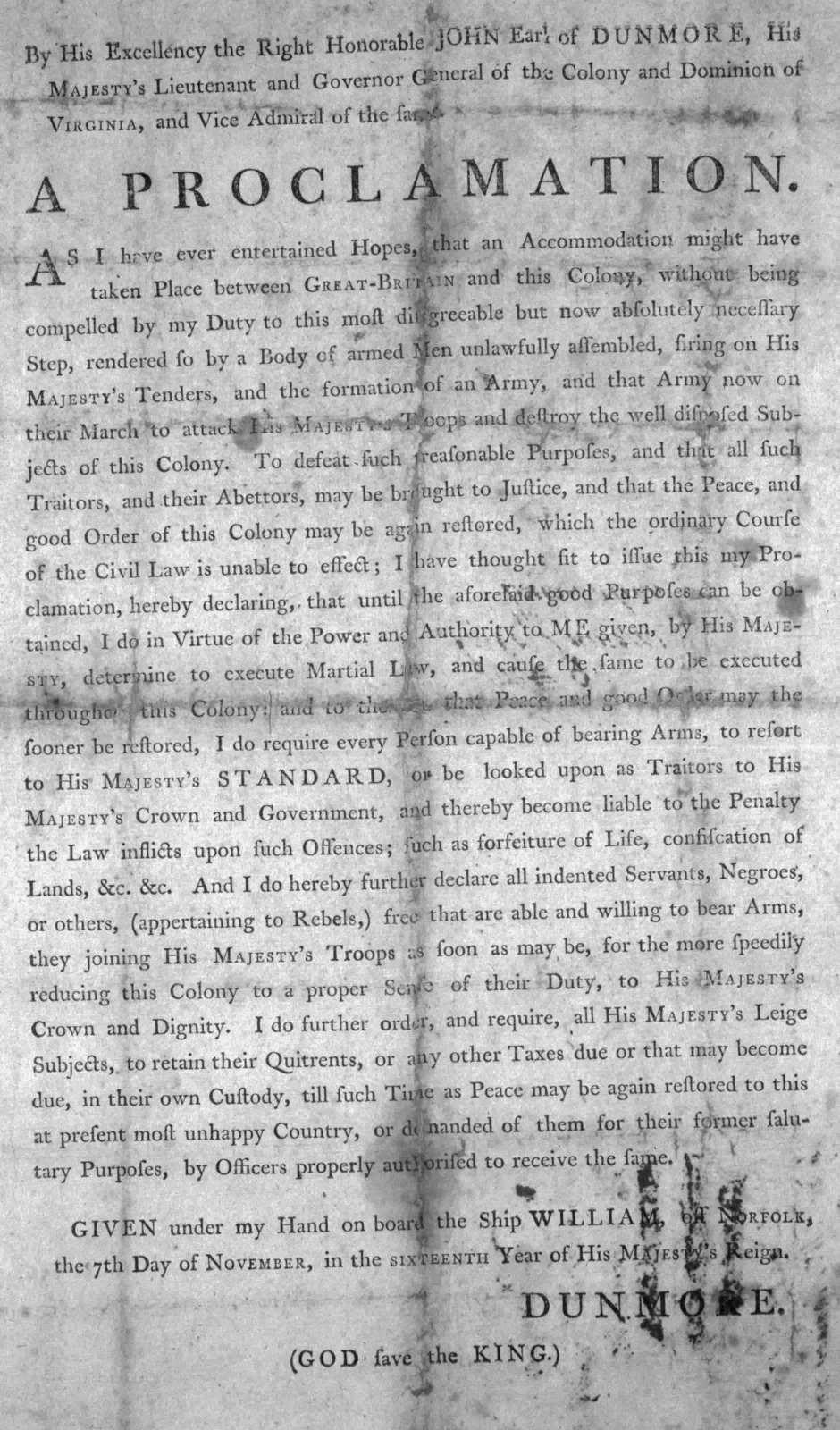
In the same season, the war opened a southern front of a very different kind. Lord Dunmore, the royal governor of Virginia, had already lost his capital and was governing from Royal Navy ships out in the Chesapeake. From there, in a proclamation, an official decree carrying the force of law, dated the seventh of November and published about a week later, he declared martial law and offered something explosive: freedom to "all indented servants, Negroes, or others (appertaining to rebels)" who were able and willing to take up arms for the King. Somewhere between several hundred and two thousand enslaved people reached his lines, and the Black soldiers among them formed what he called the Ethiopian Regiment. The full weight of that moment belongs to its own chapter. Here it is one beat in the braid, and a sharp one: a royal governor offering emancipation to the enslaved of rebel masters, in the same autumn that the King in London was refusing even to open the colonists' plea for peace.
Off the fieldFreedom offered by the other sideThe fighting came quickly. On the ninth of December, at Great Bridge, a narrow causeway south of Norfolk, Dunmore's small force of regulars, Loyalists, and the Ethiopian Regiment attacked Virginia troops under Colonel William Woodford and was bloodily thrown back. British losses were reported anywhere from about sixty-two, Dunmore's own count, up to around a hundred. The Virginians' total casualties were one man wounded in the hand. Woodford called it "a second Bunker's Hill affair, in miniature." Dunmore gave up Norfolk and pulled back to his ships.
What happened to Norfolk next has been pinned on the wrong man for two centuries, and the truth needs both halves stated plainly. On the first of January 1776, Dunmore's ships opened a bombardment of the town in the afternoon, and his landing parties burned buildings along the waterfront. He started the fire. But Norfolk was a largely Loyalist port, and the town's actual destruction was mostly the work of the Virginia and North Carolina troops inside it, who looted and torched their neighbors' houses over the following days, and whose own government then ordered the rest demolished to deny the British a base. A Virginia commission, investigating in 1777, found that patriot forces had destroyed the overwhelming share of Norfolk, close to ninety-six percent of it, against a few dozen buildings burned by the British. That report was not made public for some sixty years. By the time it surfaced, "Dunmore burned Norfolk" had long since hardened into settled patriot fact and useful atrocity. He started it; they finished it; and the blame was pinned on him.
London closes the year
While the new army dug in around Boston, a wrecked invasion froze in the snow outside Quebec, and Dunmore's ships swung at anchor off the Virginia coast, London was answering the year with words of its own. On the twenty-third of August, responding to the news of Bunker Hill, George III issued a Proclamation of Rebellion, declaring that the colonies "have at length proceeded to an open and avowed Rebellion" and ordering all his subjects "to use their utmost endeavours to withstand and suppress such rebellion." He issued it before the Olive Branch Petition had even been presented, and then he refused to receive the petition at all. The plea for peace and the declaration that there could be none crossed in the Atlantic.
On the twenty-sixth of October, opening Parliament, the King went further. The rebellion, he said, was "manifestly carried on for the Purpose of establishing an independent Empire," its leaders' professions of loyalty insincere, and he announced an expanded war, including hired foreign troops. The irony is worth sitting with. George III was telling Parliament that the Americans wanted independence months before most Americans were willing to admit it to themselves. The men who had just sent him an olive branch did not yet want what their King was already accusing them of wanting.
Then, on the twenty-second of December, the Prohibitory Act: all trade with the thirteen colonies banned, a blockade declared, and American ships and cargoes made lawful prize, fair to be seized like an enemy's. In law, Britain had begun treating the colonies as a foreign power. The colonists would not read the act until the new year, and when they did, even the moderates among them would struggle to call it anything but a declaration of war.
New Year, everything loaded
The year ended on a knife's edge. The enlistments of the men who had marched in 1775 ran out on the thirty-first of December, which meant Washington had to take one army apart and build another from scratch while sitting in siege lines within musket shot of the enemy, who could attack the moment the lines thinned. He could hardly believe he was being asked to do it. He wrote to John Hancock on the fourth of January that it was "not in the pages of History perhaps, to furnish a case like ours; to maintain a post within Musket Shot of the Enemy for Six months together," the blank in his letter concealing the word "powder" in case it was intercepted, "and at the same time to disband one Army and recruit another, within that distance, of Twenty odd British regiments."
And out on the winter roads, the answer to the siege was crawling east. Henry Knox, a twenty-five-year-old Boston bookseller who had taught himself artillery out of the books in his own shop, had reached Ticonderoga in early December, where the cannon taken in May were still sitting. In the first week of December his party loaded fifty-nine guns, mortars, and howitzers, close to sixty tons of metal, and started them on a three-hundred-mile haul: by boat down Lake George, the next lake below Champlain, then by sled team south through Albany, across the frozen Hudson, and east over the Berkshire mountains. Knox called it, in a letter he sent ahead to Washington, a "noble train of artillery." It would reach Framingham, twenty miles short of Cambridge, around the twenty-fifth of January.
So the year closed with everything in place and nothing yet decided. A new army was forming up in plain sight of the enemy it was meant to fight. The Ticonderoga guns were creeping toward the siege that needed them. A failed invasion was bleeding in the snow outside Quebec. Norfolk was smoldering. A King's blockade had just become law. And in Philadelphia that same month a pamphlet called Common Sense, by a recent English immigrant named Thomas Paine, was coming off the press. Everything that 1776 would set off was loaded by the time the bells rang in the new year. None of it had gone off yet.