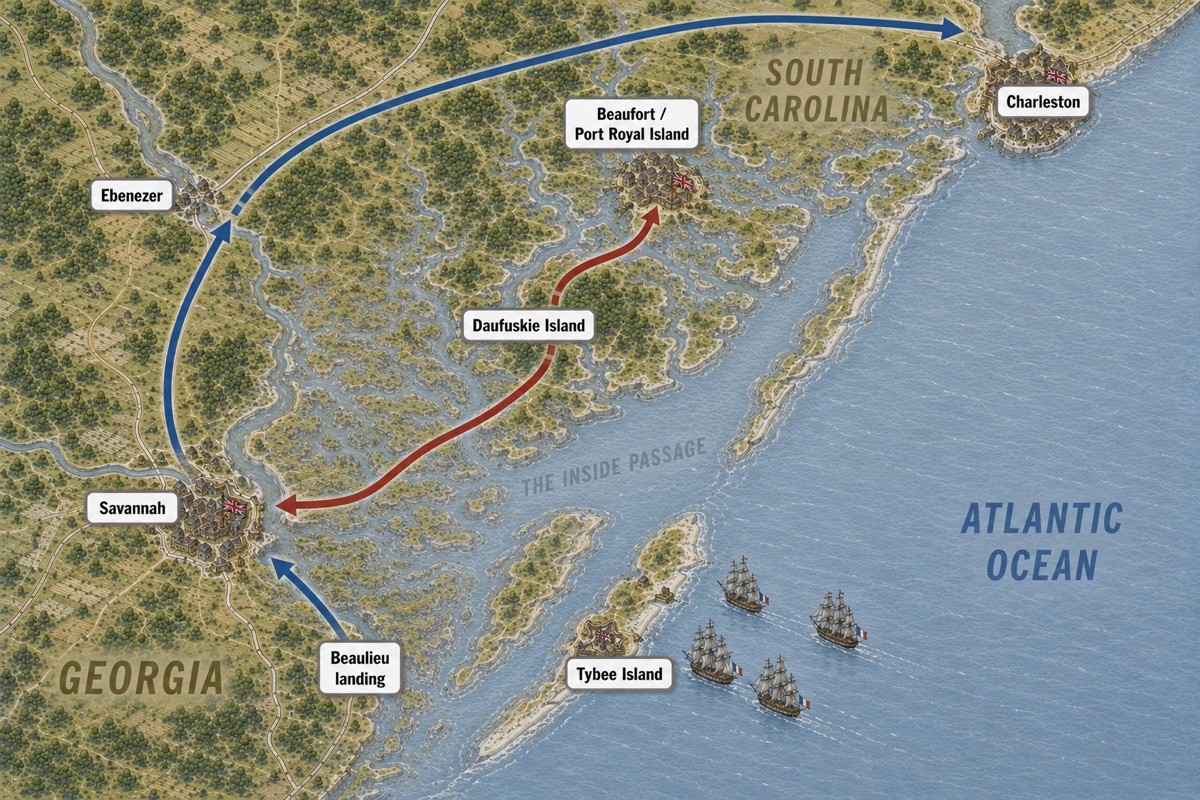
Britain already held Savannah. A small British force had taken Georgia's colonial capital on December 29, 1778, almost for free, and the siege this page is about is the allied attempt to take it back. Hold that fact, because the rest follows from it: by the summer of 1779, Britain had decided to win the whole war the way it had won this one town, from the bottom up. The reasoning ran like this. Two years of fighting in the North had taken the rebel capital of Philadelphia and won set-piece battles and ended the war not at all; then France had come in (the treaties were signed in February 1778, and Britain and France were shooting at each other by that summer), and the war went global, with the Caribbean sugar islands, the fortress of Gibraltar, and India all now competing with America for the King's ships and soldiers. So London changed the plan: hold New York, and shift the offensive to the South. The Colonial Secretary, Lord George Germain, told the British commander in chief, Sir Henry Clinton, that recovering the southern provinces was "considered by [the King] as an object of great importance in the scale of the war."
The war storyThe world war: how France's entry sent the war's whole weight southThe theory behind it was tidy on paper. The southern colonies were believed to be thick with Loyalists (colonists still loyal to the Crown) who would rise the moment a British army arrived and hold reconquered ground behind it with few regulars; southern exports of rice and indigo funded the rebellion's purchases in Europe; and taking Savannah and then Charleston would roll the whole rebellion up from its bottom edge. Britain also offered freedom to enslaved African Americans who would serve, a policy formalized that June in Clinton's Philipsburg Proclamation. And the theory had already been tested once, right here. The winter before, on December 29, 1778, a small British force under Lieutenant Colonel Archibald Campbell had taken Savannah at almost no cost: an enslaved man showed the British a path through the swamp around the American line, 600 redcoats came out behind it, and the defenders were routed at a cost to Campbell of barely two dozen men. Augustine Prevost (British) marched up from British East Florida to take overall command, and the royal governor came home. Georgia became the only rebel state where royal government was actually restored. The strategy, ten months in, looked like it was working.
Then a French battle fleet appeared off the Georgia coast, and for a few weeks the war's whole weight swung onto one harbor.
The fleet belonged to Charles Henri, the comte d'Estaing (French), a soldier-noble turned admiral who had had a frustrating American debut the year before and then won real prizes in the Caribbean: he took St. Vincent and Grenada in the summer of 1779 and fought a British fleet off Grenada to a bloody draw. Appeals from Charleston, from the American general Benjamin Lincoln (American), from South Carolina's government, and from the French consul, begged him to strike the British in Georgia before he sailed home. He came north with more than 20 ships of the line and about 4,000 troops, having sailed roughly 1,200 miles (1,900 km) up from his Caribbean base at Cap-Français, the main port on the north coast of Saint-Domingue (today Haiti), and appeared off the coast in the first days of September. And he came with a clock running against him from the moment he arrived. It was hurricane season, and his fleet lay exposed on an open coast with no harbor it could safely use; scurvy and dysentery were spreading through the crews; supplies were short; and his orders were to bring the fleet home. He had budgeted only days ashore. Every decision in this battle, the early summons, the impatience with a proper siege, the final gamble on a frontal assault, runs back to that clock.
What came ashore at Beaulieu plantation, on the Vernon River about 13 miles (21 km) south of town, starting on September 12, was the most diverse army the war would produce. There were French line regiments drawn from the Caribbean garrisons, and Dillon's regiment, Irish Catholics in French service under Colonel Arthur Dillon (French). There were South Carolina and Georgia Continentals (full-time regulars of the Continental Army) and militia (part-time citizen soldiers). There was the legion of Casimir Pulaski, the Polish nobleman Benjamin Franklin had sent to Washington as "an officer famous throughout Europe for his bravery," whom Congress had made "Commander of the Horse": about 200 cavalry and infantry drawn from Poles, Frenchmen, Germans, Irishmen, and Americans. The column leaders alone included a Swedish count, an Irish colonel, and a Polish general. And there were the Chasseurs-Volontaires de Saint-Domingue: roughly 545 men raised that spring in the French sugar colony of Saint-Domingue (the colony that is now Haiti) from free men of color and enslaved men promised their freedom for service. By the standard accounts they were the largest unit of soldiers of African descent to serve on either side in the entire war. Officially the French order of battle assigned them to labor and reserve duty, the order said they "were only to be used to dig trenches," but they would serve under fire and take casualties all the same. Add it up and the allied army numbered about 7,500, more than twice the garrison it had come to break.
It should have been enough. It was not, and the reason was a single day's truce a garrison asked for and got. At Beaufort, about 50 miles up the coast, a Scottish colonel named John Maitland had 800 men, a fever, and a knowledge of the inside water passage that the French and the Americans had both failed to watch.