By the summer of 1779 the war in the north had gone quiet, and the quiet was its own kind of problem. After the battle at Monmouth, in New Jersey, the previous June, the two main armies had stopped fighting general battles in the north for good. General Sir Henry Clinton, the British commander in chief in America, held New York City. George Washington (American), commander of the Continental Army (the rebels' full-time regular army, as opposed to part-time militia), ringed the city from New Jersey and the Hudson Highlands, the rugged stretch where the river cuts through the mountains north of the city. Neither man could force the other to fight, and Britain's real war effort was sliding south, toward Georgia and the Carolinas. What Clinton wanted in the north was a cheap way to hurt Washington, or to make him come out and fight on open ground where British regulars and bayonets would tell.
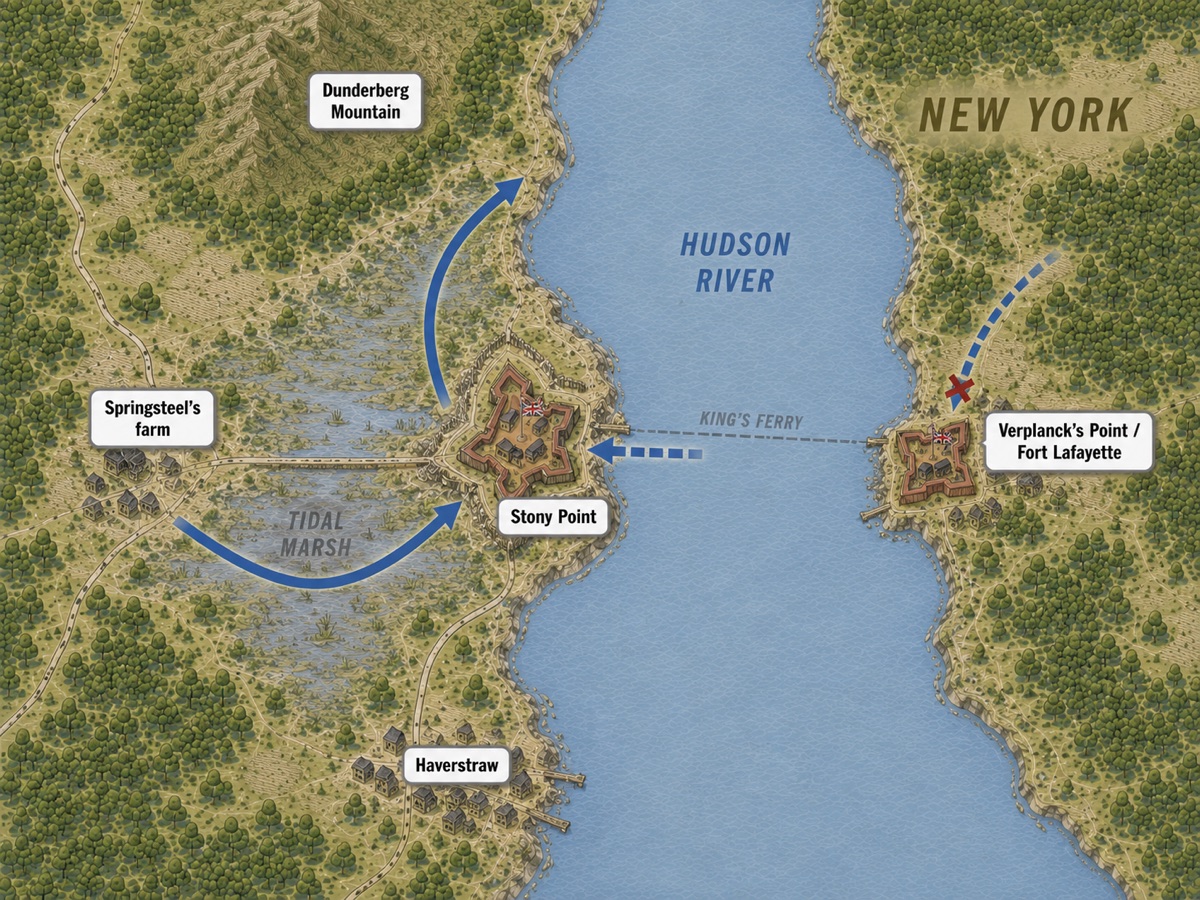
He went looking for it on the Hudson, because the Hudson was the seam of the whole Revolution. The river ran north from New York City up into the heart of the rebellion, and a British army sitting across it could split New England, the furnace of the war, off from the rest of the states. The American answer was the fortress complex being built at West Point, a bend in the river about 50 miles above the city, with a great iron chain (a massive linked boom floated across the river's full width on logs) stretched over the water to physically block ships from passing upriver. And the southernmost safe crossing below West Point was King's Ferry, where the river narrowed between two points of land: Stony Point on the west bank and Verplanck's Point on the east. King's Ferry was the shortcut for men, mail, and supplies moving between New England and the mid-Atlantic states; losing it forced everything onto a long detour up through the mountains.
So in late May, Clinton took about 6,000 men and a naval squadron up the river and seized both ends of the ferry. The unfinished American blockhouse (a small log fort) on Stony Point was burned and abandoned without a fight; the little garrison of about 70 men across the river at Verplanck's surrendered on June 1. Clinton fortified both points, garrisoned them, and waited. West Point was only a dozen miles upriver now, and his real hope was that Washington would come down and fight for the crossing. He sent raiders to burn the Connecticut coast that same month, hitting New Haven, Fairfield, and Norwalk in a week, the same bait on a longer leash. Washington refused all of it. He shifted his army to cover West Point, set up headquarters at New Windsor, and started planning a counterstroke of his own.
The war story1777: the campaign that made the Hudson the seam of the war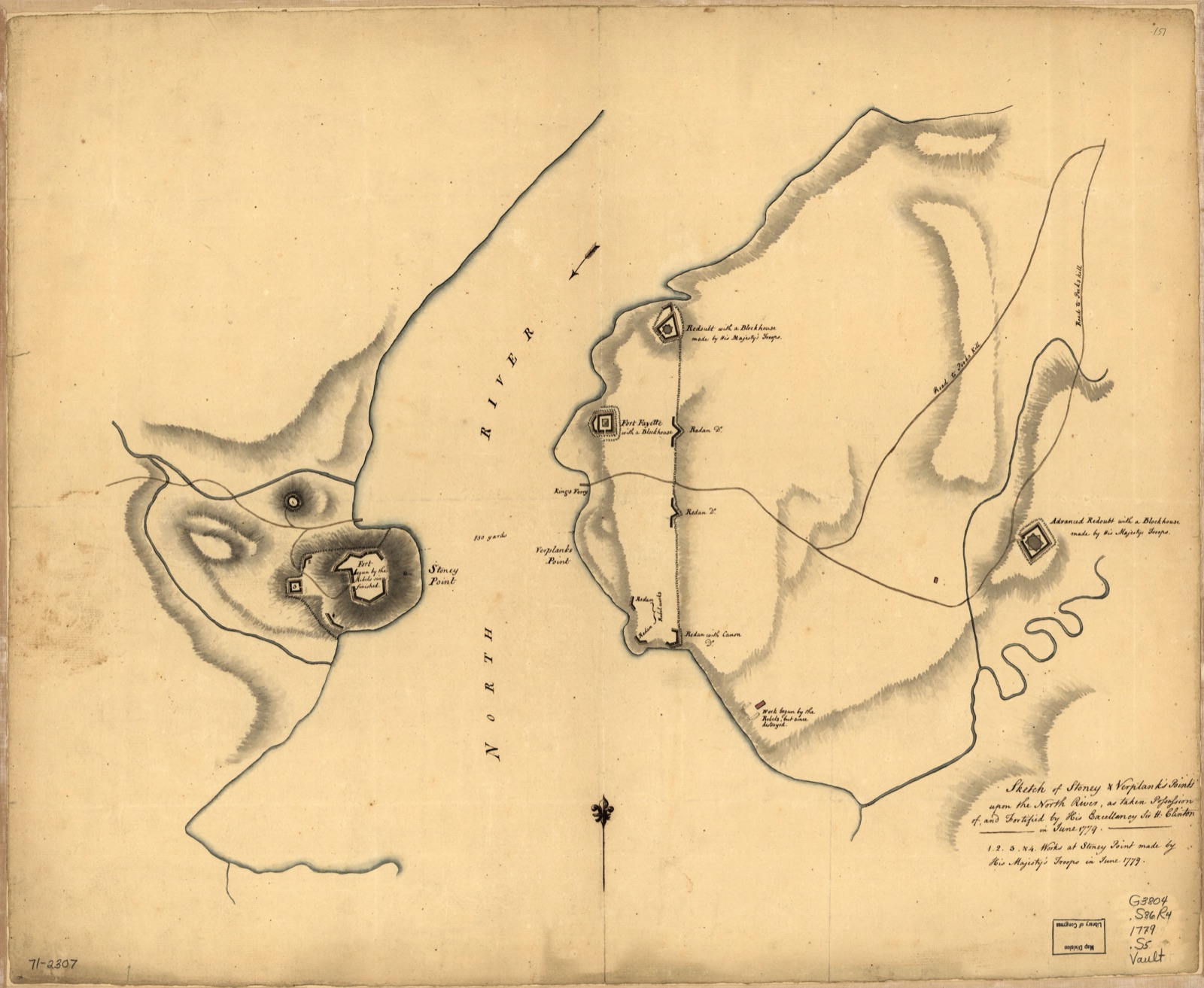
The thing he meant to hit was a hard target. Stony Point is a rocky promontory rising about 150 feet straight out of the river, surrounded by water on three sides; on the landward side a tidal marsh nearly cut it off, crossed by a single causeway, and at high tide the flats flooded. The British had not built a stone fort there but a field fortification, which for an attacker is bad enough: gun batteries with about fifteen pieces (cannon, mortars, and howitzers), earthen works, and two belts of abatis (felled trees with their sharpened branches turned outward, the period's barbed wire) belting the slope. A Royal Navy armed sloop, the Vulture, and a gunboat covered the river approaches. The garrison was a real one too: Lieutenant Colonel Henry Johnson (British) of the 17th Regiment of Foot commanded roughly 600 to 700 men, the 17th at the core, with a Highland grenadier company, a company of Loyalists (Americans who stayed loyal to the king), and Royal Artillery. British officers reckoned the place close to impregnable. The nickname that stuck to it in the histories was "little Gibraltar," after the great rock fortress Britain held in the Mediterranean.
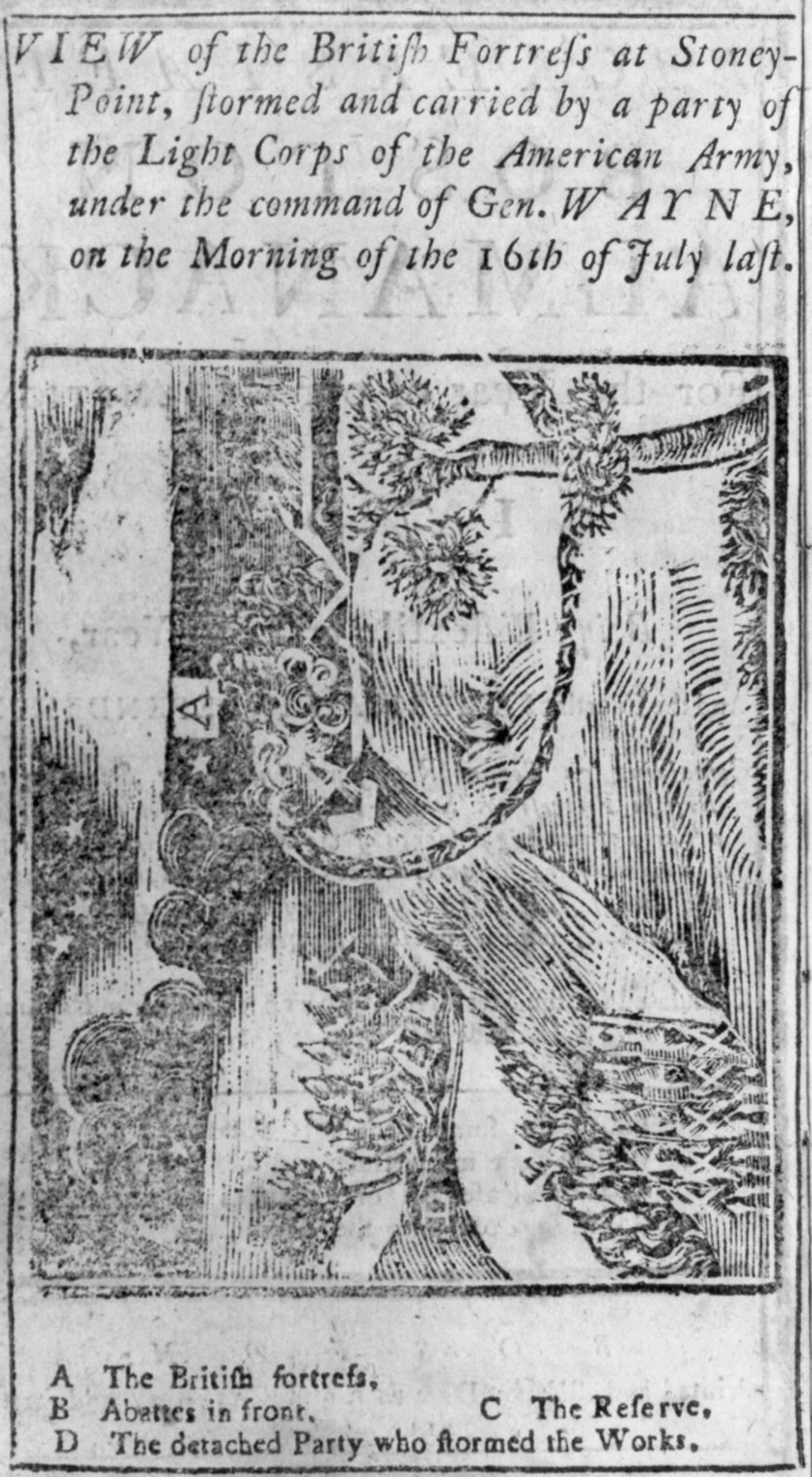
Washington studied it carefully, the way he rarely had the patience to. He reconnoitered the point himself. He gathered intelligence all through July from deserters and local informants, and from Captain Allan McLane (American), who got inside the works under a flag of truce while escorting a local woman and counted what he saw. Then he handed the operation to a man with a specific reason to want it: Brigadier General Anthony Wayne (American), a Pennsylvania tanner's son turned brigadier, who had taken command of the army's new Corps of Light Infantry on the first of July. The plan Washington gave him fixed the essentials, and they were unusual ones: a night assault, on the flanks where the water covered the approaches, in silence, with the bayonet. The attack was never meant to hold the ground, only to take it, haul off the guns, and walk away, leaving Clinton nothing to besiege. And the muskets would go in unloaded.