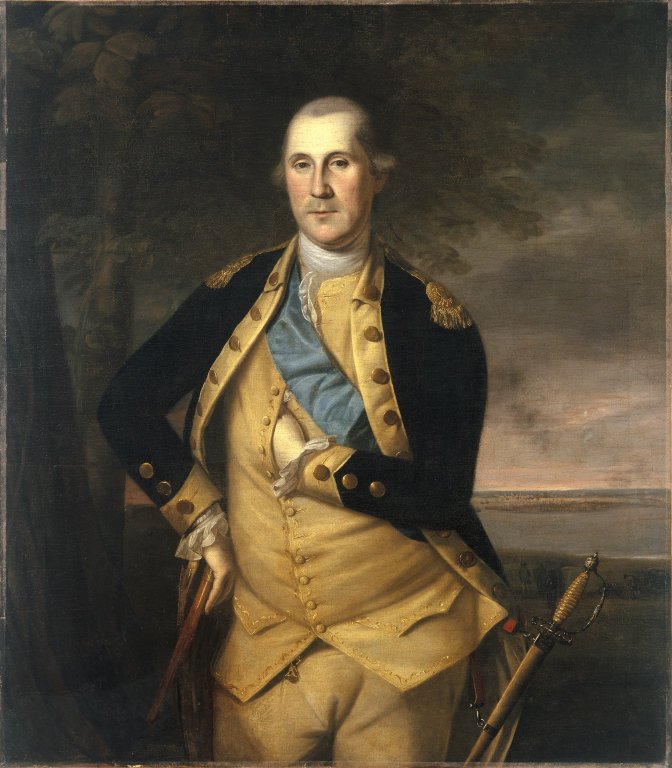
In December 1776 the American Revolution was dying, and the men running it knew it. The year had been a catastrophe since August. The British had beaten the Continental Army (the rebels' regular army, as opposed to the part-time militia) at Long Island, taken New York City, and then, on November 16, taken Fort Washington at the northern tip of Manhattan with about 2,800 American soldiers captured in a single day. Fort Lee, across the Hudson (the river on Manhattan's west side), was abandoned four days later. George Washington (American), the army's commander in chief, spent November and December retreating across New Jersey with a force that shrank as it marched: enlistments running out, men deserting, men sick. In early December he crossed the Delaware River into Pennsylvania and took every boat he could find with him, so that the British could not follow at once across a river with no bridges. The Delaware was now the front line: the British army in New Jersey on the east bank, what was left of the American one in Pennsylvania on the west.
The war story1776: the Declaration, the New York disaster, and the ten days that kept the cause aliveThey did not especially want to follow. In mid-December General Sir William Howe (British), satisfied that the rebellion was nearly finished, suspended campaigning for the winter, strung a chain of outposts across New Jersey, running from the posts nearest New York down to the Delaware itself (Perth Amboy, New Brunswick, Princeton, Trenton, Bordentown), and went back to New York. The most exposed link in that chain was Trenton, a town on the east bank of the Delaware, garrisoned by about 1,500 Hessians (German soldiers in British service) under Colonel Johann Rall, a hard-fighting career soldier who had led the decisive assault at Fort Washington weeks before. The same day Howe went into winter quarters, the Americans lost another general: Charles Lee, Washington's senior subordinate, who had been slow-walking his orders to join the main army, was captured by British cavalry at Basking Ridge, New Jersey. There was a cold consolation in it. Lee's division marched on under Major General John Sullivan (American) and reached Washington, and regiments under Major General Horatio Gates (American) came in too. For the first time in weeks, Washington had enough men to attempt something.
He had almost no time to attempt it in. The army's real enemy that December was not Howe; it was the calendar. The Continental Army was built on enlistments (fixed-term contracts; a man signed on until a stated date and then was free to walk home), and the bulk of the army's enlistments expired on December 31, 1776. This was not a risk of mass desertion; it was a scheduled, legal dissolution. On January 1 the United States would simply have almost no army, unless something happened that made men willing to stay. On December 18 Washington wrote to his brother Samuel: "I think the game is pretty near up."
While the army retreated, one of the men retreating with it was writing. Thomas Paine, marching with the army as a volunteer aide, began an essay on the retreat called The American Crisis. He got it printed in Philadelphia around December 19. The famous scene that goes with it, officers reading the essay aloud to the shivering ranks on the riverbank before the attack, traces back to a biography written in 1809, a generation later, and no eyewitness mentions it. Maybe it happened. What is certain is the text itself, and the moment it was written for.
THESE are the times that try men's souls: The summer soldier and the sunshine patriot will, in this crisis, shrink from the service of his country; but he that stands it NOW, deserves the love and thanks of man and woman.
New Jersey itself was turning. The occupation had come with plundering by British and Hessian troops, and a December 6 proclamation offering pardons to anyone who would swear allegiance to the king first cowed the population and then enraged it. By mid-December, bands of New Jersey militia were ambushing patrols and couriers all around Trenton, night after night. That harassment would matter more than anyone yet understood: it was quietly grinding down the garrison Washington was about to attack.
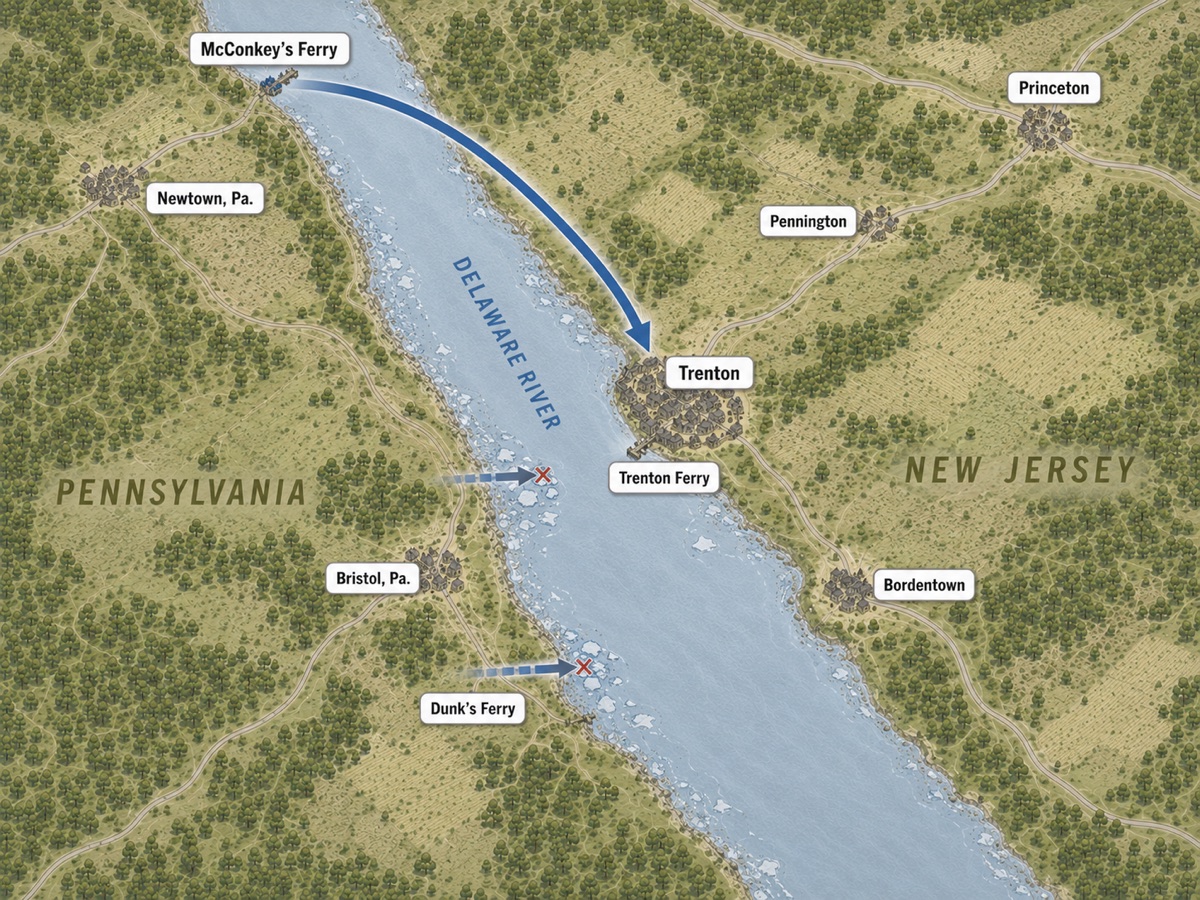
The plan Washington settled on was a gambler's plan, because only a gambler's plan fit the situation. On December 23 he wrote to Colonel Joseph Reed (a trusted aide): "Christmas day at Night, one hour before day is the time fixed upon for our Attempt on Trenton," adding, "For heaven's sake keep this to yourself, as the discovery of it may prove fatal to us," and then the sentence the whole plan rests on: "necessity, dire necessity will—nay must justify any Attempt." The attempt would be three crossings of an ice-choked river in one winter night. Washington himself, with the main body of about 2,400 men and 18 cannon, would cross at McConkey's Ferry (a boat-crossing point on the river), nine miles upstream of Trenton, and march down on the town from the north. Brigadier General James Ewing, with about 700 Pennsylvania militia, would cross directly opposite the town and seize the bridge over Assunpink Creek (the stream at Trenton's southern edge), closing the garrison's escape route. Colonel John Cadwalader, with roughly 1,500 to 1,900 more, would cross downstream near Bristol and pin down the enemy post at Bordentown (the next garrison downriver, a few miles south of Trenton) so it could not march to the rescue. The dark hours were the point: the columns would make the whole approach at night and hit the garrison before it was out of bed. Three columns, one night, a dawn attack, and an army with eight days to live if it did nothing.