For five years the war had ground on without ending. The British held the cities they could reach by ship, the Americans held the country between them, and neither could finish the other off. Then came a year in which things that had been moving separately closed on the same point at the same time: a French admiral choosing the Chesapeake against the American commander's own plan, a British government losing its nerve in the Commons, and under both a civil war burning through the Carolina backcountry that the armies barely controlled. Together they trapped an army at the edge of the water, and nobody planning it in the spring knew that was where it would end.
Greene takes the wreckage
The southern war was very nearly lost before this year began. The British had taken Charleston in May 1780, and with it an entire American army surrendered inside the city; three months later they smashed a second army at Camden, in South Carolina, and sent its commander, Horatio Gates, fleeing sixty miles in a day. The whole Southern Department, the Continental command responsible for the war below Virginia, was one more defeat from disappearing. This time Congress did not pick the replacement itself, as it had picked the three southern commanders before; it let Washington choose, and Washington chose Major General Nathanael Greene, the Rhode Island ex-ironmaster raised a Quaker who had spent the middle of the war not in the field but running the army's supply.
Greene reached Charlotte, North Carolina, on the second of December 1780 and took command from Gates the next day. What he found was an army on paper of around twenty-three hundred men, barely fifteen hundred of them fit to fight, hungry and close to naked. He did not march them anywhere to fight. He had spent 1778 to 1780 as the Continental Army's Quartermaster General, the unglamorous officer in charge of wagons, depots, forage, and river crossings, and he ran the southern war the way a supply officer would. Before he engaged anyone, he sent engineers, the Polish volunteer Tadeusz Kosciuszko among them, to survey the rivers that crossed his theater, the Dan, the Yadkin, and the Catawba, and ordered boats built and staged at the crossings. The campaign that followed would be won as much by where the flatboats waited as by where the muskets fired.
Then he did the thing the manuals forbid. With a weaker army in front of a stronger one, Greene split it. On the sixteenth of December he detached Brigadier General Daniel Morgan, the Virginia rifleman and veteran of Quebec and Saratoga, with around six hundred Continentals plus militia, to operate west of the Catawba, the river running south through the Carolina upcountry, while Greene took the rest to a "camp of repose" at Cheraw, in South Carolina. The logic was a supply officer's: two smaller forces could forage two districts instead of starving in one, threaten the British posts from two directions, and force the British commander in the South, Lieutenant General Charles, Earl Cornwallis, to divide too, because if he massed against either American wing, the other was loose in his rear. Cornwallis took the bait. He sent Lieutenant Colonel Banastre Tarleton, the feared twenty-six-year-old cavalry commander whom the backcountry had nicknamed "Bloody Ban" after his men cut down surrendering Americans at the Waxhaws, with around eleven hundred men to destroy Morgan, while he moved north to cut Morgan off. That set up the battle that took the bait apart.
Cowpens
Morgan chose his ground at a backcountry grazing common called the Cow Pens, in the upcountry of South Carolina, open woods on gentle rises with the Broad River some miles at his back. Standing with a river behind him broke another rule, and he meant it to: by his own later account he wanted no easy line of retreat, so that his militia could not melt away the way militia almost always did. How many men he had is genuinely unknown, the figure a range somewhere between eight hundred and nineteen hundred as arriving militia are counted in. The hard core was three hundred to four hundred Continentals under Lieutenant Colonel John Eager Howard, militia under Andrew Pickens, and eighty to a hundred dragoons under Lieutenant Colonel William Washington, the commander-in-chief's second cousin. Tarleton came on with something over a thousand.
Everyone knew militia ran; the question was when, and Morgan answered it by scripting the running in advance. He set three lines: skirmishers out front in the trees to bleed Tarleton's cavalry; behind them Pickens's militia line, asked for exactly two volleys aimed low and then permitted, in advance and out loud, to retire around the army's left and reform behind the third line; and on the main rise Howard's Continentals, with William Washington's horsemen hidden in reserve. What Morgan built on that ground was a machine made out of what militia could and could not do: a militia retreat, which in every previous battle had meant the line was breaking and the rout was starting, was here a planned movement. So when Tarleton's infantry saw the second line fall back and surged forward thinking they had won, they were running uphill, out of order, straight into fresh regulars who had not yet fired. Disordered men charging uphill cannot halt, dress their line, or reload; they took the volley at close range with nothing to give back.
Then the battle nearly came apart by accident and turned that into the kill. Howard ordered his right-hand company to wheel back to protect the flank; the order was misheard, and the whole Continental line began marching to the rear in good order. To Tarleton's men it looked like the regulars were breaking too, and they came on harder. Morgan rode along the retreating line, picked the spot, and on his command the Continentals halted, faced about, fired a single point-blank volley into the British packed in behind them, then went in with the bayonet. At the same moment William Washington's cavalry burst onto the British right and rear and Pickens's reformed militia came back around the other flank. The British were enveloped on both sides at once, the cleanest double envelopment of the war, and it folded in under an hour. Tarleton's own Legion cavalry refused his order to charge and rode off the field; Tarleton cut his way clear after a brief mounted clash with William Washington.
The arithmetic was ruinous for the British. Tarleton lost something like a hundred to a hundred and ten killed, more than two hundred wounded, and five to six hundred captured, roughly eighty to ninety percent of his force destroyed or taken in forty-odd minutes, along with both his field guns, the colors of the 7th Regiment, and his baggage. Morgan's own losses were a few dozen. What it meant mattered more than the count. Cornwallis had just lost his light troops, the fast quarter of his army, the part that let him pursue and screen and move quickly, and everything he did for the next two months was an attempt to make up for losing them. Morgan himself, his health broken by sciatica, left the army within weeks. Cowpens was the last battle he would ever fight.
The Battles · SoonCowpens: the full battle story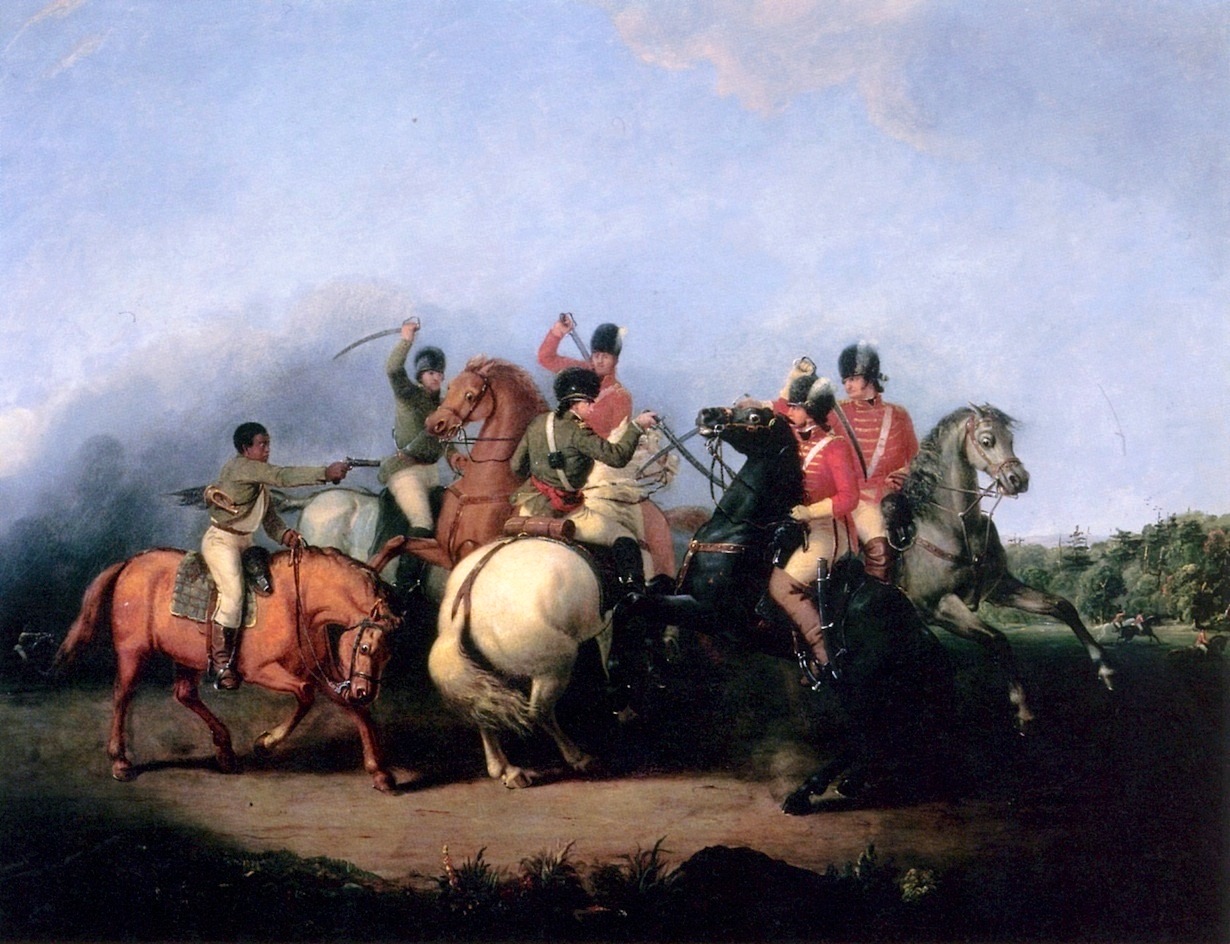
The race to the Dan
Cowpens forced Cornwallis's hand. Reinforced to somewhere between twenty-five hundred and three thousand by a column under Alexander Leslie, he set out to catch Morgan, retake the Cowpens prisoners, and destroy Greene's two wings before they could join. Then, at Ramsour's Mill in late January 1781, he made the campaign's most desperate decision: he burned his own baggage train. Tents, wagons, provisions, the officers' baggage, the rum casks staved in and poured into the mud, all of it set alight, with only ammunition, salt, hospital stores, and a few wagons kept back. He was turning his entire army into light infantry to match the speed he had lost at Cowpens, a British army deep in the American interior whose own commander had just destroyed its supply line on purpose.
What followed was a footrace across the Carolina midlands in the dead of winter. Morgan got his wing over the fords of the Catawba hours ahead of the pursuit, and the river rose behind him; Greene rode cross-country with a tiny escort to find Morgan, took hold of both wings, and steered them northeast toward the Dan River on the Virginia line, where safety lay on the far bank. The army marched ten to fifteen miles a day through freezing rain on frozen roads, rivers rising at every crossing, a rear guard of picked light troops under Otho Holland Williams, with the Legion of Henry "Light-Horse Harry" Lee, whose cavalry was Greene's fast-moving screen, holding within musket shot of the British advance.
The trick that won the race was the one Greene had set up in December with his river surveys. Cornwallis believed the lower Dan too deep to ford and its ferries too small to move an army, so he raced for the upper fords to get across ahead of Greene and trap him short of the river. But Greene's boats, staged weeks earlier on his quartermaster's orders, were waiting at the lower crossings at Irwin's Ferry and Boyd's Ferry. On the fourteenth of February 1781 the last Americans, Williams's rear guard, crossed into Virginia, and the boats crossed with them. Cornwallis reached the bank to find a river he could not cross and a country on his side of it that could not feed an army he had stripped of its wagons. He fell back to Hillsborough, raised the royal standard, and called on the loyalists of North Carolina to rise. The response was thin. Greene, refitted and reinforced with fresh Virginia and Carolina militia, recrossed the Dan on the twenty-second of February to keep those loyalists down and shadow Cornwallis.
Guilford Courthouse
In mid-March Greene decided he was strong enough to give battle, and he chose the ground himself, at Guilford Courthouse in North Carolina. He had around forty-four hundred men, the majority militia many days from their homes; Cornwallis attacked with something between nineteen hundred and twenty-one hundred veterans. Greene copied Morgan's three-line scheme from Cowpens onto bigger, more wooded ground: North Carolina militia at a fence line, asked again for their two volleys; Virginia militia in the woods behind them; and the Continentals on the rise by the courthouse. But the lines at Guilford were set too far apart to support one another, a real flaw, not a detail to smooth over. The North Carolina militia fired their volleys and went, as planned; the fighting then ran about ninety minutes back through the three positions, ending in close hand-to-hand combat near the Continental line, where the British Guards and the 1st Maryland mixed at the bayonet and William Washington's cavalry slammed in.
At the crisis of that melee came the battle's most famous moment. The story is that Cornwallis, to break the deadlock, ordered his guns to fire grapeshot, clusters of small iron balls that turn a cannon into a giant shotgun, straight into the tangle of struggling men, killing his own Guards along with the Americans. The source for that deliberate version is the memoir of Henry "Light-Horse Harry" Lee, written some thirty years later and repeated by most writers since; the modern study of the battlefield, built on roughly a thousand soldiers' pension files, argues the guns were actually aimed at William Washington's charging cavalry and that few if any Guards were hit. The British guns fired into the chaos at the crisis, the field cleared, and the story that Cornwallis knowingly shredded his own Guards to do it comes from one American memoir written decades afterward, which modern research doubts.
Greene, true to his doctrine, broke off and retreated in good order, leaving his guns behind rather than let his army be destroyed to hold a field. Cornwallis was left in possession of the ground, which by the rules of the day made it his victory. The bill for it was crushing: around five hundred and thirty British casualties, ninety-three killed, more than four hundred wounded, and some twenty-six missing, roughly a quarter to a third of the men he had put in, a disproportionate share of them officers and Guards he could not replace. American losses were about seventy-nine killed and a hundred and eighty-five wounded, plus a thousand-odd militia counted "missing," which mostly meant men who had fired their volleys and walked home when the battle moved past them, the ordinary rhythm of militia service and not a rout. When the news reached London that June, the opposition leader Charles James Fox is reported to have told the House of Commons that another such victory would ruin the British Army, consciously echoing the ancient king Pyrrhus, who said much the same after winning a battle that wrecked his own forces.
The Battles · SoonGuilford Courthouse: the full battle storyWe fight get beat and fight again. — Nathanael Greene, 1 May 1781
Cornwallis's victory had ruined him in exactly that way. With hundreds of wounded he could not move fast, no supplies because he had burned them, and no loyalist rising to fill his ranks, he marched more than two hundred miles away from the war he had been fighting, to the coast at Wilmington, to refit. And there he made the decision that set up everything still to come. Rather than march back into South Carolina to hold the posts Greene was now threatening, he turned north into Virginia. There was a real argument for it: Virginia's roads and depots fed the southern war, and Cornwallis held, on his own theory, that the lower South could never be held until Virginia, the colony that supplied it, was subdued. But he did not ask his superior, Sir Henry Clinton, the British commander-in-chief in New York, who would write afterward that had Cornwallis hinted at the plan, he would certainly have tried to stop him.
The two-front spring
Greene did not chase Cornwallis to the coast. He did the harder thing, marching back into South Carolina, straight at the chain of British posts that held the interior, while the partisan bands of Francis Marion, Thomas Sumter, Andrew Pickens, and Lee's Legion picked off the smaller forts one at a time. The partisans were irregular fighters who lived in the swamps and struck without warning, then scattered before the British could answer. What happened next looks, battle by battle, like a string of American defeats, and it was the campaign that won the South. At Hobkirk's Hill, a mile and a half from Camden, on the twenty-fifth of April, the young British commander in South Carolina, Lord Rawdon, surprised Greene's camp and broke his line at the wrong moment, taking the field; two weeks later Rawdon evacuated Camden anyway, because the post could not be held with the countryside gone. At the loyalist-held star fort of Ninety Six, Greene laid a siege from late May into June, Kosciuszko digging the approaches, and the British relieved the garrison and then, in early July, abandoned it anyway. At Eutaw Springs, northwest of Charleston, on the eighth of September, Greene's men swept through the British camp and then dissolved into plundering it; the hungry, half-clothed soldiers stopped to strip the tents instead of finishing the rout, a British counterattack drove them off, and Greene lost the field again, in one of the bloodiest battles of the whole war by proportion, each side losing a quarter to a third of its strength. The British then fell back on Charleston for good.
There was the pattern: lost the field, and the British abandoned the post anyway, three times running. By September the British in the lower South held Charleston, Savannah, and the ground their cannon could see, and nothing else. Greene never won a single battle in the campaign, and he won the campaign.
While Greene unwound the lower South, Cornwallis was loose in Virginia, and Virginia was already burning when he got there. In January a British raiding force under Benedict Arnold, three months a British brigadier after betraying the American cause, had sailed up the James River and burned much of Richmond, with Governor Thomas Jefferson watching the smoke from across the river and a militia turnout of a couple hundred men, many of them unarmed. To deal with Arnold, Washington had sent the twenty-three-year-old Marquis de Lafayette, the French volunteer who had become one of his most trusted generals, south with around twelve hundred light infantry. When Cornwallis arrived from Wilmington on the twentieth of May and joined the other British forces in the state, swelling them past seven thousand, Lafayette commanded the only American field army in Virginia, perhaps three to four thousand counting militia, against more than twice his number. He did exactly what Greene was doing two states south: refused battle, hovered, gave ground, and kept his small army intact while Cornwallis marched the length of central Virginia unable to bring him to a fight.
There was one sharp scrape, at Green Spring near Jamestown on the sixth of July, where Brigadier General Anthony Wayne's advance walked into an ambush Cornwallis had laid and had to cut its way out. And Cornwallis nearly bagged Virginia's whole government, sending Tarleton to seize the legislature, which had fled to Charlottesville; on the night of the third of June a militia captain named Jack Jouett, who had spotted the column, rode some forty miles by back trails to outrun it and warn them, and Tarleton's dragoons reached Jefferson's house at Monticello minutes behind Jefferson's own departure, by the family's account. Seven legislators were caught, but the government, and Jefferson, whose term as governor was expiring that week, escaped over the Blue Ridge. Then, under slow and contradictory orders from Clinton to establish a naval station on the Chesapeake, Cornwallis settled his army of seven to nine thousand men at Yorktown and across the river at Gloucester Point, on the York River, in August. It was a deep-water anchorage, perfectly safe so long as the Royal Navy held the sea around it.
The same summer, everywhere at once
On the first day of the year the Pennsylvania Line mutinied in its winter camp near Morristown, and nobody yet knew that the war would end in a Virginia tobacco port nine months later. They were somewhere between fifteen hundred and twenty-four hundred of the Continental Army's hardest, longest-serving veterans, and they had gone over the edge over years of no pay, no clothes, and disputed enlistment terms. Officers were killed and wounded in the scuffle; the men elected a Board of Sergeants and marched on Philadelphia to put their case to Congress. They were not changing sides. When Clinton sent agents from New York to recruit them for the Crown, the mutineers seized the agents and handed them over to be hanged as spies. The thing was settled by negotiation, about half the Line discharged, and when the New Jersey Line tried the same on the twentieth of January, Washington surrounded it and had two ringleaders shot by firing squads drawn from their own fellow mutineers. The army that would win the year very nearly dissolved in the year's first week.
The whole cause was running, that same winter and spring, on French coin and French gunpowder, and on a French army that could not yet be used: Rochambeau's five thousand regulars had sat idle at Newport, Rhode Island, since the middle of 1780, waiting for the one thing that would make them count, naval superiority off the American coast. On the twenty-first and twenty-second of May, Washington and the comte de Rochambeau, the French commander, met at Wethersfield, Connecticut, to plan the summer. Washington wanted New York, the great prize, Clinton's base, the city that had humiliated him in 1776, and the conference memorandum says plainly that New York was the plan. Rochambeau signed that memorandum agreeing to New York, and then, that same week, wrote directly to the French admiral in the West Indies, the comte de Grasse, making the Chesapeake case on its military merits: that Virginia, where Cornwallis was now loose and the country suffering, might serve far better. The campaign that would end the war thus began as a plan its American commander did not want, with his ally already steering elsewhere on paper Washington never saw.
The decision that armed everything was made on the fifth of August, at Cap-Français on Saint-Domingue, by a man none of the Americans had met. The comte de Grasse, the French admiral commanding in the West Indies, answered Rochambeau's letter by committing not part of his fleet but all of it, twenty-eight ships of the line, the heavy battleships that decided who controlled a stretch of sea, to the Chesapeake rather than New York, with around three thousand French troops borrowed from the islands under the marquis de Saint-Simon and money raised in Havana to pay for the campaign, and he weighed anchor that same day, taking the unfrequented Bahama Channel to cross unseen. He set his own deadline as he went: he had to be back in the Caribbean by the middle of October, a window only weeks wide. The hinge of the war was a French admiral's choice and a French admiral's clock, made nine hundred miles from where Washington was still planning to attack New York.
The news reached Washington's headquarters on the fourteenth of August, by way of Newport. He gave up the plan he wanted in about a day. His diary that same evening recorded that matters having now come to a crisis and a decisive plan to be determined on, he was obliged to give up all idea of attacking New York and instead to move the French troops and a detachment of the American army to the Head of Elk, at the top of the Chesapeake, to be carried down to Virginia. Within days the armies were marching, around two thousand to twenty-five hundred Continentals and four to five thousand French swinging south from the Hudson, while Washington ran a deception to keep Clinton frozen in New York and blind to where the blow was going. He laid out fake staging camps in New Jersey, collected boats as if for an assault on Staten Island, planted false dispatches written to be intercepted, and had a field of brick bread ovens built at Chatham, New Jersey, with a real French bakery actually baking in them, the surest sign an army means to stay a long while in one place. Clinton did not conclude the army had gone south until around the second of September, the day it paraded through Philadelphia. Washington admitted the whole apparatus years afterward, writing that much trouble was taken and finesse used to misguide and bewilder Sir Henry Clinton in regard to the real object, by fictitious communications, as well as by making a deceptive provision of ovens, forage, and boats in his neighborhood.
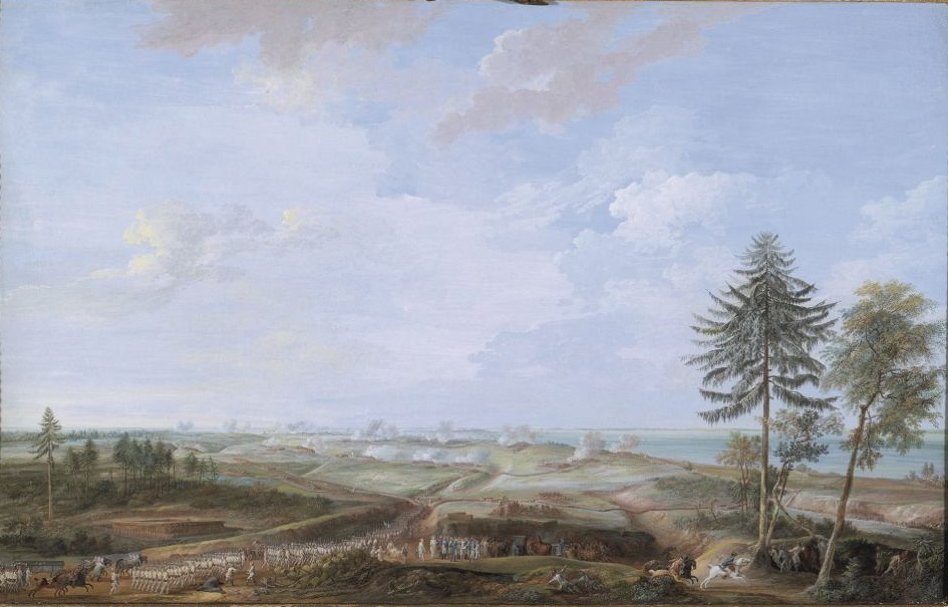
Then came the one beat that turned the trap shut, and the war-at-sea chapter owns the battle itself; the spine carries only its consequence. On the fifth of September, off the Virginia Capes at the mouth of the Chesapeake, de Grasse's twenty-four ships came out to meet a British fleet of nineteen under Admiral Thomas Graves. They fought two hours of broadsides, messy and indecisive, nobody sunk that day; but de Grasse then kept the British fleet at sea for days, long enough for a second French squadron under Barras to slip in from Newport with the heavy siege artillery. Graves, his ships battered, one of them later scuttled, turned back to New York. The bay was shut. Cornwallis's safe anchorage, the deep water that had made Yorktown a refuge, was now a trap with the enemy on three sides of him and his own navy gone.
Off the fieldThe war at seaIn the same season the war was dying in London. It was six years old there, the national debt swollen, and the enemy coalition now ran to France, Spain, and the Dutch Republic at once, so that Britain was fighting in the Channel, the Caribbean, at Gibraltar, and in India at the same time, with no ally anywhere in Europe. That June the Commons beat back a motion against the American war, but the opposition was growing in the country, and on the twelfth of December, with the news from Virginia not yet across the Atlantic and Cornwallis already weeks a prisoner, a motion to end the war drew a hundred and seventy-nine votes against two hundred and twenty. The British public's war was dying before Cornwallis surrendered. And under all of it ran the war's ugliest layer, the southern civil war: in the Carolina backcountry the same twelve months were a cycle of reprisal hangings, plundered farms, and neighbor killing neighbor, loyalist against rebel, that the armies barely governed. That was the war Greene's patient map-winning was slowly strangling, fort by abandoned fort.
For Yorktown to happen, all of it had to happen. A French admiral had to choose the Chesapeake with his whole fleet, against what Washington himself had wanted, on a self-imposed deadline only weeks wide, and get there before Graves could return. An army that had mutinied in January had to still be marching in September. A British command had to be split between a general in Virginia and a general in New York who had stopped trusting each other. A Parliament had to be losing its stomach for the war. And a southern interior had to have already slipped, post by post, from British hands. Remove any one strand and the year closes on nothing in particular, the way the five years before it had.
The siege
The allied army marched out of Williamsburg on the twenty-eighth of September and closed around Yorktown: roughly eighty-eight hundred Americans, Continentals and Virginia militia, and around seventy-eight hundred French regulars, against Cornwallis's eight thousand or so behind the town's earthworks. Counting de Grasse's fleet and sailors in the bay, the French share of the whole effort was the larger one: the siege artillery, the fleet that sealed the bay, and the engineers who would run the siege were all French. On the night of the twenty-ninth into the thirtieth, Cornwallis pulled his men back into the town's inner line, on the strength of a letter from Clinton promising relief from New York, and the allies walked into the abandoned outer positions without a fight.
What followed was siegecraft, the formal European method of taking a fortified place by digging toward it in stages, run like clockwork. On the rainy night of the sixth of October the allies dug the first parallel, a trench line two miles long some six to eight hundred yards out from the British works, dug parallel to the enemy walls so the diggers were never exposed broadside to the guns, French engineers directing the work in the dark. On the ninth the batteries opened, the French guns at around three in the afternoon and the American battery at about five, with Washington, by tradition, firing the first American gun. From then the bombardment never stopped; French heated shot set the British frigate Charon ablaze in the river that night. On the eleventh the allies began a second parallel, only three hundred yards from the British line, but it could not be carried through to the river while two British strongpoints still held the allied left: Redoubts 9 and 10, a pair of fortified earthwork positions out ahead of the main works.
They were taken on the night of the fourteenth of October, in two simultaneous assaults, and the division of labor matters. The attackers went in after dark with bayonets only, muskets unloaded so no accidental shot could give them away. Redoubt 9 was stormed by around four hundred French troops, the Royal Deux-Ponts regiment and the Gâtinais grenadiers, under Lieutenant Colonel Guillaume de Deux-Ponts. Redoubt 10, nearer the river, was stormed by around four hundred American light infantry under Lieutenant Colonel Alexander Hamilton, who had lobbied Washington hard for the command, with John Laurens circling to take the rear. Both fell in under half an hour. The French losses at Redoubt 9 ran heavier than the American losses at 10, their redoubt holding a larger garrison and its obstacles less broken. That same night the second parallel was carried through to the river, and the allied guns moved up to point-blank range. It was one assault apiece, and the French one was the harder fight.
With his inner town now under guns he could not answer, Cornwallis made his last two throws. Before dawn on the sixteenth a British sortie spiked a few guns in the second parallel, driving iron spikes into the touchholes to silence them, but they were back in action within hours. That night he tried the only move left to him: to ferry his army across the York River to Gloucester Point and break out overland to the north. The first wave got across, and then a sudden storm scattered the boats and ended it, and the troops who had crossed had to be brought back the next morning. With the town wrecked, sickness spreading, ammunition nearly gone, and the promised relief fleet still sitting in New York, at about ten in the morning on the seventeenth a British drummer boy beat the parley on the parapet and an officer waved a white handkerchief, and the guns stopped. It was four years to the day since a British army had surrendered at Saratoga.
For two days commissioners haggled the terms at the Moore House outside the lines. Washington refused the garrison the honors of war, the ceremonial courtesy by which a surrendering army marches out with its colors flying and a tune playing, the same humiliation the British had imposed on the American garrison at Charleston the year before. On the nineteenth of October the garrison marched out between the allied lines, French troops on one side and Americans on the other, their colors cased, furled and sheathed rather than flown. More than seven thousand soldiers surrendered, along with the army's naval personnel and more than two hundred guns. Cornwallis did not come out himself, pleading illness; he sent his second-in-command, Brigadier General Charles O'Hara, who offered his sword first to Rochambeau. Rochambeau pointed him across the line to Washington, and Washington, matching a deputy with a deputy, directed him to Major General Benjamin Lincoln, the officer who had surrendered Charleston to the British the year before. By tradition the British bands played "The World Turned Upside Down" as the men marched out, though no contemporary account names any tune and the story surfaces only in recollections written long afterward.
The Battles · SoonYorktown: the full battle story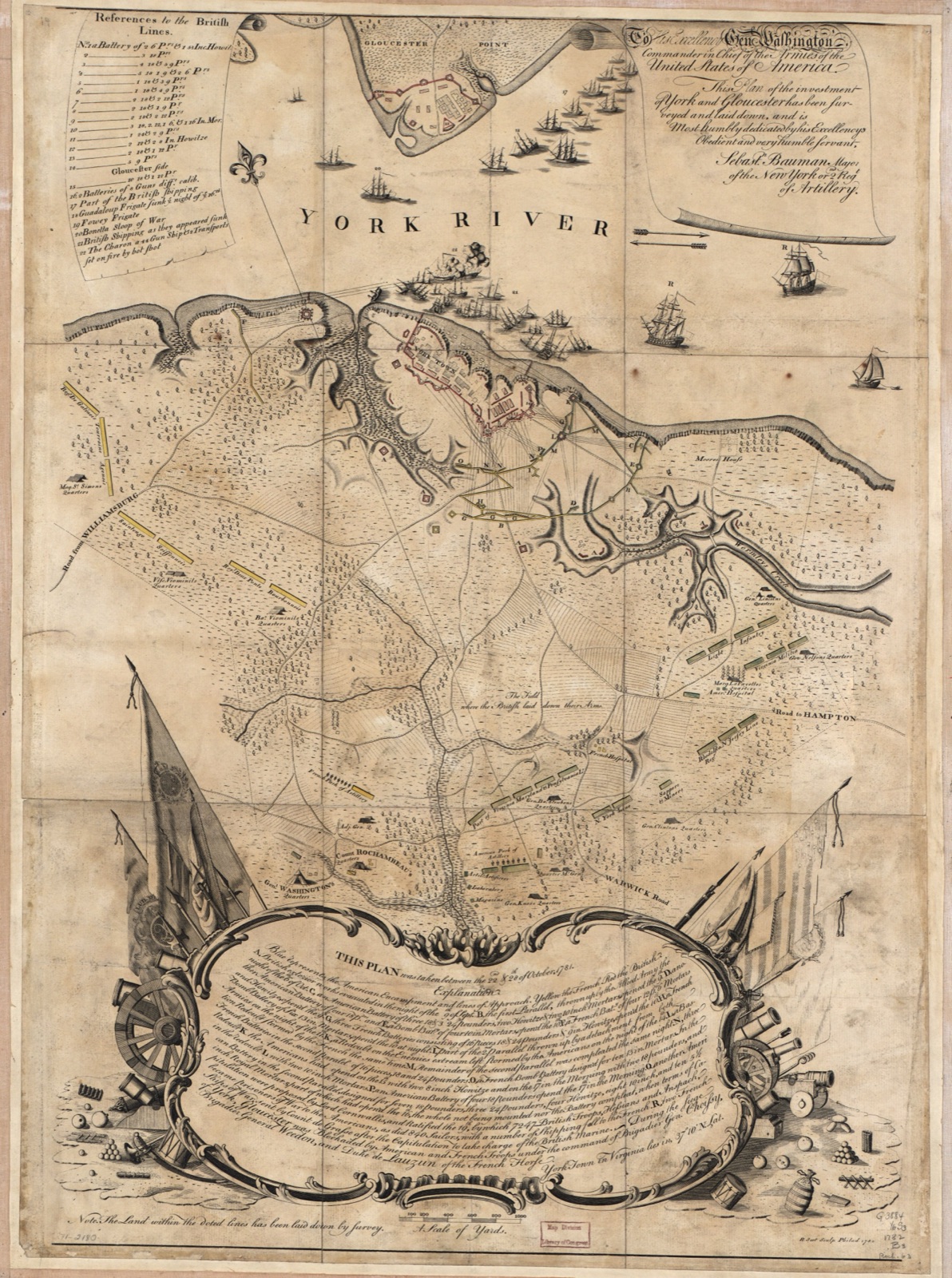
The night the war was decided
The dispatches crossed the Atlantic in about five weeks. On the twenty-fifth of November 1781 they reached London, going first to the house of Lord George Germain, the minister who had run the American war, and then by hand from minister to minister across the city to Lord North, the king's First Minister. The scene of North receiving it, and the words he is said to have spoken, belong to the next chapter; here it is enough that he took it as a man takes a mortal blow, and that the King's speech to open Parliament two days later had to be hurriedly rewritten around the news.
The war did not end at Yorktown. Britain still held New York, Charleston, and Savannah with some thirty thousand troops; the Royal Navy fought on and would win a large victory in the Caribbean at the Saintes the following April; Greene's army still watched Charleston; the frontier killing ran on into 1782. What ended at Yorktown was not the war but the British will to reconquer thirteen colonies by force. Within four months the Commons would vote against continuing the offensive war and North's government would fall, and the story of those votes, that fall, and the negotiation that followed is the next chapter's. The war was decided on the night a messenger reached Pall Mall with the news from Virginia, and it was not yet over.