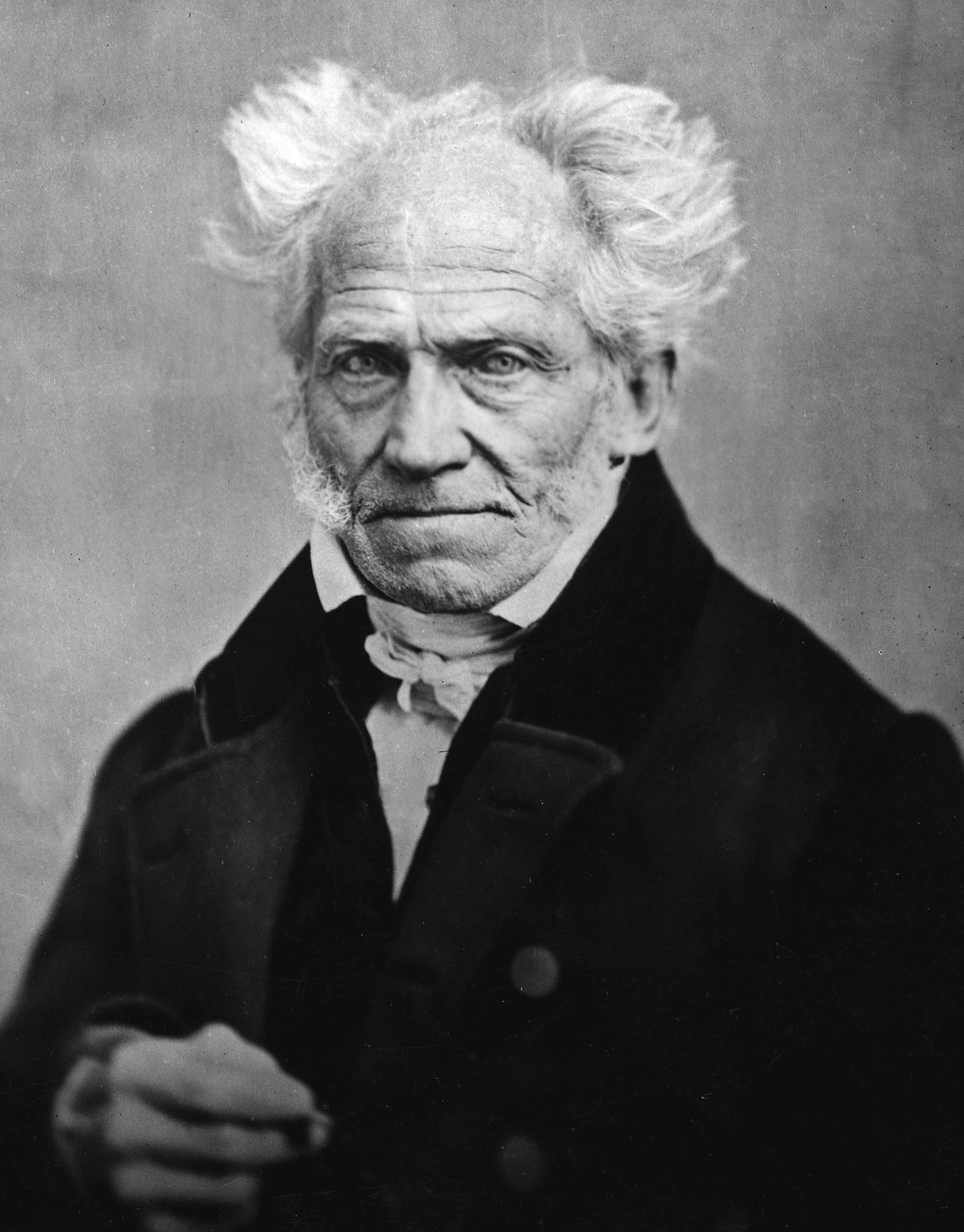
In March 1820 a thirty-two-year-old newcomer began lecturing in philosophy at the University of Berlin, and he made a decision that tells almost the whole story of his life before its end. The most famous philosopher in the German-speaking world, Georg Wilhelm Friedrich Hegel, taught there, and his lecture hall was packed. The newcomer, certain that he and not Hegel had the truth, scheduled his own course at the very same hour, head to head, daring the students to choose. They chose. Almost none of them came to him. The hall stayed nearly empty, the venture collapsed, and Arthur Schopenhauer effectively walked away from an academic career he never resumed, carrying a contempt for Hegel that he would nurse, in print, for the rest of his life.
The book he was sure of had already been published, in late 1818, and had sold so badly that most of the print run was eventually pulped for scrap. It was called *The World as Will and Representation*, and it laid out a complete philosophy: a single vision of what the world fundamentally is, why life inside it is suffering, and how, by three narrow routes, a person might find some release. It was written with a clarity and force almost no German philosopher of the era could match, in flat defiance of the foggy system-building he despised. And for roughly thirty years it sank without a trace. Schopenhauer was a man of private means, so he did not starve; he settled in Frankfurt, dined well, played the flute, kept a succession of poodles, and waited, with mounting bitterness, to be recognized as the genius he was convinced he was.
Recognition came, when it came, almost too late to enjoy. In 1851 he published a collection of essays and aphorisms, Parerga and Paralipomena, the most readable thing he ever wrote, and it caught on. An admiring English review in 1853 announced him to a wider world. Suddenly the obscure pessimist was a celebrity; disciples made pilgrimages to Frankfurt, his earlier work was reissued and read at last, and he spent his final decade as a famous man, vain and gratified, watching the fame he had earned at thirty arrive at sixty-three. He died in 1860, and within a generation his blind, striving Will had reshaped European thought far beyond philosophy.
This is the story of that system and of the man who built it against the optimism of his whole century: the world reduced first to representation, then to a single restless Will; the argument that this makes existence suffering rather than the mere claim that it does; the three doors out, art and compassion and the denial of the will; and the honest, deep debt he owed to Kant and to the philosophy of India. Schopenhauer is the great no-sayer of the nineteenth century, and nearly everyone who mattered afterward, from Nietzsche to Freud, had to pass through him.
The break
Hegel's vision deserves its full strength before Schopenhauer's revolt against it makes sense. For Hegel, reality at bottom is mind-like, a single developing Spirit (Geist) coming over the whole course of history to know itself, and history is therefore not a chaos but a plot: the slow, necessary growth of the consciousness of freedom, from ancient despotisms where one man was free up to a modern world that grasps that every human being is free. Even the carnage has a meaning. Hegel called it the cunning of reason: the private greed and ambition of conquerors gets used, behind their backs, to push the whole species forward, so that the suffering, dreadful as it is, is the price of a real advance. The real is the rational. The story is going somewhere, and where it is going is good.
Schopenhauer found this not merely false but obscene, and he said so with a venom unusual even among philosophers. He regarded Hegel as a charlatan whose reputation was a kind of intellectual corruption, a fog of self-important jargon dressed up as profundity and propped up by the Prussian state. The personal feud was real, the head-to-head lectures and all. But the philosophical break is deeper than spite. Schopenhauer simply denied every load-bearing claim of the optimistic picture. There is no rational Spirit running the world. There is no plot. History is not going anywhere; it is the same hungers, the same crimes, the same brief triumphs and long disappointments, repeating without progress under different costumes.
What is actually at the bottom of things, Schopenhauer argued, is not reason at all but a blind, aimless striving he called the Will, an urge that wants without wanting anything in particular, that drives all of nature and all of human life and never arrives, because arriving is not in its nature. And once the engine of the world is wanting rather than reason, the conclusion follows with brutal directness. To want is to lack, and to lack is to suffer; so a world whose inner being is endless wanting is a world whose inner being is endless suffering. Where Hegel saw history redeemed by its goal, Schopenhauer saw a process with no goal to redeem it, a striving that produces pain as a fire produces heat, necessarily and forever.
That is the break, and it is as total as any in the history of philosophy. From a rational, progressive, meaning-laden cosmos in which even the worst serves a good end, to a blind, purposeless, goalless one in which existence is suffering and the only freedom is to quiet the wanting that is its source. The nineteenth century mostly believed, with Hegel, that things were getting better and that reason was in charge. Schopenhauer told it that nothing was in charge, that better was an illusion, and that the truth was a hunger with no name. The century ignored him for thirty years and then could not get him out of its head.
Chapter 1
The merchant's son who hated his mother and Hegel
"The world is my idea."
Arthur Schopenhauer was born on 22 February 1788 in Danzig, then a wealthy free city on the Baltic and now the Polish Gdańsk, the son of one of the city's prosperous merchants. His father, Heinrich Floris Schopenhauer, was a shipowner and trader, cosmopolitan, proud, and determined that his son would inherit not just the money but the business. Arthur was groomed for commerce from boyhood: travel, languages, a long European tour at fifteen taken on the explicit bargain that he would afterward apprentice in a merchant's office. He kept the bargain and spent miserable months as a clerk. The training in the wider world stuck; the training for trade did not. He wanted to think, and the counting-house was killing him.
Release came through catastrophe. In 1805, when Arthur was seventeen, his father was found dead in a canal beside the family warehouse. By most accounts it was suicide, though the matter was never settled and the read leaves it where the evidence leaves it: a probable, unproven self-killing that hung over the rest of Schopenhauer's life. The death dissolved the merchant's plan. With his father gone, Arthur was eventually free, and with means, to leave commerce for the university. He came to philosophy late and from outside, a rich young man who had already seen the working world and found it hollow, and that outsider's distance never left his writing.
His mother is the other shaping presence, and the relationship was poison. Johanna Schopenhauer was clever, sociable, and ambitious in her own right: after her husband's death she moved to Weimar, set up a glittering salon that drew Goethe himself, and became a popular novelist, for a time considerably more famous than her son would be for decades. She and Arthur could not be in a room together. He was gloomy, censorious, and combative; she wanted gaiety and found him insufferable. The quarrels escalated until a final, bitter break in 1814, after which, by the standard account, mother and son never saw each other again, though she lived another twenty-four years. He kept her at the length of letters, then not even that. The first great pessimist of modern philosophy learned early and at home that intimacy was mostly friction.
He took his doctorate in 1813 with a dissertation on the principle of sufficient reason, the principle that nothing is without a reason why it is rather than is not, and that everything that happens has a ground that explains it. The young Schopenhauer sorted that principle into four distinct kinds, one for ordinary cause and effect, one for logical inference, and so on, which is dry work, but it set the foundation for everything after: it mapped the rules by which the mind organizes the world of appearances, the very machinery he would soon argue stands between us and reality. Goethe, who knew the family, took an interest in the strange, intense young man and worked with him for a while on the theory of colors. Then Schopenhauer went off to build his system.
He built it fast and young. The World as Will and Representation was finished in 1818 and published, dated 1819, when he was barely thirty: a single, sustained, four-part vision of the whole of things, written once and then defended, expanded, and footnoted for the rest of his life but never fundamentally changed. He thought it was the truth, complete. The world disagreed by ignoring it. The book sold almost nothing, and the failure curdled into the famous episode in Berlin in 1820, where he pitted his lectures against Hegel's at the same hour and lost the students in a rout. The contempt for Hegel that followed was lifelong and unmeasured: Schopenhauer cast him as a clumsy fraud whose unreadable prose passed for depth, a corrupter of philosophy propped up by the state, the anti-philosopher. Some of this is sour grapes. Some of it is a real and deep disagreement about whether the world makes rational sense at all.
He gave up on the academy and on getting an audience, and settled, on his inherited income, into a long, orderly, solitary life in Frankfurt am Main. He rose early, wrote in the morning, played the flute, dined at a good table, read The Times of London, and walked his poodle every afternoon on a fixed route a person could set a watch by. By tradition he called every dog he owned by the same name, Atma, after the Sanskrit Ātman, the world-soul of Hindu thought, nicknamed Butz. He was vain, suspicious, ferociously well read, and quietly waiting. Fame finally arrived through the back door of the aphoristic essays of Parerga and Paralipomena in 1851, and an admiring English review two years later; his last decade brought disciples, visitors, and the recognition he had been owed since thirty. He died in Frankfurt on 21 September 1860, seventy-two years old, sitting up on his sofa one morning, alone.
Chapter 2
The world as Representation
"…what he knows is not a sun and an earth, but only an eye that sees a sun, a hand that feels an earth…"
The whole system stands on a single sentence Schopenhauer chose to open his great book: the world is my idea. The German word is Vorstellung, which means a presentation, something set up before a mind, and which his first English translators, R.B. Haldane and J. Kemp, rendered as idea (their version is titled The World as Will and Idea); the now-standard English is representation. Either way the claim is the same and it is not the soft thought it can sound like. Schopenhauer is not saying the world is imaginary or that wishing changes it. He is making the hard point that everything anyone can ever know, the entire world of suns and earths and other people, is only ever known as it shows up for a knower. It is always object-for-a-subject, never a thing met raw, with no mind on the receiving end.
This is the inheritance from Kant, taken over whole and stated more plainly than Kant ever managed. Kant had argued that the mind is not a passive mirror but an active machine: space, time, and causality are not features the world hands us, they are the forms the mind itself brings, the lenses through which alone anything can appear (the Kant read walks the full argument). Schopenhauer accepts this completely and compresses it into the principle of sufficient reason, the single rule under which the knowing mind sorts everything it meets into a web of where, when, and why. The world of representation is the world run through that machinery: spread out in space, strung along in time, locked into cause and effect. It is lawful, knowable, and real as far as it goes. But it goes only as far as appearance.
The epigraph's image carries the point with no jargon at all. A man opens his eyes on a bright morning, and it seems obvious that he has met the sun and the earth themselves, brute things that were simply out there. Schopenhauer's correction is exact: what he has actually got is not a sun and an earth but an eye that sees a sun, a hand that feels an earth. The warmth, the brightness, the solidity are events in a perceiving creature, structured by that creature's equipment. Take away every eye and hand and knowing mind, and there is no sun-and-earth left standing alone in the dark; there is something about which the words bright and solid and even there no longer clearly mean anything, because those were always features of how a world appears to a subject.
The strongest version of this is the one worth stating before any reply: it is not a denial of an external world but a precise account of our access to it. Of the whole world we know, no part is ever encountered except as it is presented to a mind, and the basic shape of that presentation, its spatial spread, its temporal flow, its causal joints, can be shown to come from the side of the knower. So, Schopenhauer says, no truth is more certain or less in need of proof than that the entire world, everything that exists for knowledge, is object only in relation to a subject. The world, as known, is through and through a representation. There is no escaping the eye to check the sun against itself.
And that is exactly where the system turns, because a wall now stands where Kant left it. If everything we can know is appearance, structured by us, then reality as it is in itself, apart from all that structuring, lies on the far side, untouched by our knowing. Kant had named that far side the thing-in-itself and posted it as forever unknowable, a permanent limit. Schopenhauer agreed the world of representation is only the surface. He disagreed, fiercely, that the depth was sealed off. He thought there was one place, and exactly one, where a person stands on the inside of reality rather than looking at its outside, and that through that single crack the thing-in-itself could be read. The crack is the body. The reading is the Will.
Chapter 3
The world as Will
"…the world is my will."
Everything outside a person reaches them only as representation, from the outside, as a picture. There is one object in the whole world that is not like that, and it is the person's own body. A man knows his body the way he knows everything else, as an image among images, a thing with weight and color he can see in a mirror. But he also knows it a second way, from the inside, that he gets for nothing else in the universe: he knows it as willing. When he decides to raise his arm and the arm rises, he does not observe two events, a mental command and then a physical motion, linked by some hidden mechanism. He lives one event from two sides. The act of will and the movement of the body are not cause and effect; they are the same thing, known inwardly as will and outwardly as motion.
This is the single crack in the wall, and Schopenhauer drives the whole system through it. Here, in his own body, a person has reality from both faces at once: the outer face, the body as representation, and the inner face, the body as will. The inner face is the thing-in-itself showing through. And then comes the great, vertiginous generalization. If my own innermost reality, met from inside, is will, then by analogy the innermost reality of everything else, which I can only ever meet from outside as representation, must be will as well. The one keyhole I have into the depth of things shows will; so will is what the depth of all things is. The world is my representation, and the world is also, underneath, my will, which is to say the Will.
The Will has to be understood correctly or the whole thing collapses into nonsense, and the key is that it is blind. Schopenhauer does not mean a personal will, not God's plan, not a cosmic mind choosing goals. The Will wills nothing in particular. It is pure striving, urge as such, a wanting with no object and no end, that simply pushes, endlessly, because pushing is its entire nature. It is below reason and below consciousness; thought and intellect are late, thin tools the Will grows in higher animals to get what it blindly wants, not the other way around. The Will is the driver; the mind is the headlight it switches on to see where it is already going. Reason serves the wanting. It does not rule it.
Once a person learns to recognize this striving from the inside, Schopenhauer says, they begin to see it everywhere, at every grade of nature, the same one Will objectifying itself in countless forms. A worked tour makes the claim concrete. The Will appears as the blind pull of gravity in a falling stone; as the push of a magnet, the growth of a crystal along its fixed lines; as the silent force that drives a seed to split a paving stone and climb toward light; as the instinct that sends a spider to spin a web it has never been taught and a bird across an ocean it has never seen; as hunger, as fear, as the sexual urge that overrides every plan and scatters reason like chaff; and at last, in human beings, as the restless, never-satisfied wanting that no amount of getting can quiet. One striving, dressed in a thousand costumes, all the way up from gravity to grief.
The steelman is important, because the doctrine sounds wilder than it is. Schopenhauer is not claiming a stone consciously yearns or a magnet has feelings. He is claiming that the various forces of nature, gravity, chemical affinity, growth, instinct, desire, are not a heap of unrelated mechanisms but expressions, at different levels, of one underlying striving, the same striving each of us knows directly as our own will to keep living and getting. He is unifying physics, biology, and inner life under a single principle read off the one case we have from the inside. Whether the analogy carries that far is the obvious place to push back, and his critics pushed there hard, Nietzsche among them. But the move is disciplined, not mystical: it starts from the one undeniable inner datum, willing in the body, and extends it as the best account of the depth of a world we otherwise meet only as surface.
The plain restatement is the hinge of the next chapter. Underneath the orderly, knowable world of representation, Schopenhauer says, there is a single reality, and it is not a mind, not a plan, not a benevolence, and not a meaning. It is a blind, ceaseless, purposeless wanting that drives all of nature and all of human life, that we know most directly as our own restless hearts, and that never, ever arrives, because there is nothing in particular it is trying to reach. From that one fact about what the world fundamentally is, the entire pessimism follows by a short, hard road.
Chapter 4
Why life is suffering, argued
"All willing arises from want, therefore from deficiency, and therefore from suffering."
Schopenhauer's pessimism is famous as a mood. It is actually an argument, and the argument is what makes it formidable. It runs in a few short steps from the nature of the Will. The inner being of everything, and of every person, is wanting. To want is, by definition, to lack what one wants: a person does not crave what they already fully have. So every act of willing rests on a deficiency, an emptiness, a not-yet. And lack, felt, is exactly what suffering is. Therefore the basic condition of any willing creature, simply in being a willing creature, is suffering. As he states it flatly, all willing arises from want, therefore from deficiency, and therefore from suffering. The pain is not bad luck laid on top of life. It is built into the engine.
The natural objection arrives at once: but wants get satisfied. People do get the thing, win the prize, marry the beloved. Schopenhauer's answer is the sharpest move in the whole pessimism, and it rests on the nature of satisfaction. Getting what one wanted does not add a positive good; it merely removes a particular pain. Satisfaction is negative. It is the cessation of one specific lack, and the moment it lands, two things happen. Either a fresh want rushes in to take the empty place, and the wanting, and so the suffering, simply resumes against a new object; or, if nothing new comes, the creature is left with the wanting still running but nothing to aim it at, and that idling of the Will with no object is its own distinct torment. The first is pain. The second is boredom.
Hence the most quoted image he ever made: that a human life swings like a pendulum backwards and forwards between pain and ennui, between the suffering of wanting what one lacks and the emptiness of having nothing left to want. Ennui, the older word in the translation, is simply boredom, but the heavy kind, the gray vacancy that opens up the instant desire has nothing to push against. The two poles are not occasional. They are the whole arc of the swing, and there is no third resting place at the bottom, no neutral contentment that lasts. The brief moment of satisfaction is only the pendulum passing through the middle on its way from one misery to the other.
A worked example carries the structure better than any summary. A man wants a particular house, badly, for years; the wanting is a low ache that shapes his days. He saves, he schemes, he finally buys it, and for an afternoon the ache is gone and he calls that happiness. But the happiness was only the ache stopping. Within weeks the house is simply where he lives, the wanting has migrated to the next thing, a better street, a difficult neighbor put right, a child's future, and the same low ache is running again under a new name. Or, worse for him, he has truly nothing left to want, his desires all met, and into that vacuum comes not peace but boredom, the flat dread of an afternoon with nothing in it, and he goes looking for a new lack to feel, because a Will with nothing to do is unbearable to itself. Either way the pendulum swings on. The getting changed the object. It did not stop the wanting.
Schopenhauer presses the point all the way down to time itself. The only moment anyone ever actually lives in is the present, and the present has no thickness; it is forever sliding into the past, gone the instant it is here. So even setting aside the content of a life, its form is loss: existence, he writes, is a constant transition into death, a constant dying, the present perpetually consumed into a past that cannot be recovered. Every second, the present is lost the moment it arrives. He concludes, without flinching, how essential to all life is suffering, meaning not that suffering is common in life but that it is of its essence, inseparable from the willing and the time-bound losing that life simply is.
The steelman matters here, because it is easy to mistake this for a depressive's exaggeration. Schopenhauer is not reporting that he personally feels sad, nor counting up pleasures against pains to claim the pains are more numerous. He is making a structural claim: that pleasure and satisfaction are negative, merely the absence of a pain, while pain and lack are positive, the real and felt thing, so that the books can never balance because one column is made of nothing but the temporary silencing of the other. A life could be unusually lucky, full of met desires, and still, on this analysis, be a life of suffering interrupted by boredom, because the very mechanism of wanting guarantees it. That is the argument the nineteenth century could not easily answer, and the reason Schopenhauer's gloom has outlasted cheerier philosophies. He had reasons.
If the diagnosis stopped here it would be a counsel of despair, and Schopenhauer is sometimes read as though it does. It does not. The same book that argues existence is suffering spends its longest stretches on the question of escape: granted that the Will is the source of the pain, are there ways, even temporary, even rare, of getting free of the wanting? He found three. They are the most surprising and least quoted part of the system, and the place where the great pessimist turns out to have a strange kind of hope.
Chapter 5
Three ways out: art, compassion, and the quieting of the Will
"…music is thus by no means like the other arts, the copy of the Ideas, but the copy of the will itself…"
If suffering comes from willing, then relief, whenever it is possible at all, must come from a break in the willing, a state in which a person stops wanting and simply is. Schopenhauer found three such breaks, of increasing depth and rarity. The first and most available is aesthetic contemplation. In the ordinary way of looking, a person sees everything in terms of the Will: this is food, that is a threat, the other a means to something wanted. But in the presence of beauty, before a painting, a landscape, a piece of music, something else can happen. The wanting falls away, and for a while the person looks at the thing purely, with no stake in it, not as something to use or get but simply for what it is. Schopenhauer's phrase is that one becomes a pure, will-less subject of knowledge. The wheel of craving stops turning. For the length of the experience, the pendulum hangs still.
A worked case shows what he means. A woman worn down by a hard, anxious week stands in a gallery in front of a great landscape and, for a few minutes, forgets herself entirely. She is not wanting anything from the picture; she is not in it; she has dropped out of the whole economy of getting and lacking and is simply absorbed in the cool light and the far hills as they are. Her troubles have not been solved. They have been, for those minutes, suspended, because the self that has troubles is the wanting self, and the wanting has gone quiet. That suspension, Schopenhauer says, is the deepest pleasure most people ever get, and it is not a pleasure of satisfied desire at all but the rarer peace of desire briefly switched off.
Among the arts he ranks music alone at the summit, and the reason is a direct consequence of the whole system. The other arts, painting, sculpture, poetry, show us the Ideas, the great universal forms, the essence of a tree, of grief, of nobility, made visible in a particular thing; they copy the world's patterns. Music does something else and stranger. Music does not picture anything in the world of representation at all; it points at no objects, tells no story it needs. And yet it moves us more immediately and more deeply than any picture. Schopenhauer's explanation is that music bypasses the whole world of appearance and copies the Will itself directly, its rising and falling, its straining and resolving, its longing and brief arrival. The other arts speak of the shadow; music speaks of the thing itself. To listen is to hear the inner nature of the world rendered straight into sound, which is why music can shake a person who could not say a single thing it is about.
The second way out is deeper than art because it changes how one lives, not just how one looks: compassion, and on it Schopenhauer built his entire . The illusion that makes ordinary life a war of each against all is the conviction that each self is simply, absolutely separate from the next, walled off in its own skin, one person's good and another's two different things. Schopenhauer traces that sense of separateness to the principium individuationis, the principle of individuation, his term for the framework of space and time that splits the one underlying Will into the appearance of countless distinct beings. It is a feature of the world as representation, of the surface; underneath, at the level of the Will, there are no separate selves at all. There is one striving, appearing as many. Separateness is real as appearance and false as ultimate fact.
From that, his account of moral goodness follows without any appeal to duty or divine command, and in deliberate opposition to Kant's ethics of rational law. A genuinely good person is one in whom the wall has gone partly transparent, who no longer makes the hard egotistical distinction between their own person and everyone else's, and who therefore feels another's suffering almost as their own and is moved to relieve it. This is compassion, Mitleid, literally suffering-with, and for Schopenhauer it is the whole basis of ethics, not a feeling that decorates morality but the thing morality actually is. When the veil that divides self from other thins, he writes, such a person recognizes in all beings their own inmost and true self, and so must regard the infinite suffering of all suffering beings as their own. Cruelty is metaphysical blindness, the failure to see through the illusion of separateness; goodness is seeing through it. The good are not those who reason their way to a rule. They are those who feel, correctly, that at bottom the sufferer over there is not other than themselves.
The third way out is the highest and the rarest, and it is the one that unsettles modern readers most: the outright denial of the will-to-live. Art quiets the Will for a moment; compassion loosens its grip on the self; but the saint, the ascetic, turns the Will against itself and shuts it down. Having seen, fully, that all willing is suffering and that the whole game of getting is rigged, such a person simply stops playing: renounces possessions, appetite, the drive to perpetuate life, and lets desire after desire die unfed until the wanting itself burns out. Schopenhauer points to the Christian mystic, the Hindu renouncer, the Buddhist monk as the real instances. What remains, when the Will is finally stilled, he can only describe as a kind of holy nothing, a peace that the world of restless wanting has no word for, because every word we have is shaped by the wanting.
One sharp clarification keeps this from being misread, and Schopenhauer insists on it: the denial of the will is the exact opposite of suicide. Suicide looks like a rejection of life, but he reads it as the reverse. The person who kills themselves does so out of frustrated wanting, because life has refused to give what was demanded; they destroy the body in a final, furious act of will, still wholly in the grip of craving, raging that the world would not satisfy them. That is not the Will denied; it is the Will affirmed at its loudest, smashing the one thing it can reach when balked. The true denial is quieter and far harder: not to destroy life in anger that it disappointed, but to let the wanting itself fall silent while life goes on, until one no longer needs the world to be any way at all. The suicide says no to this life. The ascetic says no to wanting. They are opposites.
Chapter 6
Kant, the Upanishads, and everyone who came after
"It is Mâyâ, the veil of deception, which blinds the eyes of mortals, and makes them behold a world of which they cannot say either that it is or that it is not…"
Schopenhauer was unusually honest about his debts, and the two largest were Kant and the philosophy of India. From Kant he took the entire frame of the first book: the distinction between the world as it appears, structured by the mind, and the thing-in-itself behind the appearance. He revered Kant, called the distinction between appearance and thing-in-itself the most important thing Kant ever did, and presented his own philosophy as Kant's completion, the finishing of a job Kant had left half-done. Kant had walled off the thing-in-itself as unknowable; Schopenhauer claimed to have climbed over the wall at the one point where it is low, the inner experience of the body, and to have brought back word of what the thing-in-itself is. It is Will. That is his single great addition to Kant, and he knew it was the hinge of everything.
He broke with Kant on ethics, and the break is principled. Kant had grounded morality in reason, in a universal law that a rational being legislates for itself, duty done because it is duty (the Kant read covers the moral law). Schopenhauer thought that was bloodless and wrong, an ethics of abstract rule-following that never touched why anyone is actually good. Real goodness, he argued, is not reasoned; it is felt, and the feeling is compassion. Against Kant's cool legislator he set the warm, blind, immediate recognition of another's pain as one's own. Where Kant built morality up from , Schopenhauer rooted it in a metaphysical fact, the underlying oneness of all willing beings, felt directly by the compassionate as the dissolving of the line between self and other.
The other debt he named openly, and it is the one to handle with precision rather than romance. Schopenhauer was among the first major European philosophers to take the philosophy of India seriously as philosophy, and he read it closely. He owned and treasured a Latin translation of the Upanishads, the Oupnek'hat, made from a Persian version; he kept it by him and called it the consolation of his life. From the Vedanta tradition of the Upanishads he drew the image that runs all through his book, the veil of Mâyâ: in that tradition, the everyday world of separate things is Māyā, an appearance, a veil thrown over a deeper unity, exactly the role his world of representation plays over the one underlying Will. From Buddhism he drew the starting diagnosis, that existence is bound up with suffering and that release lies in the extinguishing of craving, and he embraced the parallel without hiding it, keeping a figure of the Buddha in his study and noting how near his conclusions ran to the Buddhist ones.
The precision is this: he was not vaguely gesturing at exotic wisdom, and he was not merely projecting his own ideas onto a foreign screen. He named specific texts and specific doctrines, the Upanishads and the Vedantic notion of Māyā, the Buddhist analysis of suffering and craving, and he used them as genuine philosophical sources alongside Kant and Plato, granting them the same standing. He also, by the lights of his own century, sometimes flattened the differences and read the Indian material partly through his own system; that caution belongs in the account. But the core is to his credit. At a moment when European philosophy treated itself as the only philosophy, Schopenhauer studied the Indian traditions, took their arguments seriously, and openly built them into the foundations of his thought. The veil of Mâyâ in his pages is borrowed, acknowledged, and load-bearing.
His influence ran far past philosophy, and it ran through a single overwhelming insight: that beneath the reasoning, daylight self there is a blind, driving force that runs the show, and that intellect is its servant. The young Nietzsche was, at first, a worshipful disciple; his early book on tragedy is soaked in Schopenhauer, and he never stopped owing him the basic picture of a will-driven world. Then he turned and attacked, keeping the will but flipping the verdict: where Schopenhauer's blind Will was a curse to be denied, Nietzsche's will-to-power was a force to be affirmed, and the right response to a meaningless world was not resignation but a fierce yes to life. The whole of Nietzsche can be read as an argument with Schopenhauer that never ended.
The reach went wider still. Richard Wagner read The World as Will and Representation in the 1850s and was overwhelmed; the longing and resignation of Tristan und Isolde are Schopenhauer set to music, fittingly, given Schopenhauer's own conviction that music was the voice of the Will itself. Sigmund Freud's picture of a mind ruled by drives it does not control, with reason perched precariously on top, restates Schopenhauer's primacy of Will over intellect in the language of psychology, and Freud acknowledged the kinship. The young Wittgenstein read him early, and the strange ethics of the Tractatus, the willing subject standing somehow at the edge of the world, carries his print. The man who lectured to an empty room while Hegel filled a hall turned out to be the one the next century could not get past. He spent thirty years being ignored and then, quietly, won the argument he had lost in Berlin.