After the Ohio Country burst into open war, Britain did what a great power does when a frontier embarrassment becomes a national one. It sent the regular army. In the spring of 1755 a professional British general crossed the Atlantic with trained troops and a four-part plan to break New France in a single season. What followed instead was the worst stretch the British cause would know in North America: an army destroyed in the forest, a victory that did not take its objective, the forced removal of a whole people, and two forts lost to a French general who seemed unbeatable. By the end of 1757 Britain was reeling, its government was collapsing, and the men in the field were paying for failures made in London.
Britain had the larger population, the larger economy, and the larger ambitions, and for three years it lost anyway, because the French fought better, because Native nations pursued their own aims with more clarity than either empire, and because Britain could not get its own colonies, generals, and ministers to act as one.
Braddock Marches West
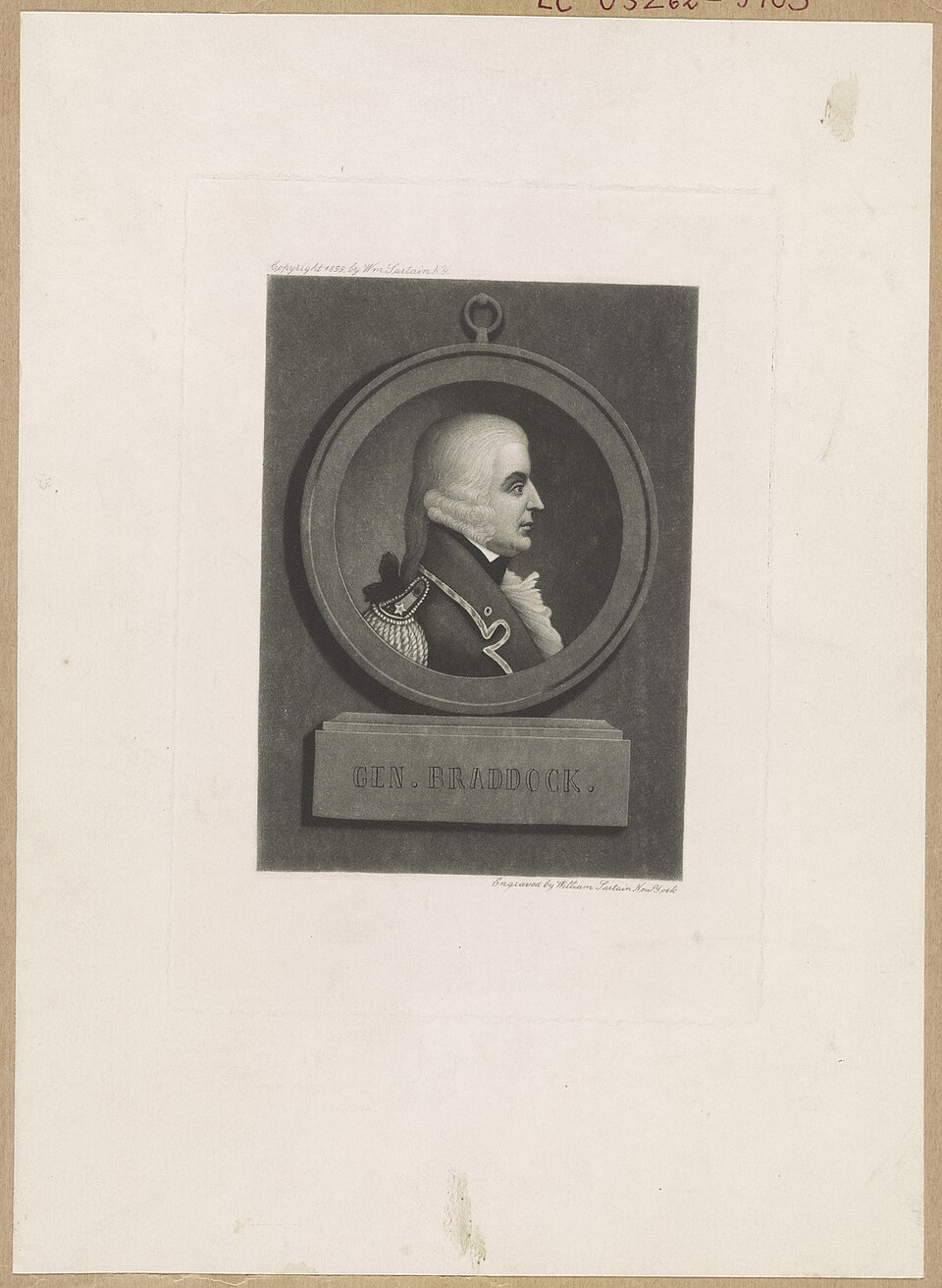
The general was Major General Edward Braddock, Commander in Chief of British forces in North America, and he came to win the war in a year. He brought regulars, full-time professional soldiers of the standing British army, the kind both empires built their order of battle around; the colonies, by contrast, raised provincials, short-term troops enlisted for a single campaign and sent home after. That fault line, regulars who scorned the provincials and provincials who resented the regulars, ran through the whole war. At the Congress of Alexandria in Virginia (April 14, 1755), Braddock laid out a four-pronged offensive meant to strike New France at four points at once and leave it nowhere to concentrate a defense. He would lead the main blow himself, marching on Fort Duquesne at the Forks of the Ohio (the French strongpoint at modern Pittsburgh, Pennsylvania, whose seizure the year before had touched off the war). Governor William Shirley, the governor of Massachusetts, would take Fort Niagara on Lake Ontario. Sir William Johnson, Britain's Superintendent of Indian Affairs for the northern colonies, would take Fort Saint-Frédéric at Crown Point on Lake Champlain. Colonel Robert Monckton would take Fort Beauséjour, a French post on the Bay of Fundy in Nova Scotia.
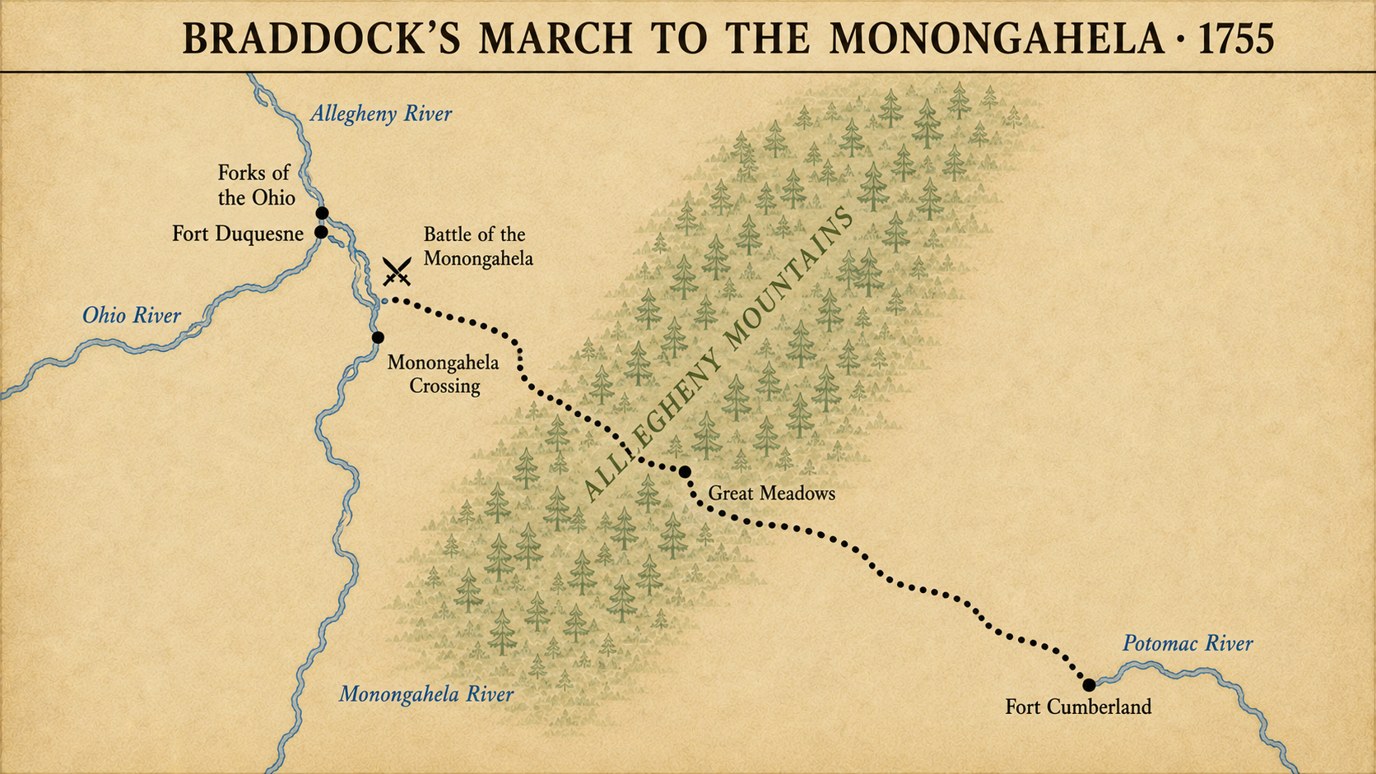
Braddock's own column left Fort Cumberland, Maryland, on May 29, 1755, headed roughly 110 miles west through the Allegheny Mountains. It moved at a crawl, sometimes only 2 miles a day, because Braddock insisted on building a road as he went. The road outlasted everything else about the campaign: cut through the mountains by his soldiers, "Braddock's Road" became a lasting artery of American westward expansion. To speed the final approach he split his force of about 2,100 men, taking a fast "flying column" of roughly 1,300 ahead under his own command and leaving a slower supply column of about 800 under Colonel Thomas Dunbar behind. Among the volunteers riding with him was George Washington, serving as an unpaid aide-de-camp, sick with dysentery for much of the march and carried for a stretch in a wagon.
Before he ever reached the French, Braddock made a decision that cost him an army. A group of Ohio Lenape (also called Delaware) chiefs came to him, led by Shingas, and asked the question that mattered most to them: if the British drove the French out, would Native peoples be allowed to keep living and hunting on their own land. Shingas asked whether Native friends of the English might be "Permitted to Live and Trade Among the English and have Hunting Ground sufficient to Support themselves and Familys." Braddock answered that "No Savage Should Inherit the Land." The chiefs told him they would not fight alongside him. He replied that he "did not need their Help."
That refusal decided which way the Ohio nations would jump. The Lenape and Shawnee had been weighing the two empires, and Braddock had just told them plainly what a British victory would mean for their land. Many joined the French at once. Shingas himself would spend the next three years leading raids that gutted the Pennsylvania and Virginia frontier, earning from terrified settlers the name "Shingas the Terrible." Braddock marched on toward the Monongahela with almost no Native scouts ahead of his column, into country he could not read, having alienated the only people who could have read it for him.
Catastrophe at the Monongahela
On July 9, 1755, Braddock's advance column forded the Monongahela River about 10 miles (16 km) below Fort Duquesne, near present-day Braddock, Pennsylvania. The crossing was unopposed, which seemed a good omen. It was not. The French commander at Fort Duquesne, Captain Daniel-Hyacinthe-Marie Liénard de Beaujeu, had learned of the crossing only just in time and rushed out to meet it with a force of roughly 900 men, the great majority of them Native warriors, perhaps two-thirds of the column, with a few hundred French colonial regulars and Canadian militia behind them. Shingas was among the Native leaders, and the Odawa war leader Pontiac, who would lead his own war against the British eight years later, was likely present as well.
The war storyThe Monongahela (Braddock's Defeat)Around one in the afternoon the French sortie collided with the British advance guard under Lieutenant Colonel Thomas Gage, the officer who, twenty years later, would command the British army at the start of the American Revolution. Beaujeu was shot dead in the opening minutes. Command passed to Captain Jean-Daniel Dumas, who rallied the Native fighters and spread them through the trees along both sides of the British column.
What happened next was less a battle than a slaughter, and it happened because British doctrine had no answer for the ground. The British regular army of the 1750s was trained for European warfare: close ranks, volley fire, the bayonet charge, all of which needed open ground to work. The forest gave none. When Gage's vanguard fell back, it collided with the main column pushing up the narrow road behind it, and the whole force jammed together into a dense, stationary mass. The French and their Native allies fired into that mass from cover the British could not see. Officers on horseback made the easiest targets, and roughly three in four of the British officers were killed or wounded. In the smoke, panicked British regulars fired on their own provincial troops. Of roughly 1,300 men engaged, near 70 percent were killed or wounded. French and Native losses were a fraction of that, somewhere around two to three dozen killed; the exact count is uncertain, with the sources giving figures that do not agree.
Washington had two horses shot from under him and four bullets pass through his coat, and was not touched. He gathered the survivors and organized the rear guard, and without that the retreat would likely have become a total rout. Braddock was shot through the chest and carried from the field. He lingered four days and died on July 13. They buried him in the middle of the road his men had cut, then drove the wagons over the grave so the enemy could not find and desecrate it. He is reported to have said near the end, "Who would have thought?" and "we shall know better another time," though those last words come down to us only as report. He left Washington his ceremonial sash and a pair of pistols, which Washington kept for the rest of his life. Washington wrote to his brother nine days after the battle in the language of a man who could not quite believe he was alive.
But by the All-powerful Dispensations of Providence, I have been protected beyond all human probability or expectation; for I had four bullets through my coat, and two horses shot under me, yet escaped unhurt, although death was levelling my companions on every side of me! — George Washington to John Augustine Washington, July 18, 1755
Colonel Dunbar, reaching the survivors with the supply column, did not regroup and try again. He burned 150 wagons and his excess stores and pulled the whole force out, abandoning the frontier entirely. Braddock's defeat at the Monongahela demonstrated, to every wavering nation watching, that the famous British regulars could be broken. Three of the four prongs of the 1755 plan accomplished nothing. Shirley's Niagara expedition bogged down at Oswego in supply failures and a personal rivalry with Johnson and never reached its target. Only Monckton's prong fully succeeded, taking Fort Beauséjour in June, and that success set in motion the war's most terrible act against civilians.
The Hudson Held at Lake George
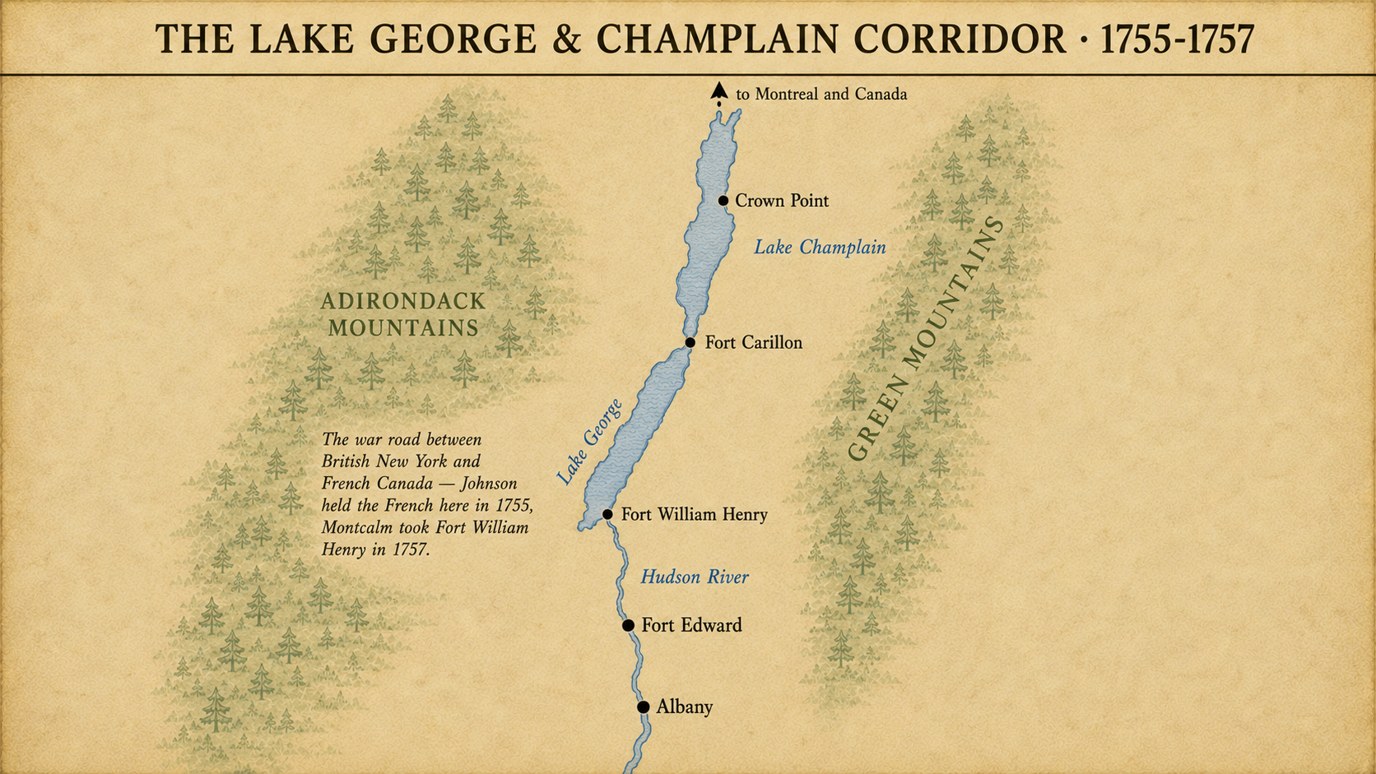
The one prong that came to open battle on the New York frontier was Johnson's. His objective was Crown Point, far up the Lake Champlain corridor, and he advanced toward it from Albany up the Hudson River. He commanded about 1,720 provincial troops and roughly 200 Iroquois allies, the Mohawk among them. The Mohawk were there for a reason that had little to do with British strategy and everything to do with Johnson himself. He had lived for years in the Mohawk Valley, spoke the Mohawk language, took part in their councils, and was in a long relationship with Molly Brant; the Mohawk knew him as "Warraghiggey," "he who does great things," and trusted him as they trusted no other British official. For the Mohawk, the British alliance was a calculation about land and trade, that British goods were cheap and that Britain had promised to protect their territory, but it ran through this one man's personal credit.
At the heart of that alliance was Hendrick Theyanoguin (Bear Clan), known to the British as "King Hendrick," about 64 years old, the paramount Mohawk war chief. More than any other person, he was the reason the Six Nations of the Iroquois Confederacy still leaned Britain's way at all.
The war storyLake GeorgeComing south to meet Johnson was Jean-Armand, Baron Dieskau, then commanding France's forces in North America, with about 200 regular grenadiers, 600 Canadian militia, and 700 Native allies, the last drawn from the Abenaki, the Nipissing, and the Caughnawaga, the Catholic Mohawk who had moved to mission villages near Montreal. That last detail captures how colonial war split Native nations down the middle: Mohawk of the valley marched with Johnson while Mohawk of the missions marched with Dieskau, the same people on opposite sides of the same field.
On September 8, 1755, Dieskau set an ambush on a forest road south of the lake. Johnson had sent about 1,000 men down that road, Theyanoguin and Colonel Ephraim Williams co-commanding, to intercept a reported French movement. They walked into it. Williams was killed early. Theyanoguin's horse was shot from under him, and he was bayoneted as he tried to rise, about 80 Mohawk warriors falling with him in what the survivors came to call "the Bloody Morning Scout." The survivors fought their way back to Johnson's fortified camp at the south end of the lake, where Dieskau threw his grenadiers straight at the British entrenchments and artillery. Johnson's cannon, loaded with grapeshot, tore the attack apart in the open. Dieskau pressed forward and was shot through the bladder, badly wounded and captured near the British guns; Johnson took a musket ball in the thigh. With Dieskau down, the French assault collapsed. A third clash followed when provincial troops fell on the retreating French baggage train at a pond that the day's blood gave its lasting name, Bloody Pond.
It counted as a British and Mohawk victory, and a real one: Dieskau captured, the French advance stopped cold. Had Dieskau broken through to the British post at Fort Edward, he might have rolled New York's and New England's defenses back to Albany itself; instead the Hudson corridor held. But the victory was incomplete in a way that defined the whole period. Johnson never marched on Crown Point, his actual objective, which stayed French. He had reason. He himself had taken a musket ball and could not go on; his provincial troops were exhausted, having spent three days burying their dead in the heat, and were sickening in large numbers; provisions were short; his Mohawk allies had gone home to conduct their condolence rituals, taking with them the fighters he depended on; the season was slipping away; and his scouts were coming back with word that the French had begun to fortify Ticonderoga to the north, planting a fresh obstacle across his path. At a council of war on September 29, 1755, his officers chose to dig in instead, building a new fort at the south end of the lake to hold the ground they had won. They called it Fort William Henry, and two years later it would be the scene of the war's most infamous day. The price of Lake George was already steep. Theyanoguin was dead, and the man who had held the Mohawk alliance together was not replaceable.
Le Grand Dérangement
While armies maneuvered, Britain made war on a population of farmers. In the late summer and fall of 1755, British soldiers fanned out across the villages of mainland Nova Scotia, seized the men first and then their families, marched them down to the shore, and loaded them onto ships. Behind them they burned the houses, the barns, and the churches, so there would be nothing to come back to. The ships carried the people away and scattered them across the Atlantic world, families split between different vessels, neighbors never to see one another again. Out of roughly 14,100 Acadians, about 11,500 were deported, and somewhere around 5,000 of them died of disease, starvation, and shipwreck in the deportations and the hard years that followed. The survivors carried their displacement into a long diaspora. Many who had been shipped first to France eventually made their way to Spanish Louisiana, settling along the Mississippi and the Atchafalaya Basin in the south of the modern state. There the word "Acadien" wore down to "Cadien," anglicized as "Cajun," and the Cajun language, food, and music of Louisiana descend directly from the people Britain shipped out of Nova Scotia.
Off the fieldThe Acadian ExpulsionThe Acadians were French-speaking Catholic settlers who had lived for generations in the region they called Acadie, the land of modern Nova Scotia, New Brunswick, Prince Edward Island, and part of Maine. Britain had held mainland Nova Scotia since 1713, and for forty years the Acadians had kept a careful neutrality, declining to swear full allegiance to a Protestant British king while declining to take up arms for France. In 1730 Britain had formally accepted this, granting them a recognized status as "French neutrals" with their property and religion protected. War broke the arrangement. After Monckton took Fort Beauséjour in June 1755, British authorities demanded that the Acadians swear an unqualified oath of allegiance to the British Crown. The Acadians refused, for reasons that were entirely coherent. The oath would have forced them to forswear their Catholic faith's loyalty to the Pope. It would have ended the neutral status they had been promised in writing. It would have made enemies of the French and of the Mi'kmaq. And they feared it would mean conscription into Britain's war. On July 28, 1755, Lieutenant Governor Charles Lawrence of Nova Scotia and his council ordered the deportation, drawing no line between Acadians who had genuinely stayed neutral and the few who had actively helped France. Lawrence called it a military necessity, a possibly disloyal population too dangerous to leave in a war zone. The roundups began on August 11.
The Mi'kmaq were not bystanders to this; they had their own stake in the land. They were the original landholders of the region Britain was consolidating as Nova Scotia, and in 1749, within months of Britain founding Halifax, Mi'kmaq leaders had formally proclaimed their ownership of that land to the British governor and their opposition to the new settlement. They were longtime French allies, bound by shared Catholic faith and a fur trade going back to the previous century, and they were already at war with British colonization. Father Le Loutre's War, also called the Anglo-Mi'kmaq War, had run from 1749 to 1755 as a continuous campaign of raids against British settlements, a fight the Mi'kmaq had begun five years before the wider war reached them. The Acadians were their closest allied settler community, and shipping the Acadians away pulled that support out from under them and sped Britain's grip on the country the Mi'kmaq had claimed as their own.
What to call this is still argued. A French officer of the time framed it as cold strategy, removing French families to starve French supply lines. Modern Acadian and Canadian scholars have called it ethnic cleansing; some Acadian organizations use the word genocide, though most historians stop at "ethnic cleansing" or "forced displacement." In 2003 the Canadian Crown issued a Royal Proclamation acknowledging the deportation and expressing regret, short of a formal apology. The bare facts need no inflation. Britain uprooted a long-settled people who had broken no treaty, scattered them across an ocean, and thousands of them died.
The War Goes Global, and Oswego Falls
In 1756 the war that had begun in an Ohio glen became the world war it is also remembered as. The European alliances inverted in what historians call the Diplomatic Revolution: Britain bound itself to Prussia by the Convention of Westminster in January 1756, which pushed France into alliance with its old enemy Austria that May, reversing the partnerships of the previous war. Britain formally declared war on France on May 17, 1756, nearly two years after the fighting in America had started, the formal trigger being a French attack on the British-held Mediterranean island of Minorca. The conflict was now genuinely global, burning across Europe, the Caribbean, West Africa, and India at once.
France's answer in North America arrived the same year, and his name was Montcalm. Major General Louis-Joseph de Montcalm-Gozon, Marquis de Montcalm, was sent by King Louis XV in 1756 to command the regular forces of New France, a professional European general with trained troops, and he did not wait to be attacked. He went straight onto the offensive against the weakest point in the British line, Fort Oswego.
The war storyFort OswegoOswego sat on the southeastern shore of Lake Ontario, at modern Oswego, New York, and it was Britain's only base on the lake, its one foothold for threatening French positions to the west. Montcalm came against it in August 1756 with about 3,000 men. The British garrison, three connected forts under Colonel James Mercer, numbered around 1,100 fit for duty, the rest sick or noncombatant. After the French overran the outlying Fort Ontario on August 13, the British pulled back into the main works; the bombardment the next day killed Mercer on August 14 when a cannonball struck him while he inspected the walls. Command passed to Lieutenant Colonel John Littlehales, who surrendered that same day. French losses were around 30; the British had perhaps 80 to 150 killed or wounded and roughly 1,700 taken prisoner, a figure that included laborers, shipbuilders, and the women and children with the garrison. Montcalm refused the defeated army the full honors of war, the surrender terms under which a beaten garrison is allowed to march out free, keep some of its belongings, and not be plundered or killed, in exchange for a pledge to give up the fight on agreed conditions. In the disorder of the surrender, some British soldiers trying to escape were killed amid Native plundering. The French took 121 cannon, burned all three forts and the captured boats and supplies, and carried their prisoners back to Quebec in triumph.
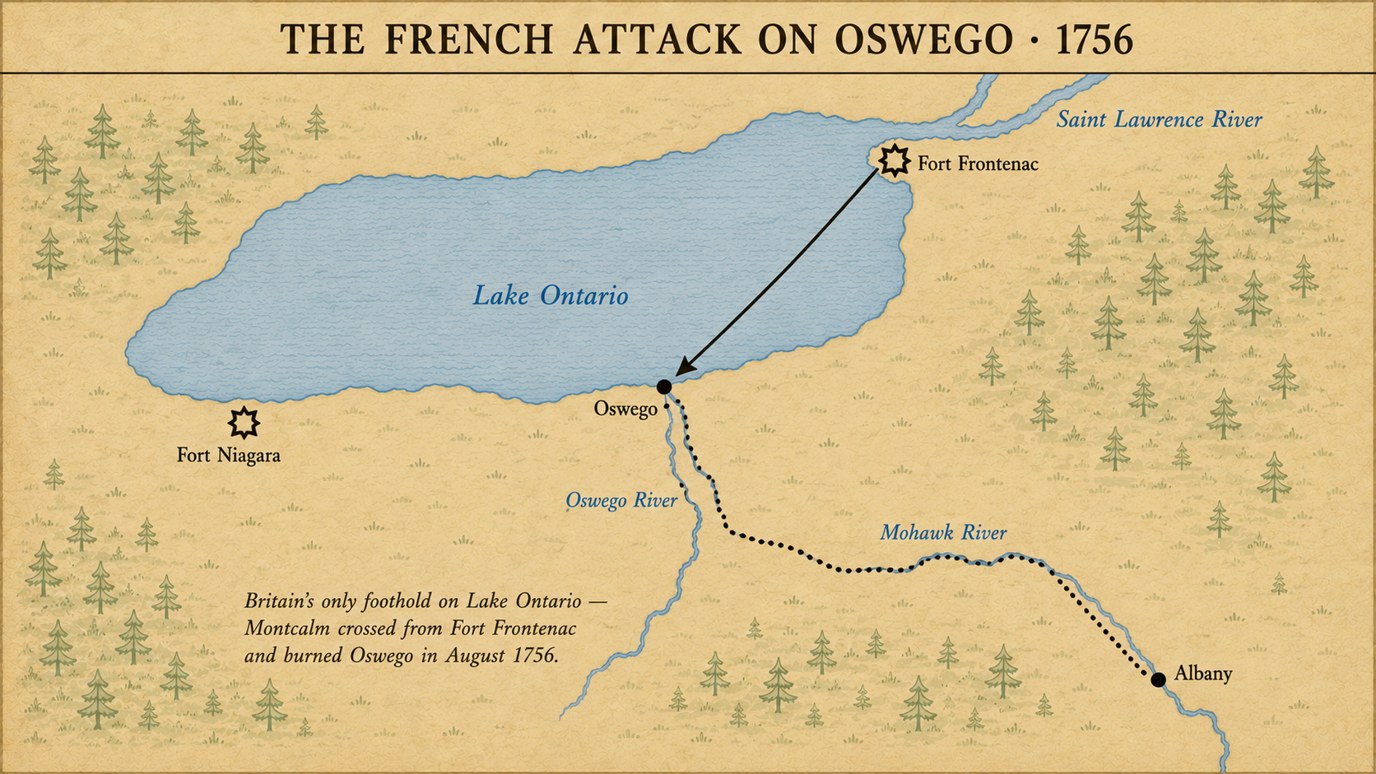
The fall of Oswego handed France complete control of Lake Ontario. It also reverberated through Native diplomacy exactly the way Braddock's defeat had. The Oneida and the Seneca, two nations of the Iroquois Confederacy that had been leaning toward Britain, watched Oswego fall and shifted toward France. The Iroquois alliance was always conditional, earned and lost on military performance, and France was winning. This was the high-water mark of French momentum.
Fort William Henry
In August 1757 Montcalm came south for the fort Johnson had built after Lake George. Fort William Henry stood at the southern tip of Lake George in the Province of New York, the northern anchor of the corridor down to Albany; the French held Fort Carillon (later Ticonderoga) about 15 miles to the north. Montcalm assembled the largest force yet seen in North American warfare to take it: 6,200 regulars and militia and about 1,800 Native warriors drawn from roughly 33 nations, a coalition reaching from the Great Lakes and the St. Lawrence, the Odawa, Abenaki, Potawatomi, Nipissing, Ojibwa, Menominee, Caughnawaga, and many more, some of whom had traveled hundreds of miles to be there.
The largest part of that coalition came up from the pays d'en haut, the upper country of the Great Lakes, and they came for their own reasons, not Montcalm's. They served without pay, asking only for rations, ammunition, and what gifts the French could give, because what they had come north to win was the substance of war as their own cultures counted it: honors that proved a warrior's standing, plunder, and captives to adopt as replacements for their own dead, to ransom, or to hold for ritual. France's victory at Oswego the year before had circulated through their villages as a story of a generous and winning ally, and that story is what drew them. They came inside the French alliance, an alliance of trade and gifts that supplied them, but they came as men with their own purposes, and those purposes would matter enormously when the fort fell.
The war storyFort William HenryThe garrison was about 2,500: some 200 British regulars and 800 colonial militia in the fort, many sick with smallpox, under Lieutenant Colonel George Monro, a career officer of the 35th Foot. Another 1,500 militia and about 150 Mohawk sat 17 miles south at Fort Edward, under Major General Daniel Webb, and they never came. Webb held them there out of fear; the Mohawk, weighing a fight they had not chosen against a French force whose size and momentum they could read better than Webb could, made their own decision not to spend themselves on it. The two refusals were not the same refusal. The siege ran from August 3. The French opened their trenches and their guns on the fifth, breached the walls and disabled most of the British cannon by the seventh, and Monro sent message after urgent message to Webb begging for relief. Webb, deceived by a captured Frenchman into believing Montcalm had 11,000 to 12,000 men, refused. He wrote Monro advising him to negotiate the best terms he could, a letter the French intercepted and handed to Montcalm before it ever reached the fort. Webb was later recalled; Johnson said of him afterward that he was the only Englishman he ever knew who was a coward, a remark passed down through later accounts.
Monro surrendered on August 9. Montcalm gave him generous terms: the garrison would march to Fort Edward with the full honors of war, keeping their colors, their muskets, and one symbolic cannon, on parole, a sworn promise not to take up arms against France again for eighteen months, not a prison term. Montcalm had warned Monro in writing beforehand that once a surrender was signed there might not be time, nor would it be in his power, to restrain "a mob of Indians." That warning came true.
The Native nations in Montcalm's army had not crossed half a continent for a European general's idea of an honorable surrender. The terms handed the British their lives and their belongings and handed the warriors nothing, the captives and the plunder and the war honors they had come for all signed away, with no compensation and no alternative arranged. To them it looked like the French had conspired with their enemies against their friends. Their own leaders held only limited authority to restrain individual men in that moment. On the morning of August 9, before and during the British withdrawal, warriors attacked the column and the camp. They killed and scalped wounded prisoners, seized women and children, and broke the march into chaos. Montcalm and his officers intervened in person, recovering perhaps 500 captives from Native hands, an act that took real physical courage; he could not stop the outbreak, only limit it.
How many died has been argued for more than two centuries, and the honest answer is far smaller than the legend. Contemporary British accounts claimed around 1,500 dead, a number inflated for outrage; French accounts minimized in the other direction. The most careful modern reconstruction is by the historian Ian Steele, whose 1990 study Betrayals is the standard academic account. Steele concluded the dead numbered at least 69 and could not possibly have exceeded 184, somewhere between roughly 3 and 7.5 percent of the surrendered force. About 200 more captives were carried off, and by year's end some 300 remained missing, at least 40 of whom refused to return, having chosen lives in the communities that adopted them. The famous figure of 1,500 has almost no basis in the evidence. It descends instead from James Fenimore Cooper's 1826 novel The Last of the Mohicans, which dramatized the day through a lens of nineteenth-century racial hierarchy, and from popular historians who amplified Cooper's numbers afterward.
The dying did not stop with the killing. Some warriors had dug up bodies from the fort's cemetery to take scalps, and smallpox went into the ground with those bodies. Warriors carried the disease home along the trails to the Great Lakes and the St. Lawrence, and a massive epidemic followed, devastating nation after nation; the Potawatomi were nearly wiped out. The side that won at Fort William Henry paid for it in a currency no European army could have inflicted, and the bill came due over the following years far from any battlefield. As for Monro, he survived the march to Albany and died there suddenly on November 3, 1757, of a stroke, some said brought on by his rage at Webb and the trauma of watching his men cut down.
Britain at the Bottom
Three campaigns, three years, and Britain had almost nothing to show but disasters. The reasons were not bad luck. After Braddock died there was no effective theater commander; command fell to Shirley, who could not make the colonies and the regulars work together and whose feud with Johnson had already wrecked the Niagara prong. France had Montcalm, a first-rate professional who kept the initiative and won where he chose. The Ohio nations had gone over to France after Braddock's defeat and were bleeding the Pennsylvania and Virginia frontier raw; the Oneida and Seneca had followed after Oswego. And the war had gone global at the worst moment for the British government. In June 1756, when Admiral John Byng failed to relieve the garrison on Minorca and the island fell, the reaction at home measured the depth of British panic. Byng was court-martialed, convicted of failing to do his utmost against the enemy, and on March 14, 1757, shot by a firing squad on the quarterdeck of his own ship, in full view of the fleet. Voltaire would have a character in Candide shrug that in England it is good to shoot an admiral now and then "to encourage the others." Oswego had fallen the previous summer and Fort William Henry would fall that one. The ministry of the Duke of Newcastle, which had believed diplomacy could keep Britain out of a European war, lost the country's confidence and fell apart.
Out of that wreckage rose the man who would reverse it. William Pitt emerged as the dominant figure in a new government and is said to have declared, "My Lord, I am sure I can save this country, and no one else can," a line passed down by his admirers. By June 1757 he had built a working partnership with Newcastle, Newcastle managing Parliament while Pitt directed the war, and that arrangement would hold for the next four years. At the end of 1757 the British cause in America was at its lowest point of the entire war, the frontier aflame, two forts gone, an ally dead, and a people scattered across the sea. But Pitt was already turning the machine over. He would pour subsidies into Prussia to keep France pinned down in Europe, throw Britain's money and the full weight of the Royal Navy across the Atlantic on a scale the colonies had never seen, and replace the failed generals with hungry new ones. That surge, beginning in 1758, would break the run of French victories. It would also begin the end for the Native nations who were winning right now, because the same British flood that drowned New France would not stop at the Appalachians; the men celebrating at Fort Duquesne and Fort William Henry were, without knowing it, near the high-water mark of their own power.