In the summer of 1754 the British colonies in North America had a problem they could not solve one colony at a time. War had already started on the Ohio frontier, the land beyond the Appalachian Mountains where the colonies, France, and a half-dozen Native nations all claimed the same rivers. A young Virginia officer named Lieutenant Colonel George Washington had marched west that spring and stumbled into the opening shots of it: a deadly skirmish at a place called Jumonville Glen in May, and then, on July 3, a humiliating surrender at a hasty stockade he had named Fort Necessity. Those small, ugly fights in the woods were the first sparks of what would grow into a war fought on three continents.
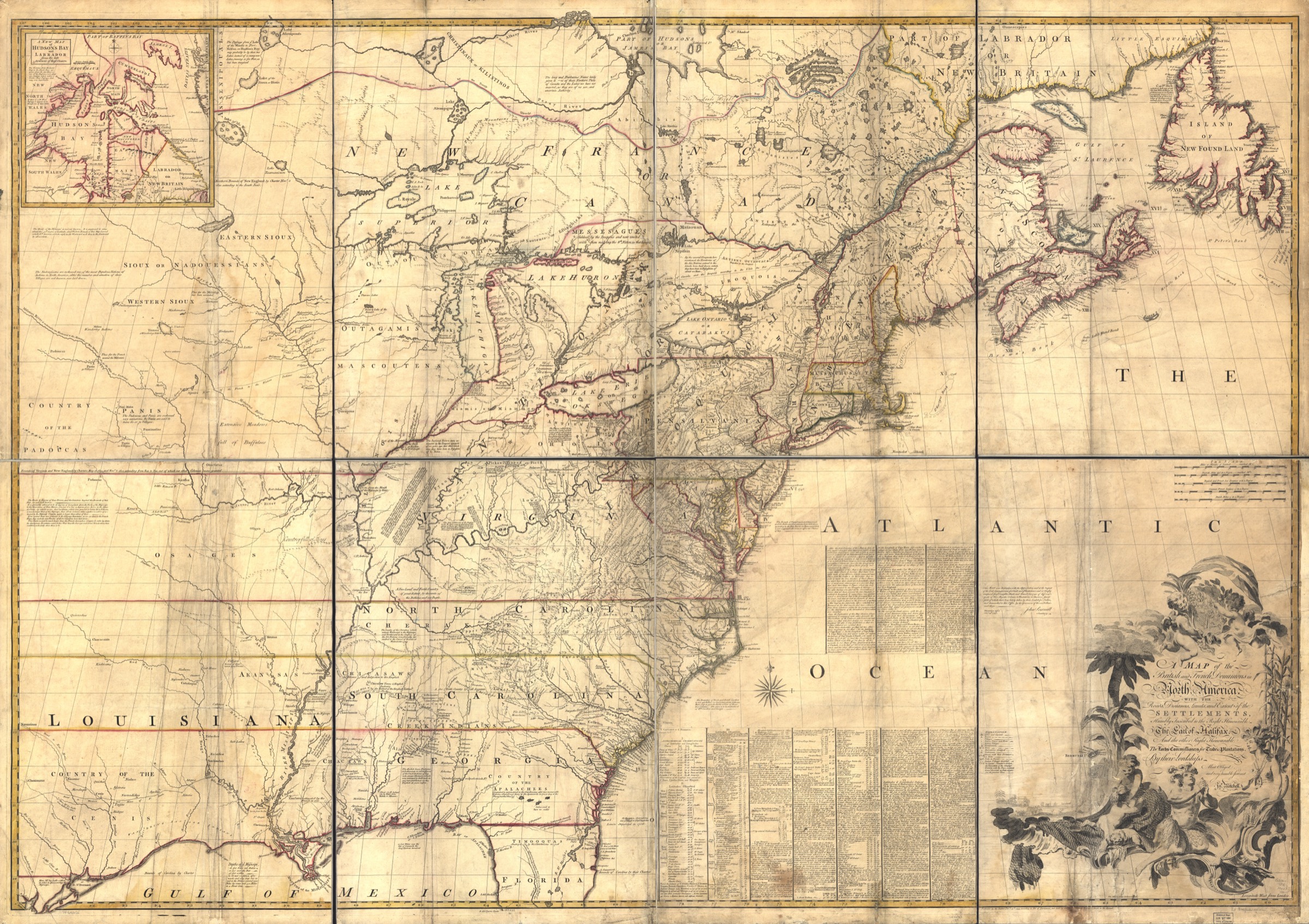
So when delegates from seven colonies gathered at Albany, New York, that June, the situation was urgent. But the meeting was not really their idea, and the thing it is remembered for was not the first thing on its agenda.
Why London called the meeting
The congress at Albany happened because the British government told the colonies to hold it. But the order itself was a reaction to something a Native leader had done the year before. In 1753 the Mohawk leader Theyanoguin, known to the English as Hendrick, led a delegation of 17 Mohawk leaders past Albany and straight to Governor George Clinton in New York City, where they declared the alliance between the Iroquois and the British broken and walked out.
"...the Covenant Chain is broken between you and us. So brother you are not to expect to hear of me any more, and Brother we desire to hear no more of you." — Theyanoguin (Hendrick), Mohawk, to Governor George Clinton, 1753
That alliance had a name: the Covenant Chain. It was the metaphor, and the working relationship, that linked the Iroquois (and through them other Native nations) to the British colonies, above all to New York. When word of Hendrick's walkout reached London, the Board of Trade, the body that oversaw colonial affairs, ordered the colonies to meet the Iroquois and repair the chain. That order became the Albany Congress, and it was specific about what mattered most. The first order of business, ahead of anything else, was to mend the fraying alliance with the Iroquois Confederacy, the powerful league of Native nations whose friendship the British could not win the coming war without.
The anger behind Hendrick's break had a concrete cause: the Kayaderosseras Patent, a land grant in the Saratoga region that the Mohawk denounced as fraudulent. A deed for a few small farms had, on paper, ballooned into a claim of hundreds of thousands of acres of Mohawk land, and the Mohawk were still raising it at the 1754 congress. By 1754 the chain had gone badly rusty for reasons like this. There had been no formal treaty council at Albany in roughly three years, and that neglect had a cost. The Iroquois were drifting toward neutrality, or worse, toward France, whose agents were busy and attentive while the British were absent. London understood the arithmetic perfectly well: a frontier war could not be fought without Native allies, and the alliance was the precondition for everything else. The Board of Trade even specified that proper presents be furnished to the Native delegates, because gift-giving was not a courtesy in this diplomacy, it was the diplomacy.
The reason the colonies met at all was that the Native nations were drifting away, and the empire needed them back.
Off the fieldThe Contest for Native AlliancesThe colonies that came
Seven colonies sent delegates, twenty-one commissioners in all: New York, Pennsylvania, Maryland, and the four New England colonies (New Hampshire, Massachusetts, Rhode Island, and Connecticut). Virginia, New Jersey, and the southern colonies did not bother to come, even though the union plan that emerged would later set aside seats for them.
The chairman was James DeLancey, the Lieutenant Governor of New York, meaning the deputy to the colony's royal governor. Among the commissioners were men whose names would echo later. Thomas Hutchinson of Massachusetts, who would help draft the union plan and one day become the colony's royal governor and a hated symbol of Crown authority. Stephen Hopkins of Rhode Island, who would live to sign the Declaration of Independence. William Johnson of New York, the colonies' most important go-between with the Iroquois and later the Crown's Superintendent of Indian Affairs. And, from Pennsylvania, Benjamin Franklin, who arrived with an idea bigger than the meeting he had been sent to.
They met daily, mostly in the city hall at Albany, from June 19 to July 11, 1754.
The Iroquois come to the table
About 150 Iroquois delegates came to Albany. This was not a side event. By London's own instruction it was the main one.
A word on who they were. The Iroquois Confederacy, who call themselves the Haudenosaunee ("People of the Longhouse"), were by 1754 a league of Six Nations: the Mohawk, Oneida, Onondaga, Cayuga, Seneca, and, since around 1722, the Tuscarora. Their central council fire, the seat of the confederacy's decision-making, burned at Onondaga in what is now central New York. They were not anyone's subjects. They were a power, and they negotiated like one, protecting their own land and their own interests and playing the British and French empires against each other as it suited them.
The man who spoke for them at Albany was a Mohawk leader named Theyanoguin, born around 1692 and known to the English by his baptismal name, Hendrick, and often called King Hendrick. He was a sachem (a civil leader), a warrior, and an orator, and when he rose to address the commissioners around July 2, he did not soften anything.
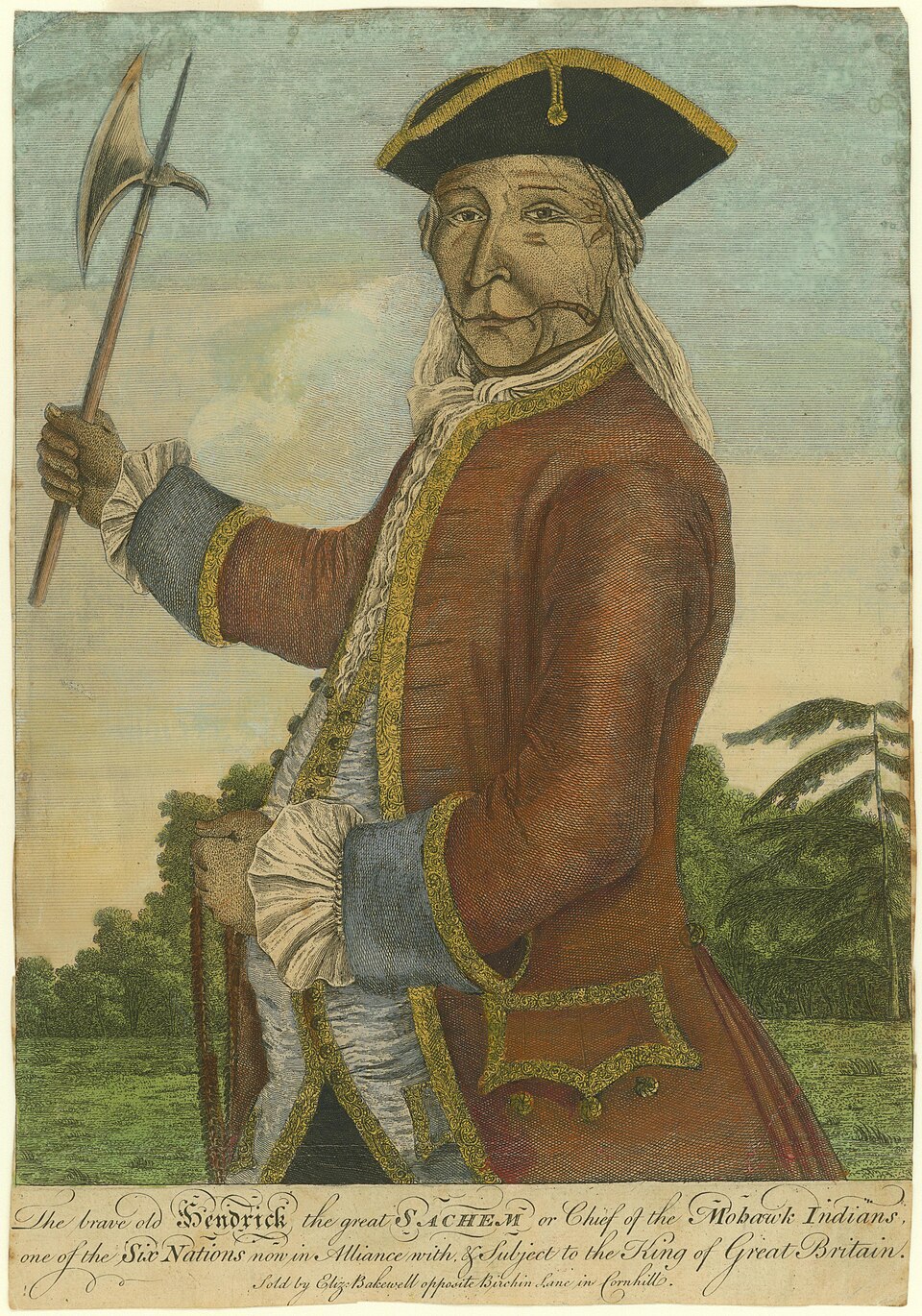
He started with the silence. The British had let the friendship fire go cold.
"Brethren, this is the ancient place of treaty where the fire of friendship always used to burn, and it is now three years since we have been called to any public treaty here." — Theyanoguin (Hendrick), as recorded at Albany, 1754
Then he made the neglect physical. As the proceedings record it, he took up a stick and threw it behind his back.
"the reason is, your neglecting us these three years past… You have thus thrown us behind your backs, and disregarded us; whereas the French are a subtle and vigilant people, ever using their utmost endeavours to seduce and bring our people over to them." — Theyanoguin (Hendrick), as recorded at Albany, 1754
And then he said the line that landed hardest, contrasting French energy on the frontier with British passivity. The French were building forts everywhere. The British sat exposed.
"Look at the French, they are men; they are fortifying every where; but, we are ashamed to say it, you are like women, bare and open, without any fortifications." — Theyanoguin (Hendrick), as recorded at Albany, 1754
These words reach us secondhand. Hendrick spoke in Mohawk; what survives is the speech as written down by interpreters and clerks and printed in the congress proceedings. We have it as recorded, filtered through other men's pens, not as a recording. But the force of it is unmistakable, and so is the point underneath it. He was not pleading. He was telling a partner it had failed to hold up its end, and reminding it who needed whom.
He also named the thing the whole war was actually about. The empires were fighting over ground that belonged to Native nations, and Native nations stood to lose either way.
"The Governor of Virginia and the Governor of Canada are both quarrelling about lands which belong to us, and such a quarrel as this may end in our destruction." — Theyanoguin (Hendrick), as recorded at Albany, 1754
In the end the two sides agreed to renew the Covenant Chain. The Iroquois accepted the renewed alliance, but on their own terms, and Hendrick made clear it would be kept where their authority lived.
"We will therefore take it to Onondaga, where our council-fire always burns, and keep it so securely that neither thunder nor lightning shall break it." — Theyanoguin (Hendrick), as recorded at Albany, 1754
The chain was brightened. But the grievance underneath it, settlers pushing onto Iroquois land, was not fixed. It was left unresolved, in the colonists' favor. The Iroquois went home only partly satisfied, with the alliance shored up and the land problem worse than before.
The land taken in the next room
While one part of the congress was renewing a friendship, another part was quietly stealing land.
On or around July 11, the very day the congress closed, agents of Connecticut's Susquehannah Company obtained from an Iroquois delegation a deed to the Wyoming Valley, a stretch of Susquehanna River country in what is now northeastern Pennsylvania, for about £2,000 (New York currency). The deal has been called fraudulent ever since, and for good reason. It was negotiated in secret, reportedly greased with liquor and bribes, and it sold land that the Mohawk signing it did not rightfully control.
The people who actually lived in the Wyoming Valley were not in the room. They were the Delaware (who call themselves the Lenape), already shoved off their land once by the swindle known as the Walking Purchase of 1737, and the Shawnee. Neither nation was a party to this sale of their own home. Being sold out at Albany pushed the Delaware and the Shawnee toward the French, and that drift would come back as fire and blood along the Pennsylvania frontier within a few years.
Pennsylvania, not to be outdone, ran its own grab at the same congress. Its Indian agent Conrad Weiser secured a deed to unceded Iroquois land west of the Susquehanna, reaching toward the Ohio and Lake Erie, for a nominal sum and a promise of more. ("Cede" means to formally hand over territory; "unceded" land is land that was never given up.) The Connecticut and Pennsylvania claims overlapped, and that overlap would later explode into the Pennamite-Yankee Wars, settlers of the two colonies shooting at each other over the same valley starting in 1769.
The same gathering that renewed the Covenant Chain also stripped land from Native nations who were not even present to object. Both things happened in the same town, in the same three weeks.
Off the fieldThe Ohio Country & the Ohio CompanyFranklin's bigger idea
Benjamin Franklin had come to Albany carrying more than the agenda. He had been arguing for months that the colonies were dangerously, foolishly divided, each one negotiating its own Indian policy and minding its own defense while France acted as a single will.
He had already made the case in print, and made it unforgettable. On May 9, 1754, weeks before the congress, his Pennsylvania Gazette ran a small woodcut he had drawn: a snake cut into eight pieces, each segment labeled for a colony or region, under the words "JOIN, or DIE." It is widely regarded as the first American political cartoon. The image leaned on an old folk superstition that a snake chopped to pieces could come back to life if the parts were rejoined before sunset. The message was not subtle. Reunite, or die in pieces. The cartoon ran before the Albany delegates ever sat down. It was the argument for union, printed first; the plan was what Franklin carried to Albany next.
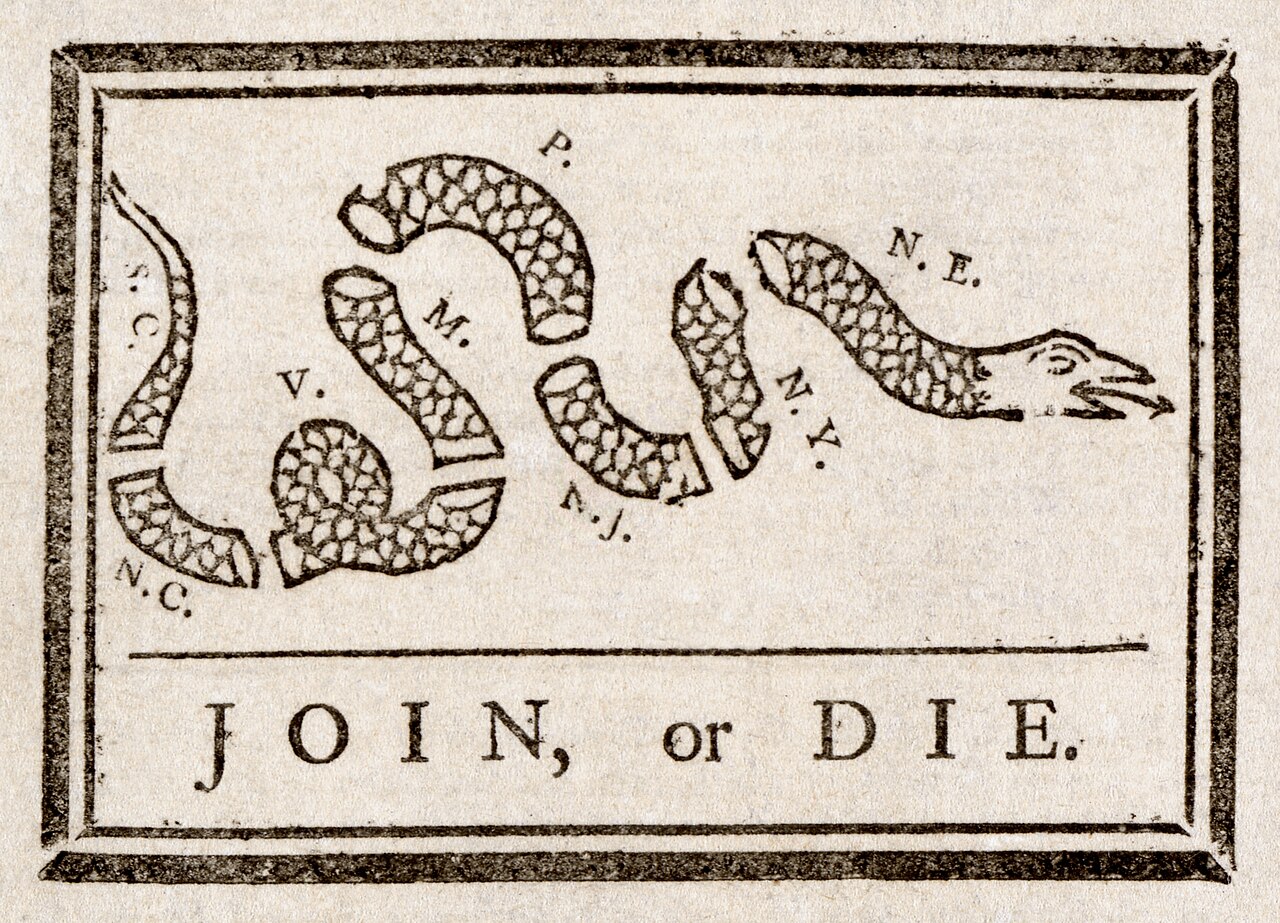
At Albany the commissioners voted on June 24 to take up the question of union. A committee worked out a draft, with Thomas Hutchinson of Massachusetts among those shaping it, and submitted it on June 28. On July 10, one day before the congress broke up, it was adopted: the Albany Plan of Union.
The plan tried to thread a hard needle. It proposed a single government over all the colonies for shared purposes, with two heads. At the top would sit a President-General, a single executive appointed and paid by the Crown, meaning the king chose him and the king's treasury supported him. Underneath would sit a Grand Council, a legislature whose members were chosen by the colonial assemblies, the elected bodies that governed each colony. So the colonies would elect the lawmakers, and the king would appoint the boss, whose consent was required for everything the council did. The council would meet each year at Philadelphia, and members would serve three-year terms.
Seats were handed out by colony, forty-eight in all to start, with the bigger colonies getting more: Massachusetts and Virginia seven each, Pennsylvania six, Connecticut five, on down to two apiece for New Hampshire and Rhode Island. After three years the apportionment (the share-out of seats) would be adjusted to match what each colony actually paid in.
And the powers were real. The union would handle common defense (raising and paying soldiers, building forts, fitting out armed ships). It would run Indian affairs, holding treaties, declaring war or making peace with Native nations, and regulating the trade. It would control the western lands, buying territory from Native nations on the Crown's behalf and managing new settlements. And to pay for all of it, the union could levy taxes and duties. The three things the plan most wanted to take out of thirteen quarreling hands and put into one were defense, Indian affairs, and western lands. The same things, in other words, that the colonies had just spent three weeks mishandling in person.
Adopted, then refused by everyone
The congress approved Franklin's plan. Then it was sent out to the colonial assemblies and to London, and there it died, rejected from both directions for exactly opposite reasons.
The colonial assemblies turned it down because it took too much power away from them. Each colony's legislature guarded its own authority jealously, and a Grand Council that could tax them and command their defense looked like a thief of local control.
London turned it down because it gave the colonies too much. To the Crown and the Board of Trade, a self-governing intercolonial council with its own taxing power and its own armies looked like too much unity and too much independence handed to provinces that were supposed to take orders. The British government preferred to run the war directly from home. The plan was never enacted.
Franklin, looking back years later in his autobiography, saw the symmetry and thought it proved he had gotten the balance right.
"The Assemblies did not adopt it, as they all thought there was too much prerogative in it; and in England it was judg'd to have too much of the democratic." — Benjamin Franklin, Autobiography
"The different and contrary reasons of dislike to my plan make me suspect that it was really the true medium; and I am still of opinion it would have been happy for both sides the water if it had been adopted." — Benjamin Franklin, Autobiography
What the failure rehearsed
The name itself admits something. The British colonists called this the French and Indian War, naming it for the two enemies they expected to fight, the French and the Native nations allied with them. The name centers their point of view and hides a larger truth: Native nations were not one side's tool. They fought on all sides and, more than anything, for themselves, for their land and their sovereignty, playing the empires off each other for as long as they could. The Albany Congress is the proof in miniature. The Iroquois walked in as a power London needed and walked out with the alliance renewed but their land quietly slipping away. When the war finally ended, it would end as a catastrophe for the Native nations of the eastern woodlands, who lost the leverage of two competing empires and, with it, the ground itself.
For the colonies, the failure had a different afterlife. The Albany Plan was the first serious proposal that they should join under a common government. It failed completely in 1754. Not one of the bodies that could have made it real said yes. And yet it did not vanish. It became a precedent, a thing that had been tried and remembered, and the idea of intercolonial union resurfaced when the colonies' quarrel was no longer with France but with Britain itself: at the Stamp Act Congress of 1765, and at the First Continental Congress of 1774. The union the colonies refused to build for defense in 1754 was the one they would build, in anger, about twenty years later.
Franklin thought the refusal had cost more than a plan. In his autobiography he argued that a union strong enough to defend itself would have made the later quarrel unnecessary.
"The colonies, so united, would have been sufficiently strong to have defended themselves; there would then have been no need of troops from England; of course, the subsequent pretence for taxing America, and the bloody contest it occasioned, would have been avoided." — Benjamin Franklin, Autobiography
Off the fieldWar Finance & the Road to Taxation