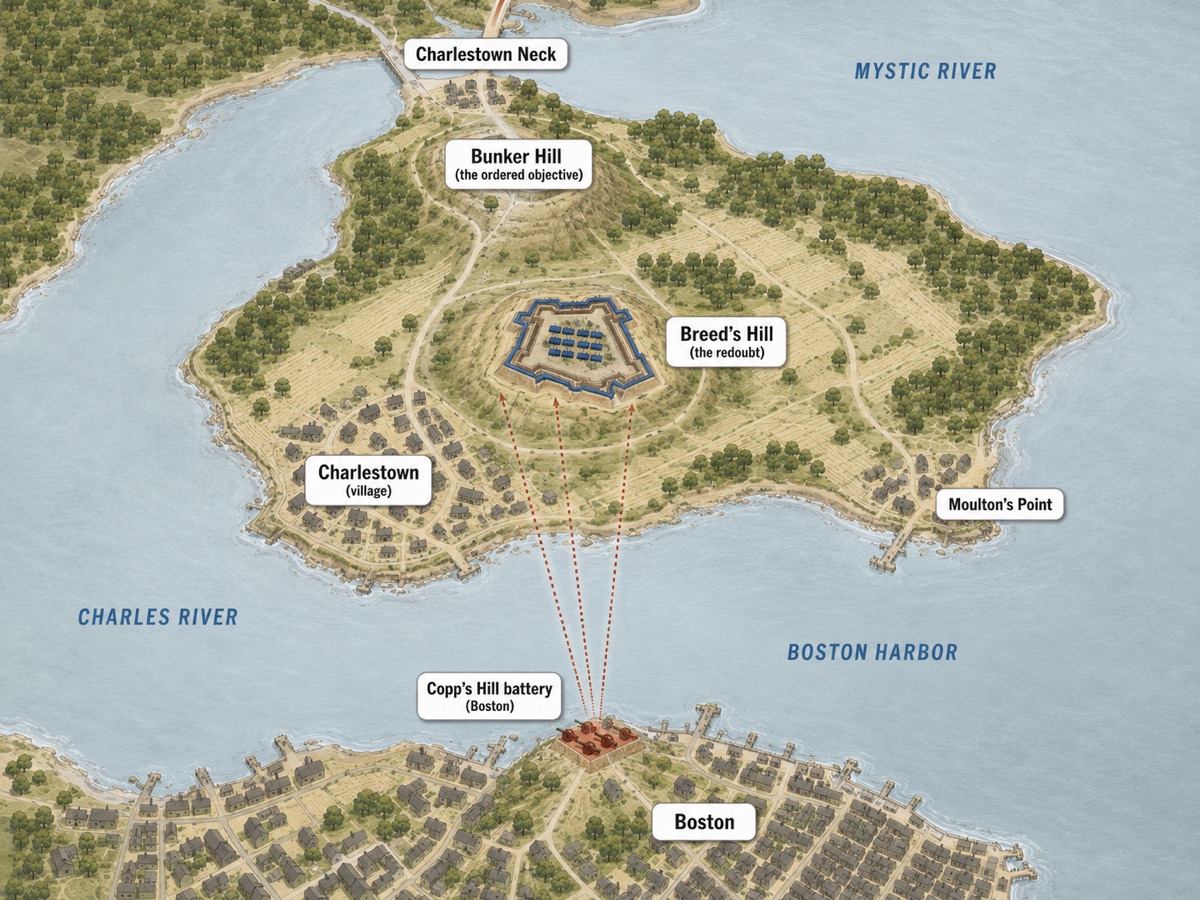
In June 1775 the strangest army in America had the king’s troops trapped in a town. Two months after the shooting at Lexington and Concord (the April skirmishes outside Boston where the war began), a New England militia army (part-time citizen soldiers, as opposed to Britain’s professional regulars) had gathered around Boston, somewhere between fifteen and twenty thousand farmers and tradesmen with muskets, the number swelling and shrinking week to week. Inside the town sat General Thomas Gage (British) and a garrison of roughly six to six and a half thousand regulars, penned in. It was a siege, eight weeks old, and it was stuck. What would unstick it was geography. Two sets of unoccupied heights commanded Boston and its harbor: Dorchester Heights to the south, and the hills of the Charlestown peninsula just across the water to the north. Whoever fortified them first, and put cannon on them, would dominate the town. Both sides knew it. Neither had moved.
The war storyHow a standoff became a shooting war and a siegeThe British moved first, on paper. On May 25 the warship Cerberus had delivered three newly arrived major generals, William Howe, Henry Clinton, and John Burgoyne (all British). Pushed by them, Gage finalized a plan on June 12 to break the siege: seize Dorchester Neck and fortify Dorchester Heights first, march on the American lines at Roxbury, then take the Charlestown heights. Execution was set for Sunday, June 18.
The plan leaked almost immediately. On June 13 the New Hampshire Committee of Safety (the emergency rebel body running the colony’s war effort) passed word to Massachusetts that a New Hampshire gentleman “of undoubted veracity” had overheard British officers discussing plans to seize Dorchester and Charlestown. Who he was, nobody knows to this day. On June 15 the Massachusetts Committee of Safety voted that “the hill called Bunker’s Hill in Charlestown be kept and defended.” The besiegers would move first, by three days. General Artemas Ward (American), commanding the army at Cambridge, gave the order, and on the evening of June 16 the fortifying column assembled on Cambridge Common, was prayed over by President Langdon of Harvard, and marched off after dark.
The column was about 1,200 men under Colonel William Prescott (American) of Pepperell, mostly Massachusetts regiments plus some 200 Connecticut men under Captain Thomas Knowlton (American), with Colonel Richard Gridley (American), the army’s chief engineer, along to lay out the works. Their orders named Bunker Hill, the higher of the peninsula’s two hills, about 110 feet, standing back near the Neck (the narrow strip of land that was the only way on or off the peninsula), where a fort could be supplied and, if it came to it, abandoned. That is not where they built. On the ground, after a debated council that tradition puts Prescott, Gridley, and Brigadier General Israel Putnam (American) in the middle of, the work went up on Breed’s Hill instead: lower, about 62 feet, well forward, and within cannon range of Boston. No participant left a clear account of why, and the Committee of Safety’s own report said the position was taken “by some mistake.” The most common modern reading is that it was no mistake at all but a deliberate provocation, because a fort on Breed’s Hill was a knife held to Boston’s throat, and the British could not ignore it. Blunder or dare, nobody can say for certain. The battle would be named for the hill the Americans were ordered to fortify, not the one they fortified, and the confusion is fossilized in the name to this day.
In one night they built a fort. Gridley staked out the lines around midnight, and the men dug in silence, close enough to the enemy to hear Boston’s church bells and the harbor watch calling “All’s well” across the water. By dawn they had a redoubt (a small enclosed dirt fort) roughly 130 feet on a side, its walls about six feet high, with a breastwork (a chest-high wall of earth to stand behind and fire over) running about a hundred yards down the northern slope.
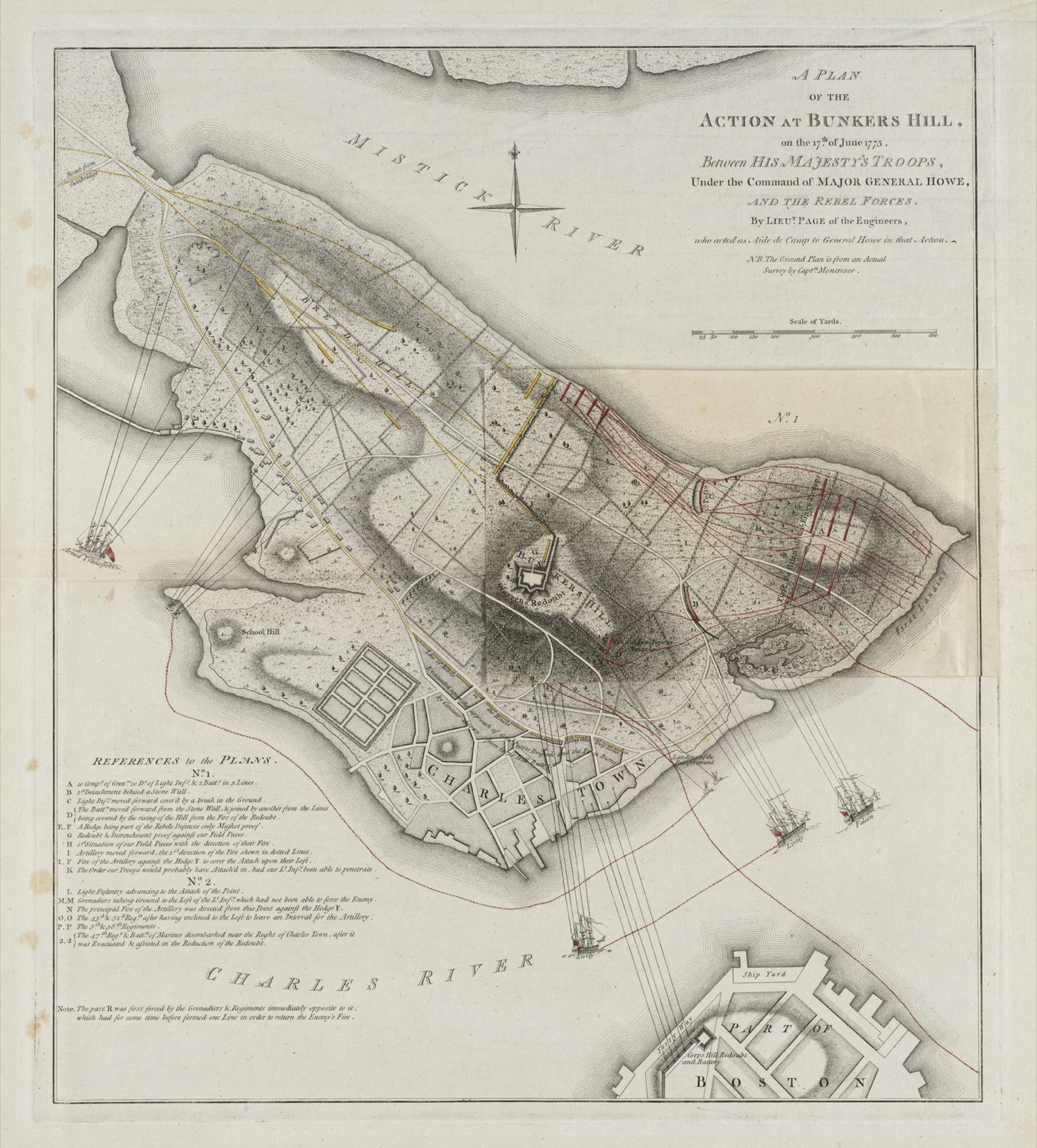
At about four in the morning a watch officer on one of the warships, HMS Lively by most accounts, spotted the fresh earth and opened fire, and the shore batteries and other ships joined in. The cannonade’s first kill was Asa Pollard of Billerica, decapitated by a cannonball while working outside the redoubt. Men crowded around the body, staring, and Prescott, afraid of exactly that, ordered Pollard buried immediately, without ceremony. When a minister insisted on prayers, accounts have Prescott breaking up the crowd and sending the men back to their shovels (a chaplain said words over the grave anyway). Then, with his exhausted men flinching at every shot, Prescott climbed onto the parapet (the flat top of the redoubt’s earth wall) and walked it, slowly and deliberately, conspicuous in a light-colored banyan (a loose linen gown) over his waistcoat, giving directions, to show them the cannonballs could be ignored. They had been digging all night, they had little water and no relief coming, and the navy was firing on them. One of them, Private Peter Brown, told his mother in a letter what the morning felt like from inside the fort.
The danger we were in made us think there was treachery, and that we were brought there to be all slain.
Across the water that morning, Gage convened Howe, Clinton, and Burgoyne. Clinton urged a landing at Charlestown Neck, behind the rebels, which would have corked the bottle and trapped the entire force on the peninsula. He was overruled. The others would not put a landing force between two enemy bodies, and the shallow flats of the Mystic River and the militia army at Cambridge argued against it. The decision instead: Howe would cross with the infantry and take the position by direct assault, up the hill and over the works. The choice rested partly on contempt for militia, and partly on the era’s settled conviction that regulars beat irregulars in the open field. Clinton was right, and the choice that overruled him bought everything that happened that afternoon.