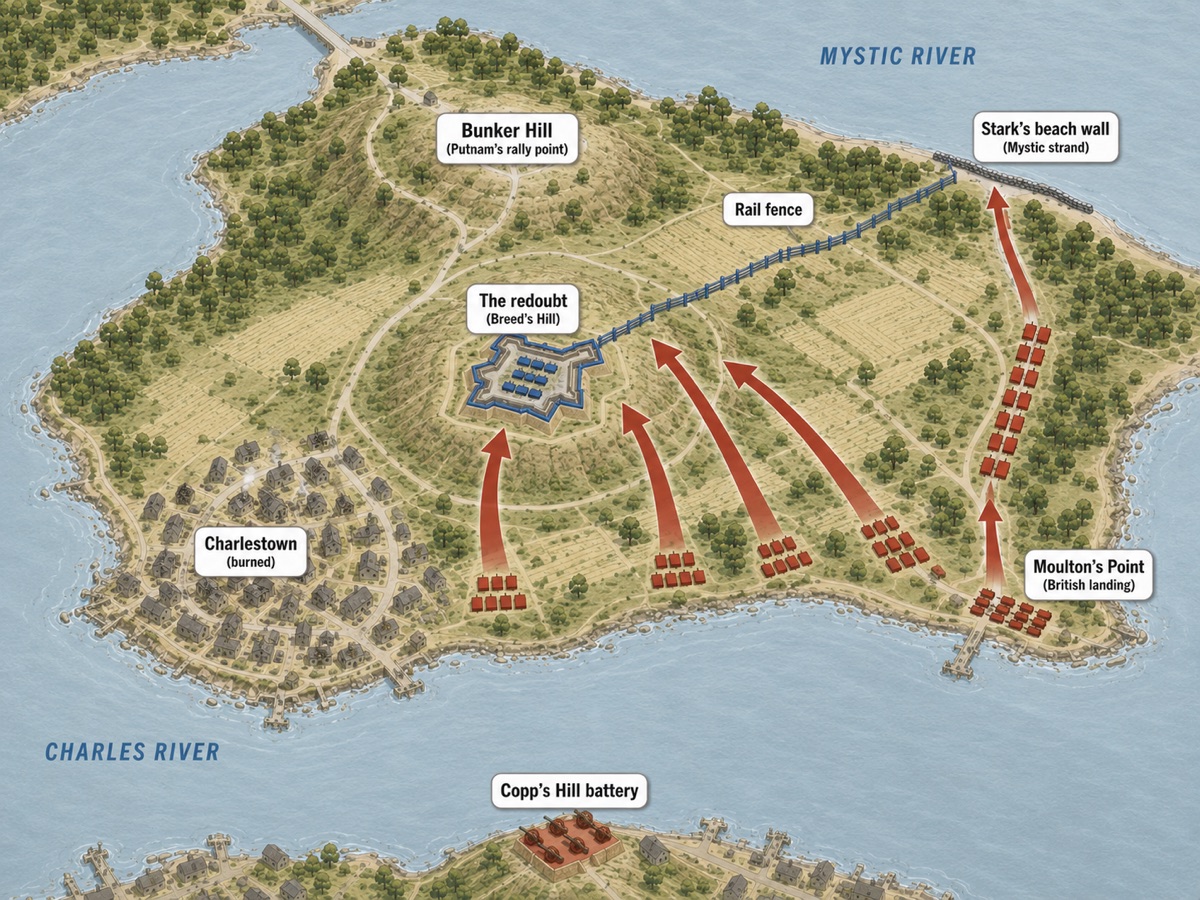
The night before, the American militia army besieging Boston had dug a small dirt fort (a redoubt) on Breed’s Hill, on the Charlestown peninsula just across the water from the city, close enough to put cannon in range of the town. On the morning of June 17 the British command decided to cross the harbor and take it by direct assault. From about one in the afternoon the longboats began putting Major General William Howe’s (British) first wave ashore, some 1,500 men, at Moulton’s Point on the eastern corner of the peninsula, unopposed and out of musket range. And then Howe stopped. He could see the American position growing in front of him: a rail fence now extended the line from the redoubt down toward the Mystic River (the water along the peninsula’s north side), and fresh men were streaming across the Neck (the narrow strip of land that was the only way on or off the peninsula) to fill it. He sent back for reinforcements and let his men eat while the navy worked the hill over. The pause cost him two hours, and the Americans spent them on their open left flank. Captain Thomas Knowlton’s (American) Connecticut men held the rail fence (an ordinary farm fence of wooden rails, its gaps stuffed with hay so it read as solid cover). Colonel John Stark (American), who had walked his big New Hampshire regiment across the shot-swept Neck at a deliberate pace, cannonballs and all, extended the fence line and then saw the hole in the position: a strip of open beach along the Mystic, below the riverbank, where a column could walk right around the American line at the water’s edge. He put men on the strand behind a hastily piled stone wall and, the story has it, drove a stake about forty yards out as a firing mark. Also coming onto the peninsula that afternoon was Joseph Warren (American), a Boston physician, the president of the Massachusetts Provincial Congress (the rebels’ stand-in legislature for the colony), commissioned a major general three days earlier; offered command twice that day, he refused it both times and took a musket in the ranks.
That beach was Howe’s whole plan. The assault was designed as an envelopment: Brigadier General Robert Pigot (British) would demonstrate (make a threatening show of attack, to pin the defenders in place) against the redoubt on the left while the grenadiers (the big assault companies of each regiment) struck the rail fence, and the light infantry (the fast flanking companies) charged in column up the Mystic beach to turn the line and take the defenders from behind. The beach was about as wide as a wagon. The column had no room to spread out. At around three o’clock it came on, the light company of the Welch Fusiliers (a British infantry regiment) leading, and Stark’s men held their fire to about fifty paces and then delivered rotating volleys (ranks firing in turn, so someone was always loaded and the fire never paused) that wrecked the head of the column. The survivors recoiled. Ninety-six British dead were counted on that little beach afterward.
With the flanking move dead on the beach, the rest of the first assault went in frontally and was shot flat: grenadiers at the rail fence, Pigot’s wing at the redoubt, regulars (Britain’s professional full-time soldiers) struggling uphill through thick unmown grass, over fences and brick kilns, in wool that felt like a hundred degrees, while defenders rested their muskets on the fence rails and fired low. The lines fell back.
Somewhere in that fighting legend places the most famous order in American history: “don’t fire until you see the whites of their eyes.” The legend has never settled who gave it; the line was handed after the fact to four different American officers (Putnam, Prescott, Stark, and Gridley), and it was an old European army formula decades before anyone dug into Breed’s Hill. What the defenders verifiably did needs no improving: they held their fire murderously close and, on order, aimed low.
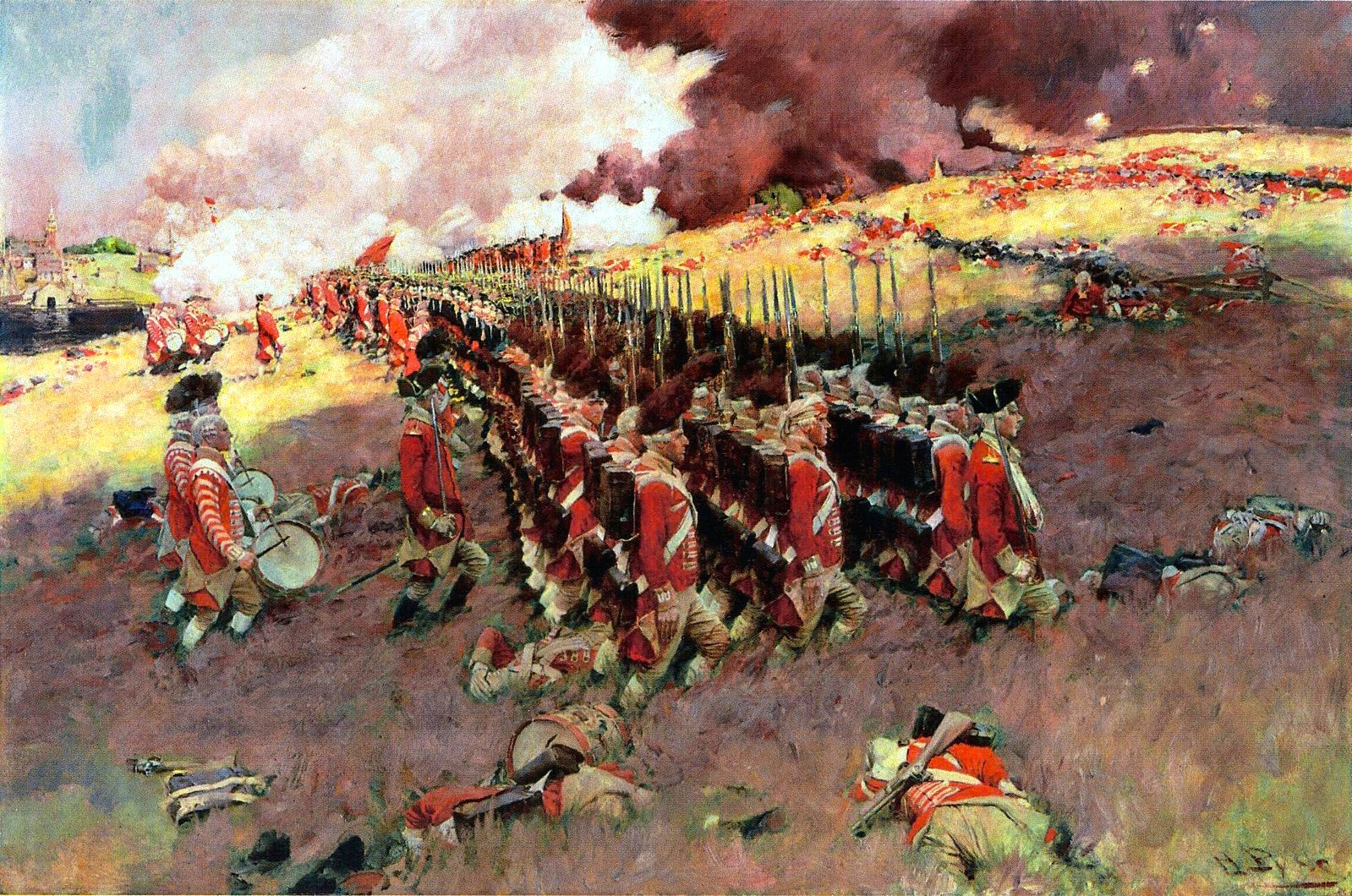
And while the British re-formed, Charlestown itself caught fire, deliberately. American sniper fire from the village at the peninsula’s southern foot had been galling Pigot’s flank, so the British batteries (clusters of heavy cannon) on Copp’s Hill, across the water in Boston, and the ships set the town alight with heated shot (cannonballs fired red-hot to start fires) and carcasses (incendiary shells), and some three to four hundred buildings went up in one vast blaze beside the battlefield. Major General John Burgoyne (British), watching from the Copp’s Hill battery, called the panorama “one of the greatest scenes of war that can be conceived.”
Within the half hour Howe attacked again, the same plan minus the beach: grenadiers and line regiments at the fence, Pigot at the redoubt. The second assault was repulsed at least as bloodily as the first, with some companies reported at two-thirds losses, and Howe’s own staff was being shot down around him as he walked, on foot, in the front line. And still they re-formed and walked back up that hill, in order, into massed fire from men behind walls, behind officers who fell at a rate that scandalized the army. Lieutenant Lord Rawdon (British), in the assault, wrote home three days later.
They rose up and poured in so heavy a fire upon us that the oldest officers say they never saw a sharper action.
Inside the redoubt the real crisis was not courage but arithmetic. The powder (the loose gunpowder a man poured down his musket’s barrel for every single shot) was nearly gone. Colonel William Prescott’s (American) men had perhaps one volley left, and no relief was coming: of the men sent toward the fighting that afternoon, many never crossed the shot-swept Neck at all. For the third assault Howe changed everything: reinforced by about four hundred fresh men of the 47th Foot (an infantry regiment) and the Marines, with Major General Henry Clinton (British) crossing from Boston on his own initiative to rally the shaken units, the army dropped its packs, formed columns instead of lines, made the redoubt the single objective, and went in with the bayonet.
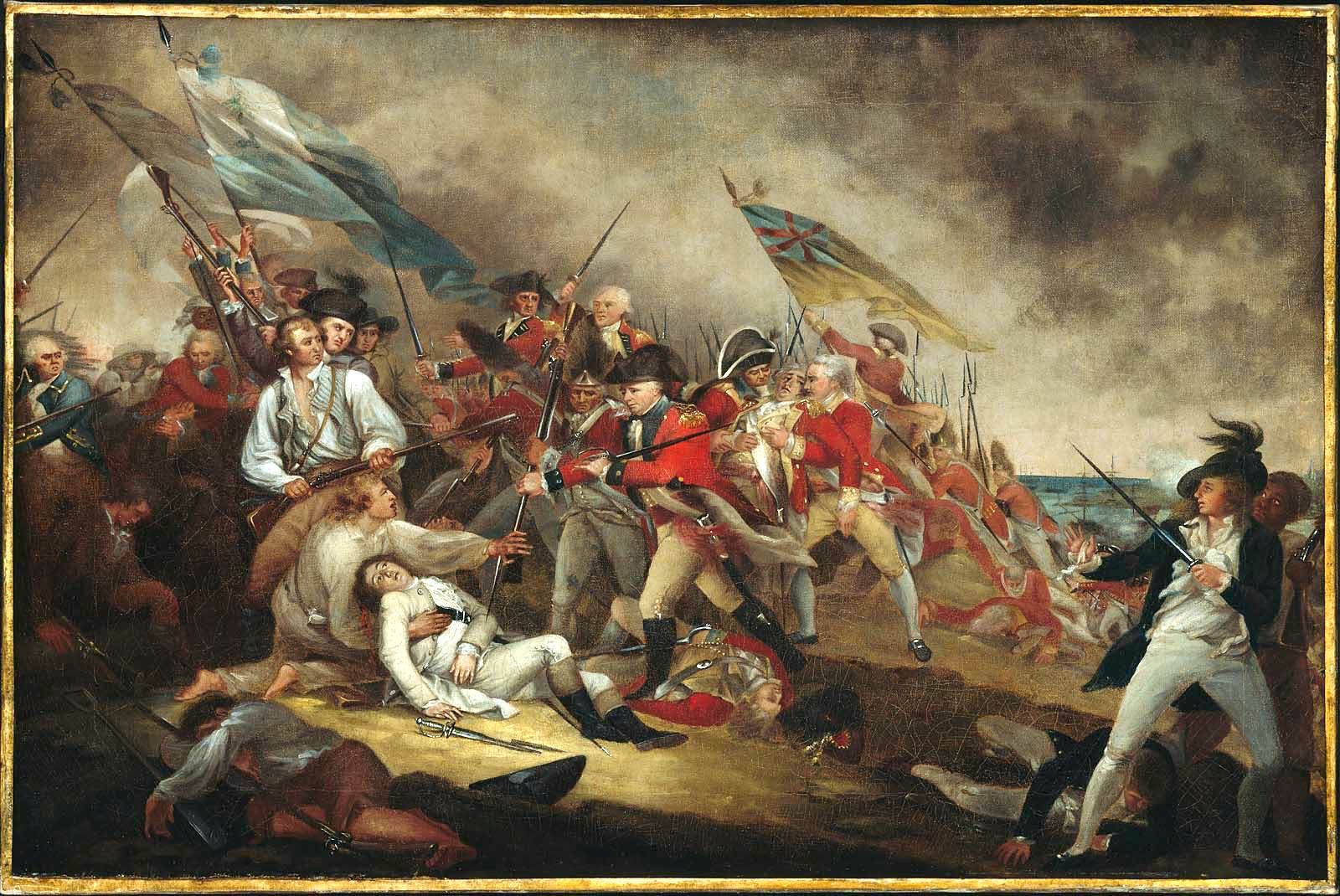
Imagine standing in that fort. You marched out of Cambridge the evening before, dug all night, and have been under fire since dawn. You have one load of powder left, maybe, and no bayonet, because almost nobody in the redoubt has one, and the six feet of dirt you piled up last night is the only thing between you and an army that has just dropped its packs to climb faster. You hold that last shot while the columns come up the slope, fire it into their faces at point-blank range, and then the parapet (the top of the fort’s wall) darkens with regulars coming over it, bayonets first, and what is in your hands now is a club. The fight inside was brief and ugly: clubbed muskets, thrown stones, swinging and shoving in the dust. Major John Pitcairn (British), the Marine officer who had commanded the troops at Lexington in April, where the war’s first shots were fired, fell mortally wounded at the parapet; an 1818 account credits the shot to Peter Salem, a Black soldier in the American ranks, a tradition rather than a certainty. What is documented beyond doubt is the case of Salem Poor, another Black soldier at the battle, whose conduct moved fourteen officers to sign a petition that he “behaved like an experienced officer.” Prescott, parrying bayonet thrusts with his sword, his banyan (his loose linen gown) and waistcoat run through, got out untouched and ordered the retreat.
The retreat was where most of the American dead fell, back across Bunker Hill and over the Neck under naval fire, HMS Glasgow and gun-barges firing down the one land exit. It was ragged but it was not a rout; Brigadier General Israel Putnam (American), the senior officer on the field, tried and failed to rally a stand at the half-dug fallback works on Bunker Hill proper. Private Peter Brown wrote that he “was in the fort when the enemy came in, jumped over the wall, and ran half a mile, where balls flew like hail stones.” And in the last moments by the redoubt, covering the retreat, Warren was killed by a musket ball to the head. The British officers who found the body knew exactly who they had. Captain Walter Laurie wrote that he “stuffed the scoundrel with another rebel into one hole, and there he and his seditious principles may remain.” The body was stripped and buried in a shallow mass grave on the field. By about five o’clock the peninsula was British. The Americans dug in a mile away on the mainland, on Winter and Prospect Hills, that same evening, and the siege resumed as if the lines had merely shifted one peninsula.