In 1754 a twenty-two-year-old Virginia officer named George Washington marched a few hundred men into a forested valley west of the Appalachian Mountains, looking to push the French out of land his colony claimed. What he set off instead was a war that would burn for nine years across four continents. The shot that started it was fired in a damp Pennsylvania ravine, in an engagement that lasted about fifteen minutes, and the man who turned that skirmish into a killing was not Washington and not the French. He was a Native leader pursuing his own war, for his own reasons, using both empires as his instruments.
The French and Indian War did not begin as a war between France and Britain. It began as a contest over the Ohio Country, a stretch of frontier neither empire had ever properly governed, and the people with the clearest aims in that contest were the ones the war was named against. Over the next few years two empires would collide there, a young and untested Washington would blunder into command of the opening moves, and a clash in the woods would escalate into a global conflict.
The Land in the Middle
The Ohio Country was a loosely bounded region west of the Appalachian Mountains and south of Lake Erie, the upper basin of the Ohio River, roughly today's western Pennsylvania, eastern Ohio, and northern West Virginia. To London and Paris it looked like empty interior. It was nothing of the kind. It was home to several Indigenous nations, and it was the hinge the balance of North America turned on. For France, holding it meant linking New France in the north to Louisiana in the south down one spine of forts and trade. For Virginia, it was the next direction of growth, land its charter claimed and its farmers and speculators meant to take.
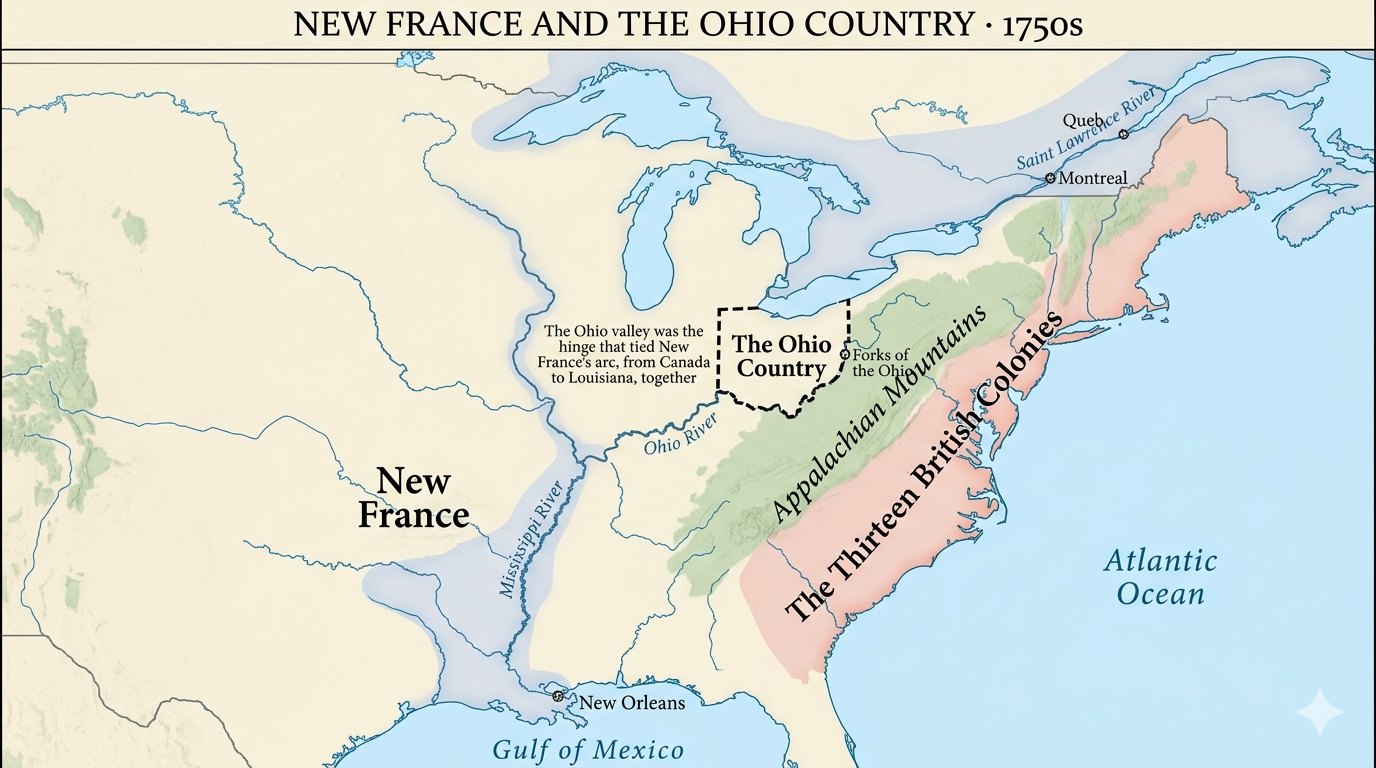
Underneath the rivalry sat a difference that shaped how Native nations chose sides. The French came mostly to hunt, trade, and garrison. The British came to clear forest, plant crops, and stay. A French fort was a trading partner with cannon; a British farm was the leading edge of dispossession. That difference pushed several Ohio nations toward France, even as one Ohio leader worked to pull Britain in for reasons of his own.
Virginia's ambition had a name and a balance sheet: the Ohio Company of Virginia, a land-speculation venture formed in 1748 to take and sell that western country. Its shareholders ran from George Washington's older half-brothers to Robert Dinwiddie, the lieutenant governor who would soon send soldiers to defend land he had money in.
Off the fieldThe Ohio Country & the Ohio CompanyThe French Won't Leave
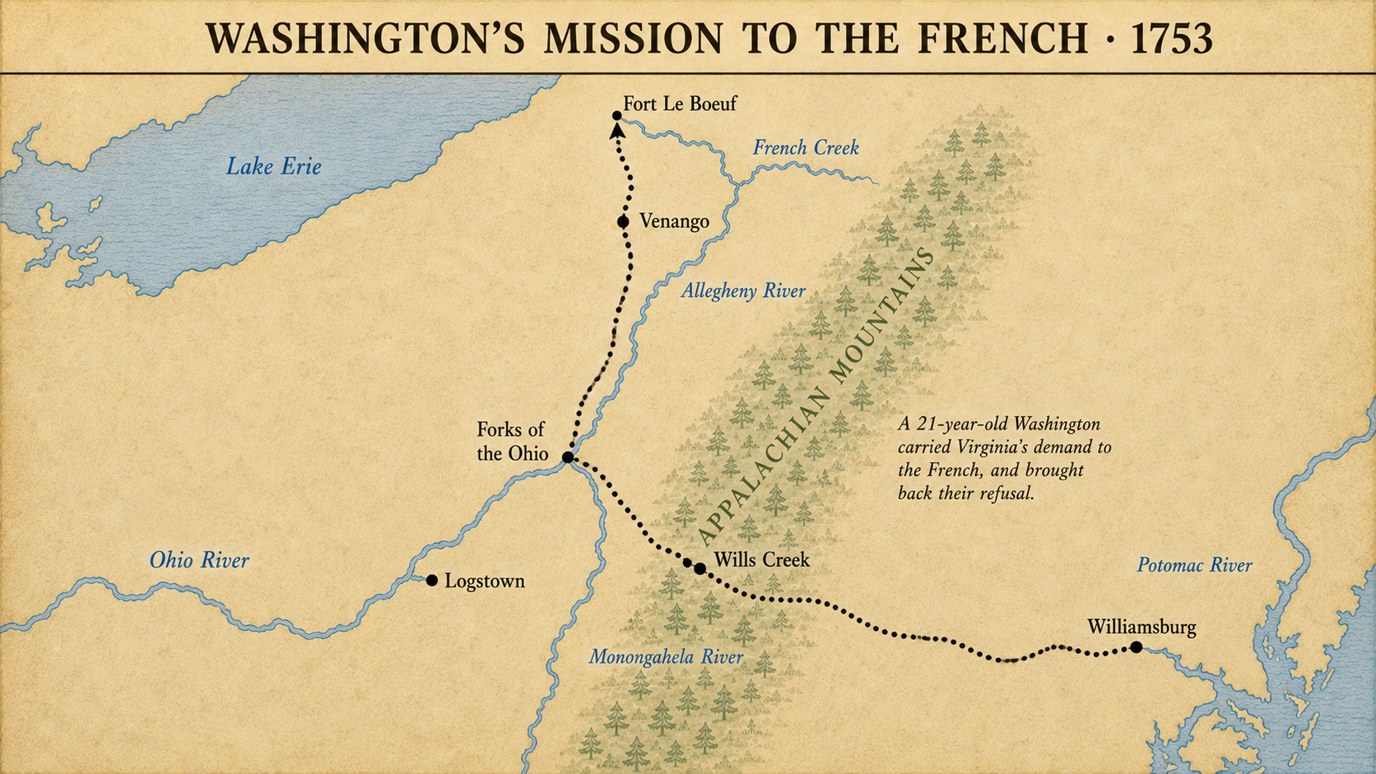
France moved first, and moved with soldiers. Through 1753 it planted a chain of forts running south from Lake Erie toward the Forks of the Ohio, turning a paper claim into a physical fact. Dinwiddie answered with a letter, carried by a very young man: in late 1753 he sent twenty-one-year-old Major George Washington on a thousand-mile winter round trip to demand the French withdraw. The fort commander, Jacques Legardeur de Saint-Pierre, heard him out courteously and refused flatly, saying France's claim was beyond dispute and that he did not consider himself obliged to leave. Washington nearly drowned in the ice-choked Allegheny coming home, then handed Dinwiddie a journal of the trip. Dinwiddie published it, broadcasting the French threat and making the unknown major a name on two continents. The errand had failed. The next move would not be a letter.
The Forks Are Lost
The single most valuable point on the continent was the Forks of the Ohio, where the Allegheny and Monongahela rivers meet to form the Ohio (the site of modern Pittsburgh). Whoever held the Forks held the river highways running in every direction, north toward the Great Lakes, south and west into the heart of the continent. It was the prize the whole contest turned on. After Washington's report, Dinwiddie ordered a fort built there, and in January 1754 a work party of about forty-one Virginians under Captain William Trent went out and began throwing one up.
It was less an army than a construction crew, and it was alone. On April 17, 1754, with the walls still unfinished, roughly 600 French soldiers and Native allies under Claude-Pierre Pécaudy de Contrecœur came down the Allegheny, ran out their cannon, and gave the Virginians an hour to surrender. The math was not close. A few dozen men with axes faced a fortified column more than ten times their number. They handed over the half-built fort and were allowed to march away with their tools. The most strategically valuable spot in North America had changed hands without a shot, traded by a small work crew that never had a chance to load a gun. The French pulled down the British walls and began raising their own on the same ground: Fort Duquesne, named for the governor general, the keystone of the whole French chain. Britain had reached for the Forks and had its hand brushed aside before it could close.
Washington was already on his way to help hold that fort when it fell. Promoted to lieutenant colonel after his 1753 mission, he had marched west in April 1754 with about 159 men, and he learned the bad news on the road: the place he was marching to support no longer existed, and a French army now sat at the Forks. He pressed on anyway, into a situation he did not control, toward a clash he did not plan.
Fifteen Minutes in a Ravine
Washington halted at the Great Meadows, a natural clearing in the Pennsylvania backcountry that offered water and grazing, and made it his base. There, word reached him from Tanaghrisson that a French party was camped in a rocky glen about 7 miles (11 km) off. On the night of May 27, 1754, Washington led roughly forty Virginians through the dark to find it, joining a dozen Mingo warriors under Tanaghrisson along the way. At dawn on May 28 they closed in on the French camp, which had posted no sentries. The French numbered perhaps thirty-five, under a young officer named Second Ensign Joseph Coulon de Villiers, Sieur de Jumonville.
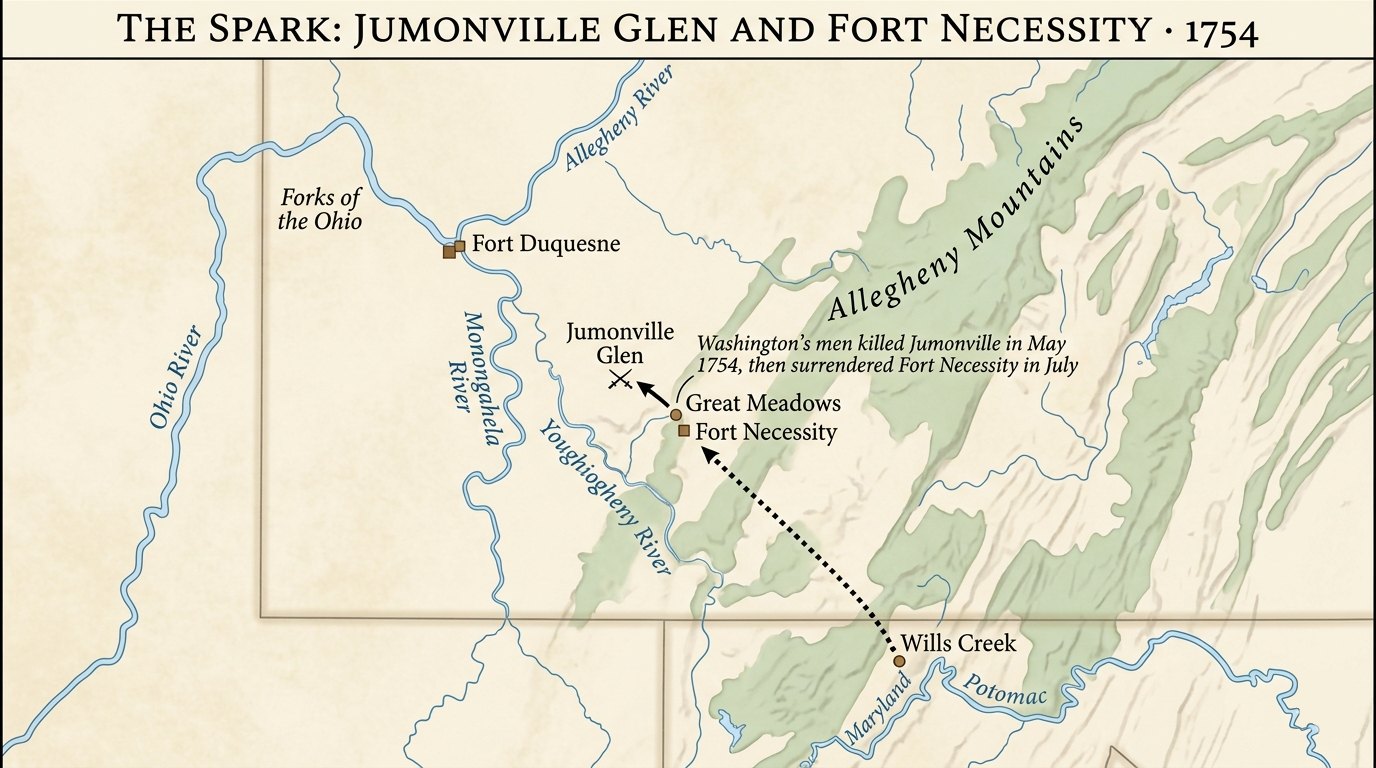
What exactly happened next is the first of several things about this day that the surviving evidence cannot settle. The French survivors said the Virginians opened fire without warning. Washington said a Frenchman fired first. Who pulled the first trigger is genuinely lost. What is clear is that Washington's men poured fire into the camp, the fight lasted about fifteen minutes, and the French moved to surrender.
The war storyJumonville GlenThe surrender did not save Jumonville, and the man who killed him was not Washington. After the French gave up, Tanaghrisson approached the wounded Jumonville. By one French-derived account he said, "Tu n'es pas encore mort, mon père" ("Thou art not yet dead, my father"), and struck him dead with a hatchet. The accounts differ on the gruesome specifics, and the most graphic of them come from sources hostile to the British, so the precise manner is uncertain. But most historians accept the core of it: Tanaghrisson personally killed Jumonville after the surrender, and his warriors then killed nearly all the French wounded. Around ten French were killed and twenty-one taken prisoner. One man escaped and carried word back to Fort Duquesne. On Washington's side, the cost was light, one killed and a few wounded.
Tanaghrisson was not fighting Washington's war. He was fighting his own. He had been born likely Catawba, captured young and adopted by the Seneca, and had risen to influence among the Mingo, Iroquois-speaking people who had migrated into the Ohio Country a generation earlier. The British called him "the Half-King" and treated the title as a formal office, a spokesman for the Ohio nations, but the title was probably a British invention; the Iroquois Confederacy's governing council at Onondaga regarded the Ohio Mingos as warriors, not as delegated viceroys. By 1754 Tanaghrisson's own standing had crumbled. He was living near the Forks as something close to a refugee, with a small band of relatives and followers, his influence over his people nearly gone.
He had reasons to hate the French that were personal and visceral; he claimed French soldiers had killed and eaten his father. But the killing in the glen was also a calculated act of statecraft. By striking down a French officer and then sending word to the French that Washington was responsible, Tanaghrisson was deliberately forcing a war between the two empires, a war in which Britain would do the fighting he needed done, the expulsion of the French from the Ohio, while he avoided the blame. If Britain drove out the French, the Ohio nations would remain the indispensable middlemen of the fur trade and frontier diplomacy, and Tanaghrisson would have his prestige back. The French had treated him with contempt; this was answer and provocation at once. The decision that mattered most at Jumonville Glen was his, a Native leader playing a longer game than either European army understood.
Who Jumonville had been was its own contested question. The French insisted he was a diplomatic envoy carrying a summons for the British to withdraw, which would make his killing an assassination, the murder of a protected messenger. Washington and the British noted that the party had hidden in a ravine rather than approach his camp openly, which looks less like diplomacy than reconnaissance. The ambiguity may have been built in. An eighteenth-century frontier officer's orders often gave him room to act as envoy or scout depending on what he found, and Jumonville's likely did. The label "diplomat" or "spy" was never going to be settled by the facts on the ground. It was going to be settled by whoever could put it in writing, and the French were about to.
Washington's own reaction, written days later to his brother, became one of the most quoted lines of his early life. He was twenty-two, he had just survived his first firefight, and he was, by his own admission, exhilarated.
I heard Bulletts whistle and believe me there was something charming in the sound. — George Washington to his brother John Augustine Washington, May 31, 1754
That Little Thing Upon the Meadow
Knowing the French would come for revenge, Washington fell back to the Great Meadows and built a fort. Calling it a fort flatters it. Fort Necessity was a small circular palisade of split logs about seven feet high and fifty feet across, ringed by shallow trenches, finished in early June 1754. It sat in a clearing, but the clearing was a mistake: wooded hills overlooked it on the sides, close enough for an enemy in the trees to fire down into the enclosure. Washington either did not see the problem or had nowhere better to stand.
He had help by then. About 100 South Carolina regulars under Captain James Mackay had joined his roughly 293 Virginians, which brought him to nearly 400 men but also created friction. An officer holding a royal commission, in the regular British army, outranked any officer of a provincial colony-raised unit no matter what the provincial's rank was. So Mackay, a regular captain, would not take orders from Washington, a provincial colonel. That was the friction, and it sat unresolved over a fort about to be attacked. Against them came the revenge the French had promised. Around 600 French and Canadian troops, plus a fluctuating number of Native allies, marched out of Fort Duquesne under Captain Louis Coulon de Villiers. He was Jumonville's brother, and he had specifically asked for command of this expedition.
The fight on July 3, 1754, went exactly the way the ground said it would. The French arrived around midday and took position in the surrounding woods and on the hillsides, firing down into the fort almost at will. Heavy rain turned the trenches into pools of muddy water and soaked the defenders' gunpowder until it would barely fire. After about nine hours of this, with dozens dead and wounded, Washington asked for terms. The casualties told the story: roughly thirty Virginians and South Carolinians killed and seventy wounded, against a handful of French dead. It was Washington's first battle as a commander, and he had lost it badly.
The war storyFort NecessityThen came the single most consequential thing Washington did that year, and he did it in the dark, not knowing what it was. Louis Coulon de Villiers, avenging his brother, drafted the surrender terms in French, and into Article VII he wrote the phrase "l'assassinat du Sr. de Jumonville," "the assassination of Sieur de Jumonville." The terms came across to the fort late that rainy night. Washington could not read a word of French. So in the wet and the dark, with the rain still coming down and his dead and wounded around him, the document was read aloud to him by Jacob Van Braam, the Dutch-born fencing master who had taught him a little of the language years before, now rendering French into English by candlelight for a beaten twenty-two-year-old who had to take his word for it. By the surviving accounts, Van Braam gave him the critical word not as "assassination" but as "the death" or "the killing" of Jumonville. On that understanding Washington signed, and so did Mackay. Washington put his name to a sentence confessing that he had assassinated a French envoy, and he did not know that was what the sentence said. His men were allowed to march out with honors on July 4, drums beating and flags up, carrying one small cannon, on a promise not to return to the Ohio for a year. Two of his men, Van Braam and Captain Robert Stobo, were left behind as hostages.
Whether Van Braam's slip was honest incompetence or something worse has never been fully resolved; most historians treat it as the genuine fumble of a man translating between three languages under pressure. Washington maintained for the rest of his life that he had never knowingly signed any admission of assassination.
Every Officer, then present, is willing to declare, that there was no such Word as Assassination mentioned; the Terms expressed to us, were "the Death of Jumonville." — George Washington
It did not matter what Washington had understood. It mattered what his signature said. To the French crown and the French public, a British commander had signed a confession that he had ordered the murder of a peaceful envoy. That document, very likely seeded with the word "assassinat" on purpose, gave France exactly the justification it wanted. A backwoods ambush over a half-built fort had been converted, in a few lines of French, into a casus belli, an act a nation uses to justify going to war. The naming of Jumonville's death decided more than the naming of any battle.
A Union That Wasn't
While Washington was losing a fort in the woods, the British colonies were holding a meeting that showed, just as clearly, how unready they were. The two events ran in parallel through the summer of 1754. The empire's military answer to the French and its political answer to the French were both improvised, and both fell short.
Even before the shooting started, one colonist had diagnosed the problem and put it in a picture. On May 9, 1754, nineteen days before Jumonville Glen, Benjamin Franklin published a woodcut in his Pennsylvania Gazette in Philadelphia: a snake chopped into eight pieces, each labeled for a colony or region, under the caption "JOIN, or DIE." It is generally called the first American political cartoon. Its argument was that the colonies were as helpless divided as a snake cut to bits, and that French confidence rested on exactly that disunity.
Off the fieldThe Albany Congress & the Plan of UnionA month later the colonies tried, weakly, to act on it. From June 19 to July 11, 1754, delegates from seven of Britain's North American colonies met at Albany, New York, in a gathering remembered as the Albany Congress, chaired by James DeLancey, the lieutenant governor acting as governor of New York. They had two jobs. The first was to repair relations with the Iroquois Confederacy, the powerful alliance of Six Nations to the north, whose Mohawk leaders had declared their long alliance with the British, the Covenant Chain, broken in 1753 after New York let hundreds of thousands of acres of Mohawk land slip away in fraudulent deals. The Covenant Chain was not a figure of speech but a named, formal alliance system, a chain of treaties dating back to the 1680s that bound the Iroquois Six Nations and the British colonies (with New York at its center); letting it fray meant losing the one Native alliance that anchored British standing in the north. The Mohawk leader Theyanoguin, whom the British called "King Hendrick", had been the one to tell New York officials plainly that the chain was broken. The Congress's second job was to coordinate a common defense against the French.
Off the fieldThe Contest for Native AlliancesOut of it came Franklin's Plan of Union, the boldest idea in the room. It proposed a single colonial government for defense and Indian affairs: a president-general appointed by the Crown and a grand council of delegates sent by the colonial assemblies, apportioned by what each colony paid in. The delegates unanimously approved it. Then it died twice over. The colonial legislatures rejected it, jealous of the independent charters that gave each colony its own power. The British government rejected it too, preferring a military command structure to colonial self-rule. The first serious attempt at American union failed before it began, although its skeleton, a federal layer over self-governing colonies, would surface again decades later in the Articles of Confederation and the Constitution.
The Congress's other job went no better. It was also meant to mend the broken Covenant Chain and bring the Iroquois firmly back to the British side, and it did not. The delegates heard the Mohawk grievances and made gestures toward repair, but the alliance stayed shaky, and the Six Nations went into the war that was coming without committing to it. Britain entered the conflict with its central Native alliance still half-broken.
So the summer of 1754 set the pattern for the years to come. France acted as one. Britain's colonies could not even agree to act as one, and the men in the field paid for it.
The Spark and the World It Burned
A twenty-two-year-old provincial officer, an unfinished fort, a fifteen-minute fight in a glen, and a mistranslated word touched off a war that France and Britain would fight not only in North America but in Europe, the Caribbean, West Africa, India, and the Philippines.
The widening can be traced step by step. In 1755 Britain sent regulars across the Atlantic under Major General Edward Braddock, who marched on Fort Duquesne and was destroyed near it that July. Through the second half of 1755 the British navy began seizing French ships without any declaration of war, an undeclared naval war on top of the land fighting. Then the alliances of Europe flipped. In a realignment historians call the Diplomatic Revolution, Britain bound itself to Prussia (the Convention of Westminster, January 1756) and France bound itself to Austria (the First Treaty of Versailles, May 1756), reversing the partnerships of the previous war. Britain formally declared war on France on May 17, 1756, and France declared war that June. The fighting spread into Europe, India, the Caribbean, and West Africa. The frontier clash had become the Seven Years' War, a genuinely global conflict, the first of its kind.
A line long attributed to the British writer Horace Walpole has it that a volley fired by a young Virginian in the American backwoods set the world on fire. The attribution is doubtful, and probably wrong, so the line is best left to the side. The thing it describes, however, is sound. The world really did catch fire, and the first sparks were struck in the Ohio Country.
The war's name still sits oddly. We call this the French and Indian War, naming it for the two enemies the British colonists faced. The name centers the British colonial view and flattens everyone else, lumping dozens of distinct nations into a single word, "Indian," and casting them as the enemy or the auxiliary, never as players with aims of their own. Yet the people with the clearest and most independent strategy in 1754 were Native. Tanaghrisson was no flag carried behind a European army; he tried to use the British to win his own war for the Ohio, and very nearly did. The Shawnee and the Delaware (Lenape) leaned toward France precisely because British farms, not French forts, threatened to swallow their land. The Iroquois Confederacy worked to keep both empires weak and dependent, the strategy that had preserved its power for generations.
And it was the Ohio nations who would pay the longest bill. They had spent decades balancing between two empires, trading with both, playing each against the other to keep their own ground. The war Tanaghrisson helped light would end that balance. Whichever empire won, the contest over the Ohio Country was, in the end, a contest over their homeland, and the people who lived there would be the ones with the most to lose.
Tanaghrisson did not live to see any of it, and the alliance he had bet on had soured before he died. In early September 1754, after the defeat at the Great Meadows, he reached Aughwick, a Pennsylvania trading post, where the British agent George Croghan wrote down what he had to say about Washington. He had little good to say. He called Fort Necessity "that little thing upon the meadow." He charged that Washington had "took upon him to command the Indians as his Slaves," and that the young colonel "never consulted with us nor yet to take our Advice." The man Tanaghrisson had tried to steer into a war for the Ohio had, in his telling, treated his warriors as servants and ignored the people who knew the country. A month later he was dead. He had withdrawn his warriors before Fort Necessity, retreated east with a small band of Mingos, and died of pneumonia near modern Harrisburg, Pennsylvania, on October 4, 1754, a few months after the killing in the glen that he, more than anyone, had made matter.