For three years the Union had fought the Civil War as if it were several separate wars going on at the same time. An army in Virginia, an army in Tennessee, a fleet on the rivers, a column in the Shenandoah Valley: each moved on its own clock, and when one of them attacked, the others usually sat still. That arrangement quietly handed the Confederacy its single greatest advantage. With shorter routes inside its own territory (its interior lines), the South could pull troops off a quiet front and rush them to a hot one, beating one Union threat at a time and then turning to face the next. The whole war had a rhythm the South could exploit: one Northern punch, a Southern parry, a pause, repeat.
In March 1864 that changed, because one man was finally put in charge of all of it. His plan was simple: advance on every front at once, grind the smaller Southern armies down faster than they can be rebuilt, and cut the railroads and farms that feed them, until the Confederacy simply runs out. And 1864 forced a second idea into the open. The battlefield that year was not only a military objective. It was a political one. Whether the North kept fighting at all came down to whether the armies could show a visible win before the voters lost their nerve.
One war, not five
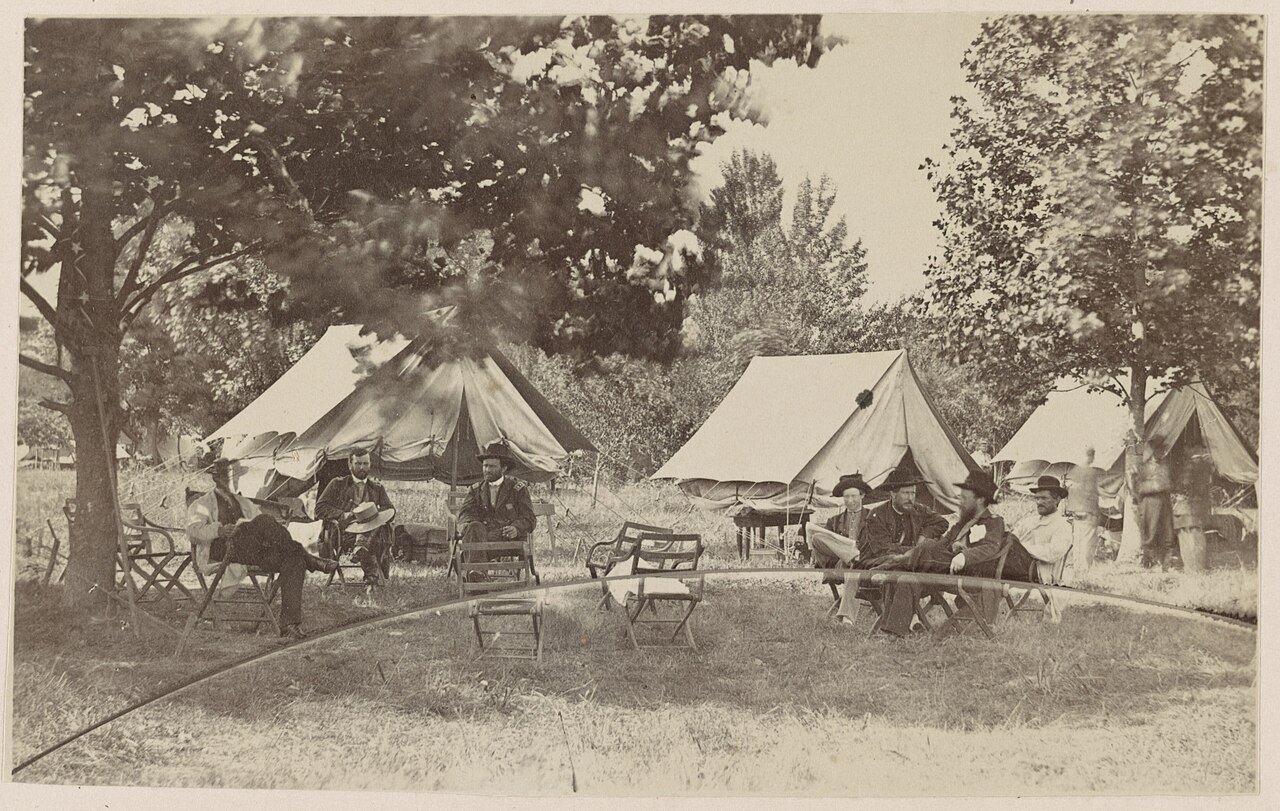
In the winter of 1863 Congress revived a rank no one had held in full grade since George Washington: lieutenant general, the senior commission in the U.S. Army. The Senate confirmed Ulysses S. Grant's promotion to lieutenant general on March 2, 1864, and on March 9 President Abraham Lincoln presented him the commission in person at the White House. The title that came with it was general-in-chief: command of every Union army in the field, everywhere. Grant put William T. Sherman in his old place, in charge of all the armies in the West.
What made the appointment matter was not the rank but the relationship. For three years Lincoln had cycled through generals, advancing one, relieving the next, half-running the strategy himself because no soldier had earned his full trust. With Grant he stopped. Lincoln let Grant devise the strategy and run the war, and for the first time the President had a general-in-chief he could simply turn the whole thing over to.
Grant's idea was almost crude in its simplicity, and that was its strength. Stop fighting the theatres as separate wars. Make every Union army advance at the same moment, so the South could never again strip a quiet front to save a threatened one. The Confederacy's smaller army would be forced to fight everywhere at once, and an army that cannot shift its weight cannot use interior lines. Lincoln blessed the plan in his own homespun terms, a butchering proverb from the western country he had grown up in: even the men not doing the skinning are useful if they hold the animal down.
"Those not skinning can hold a leg." - Abraham Lincoln
He meant that an army which merely advances and holds ground is doing real work, even when it is not the one landing the killing blow. Five advances were set in motion for the spring of 1864. Grant himself would travel with Major General George G. Meade's Army of the Potomac and drive straight at Robert E. Lee in Virginia. Sherman would go after Joseph E. Johnston's army and take Atlanta. Three smaller columns would pin the South's flanks: Major General Franz Sigel up the Shenandoah Valley, Major General Benjamin Butler up the James River toward Richmond from the southeast, and Major General Nathaniel Banks toward Mobile on the Gulf.
There was a reason the North could even contemplate moving everywhere at once: it had the men, and a large and growing share of them were Black. By 1864 something like 179,000 men had enlisted in the United States Colored Troops, most of them formerly enslaved, filling the Union ranks as white volunteering fell off. The Confederacy had no such reservoir to draw on, because the people it might have armed were the four million it was fighting the war to keep enslaved. That is the engine under the whole year. The United States by 1864 was fighting to destroy slavery, in growing part with the very people slavery was built on, while the South fought to preserve it, and the manpower arithmetic bent accordingly.
Off the fieldFreedom Seekers & the USCTAttrition as a decision
The plan met Lee on May 5, 1864, in a stretch of scrubby second-growth forest west of Fredericksburg called the Wilderness. For two days the two armies tore at each other blind, in woods so thick that men could not see fifty feet, while brush fires spread through the undergrowth and burned the wounded where they lay. It was the kind of bloody, inconclusive check that had ended every previous Union offensive in Virginia. Every one of Grant's predecessors, beaten or stalled, had pulled back across the river to refit.
Grant did not pull back. On the night of May 7 he ordered the army to march, and he ordered it south, around Lee's right flank, deeper into Confederate Virginia. Veterans who had braced for the familiar retreat realized at the crossroads that they were still going forward. A repulse no longer meant a retreat. From here on, a bloody afternoon was just the price of staying in contact, and staying in contact was the entire point.
Eastern TheatreThe WildernessThe army that did this was nearly twice the size of Lee's: roughly 120,000 Union troops against perhaps 60,000 Confederates. That gap was the strategy. Grant meant to hammer continuously at Lee's army, accepting heavy losses, because the North could replace what it spent and the South could not. The two armies grappled again a day's march south, at Spotsylvania Court House, in some of the most savage close-quarters fighting of the war: hours of hand-to-hand killing in the rain at a bulge in the line the soldiers named the Bloody Angle. (A salient is a place where a defensive line juts forward into a vulnerable point.) In the middle of it, on May 11, Grant wrote a dispatch to Washington whose closing line became the rallying cry of the North.
"I propose to fight it out on this line if it takes all summer." - Ulysses S. Grant, May 11, 1864
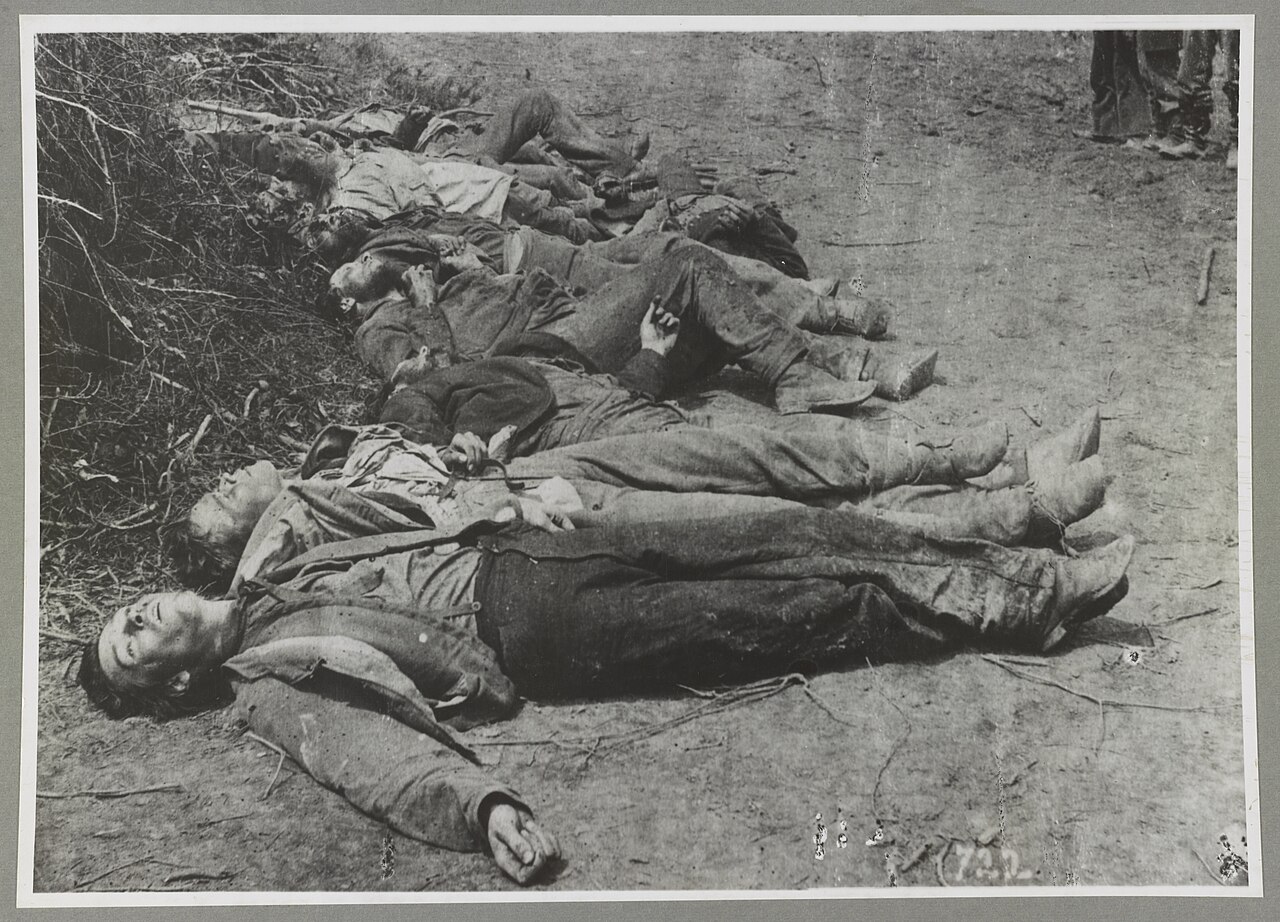
Eastern TheatreSpotsylvania Court HouseThe method had a cost, and Grant paid one installment of it in a single hour. On June 3 at Cold Harbor he ordered a frontal assault on Lee's entrenched line, and roughly 7,000 Union men were shot down in front of the works for nothing. He regretted it for the rest of his life.
"I have always regretted that the last assault at Cold Harbor was ever made." - Ulysses S. Grant, Personal Memoirs
Eastern TheatreCold Harbor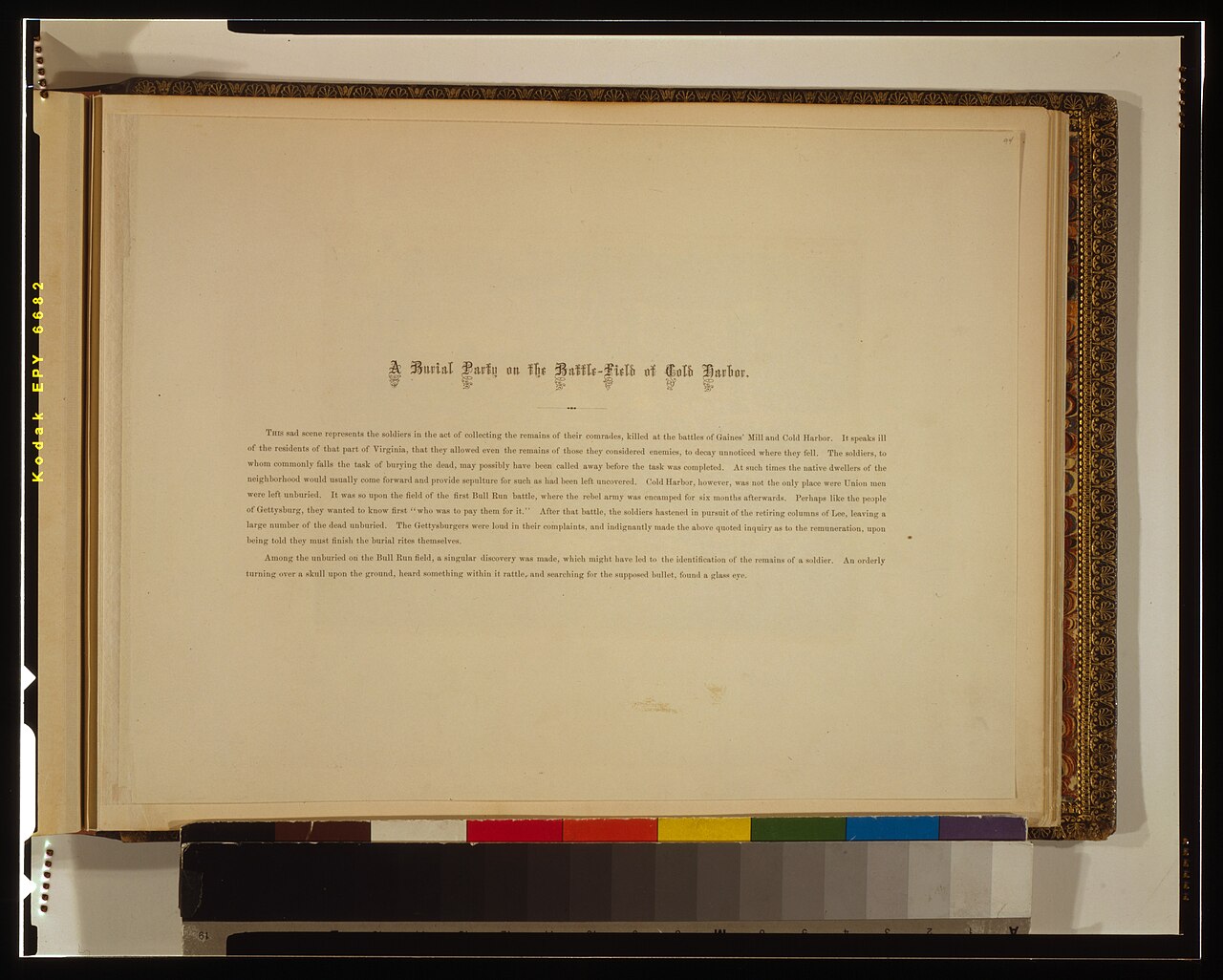
By the end of the campaign the Union had lost something on the order of 55,000 men, a number that earned Grant the nickname "butcher" in the Northern press. Lee's losses are harder to fix and the estimates vary, somewhere around 30,000 to 35,000. In raw arithmetic Lee inflicted more than he absorbed. But that is the wrong arithmetic. Grant lost a smaller share of a much larger army that could be filled again, while Lee bled veterans he had no way to replace, toward a total his army could not survive. Every fight looked like a Union defeat. Attrition was working anyway, exactly as designed.
Pin him in place
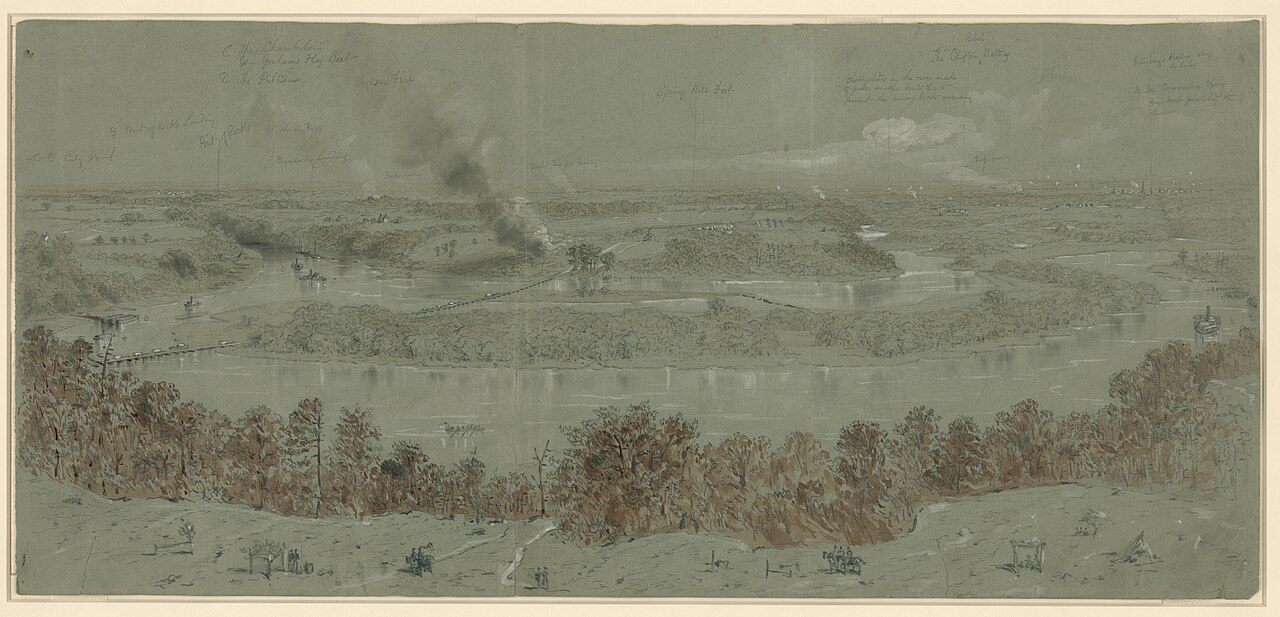
After Cold Harbor, Grant gave up trying to break Lee's army in a day's battle and went after the thing that kept it alive instead. In mid-June he slipped his whole army across the James River in a difficult, beautifully screened maneuver and struck at Petersburg, the rail hub some 20 miles south of Richmond through which nearly all of Lee's supplies flowed. Take Petersburg and Richmond starves. The war of movement was about to become a war of supply.
For a few hours in mid-June the city lay open. The first Union assaults, with USCT regiments among the leading attackers, broke into Petersburg's outer works against a thin garrison. Then the attack stalled, Lee's army came up to man the lines, and the open door swung shut. What began instead was a siege (the slow strangling of a fortified place by surrounding it) that would last nearly ten months.
Eastern TheatreSecond PetersburgThe siege was not a failure of the plan. It was the plan. Grant's object now was to fix Lee in place, to pin his army to a line of trenches and earthworks (breastworks, the chest-high barriers of dirt and timber soldiers threw up to fight behind) it could not leave, and then slowly cut the railroads feeding it while the rest of the Union armies wrecked the Confederacy everywhere else. A besieged army cannot maneuver, cannot reinforce another front, and cannot replace what it loses. The trench lines that ran for miles around Petersburg, a grim preview of the war Europe would fight fifty years later, were attrition made geographic.
The siege also produced the ugliest single hour of the year. Coal miners of the 48th Pennsylvania, led by Lieutenant Colonel Henry Pleasants, dug a tunnel under the Confederate line and packed it with four tons of powder. It blew at dawn on July 30, 1864, killing hundreds of Confederates and tearing a crater in the earth more than 170 feet long and 30 feet deep. A division of USCT had trained for weeks to lead the assault through the gap. At the last moment Meade ordered Major General Ambrose Burnside to swap in untrained white troops instead, afraid of the political damage if Black soldiers were slaughtered leading a failed attack. The white divisions poured down into the crater rather than around it and were trapped in a killing pit. The USCT, sent in afterward, took terrible losses, and many Black soldiers were murdered by Confederates after trying to surrender, because the Confederacy refused to treat Black men as legitimate soldiers, treating them instead as slaves in revolt, so to surrender to it was to risk being killed or sold rather than taken prisoner. The attack failed completely. In his dispatch to Washington the next day, Grant called the whole affair a disaster.
"It was the saddest affair I have witnessed in this war." - Ulysses S. Grant, dispatch to Henry Halleck, July 30, 1864
Eastern TheatreThe CraterThe side bets fail
Three of the five spring advances came apart almost at once, and the fact that it barely mattered is the clearest proof of what Grant's plan bought.
Butler's Army of the James landed between Richmond and Petersburg and was promptly sealed off by a much smaller Confederate force under General P.G.T. Beauregard. Grant's engineer described Butler as a man corked in a bottle, with Beauregard holding the neck, and the phrase stuck: Butler sat there, useless, for weeks. Up the Valley, Sigel was beaten at New Market on May 15 by a scratch Confederate army under John C. Breckinridge, an army that famously included 247 cadets from the Virginia Military Institute, ten of whom were killed. Sigel retreated and the Valley stayed Confederate. Far to the west, Banks had marched up Louisiana's Red River on a tangled cotton-and-conquest expedition, and Richard Taylor wrecked it at Mansfield in early April; Banks barely got his fleet out and accomplished nothing, tying up troops Grant had wanted at Mobile.
Trans-MississippiMansfieldThe far Trans-Mississippi, the country west of the river, had one more Confederate flare-up left in it. In October, Sterling Price led a long cavalry raid up through Missouri, the last real Confederate bid for that state, and it was run down and crushed at Westport, near Kansas City, in the largest battle fought west of the Mississippi in the war. It ended major Confederate operations in the Trans-Mississippi for good and tied down no Union strength that mattered to the main fronts.
Trans-MississippiWestportThree failures, and no collapse. In the old war, a Confederate win on any one of those fronts could have freed troops to break a Union army somewhere else. Now there was no somewhere else to send them, because every front was moving at once and there was always another Union army still coming on. The two main advances, Grant against Lee and Sherman against Atlanta, ground forward regardless. Simultaneity meant the North could afford to lose the side bets.
Atlanta becomes the prize
While Grant fixed Lee at Petersburg, Sherman pushed toward Atlanta with about 112,000 men against Johnston's 50,000. Johnston, badly outnumbered, fought the campaign Lee could not afford to fight: he gave ground on purpose, falling back from one strong position to the next, trading space for time and for Northern casualties. Sherman mostly refused to take the bait. Instead of charging the entrenched line in front of him, he kept sliding around its end, flanking Johnston out of one position after another and forcing him back toward the city without a head-on bloodbath. His men joked he could flank the devil out of hell. The one time he abandoned the method, a frontal assault at Kennesaw Mountain on June 27, he lost roughly 3,000 men to Johnston's 1,000 and went straight back to flanking.
Jefferson Davis, the Confederate president, lost patience with all the retreating. In mid-July he relieved Johnston and gave the Army of Tennessee to John Bell Hood, a fighter who could be counted on to attack. Hood attacked, three times in eight days, at Peachtree Creek, at the Battle of Atlanta (where the Union lost Major General James B. McPherson, killed), and at Ezra Church. Each assault was thrown back with heavy loss. Hood was burning up the very army he had been put in charge to save. At the end of August, Sherman swung wide and cut the last railroad into the city at Jonesborough. Hood had to abandon Atlanta, and the city fell on September 2. The next day Sherman wired the news to Washington.
"Atlanta is ours, and fairly won." - William T. Sherman, September 3, 1864
Western TheatreJonesboroughAtlanta is the pivot of the whole year, and not for any ground it sat on. It converted a military gain into a political event, and the political event was about to decide whether the war went on at all.
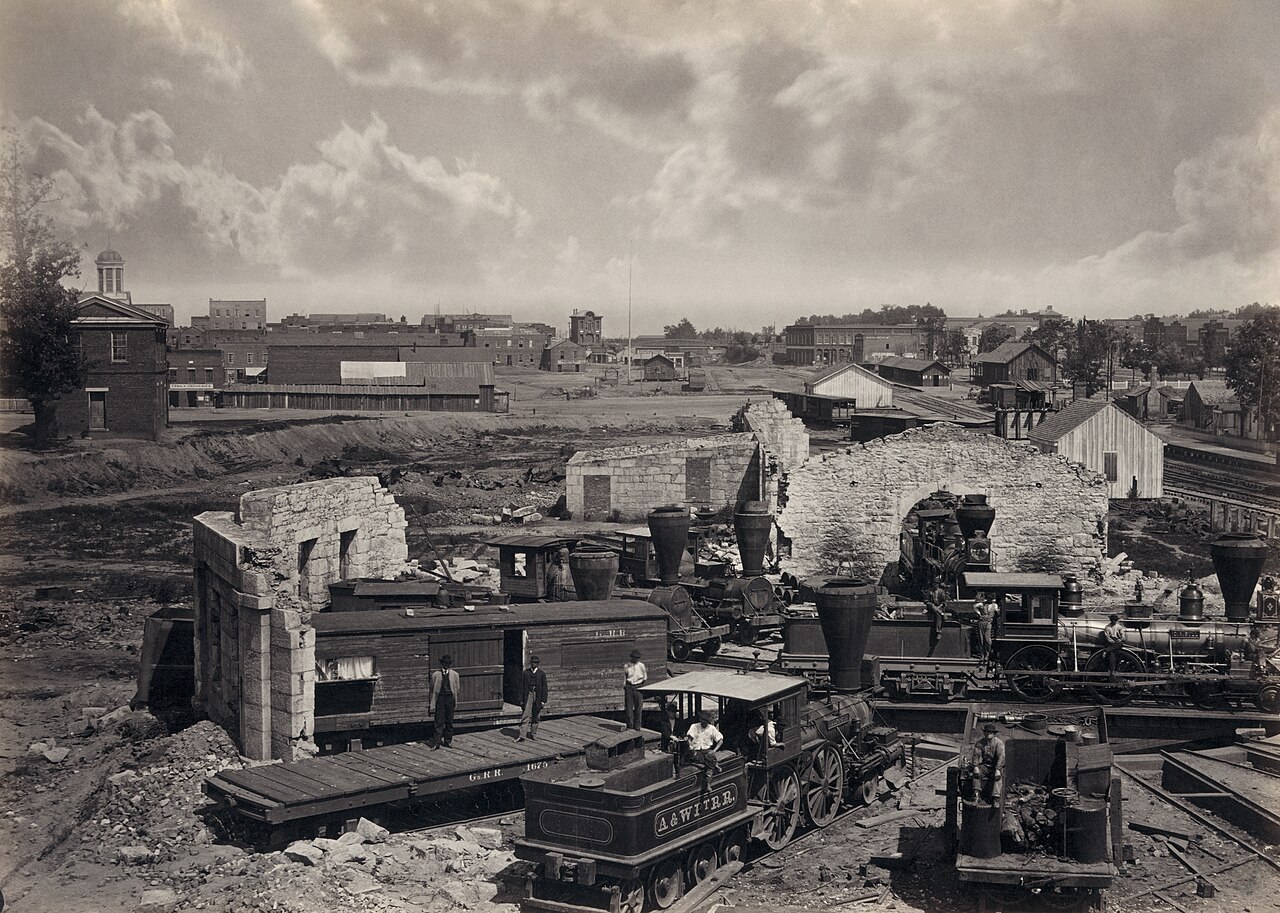
The battlefield decides the election
Through the summer of 1864 the North was sick of the war. The casualty lists from the Overland Campaign and the stalemate at Petersburg had drained the public's faith, and Lincoln himself expected to lose the November election. On August 23 he wrote a private memorandum, folded it so no one could read it, and had his whole Cabinet sign the blank back of it, a pledge to do their duty in the months between losing the election and handing over power.
"This morning, as for some days past, it seems exceedingly probable that this Administration will not be re-elected." - Abraham Lincoln, August 23, 1864
The stakes were the war itself. The Democrats nominated Major General George B. McClellan, the general Lincoln had twice removed, on a party platform that called the war a failure and demanded a negotiated peace. McClellan, for his part, personally rejected that peace plank. But the platform was the party's position, and a Democratic victory plausibly meant a settlement that left the Confederacy standing and slavery with it. The election was, in plain terms, a referendum on whether to keep fighting to the end.
Then the battlefield answered. Mobile Bay was closed in early August (more on that shortly). Atlanta fell on September 2, and with it the argument that the war could not be won. Through September and October Major General Philip Sheridan cleared the Shenandoah Valley in a run of decisive victories. The military attrition plan had only ever needed to last long enough to produce a visible win before the political clock ran out, and it produced one just in time.
On November 8 Lincoln won 212 electoral votes to McClellan's 21, with about 55 percent of the popular vote. The soldiers voted too, in the field, and they went for Lincoln by something like three to one. The men actually doing the fighting voted to keep doing it.
Off the fieldThe War Within the North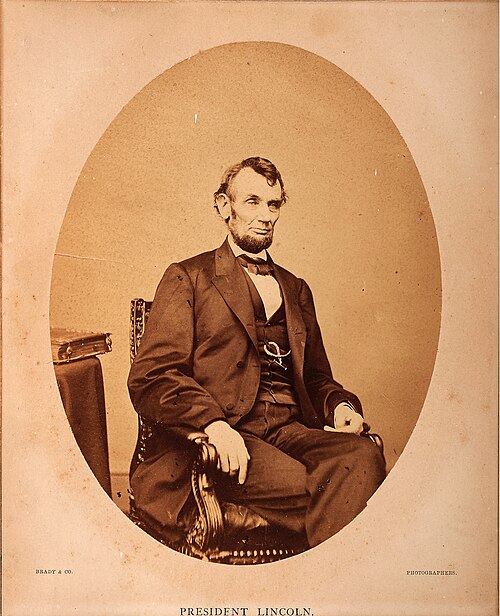
Hard war and the system behind it
By 1864 the Union had stopped trying only to beat the South's armies and started deliberately wrecking the South's capacity to field them, while its own supply machine ran at a scale the Confederacy could not approach. That shift runs through the rest of the year.
It opened on the water. On August 5, Rear Admiral David Farragut forced his fleet into Mobile Bay, steering past the mines (called "torpedoes" then) that guarded the channel, and captured the ironclad ram CSS Tennessee, closing the South's last major Gulf port east of the Mississippi. One of his monitors struck a mine and sank with most of her crew. The line everyone remembers, "Damn the torpedoes, full speed ahead," is almost certainly a later polishing of something blunter he said in the moment, but the result was real.
Naval & CoastalMobile Bay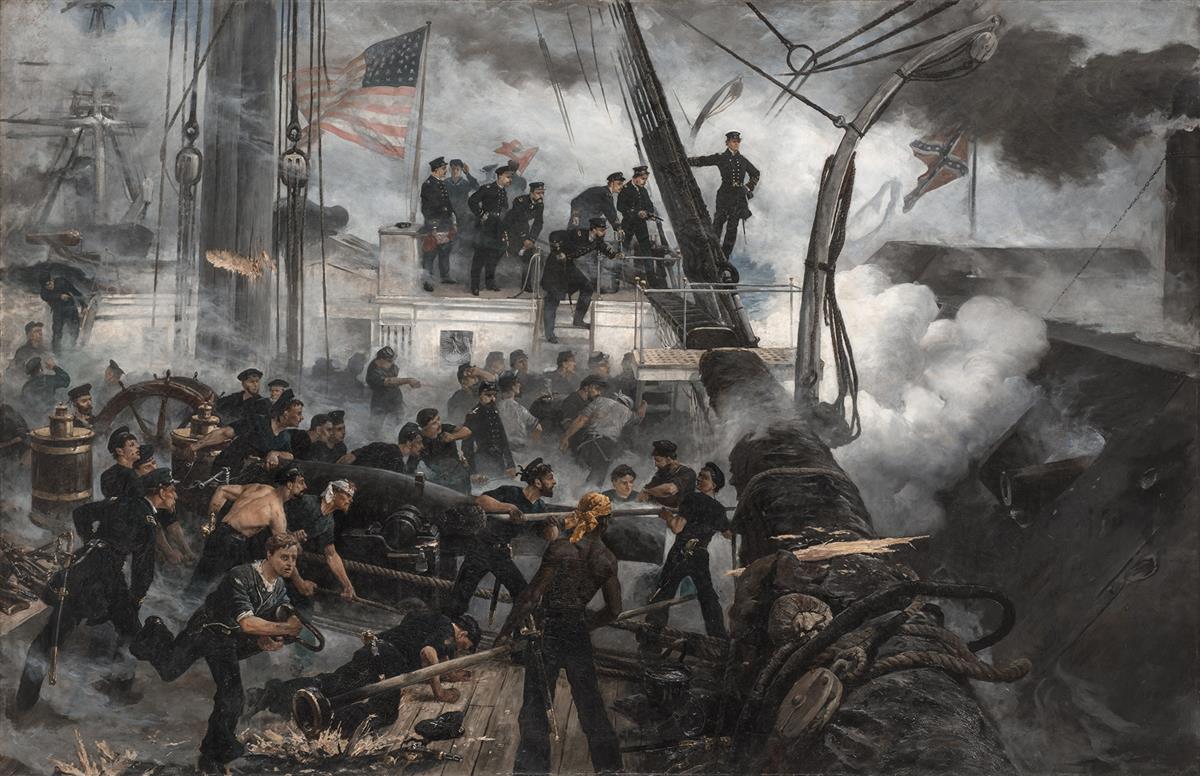
In the Shenandoah Valley, the South's breadbasket and a corridor straight at Washington, the fighting turned to supply itself. Lieutenant General Jubal Early had driven down the Valley that summer, crossed the Potomac, and reached the very edge of Washington in July before pulling back. Grant's answer was to give Sheridan a new army and an order to strip the Valley bare, a deliberate scorched-earth campaign that burned the crops, barns, and mills so the land could never feed Lee's army again. Then Sheridan beat Early in the open. In September he broke Early at Opequon, outside Winchester, in a hard day's fight that finally drove the Confederates up the Valley.
Eastern TheatreOpequonThe Valley was not yet settled. A month later, at Cedar Creek in October, Early's surprise dawn attack shattered two-thirds of the Union army before Sheridan rode up from Winchester and turned a rout into a victory that won the Valley for good.
Eastern TheatreCedar CreekThe same hard-war logic carried Sherman out of Atlanta. In mid-November he cut loose from his supply line entirely and marched some 62,000 men about 300 miles to the sea, from Atlanta to Savannah, living off the country and methodically destroying the railroads, mills, and crops that kept Confederate armies in the field. He was wrecking the South's ability and its will to keep fighting at the same time. Roughly ten thousand freedpeople left their plantations and followed the army as it passed; the march's darkest hour came at Ebenezer Creek, where a Union general, Brigadier General Jefferson C. Davis (no relation to the Confederate president), pulled up the pontoon bridge behind his troops and left those freedpeople trapped on the far bank as Confederate cavalry closed in. Sherman reached Savannah just before Christmas and offered the city to Lincoln as a present. The march was the new way of war in its purest form.
Off the fieldThe New Way of WarIt was also a campaign waged across a civilian landscape, on farms and in towns, on the people who lived in the army's path.
Off the fieldThe Home FrontHood, meanwhile, made the year's last great Confederate gamble and destroyed his own army with it. Rather than chase Sherman, he swung north into Tennessee, hoping to pull Sherman back after him. At Franklin on November 30 he ordered a frontal assault across two miles of open ground against entrenched Union troops under Major General John Schofield. It was a massacre of his own men: six Confederate generals were killed or mortally wounded, including Major General Patrick Cleburne, a division commander widely rated the best in the Western army, and Hood lost something like 6,000 men to Schofield's 2,300.
Western TheatreFranklinTwo weeks later, at Nashville, Major General George H. Thomas finished the job. In two days of fighting, with USCT regiments prominent in the assault, he destroyed the Army of Tennessee as a fighting force. Hood resigned soon after. The Confederacy's second great army had effectively ceased to exist.
Western TheatreNashvilleUnder all of it ran a logistics machine that made attrition possible in the first place, because attrition only works if you can keep replacing what you spend. The U.S. Military Railroad grew from a few miles of track early in the war to more than 2,000 miles by its end, with hundreds of its own locomotives, able to move whole armies hundreds of miles in days. Grant's supply base at City Point, on the James River below Petersburg, became one of the busiest ports anywhere, feeding more than 100,000 men and tens of thousands of horses and mules from its docks. The Confederate rail net, by contrast, was decaying, built in mismatched gauges that could not share cars, and could not be repaired. The South was being beaten in the workshops and the rail yards as surely as on the field.
And the deepest reason the attrition math ran the North's way returns us to what the war was about. The South could not replace its dead because the great reservoir of people it might have drawn on were the enslaved people it was fighting the war to keep, and who were increasingly fighting on the other side. The brutality of that collision was on plain display in April, at Fort Pillow on the Mississippi, where Nathan Bedford Forrest's men overran a garrison roughly half made up of USCT and massacred Black soldiers as they tried to surrender. Black prisoners survived at a fraction of the rate white prisoners did. "Remember Fort Pillow" became a USCT battle cry for the rest of the war.
Off the fieldFort Pillow & the Guerrilla WarThe same collision helped break the system that had once kept captured men from rotting. The South would not treat captured Black soldiers as ordinary prisoners of war, and the North would not exchange prisoners while it did not, so the old practice of swapping captives back and forth largely stopped, and the captured of both sides began to pile up in camps neither government could feed. The worst of them opened in southwest Georgia in February 1864: Andersonville, a stockade with no shelter and a single fouled creek for water, where overcrowding, disease, and starvation killed close to 30 percent of the men sent there, some 13,000 of about 45,000 in a little over a year. The prison camps were attrition of another kind, the war's accounting paid in men who never fired a shot.
Off the fieldAndersonville & the PrisonsBy the end of 1864 the plan had done what it was built to do. Lee was pinned at Petersburg, the Valley was burned, Atlanta was gone, the Army of Tennessee was destroyed, and Lincoln had four more years. The Confederacy had not surrendered. But it had been reduced to one besieged army and a dwindling country that could no longer feed it, replace it, or move it. What was left was the running-out.